Quick Answer
Helping a reluctant reader starts by finding out what makes books uncomfortable or unappealing, then offering appealing choices, shared read-alouds, manageable text, and a dependable invitation rather than a demand. Keep reading instruction available when needed, but separate skill practice from relaxed story time. Notice connection and curiosity, not only pages completed.
Quick Picks
- For a child who says books are boring: let interests lead the next library visit.
- For a child who struggles to decode: pair enjoyable listening with appropriate explicit reading instruction.
- For a tired child: try a short shared story at a calmer time, or simply listen.
- For a classroom: offer varied texts and private choice without public reading rankings.
- For adults: ask what changed about the experience, not how many pages were finished.
A child can dislike being asked to read while still loving stories, jokes, animals, sports, mysteries, or surprising facts. That difference matters. The goal is not to persuade a child that a difficult task is magically easy; it is to make books feel worth approaching while ensuring genuine reading difficulties receive real help.
These ideas are for families and teachers supporting children roughly ages three to ten. Some children are pre-readers, some are learning to decode, and others can read accurately but avoid books. The right response depends on which experience your child is having.

Why children resist reading: start with the reason
“I hate reading” can mean “I cannot make sense of these words,” “I never find stories about things I like,” “I am embarrassed when I read aloud,” or simply “I need a break.” Treat the statement as information, not defiance. Ask a neutral question such as “What is the hardest part of book time?” and allow a shrug or a later answer.
Interest and access are not the same as skill
A child may follow an audiobook enthusiastically but struggle to read the printed version. Another may decode a passage smoothly and still find its subject dull. Listening, decoding, comprehension, and enjoyment overlap, but they are not interchangeable. That is why a single incentive chart rarely solves every kind of reluctance.
Research from the National Literacy Trust research on reading experiences describes how children’s relationships with reading are shaped by confidence, choice, social context, and perceived relevance. It is descriptive research, not proof that any one household tactic will work. It does support a practical starting point: take children’s explanations seriously.
Look for patterns before changing the routine
Notice whether resistance appears only after school, when text is especially dense, during performance-based reading aloud, or whenever the adult chooses the book. Ask the teacher what the child finds easy and hard in class. A low-pressure two-week observation can reveal more than repeated arguments about attitude.
For children who are just beginning to read, the AAP guidance on reading readiness explicitly emphasizes curiosity and enjoyable experiences rather than pushing early mastery. That encouragement does not mean skipping explicit instruction when a school-age child needs it.
Helping a reluctant reader through genuine choice
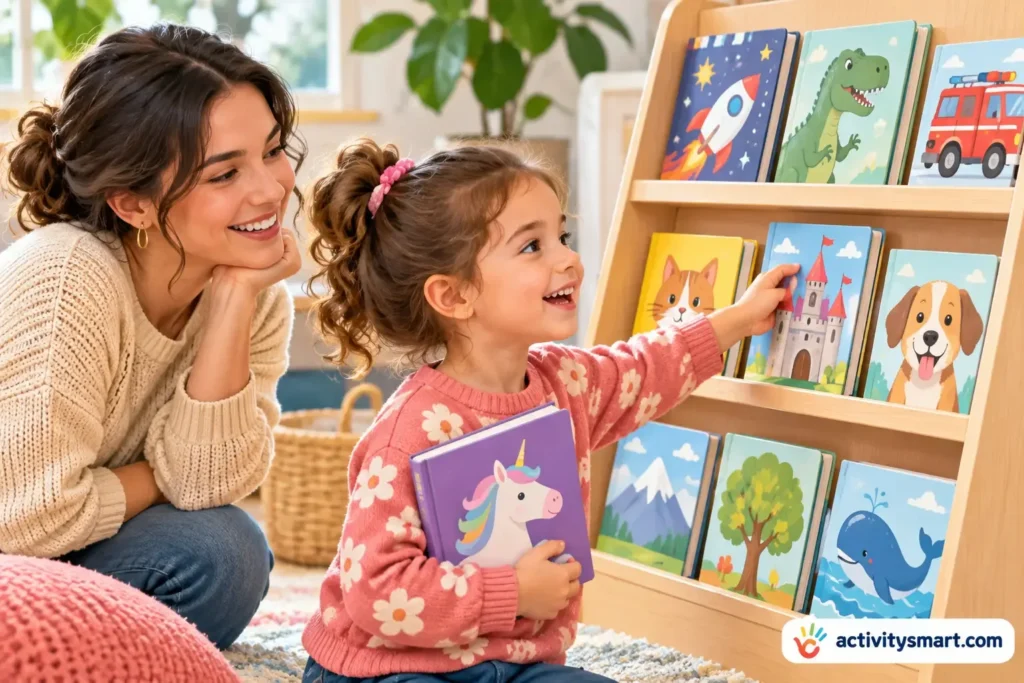
Choice works best when it is real but not overwhelming. Place three or four accessible options within reach: a funny picture book, a fact-packed animal book, a comic, and a story linked to a hobby. Ask “Which one should we explore?” rather than “Which one will you finish?” The adult can curate quality and difficulty while the child selects the doorway.
Broaden what counts as reading
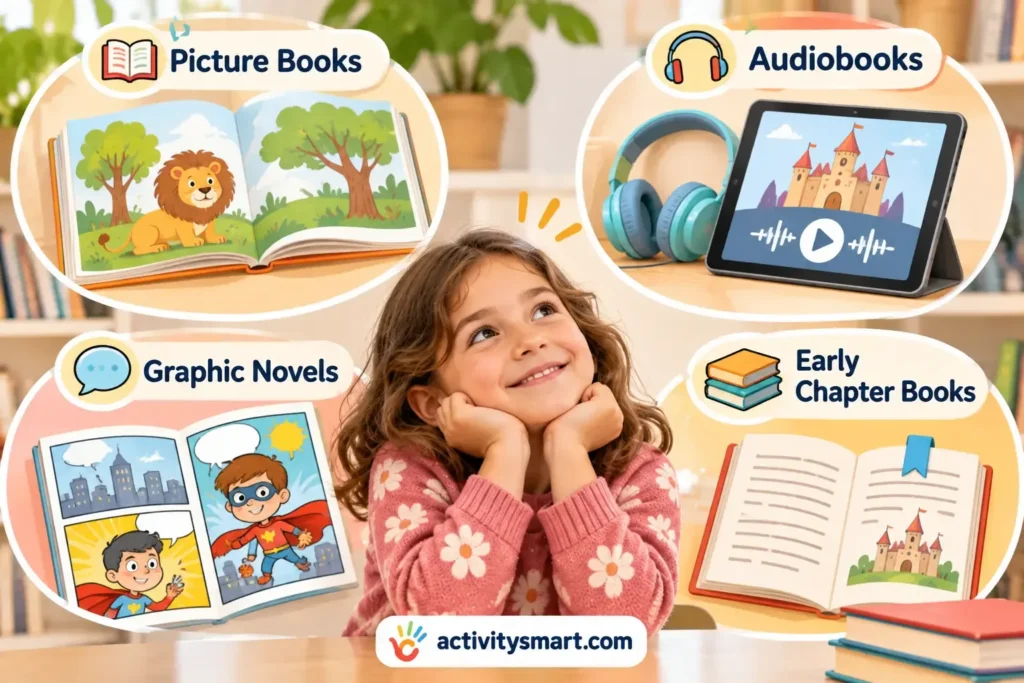
Recipes, captions, graphic novels, illustrated nonfiction, joke collections, menus, poems, game instructions, and bilingual books can all have a place in a print-rich environment. A child fascinated by dinosaurs might begin by examining labeled diagrams before volunteering to read a paragraph. The aim is meaningful contact with language and ideas, not winning an argument about genre.
Books should represent children’s interests, languages, families, and everyday experiences where possible. Libraries are useful for sampling without making every unsuccessful choice feel like wasted money. If a title does not click, return it without ceremony. Adults may still gently introduce unfamiliar topics, but avoid turning every selection into a correction.
Offer a small menu, then follow through
Try a simple choice ritual: “Would you like me to read the space book, or should we look through the animal facts together?” If the response is “neither,” offer another calm opportunity later. Children notice when an apparent choice is really an instruction in disguise. Consistent adult warmth matters more than the elegance of a reading schedule.
If a child enjoys talking about illustrations, the picture-book conversations that build understanding can help adults develop conversation without turning the page into a quiz. For younger children, play-based school readiness ideas also offers ways to connect books with play and everyday exploration.
Make shared reading feel like time together
Reading aloud is not a consolation prize for children who cannot yet read independently. It gives access to stories and vocabulary beyond what they can decode on their own, creates opportunities for conversation, and lets the adult model fluent expression. The Reading Rockets reading motivation resources discusses choice, interactive read-alouds, and meaningful engagement as ways to support motivation.
Read with a child instead of testing them
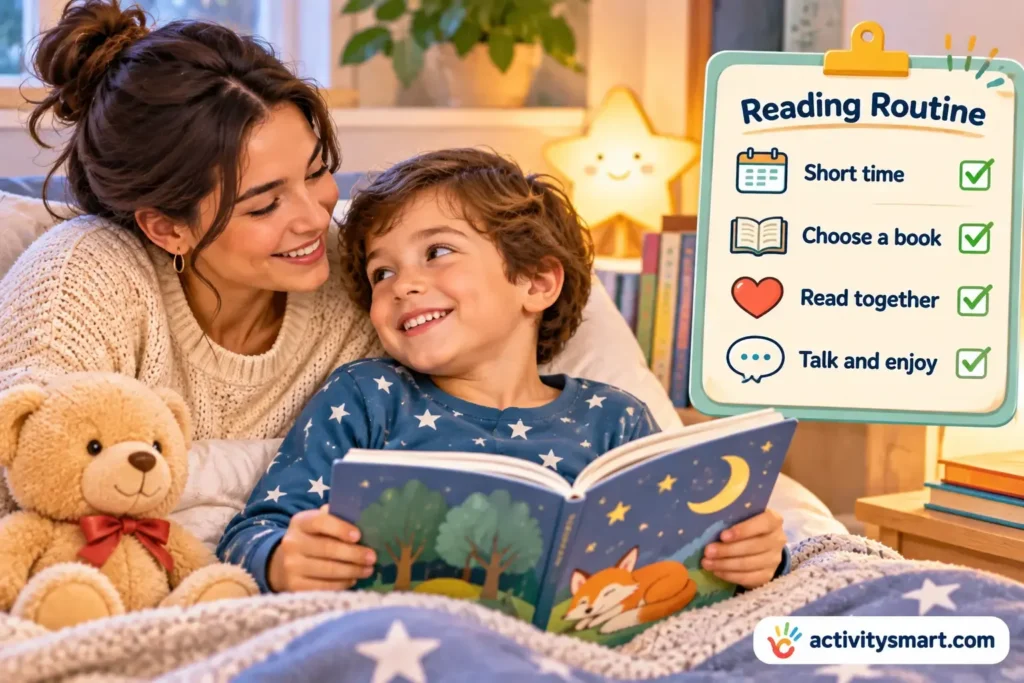
Start with an invitation: “I found a strange story about a lost penguin. Want to hear the first page?” If they join, read naturally. Pause only when an illustration invites a comment or the child has a question. A wondering remark such as “That character looks worried” is often easier to respond to than a rapid sequence of comprehension questions.
Let the child control the pace sometimes: reread a funny page, skip to an interesting diagram, or stop before the ending. Repetition can be comforting, and finishing is not the only meaningful outcome. If a child wants a predictable favorite, do not dismiss it as too easy or too familiar.
Share the effort without hiding the text
A developing reader might read the speech bubble while an adult reads the narration, or point to repeating words while hearing the whole story. Choose roles privately and allow the child to change their mind. When they stumble, provide help without theatrical correction: “That word is whisper. I will read this sentence, then you can choose what happens next.”
Listening to a story and independently decoding text build different experiences. A happy story session does not replace instruction in letter–sound relationships. It can, however, preserve a child’s connection to books while that instruction continues.

Match the book and the support to the actual challenge
An engaging book that is far above a child’s independent decoding ability may be perfect for a read-aloud and frustrating as solo practice. Conversely, very simple controlled text can support a new skill without being the only story the child encounters. Think in two lanes: rich experiences with stories and carefully matched opportunities to practice reading words.
| What you notice | Possible need | Low-pressure response | What to monitor |
|---|---|---|---|
| Enjoys listening but avoids reading print | Text may exceed current decoding skill | Read aloud for pleasure and coordinate targeted skill work | Accuracy and effort with appropriately matched text |
| Reads accurately but calls every book boring | Limited choice or relevance | Offer comics, nonfiction and hobby-connected topics | Voluntary browsing and conversation |
| Reads at school but resists at home | Fatigue or performance pressure | Move book time, shorten it, or let the adult read | Whether resistance changes with timing |
| Becomes upset when asked to read aloud | Embarrassment or fear of mistakes | Stop public performance, use private supported reading | Comfort and teacher observations |
These are interpretation prompts, not diagnoses. If a pattern persists, get the child’s own account and information from school rather than assuming the table has identified a cause.
Keep skill teaching explicit when it is needed
The What Works Clearinghouse foundational reading guide gives strong-evidence recommendations for linking speech sounds to letters and teaching decoding and word recognition; it also recommends opportunities to read connected text. Effective literacy instruction is not identical to forcing recreational reading. A child can receive systematic teaching and still have autonomy during leisure books.
Adults supporting sound–letter learning can consult gentle ways to introduce letter sounds and the explanation of how sound awareness differs from phonics. Short, suitable practice with a teacher’s guidance is more useful than asking children to guess unfamiliar words only from pictures.
Use practice materials for a specific purpose
A short word list may help reinforce a spelling pattern the child has already been taught. Materials such as short consonant-vowel-consonant word practice can be considered as optional practice when they align with that learning target; do not treat printable pages as a replacement for instruction or a measure of a child’s love of books. Likewise, optional alphabet activities can complement interest-led exploration without becoming compulsory busywork.
Build a routine that does not feel like a countdown
Predictability can make opportunities easy to accept, but an arbitrary minute target can recreate the same battle in a different form. Choose a dependable window when the child is neither hungry nor exhausted. Keep an appealing book visible and an adult available. Say, “I’ll be on the sofa with a story after snack if you want to join.”
Try a seven-day reset with flexible invitations
- Day one: Ask what the child likes outside books; listen without rebuttal.
- Day two: Browse a library shelf or a small home selection together.
- Day three: Offer a brief read-aloud with no follow-up quiz.
- Day four: Let the child choose a comic, picture book, or information page.
- Day five: Connect a favorite topic to real life, such as reading a recipe before cooking.
- Day six: Invite a shared reread or let the child tell a story from pictures.
- Day seven: Ask which moments felt pleasant and what should change next week.
This sequence is an adaptable planning example, not a tested seven-day intervention. A child who needs more rest or a different approach can skip a day. Success could mean selecting a book willingly, laughing at a page, or telling you that one format feels better than another.
Protect the relationship when the answer is no
A calm “Not now” can remain a no. The adult can model reading without commentary, then revisit at another time. If the child resists a school-required reading assignment, coordinate with the teacher about manageable practice instead of quietly dropping necessary instruction. The article on supporting a child frustrated by homework offers related strategies for moments when learning tasks become emotionally charged.
A quiet place can help some children, but others like a busy kitchen or hearing a familiar adult nearby. Ask where the child feels comfortable. The point is to remove avoidable friction, not to enforce a magazine-perfect reading corner.
Useful formats and activities for different ages
Ages three to five: play, pictures and oral language
At these ages, enjoyment can mean listening, naming objects, joining refrains, acting out a character, or turning pages. Children vary widely in readiness for formal print work. Follow their curiosity and use short exchanges about stories rather than demanding correct answers or early independent reading.
After reading about animals, invite a pretend veterinarian game. Make up a silly rhyme together, draw the setting, or let the child choose the next bedtime story. These activities connect storytelling with play. They do not prove faster reading acquisition, but they can make language experiences socially meaningful.
Ages six to eight: balance real decoding practice and pleasure
Many children in this range are working on the mechanics of recognizing words. Offer a teacher-recommended level for independent practice and a much wider menu for listening or browsing. If a child says “This is a baby book,” acknowledge the feeling, find age-respectful content, and ask the teacher about appropriate text difficulty.
Alternating a sentence each can be enjoyable when the child opts in, but it can be uncomfortable for a reader who fears being corrected. Discuss the role before opening the book. An audiobook alongside print can support access to a story, though it does not automatically teach independent decoding.
Ages nine to ten: respect identity and privacy
Older elementary children may compare their reading with classmates. Avoid announcing levels, calling books “too easy,” or asking for public demonstrations. Give space for graphic novels, nonfiction series, short biographies, and books with relatable concerns. Some children enjoy discussing a story with a friend more than talking with an adult.
If they resist longer novels, offer shorter complete texts with satisfying endings. Let them abandon a title after a fair sample and explain why. That explanation is useful reader judgment, not a failure to persist.
Mistakes that quietly increase resistance
- Making every story a test: constant recall questions can turn connection into performance; use conversation selectively.
- Using shame or comparison: statements about classmates or siblings can undermine confidence without revealing the cause.
- Equating page count with progress: more pages do not necessarily mean greater understanding or enjoyment.
- Withholding all other pleasures until reading happens: this may make books feel like a penalty; keep reasonable family boundaries without making reading the villain.
- Offering only one genre: invite meaningful variety and let a child reject an unappealing selection.
- Confusing fun with the absence of teaching: children with word-reading difficulties still deserve explicit, well-matched instruction.
- Assuming screens or print are automatically good or bad: format, content, access, and family context matter.
When a child would rather watch videos, avoid treating it as a moral contest between screens and paper. You can set consistent media limits while leaving books inviting rather than punitive. For practical boundary-setting, see family-friendly screen time boundaries.
When reluctance signals a need for more support
Occasional avoidance is common and can have many explanations. Repeated difficulty connecting letters to sounds, inaccurate word reading despite instruction, unusually effortful decoding, or strong distress around reading deserve careful attention, especially when the teacher notices similar problems. Not every reluctant reader has dyslexia, and a web article cannot determine that.
What to ask the teacher or school
Ask which specific skills are secure, what errors appear during reading, what instruction has been provided, and whether screening or additional support is appropriate. Request examples of work that show both strengths and difficulties. A reading specialist may help identify instructional needs; families can also discuss persistent concerns with a pediatrician.
The AAP guidance on reading difficulties encourages parents to raise concerns with teachers and pediatricians rather than waiting for difficulties to grow. Hearing or vision concerns, language differences, and other circumstances may also affect a child’s experience; qualified professionals can assess those questions without making assumptions from motivation alone.
If English is not the home language
Value books and storytelling in the language a family uses most comfortably. The child’s oral language strengths and prior learning matter; difficulty reading English alone does not establish a reading disorder. Ask educators how language learning and literacy instruction are being supported, and avoid comparing a multilingual learner with a monolingual peer using a single informal observation.
If the child says a page hurts their eyes, describes visual discomfort, or seems unable to see the print, seek appropriate professional advice. For ordinary sessions, use readable print and comfortable light. This is a practical accessibility step, not a treatment claim.
A simple check-in that measures the right things
After a week or two, notice whether your child approaches books with less tension, asks to hear another page, explores a topic independently, or tells you what they liked and disliked. These are observations of engagement, not standardized reading scores. Keep separate track of school-based skill progress through the teacher or reading specialist when needed.
Try three questions: “What part felt interesting?” “What made reading harder today?” and “What would you change next time?” Ask one, not all three, and accept “I don’t know.” For a classroom, a private choice slip or quiet conversation can reveal preferences without ranking children by reading speed.
If a method increases conflict for several days, adjust the timing, text, expectations, or amount of adult direction. There is no universal number of minutes or books that demonstrates a healthy reading relationship. Regular opportunities, effective instruction, and respectful listening can coexist.
Final takeaway: protect pleasure and provide instruction
Helping a reluctant reader is less about convincing a child to finish a book and more about making stories accessible, emotionally safe, and genuinely relevant. Invite choice, share reading, respect fatigue, and follow curiosity. When reading itself is unusually hard, pair warmth with assessment and appropriate teaching rather than hoping motivation alone will fix the difficulty.
Children deserve both the freedom to enjoy books at their own pace and the support to develop the skills that open more books to them. A meaningful next step is to let the child choose one appealing title and agree on a comfortable way to explore it together.
Frequently asked questions
Should I make my child read every day if they refuse?
Do not turn daily reading into a recurring confrontation. Offer a predictable, welcoming opportunity and coordinate necessary skill practice with the teacher; a tired child may prefer listening on some days.
Do audiobooks count as reading for a reluctant reader?
Audiobooks count as meaningful engagement with stories and language, although listening is not the same as independently decoding print. They can maintain access to rich books while targeted word-reading instruction continues.
What books work best for a child who says reading is boring?
Books connected to the child’s interests are a sensible first choice. Offer a small mix of comics, humorous stories, illustrated nonfiction, poems, or hobby-related texts and let the child decide what is worth exploring.
How can I help when my child guesses words instead of sounding them out?
Ask the child’s teacher for explicit decoding strategies and suitably matched practice text. Encourage attention to letters and their sounds rather than relying only on pictures or the first letter to guess a whole word.
Is it okay for my child to reread the same book?
Yes, rereading a favorite book is fine. Familiar stories can feel comfortable and invite participation; continue to offer new options without insisting that the old favorite disappear.
Should I reward completed books with prizes?
Prizes are not necessary to build an inviting reading experience. If rewards are already part of a family routine, avoid making them the only reason to read and prioritize choice, discussion, and satisfaction with the story.
What if my child loves being read to but refuses to read aloud?
Keep reading aloud together and remove public performance pressure. Separately ask the teacher whether decoding difficulty, anxiety, or text mismatch could be involved, and use supported practice when appropriate.
When should I worry that reading reluctance is a learning difficulty?
Seek advice when reluctance accompanies persistent trouble with sounds, letters, word reading, or intense distress despite suitable instruction. Talk with the teacher and pediatrician about screening or further assessment rather than self-diagnosing.
Can graphic novels and comics help children enjoy books?
Yes, comics and graphic novels are legitimate reading choices that may appeal to a child’s interests. Select age-appropriate material and treat pictures as part of meaning-making while continuing needed print-reading instruction.