Phonemic awareness vs phonics is a difference between working with spoken sounds and connecting those sounds to print. Children need both. Begin with accessible listening and sound activities, introduce useful letter–sound relationships, and bring them together in reading and spelling rather than waiting for perfect oral skills.
Quick Answer
Phonemic awareness means noticing and working with individual sounds in spoken words. Phonics connects those sounds to letters and spelling patterns. Teach them in coordination: model hearing, blending, and segmenting sounds, then connect them to familiar letters. Choose the next step from the child’s demonstrated skills, not age alone.
This guide is for parents and teachers supporting children roughly ages three to ten. The activities are teaching suggestions, not a developmental test or a complete reading curriculum. School terminology and starting ages vary, so coordinate home practice with the sequence used in class.
Phonemic awareness vs phonics: the practical difference
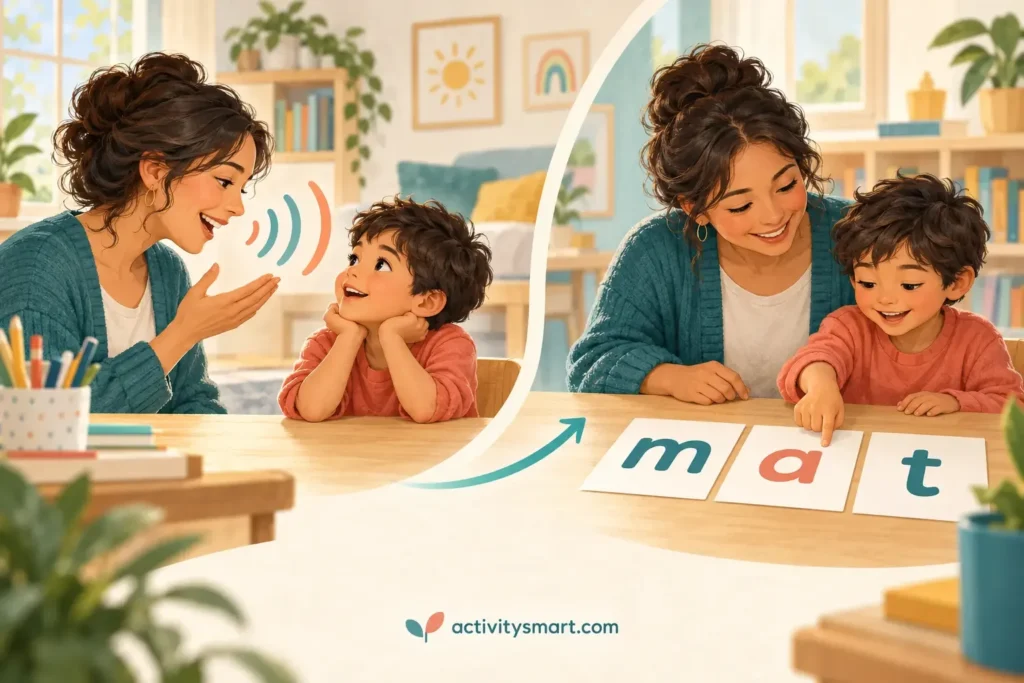
A phoneme is an individual speech sound that distinguishes words. When you say sun and ask a child to identify its first sound, the target is /s/. No printed letters are required. When you show the letter s and teach that it represents /s/ in sun, you are connecting speech and writing.
A grapheme is a letter or letter group representing a sound in a word. In ship, sh represents one sound, followed by the vowel sound and /p/. The word has four letters but three phonemes. Counting visible letters therefore cannot replace listening to the spoken word.
Phonological awareness is the broader umbrella, including awareness of syllables, rhyme, and individual phonemes. Clapping the two syllables in rabbit is phonological awareness; isolating its first /r/ is phonemic awareness. These labels describe different teaching targets, not competing programs.
| Feature | Phonemic awareness | Phonics |
|---|---|---|
| Main focus | Individual sounds in spoken words | Relationships between sounds and written spellings |
| Simple example | Blend spoken /m/ /a/ /t/ into mat | Read the printed word mat using its letter–sound relationships |
| Spelling connection | Separate a spoken word into its phonemes | Choose letters to represent those phonemes |
| Materials | Speech alone can be sufficient | Print is involved |
| Useful observation | Can the child hear and work with each sound? | Can the child connect sounds to print and apply them? |
The boundary is useful but not absolute in a lesson. Saying the sounds in mat, placing letters for them, and reading the result combines both. The historical National Reading Panel explicitly recognized this overlap; it did not define the skills as mutually exclusive classroom choices.
What to teach first, and what can overlap
Start with something the child can understand
Use familiar spoken words, explain the task, and demonstrate an answer before asking for one. A child who does not understand “first sound” may need you to stretch /mmm/ at the beginning of moon, then compare it with map. Do not begin by expecting independent performance on unfamiliar terminology.
Rhyme, songs, and syllable games can be enjoyable parts of early language play. However, do not make perfect rhyming or syllable clapping an entrance exam for letter learning. The International Dyslexia Association’s guidance on building phoneme awareness explains that larger sound-unit skills are not prerequisites for teaching individual phonemes.
Connect sounds to letters promptly
Once a child notices a target sound, show how it is represented in a suitable word. For example, hear /m/, find m, and connect it to map. Teach a manageable selection of correspondences from the child’s school program, rather than presenting every possible spelling of a sound at once.
The Florida Center for Reading Research letter–sound training materials pair letter–sound teaching with word building that links letters and phonemic awareness. The practical lesson is to create a bridge between hearing a word and reading or spelling it, rather than maintaining separate tracks indefinitely.
Keep meaning in the lesson
After blending mat, briefly discuss what it means or use it in a sentence. Reading words accurately matters, but understanding language matters too. Continue reading interesting books aloud, explaining vocabulary, and talking about characters while beginning word-reading skills develop.
The NICHD overview of reading instruction includes phonemic awareness, phonics, fluency, vocabulary, and comprehension. Neither sound games nor phonics alone covers everything children need. A short decoding lesson and an adult read-aloud can serve different purposes on the same day.
When to teach each skill: use age as context
The groupings below organize possible teaching choices; they are not age-based pass marks. A child’s previous instruction, language experience, current understanding, and learning needs should shape the starting point. An older beginner may need the same foundational concept as a younger child, with more mature materials.
Preschool: approximately ages three to five
Make conversation, stories, songs, and playful attention to words regular opportunities. If a child enjoys a short sound game, model a beginning sound using a familiar name or object. Introduce letters meaningfully when appropriate, without turning play into a long daily quiz.
Letter formation and sound knowledge are related classroom activities but different tasks. A child can recognize a sound before controlling a pencil accurately. ActivitySmart’s guide to teaching children to write their names offers a separate writing context; remember that some names contain spellings beyond an introductory phonics sequence.
Kindergarten and beginning reading: approximately ages five to seven
Use explicit, systematic phonics teaching alongside purposeful blending and segmenting. Choose words that fit taught correspondences, show how to blend them, and connect spelling with listening for sounds. Keep reviewing earlier material while adding new relationships in the program’s planned order.
A child does not need to know the whole alphabet before reading any words. What matters for a particular word is knowing the required correspondences and being supported to blend them. The alphabet worksheet collection can provide selected letter practice; completing every sheet is not a prerequisite for beginning word reading.
Elementary learners: approximately ages seven to ten
Check which parts of reading are difficult rather than automatically repeating a preschool routine. Some children need help with letter patterns or blending; others read words accurately but need vocabulary, fluency, or comprehension support. Materials should respect their age even when the targeted skill is foundational.
The Education Endowment Foundation’s phonics evidence summary recommends matching teaching to current knowledge and identifying the precise difficulty. If decoding remains weak, additional phonics can be appropriate. If decoding is secure, extending isolated sound drills may miss the more useful teaching target.
Quick Picks: choose the next useful activity
- Unclear about individual sounds: model the first sound in a familiar word, then offer two spoken choices.
- Can hear sounds but cannot connect them to print: teach the corresponding letters and practice building a short word.
- Knows letters but cannot blend: model blending a word made only from known correspondences, then practice together.
- Can blend but spells incompletely: segment a spoken word, represent each sound, and reread the spelling.
- Reads words accurately: apply knowledge in connected text and discuss meaning rather than adding unrelated drills.
These are lesson-selection prompts, not diagnoses. Try the smallest useful change, observe the response, and share patterns with the teacher. Repeated difficulty after clear instruction needs a closer look rather than an assumption that the child is careless.

A connected lesson using mat
This sample routine illustrates how the two skills can work together. Use it only if m, a representing the vowel in mat, and t are appropriate to the child’s current teaching sequence. The steps are adaptable teaching examples, not a research-tested script or required timetable.
Hear the spoken word
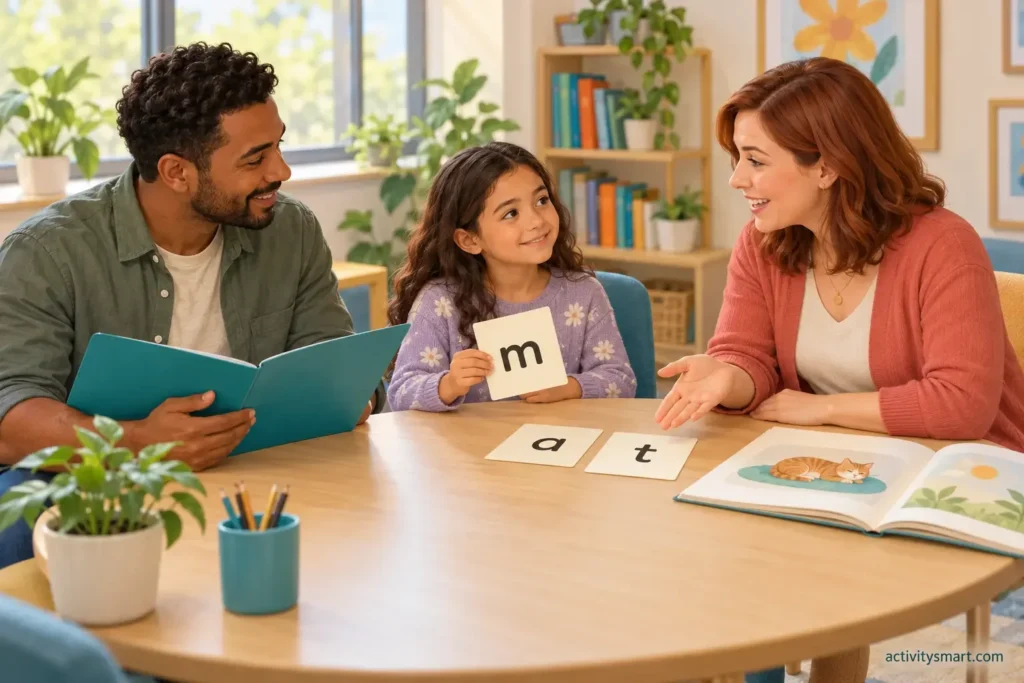
Say mat naturally and check that the child knows its meaning. Then say its three sounds, /m/ /a/ /t/, with /a/ representing the short vowel heard in this word. Ask the child to blend them into mat. Keep the sounds clear and close enough together to combine.
If the child repeats three isolated sounds without finding the word, model the whole process again. Stretch /m/ into the vowel and finish with a brief /t/, then say mat naturally. Avoid adding “uh” to every consonant, which can turn a simple word into extra syllables.
Segment, then connect to print
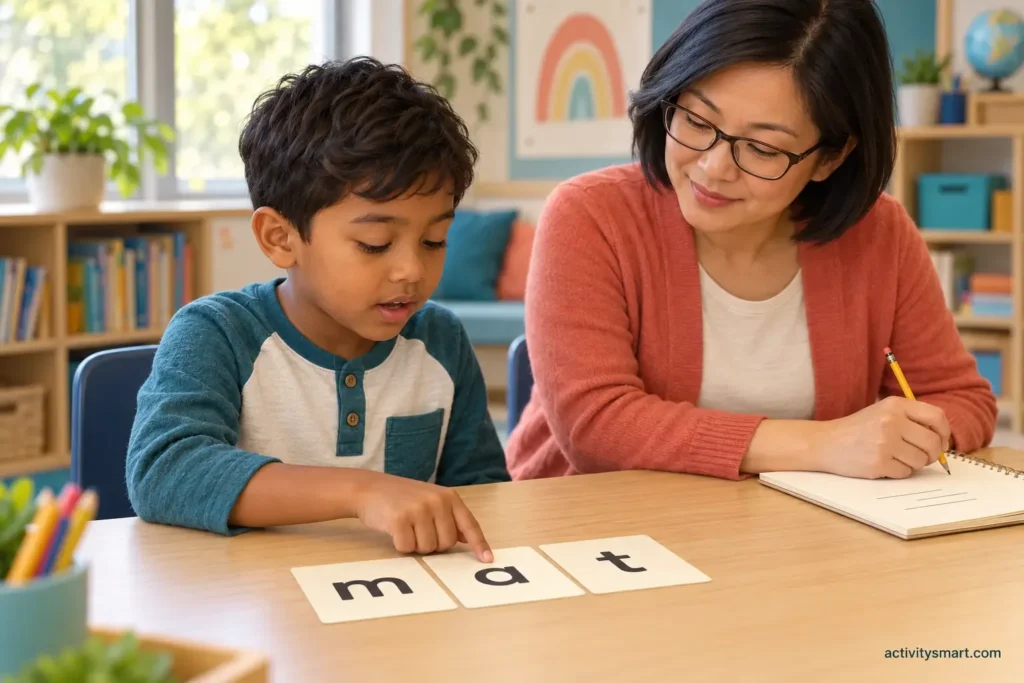
Say mat and move one finger for each sound. Next, place large paper letters m, a, and t from left to right, explaining which sound each represents. Read the word by pointing to the letters and blending, rather than reciting the letter names as the reading strategy.
Now cover the model and ask the child to build or write mat. If writing is difficult, let the child select large letter cards. This keeps the task focused on sound–spelling knowledge without requiring handwriting to be equally secure.
Change one sound and read again
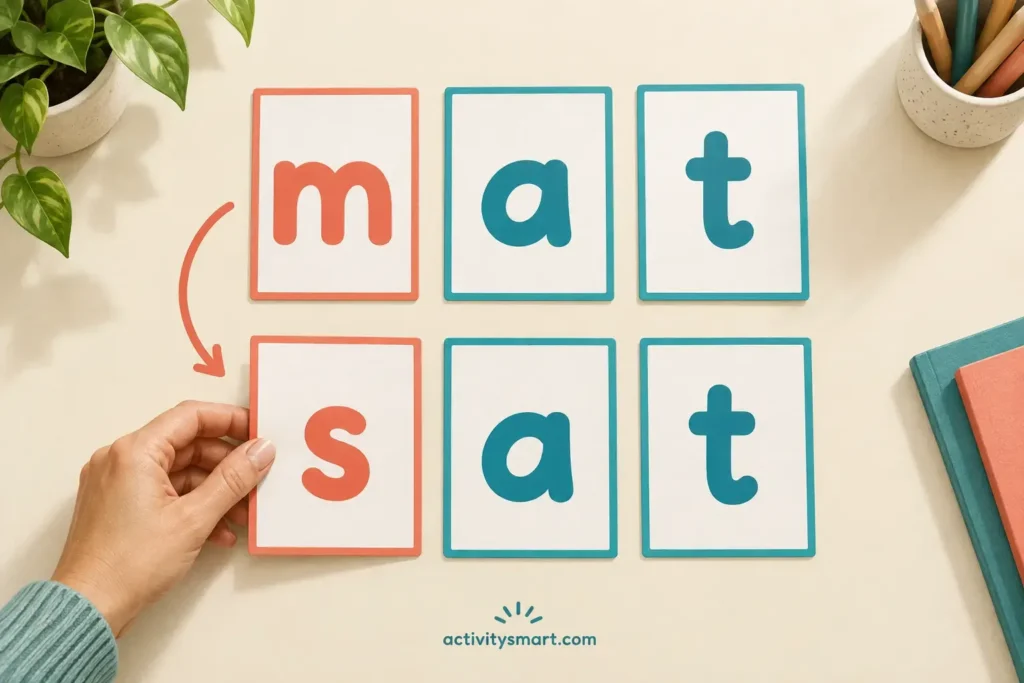
If s has been taught, change m to s and read sat. Ask what changed in the spoken word and in the letters. Then return to mat so the child must attend to print instead of simply continuing a memorized sequence.
End by using an appropriate short text containing taught patterns. Do not construct a sentence full of untaught spellings and call it independent practice. For additional word practice, select suitable examples from the CVC word worksheet collection, checking every word against what the child has learned.
Notice the error before changing the lesson
Watch the process as well as the answer. If a child reads sat when the page says mat, several explanations are possible. Ask the child to point to the first letter and say its sound, then blend the word again. That reveals more than immediately adding another worksheet.
If the letter–sound link is missing, reteach that correspondence. If each sound is correct but the word remains fragmented, model blending. If the word is read accurately but its meaning is unfamiliar, explain the vocabulary. A single wrong answer cannot identify the cause reliably.
Record a few concrete observations: the word used, what the child did independently, and what support helped. “Blended mat after an adult model” is more informative than “bad at phonics.” Revisit the skill with another suitable word to check whether the response transfers.
For teachers, avoid letting the strongest voices answer every group question. Brief individual responses can reveal who needs support. For families, one calm exchange is usually more useful than repeatedly testing the child after frustration has already taken over.
Oral activities, print activities, and their tradeoffs
Oral tasks require little equipment and let you focus directly on sounds. Their limitation is that success does not automatically show that a child can read a printed word. Printed word tasks reveal application to reading, but they combine sound awareness with letter knowledge and may hide which component needs help.
Use both kinds of observation when needed. An oral blending task can clarify a difficulty noticed during reading; letter cards can then help connect the sounds to spelling. The aim is useful information and instruction, not a competition between materials.
Worksheets offer a convenient record, but the adult still needs to hear how the child approaches the task. Matching a picture to a word may be solved by guessing. Ask the child to read the word before discussing the picture, and use shared conversation afterward to check meaning.
Likewise, neat handwriting is not proof of decoding. If pencil control limits participation, provide cards or allow pointing. For separate movement activities, consider the fine motor activity guide. Keep tracing-line practice as a separate option for pencil movement rather than treating successful tracing as evidence that a child understands speech sounds.
Common mistakes that obscure learning
- Waiting for advanced oral mastery: do not postpone useful letter–sound links until every deletion or substitution task is perfect.
- Confusing names with sounds: the name of m is not the sound used to blend mat. Teach both purposes clearly.
- Counting letters instead of sounds: sh in ship is a useful reminder that one sound may use two letters.
- Using untaught spellings as a test: select practice words deliberately rather than judging difficulty by word length alone.
- Prompting picture guessing: direct attention to the printed spelling for word identification, then use the picture for discussion.
- Practicing only isolated words: provide suitable connected reading and rich adult read-alouds as well.
The last distinction matters because a child can perform a small exercise without yet applying it comfortably in a book. Moving between a taught pattern, a word, and an appropriate text helps you see what is secure and what still needs modeling.
Keep practice accessible, safe, and emotionally manageable
Use fingers, drawn sound boxes, or large paper cards rather than loose tiny counters when younger children or siblings are present. Avoid small magnets and other objects that could be swallowed. Materials are optional: no purchase is necessary to demonstrate spoken blending or segmenting.
Keep the task brief enough for active participation and stop if it becomes distressing. Offer a model, reduce the number of choices, or return to a familiar word. Speed contests, public comparisons, and repeated correction without demonstration do not tell you what help the learner needs.
For a child learning English, check familiarity with the spoken word before interpreting a missed response. Invite families to share pronunciation and language background with the teacher. Do not treat a home accent or limited experience with English vocabulary as proof of a reading disorder.
A child with hearing, speech, communication, or other access needs may require adapted instruction and assessment. Ask the school team how the activity should be presented and how the child can respond. This article’s spoken examples are not a universal assessment method for every learner.
When to ask for additional support
Speak with the teacher when a child repeatedly struggles to learn taught correspondences, blend simple taught words, or segment words for spelling despite clear teaching and practice. Ask what has been assessed, what targeted instruction is being provided, and when progress will be reviewed.
You do not need to diagnose dyslexia before requesting help. Equally, one difficult task does not establish dyslexia. A reading specialist or other appropriately qualified professional can help interpret the pattern; concerns about hearing, speech, or broader development may also warrant discussion with the child’s healthcare professional.
Agree on a small, consistent home activity that matches classroom teaching. Share examples of what helps rather than simply increasing practice time. For an older child, protect confidence by explaining the specific skill being learned and using content that respects their interests.
Final verdict: teach the connection, then apply it
Teach children to notice sounds and understand how print represents them. Use oral work to clarify the spoken structure, phonics to connect it to letters, and reading and spelling to apply the connection. Adjust the task according to demonstrated understanding rather than following an inflexible birthday schedule.
The strongest practical choice is a coordinated plan: a clear next skill, suitable examples, helpful modeling, and opportunities to use learning meaningfully. Keep books, conversation, vocabulary, and enjoyment alongside foundational instruction so the purpose of reading stays visible.
Frequently asked questions
What is the main difference between phonemic awareness and phonics?
Phonemic awareness concerns individual sounds in spoken words, while phonics connects sounds with written letters and spelling patterns. Saying the sounds in mat without print targets phonemic awareness; reading the printed word using letter–sound relationships involves phonics.
Should I teach phonemic awareness before phonics?
Begin with accessible sound work, but connect it to letters rather than waiting for complete phonemic awareness mastery. The skills can develop together, with teaching adjusted to what the child understands.
Does my child need to rhyme before learning letter sounds?
No, perfect rhyming is not a prerequisite for learning letter sounds or beginning phoneme instruction. Enjoy songs and rhymes while also explicitly showing useful sound–letter relationships.
At what age should phonics begin?
There is no single birthday that determines when every child should begin phonics. Use the school’s instructional expectations and the child’s current knowledge, introducing appropriate letter–sound links and supported word reading without turning age ranges into diagnostic deadlines.
Can I teach phonemic awareness without letters?
Yes, oral blending and segmenting can be taught without showing letters. Connect the sounds to their written representations as appropriate so the work supports reading and spelling.
Are phonological awareness and phonemic awareness the same?
No, phonemic awareness is the individual-phoneme part of the broader category of phonological awareness. Syllable and rhyme activities address other sound structures within that broader category.
Why can my child name letters but not read a word?
Naming letters does not by itself provide the sound knowledge and blending needed to read a word. Check the specific letter–sound relationships, then model blending a word made from taught correspondences.
Do struggling older readers still need phonics?
Older readers may still need phonics if assessment shows difficulty decoding words. Teaching should target the identified gap and use age-respectful materials; secure word readers may instead need support with fluency, vocabulary, or comprehension.
Do sound games replace reading books together?
No, sound games do not replace reading books together or a complete reading program. Continue shared stories and language discussion while providing systematic word-reading instruction and suitable independent reading practice.
Sources and further reading
The recommendations draw on the organizations linked in the relevant sections: NICHD for the components of reading instruction, EEF for phonics implementation, FCRR for connecting sounds and letters, and the International Dyslexia Association for phoneme-awareness instruction. Their guidance supports principles rather than guaranteeing outcomes for this sample lesson.
The IES foundational reading practice guide, revised in December 2019, rates support for sound–letter connections and decoding as strong and for daily connected-text reading as moderate. The National Reading Panel findings provide historical evidence and terminology; NICHD labels that report as historical rather than continuously updated.