Quick Answer
Tracing Lines Worksheets are free printable PDF activities that help preschool and kindergarten children develop pencil control, hand-eye coordination, visual tracking, and the pre-writing movements needed for letters and numbers. Start with thick straight lines, then introduce curves, waves, zigzags, loops, and simple paths. Keep practice short, use a comfortable pencil or crayon, and let children stop before their hands become tired.
Quick Picks
- Best overall: Mixed tracing lines worksheet pack with easy-to-hard pages
- Best for beginners: Wide horizontal and vertical lines with large start dots
- Best for pencil control: Curved, wavy, and zigzag tracing paths
- Best for preschool centers: Laminated reusable tracing mats
- Best next step: Shape tracing and letter tracing worksheets
- What to avoid: Tiny paths, crowded pages, sharp difficulty jumps, and long sessions
Tracing Lines Worksheets give young children a simple way to practice the movements they will later use for drawing, writing letters, and forming numbers. Instead of asking a beginner to write a perfect alphabet immediately, line tracing breaks the job into smaller steps: move left to right, follow a curve, stop at a point, turn a corner, and stay reasonably close to a path.
That sounds easy to an adult. To a preschooler holding a pencil like a tiny garden shovel, it is a serious mission. The good news is that practice does not need to feel serious. A printable page with roads, animals, rockets, rainbows, or simple patterns can turn pre-writing work into a quick game.
This guide explains how to choose and use free printable tracing lines PDF pages for preschool, pre-K, kindergarten, homeschool, occupational therapy support, morning work, fine motor centers, and extra practice at home. You will also find age-based suggestions, common mistakes, practical printing tips, and ideas for moving from basic lines to independent handwriting.
Why Tracing Lines Worksheets Help Pre-Writing Skills
Before children can write letters clearly, they need to control small hand movements while watching where the pencil goes. They also need to understand direction, spacing, starting points, stopping points, and changes in movement. Tracing Lines Worksheets isolate these skills so children can practice them without also worrying about letter names or spelling.
A straight horizontal line supports left-to-right movement. A vertical line encourages controlled top-to-bottom motion. Curves prepare children for letters such as C, O, S, and U. Diagonal and zigzag lines introduce direction changes used in letters such as A, M, N, V, W, X, and Z.
Tracing is not the only activity children need. Play dough, blocks, coloring, cutting, threading beads, drawing in sand, and outdoor play also strengthen the hands and support coordination. Printable line tracing works best as one useful tool in a larger fine motor routine, not as a stack of twenty pages delivered before breakfast.
Tracing Lines Worksheets Build Pencil Control
Pencil control means moving a writing tool on purpose rather than letting it wander freely across the page. Beginners may press too hard, move too quickly, lift the pencil repeatedly, or drift far from the line. Wide tracing paths give them room to succeed while they learn to slow down and guide the tool.
Success matters because children are more willing to repeat an activity when it feels possible. A thick line with clear visual boundaries is usually a better starting point than a thin dotted trail that requires the precision of a miniature architect.
Tracing Lines Worksheets Support Visual Tracking
Visual tracking is the ability to follow a moving point or path with the eyes. On a tracing page, children look from the start symbol toward the finish symbol while coordinating their hand movement. This supports the left-to-right tracking used later when reading and writing.
Pages with one path per row are easier than crowded mazes. Early worksheets should have generous spacing and limited distractions so the child can see exactly where to begin and where to finish.
Tracing Lines Worksheets Prepare Children for Letter Strokes
Letters are combinations of basic strokes. A capital L uses a vertical and horizontal line. A capital A uses diagonal strokes and a crossbar. Lowercase c begins with a curve. When children practice these movements separately, letter formation becomes less overwhelming.
The goal is not perfect tracing. The goal is controlled movement, growing confidence, and gradual independence. A slightly wobbly line completed with effort is useful practice, not a failure that needs a red pen and a committee meeting.
Types of Free Printable Tracing Lines Worksheets
A strong printable pack should progress from simple movements to more complex combinations. Children learn at different rates, so the order can be adjusted. Begin with pages the child can complete successfully, then add one new challenge at a time.
Straight Line Tracing Worksheets
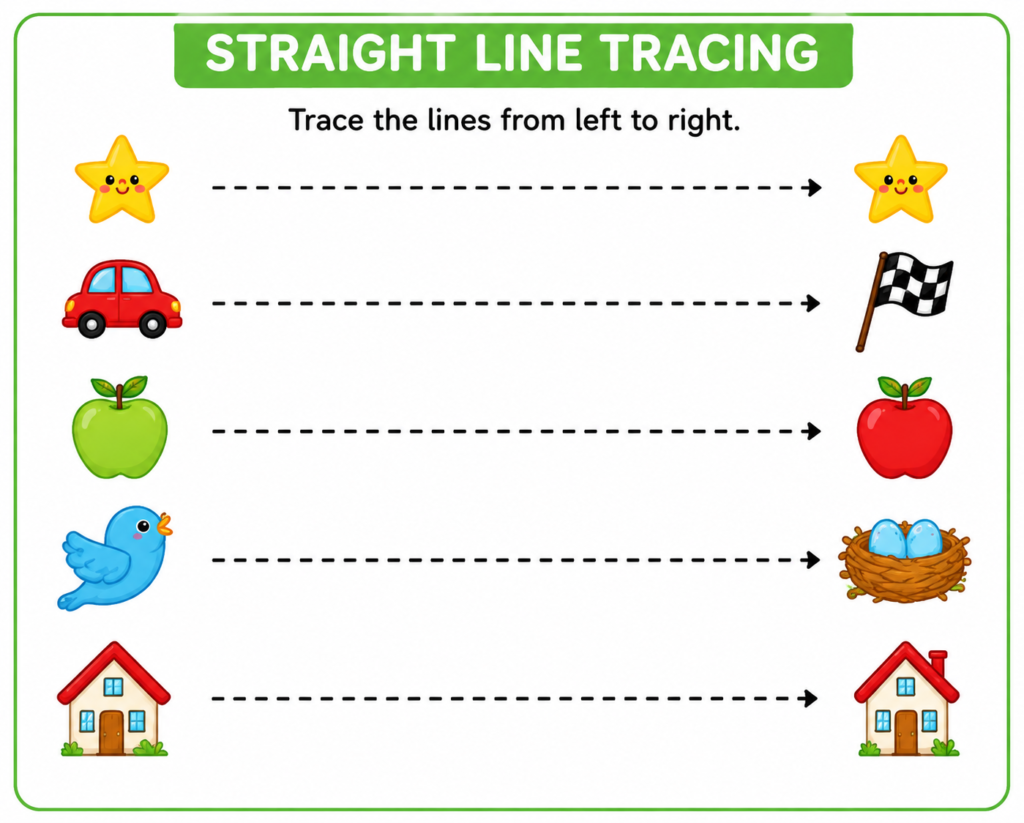
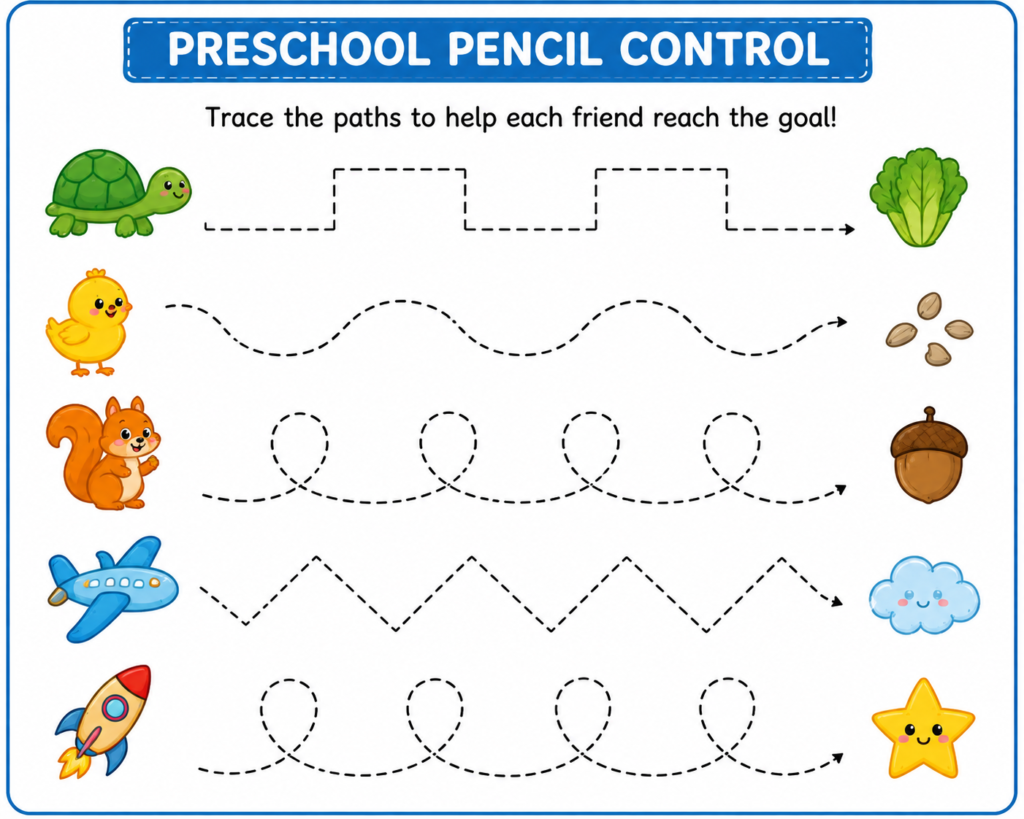
Straight lines are the easiest starting point for many children. Horizontal paths teach left-to-right movement, while vertical paths teach top-to-bottom control. Diagonal paths add a new direction and require more careful wrist and finger movement.
Look for large start dots, arrows, or familiar pictures at each end. For example, a child might trace from a bee to a flower or from a car to a garage. The small story gives the movement a purpose and makes the worksheet feel more like play.
Curved Line Tracing Worksheets
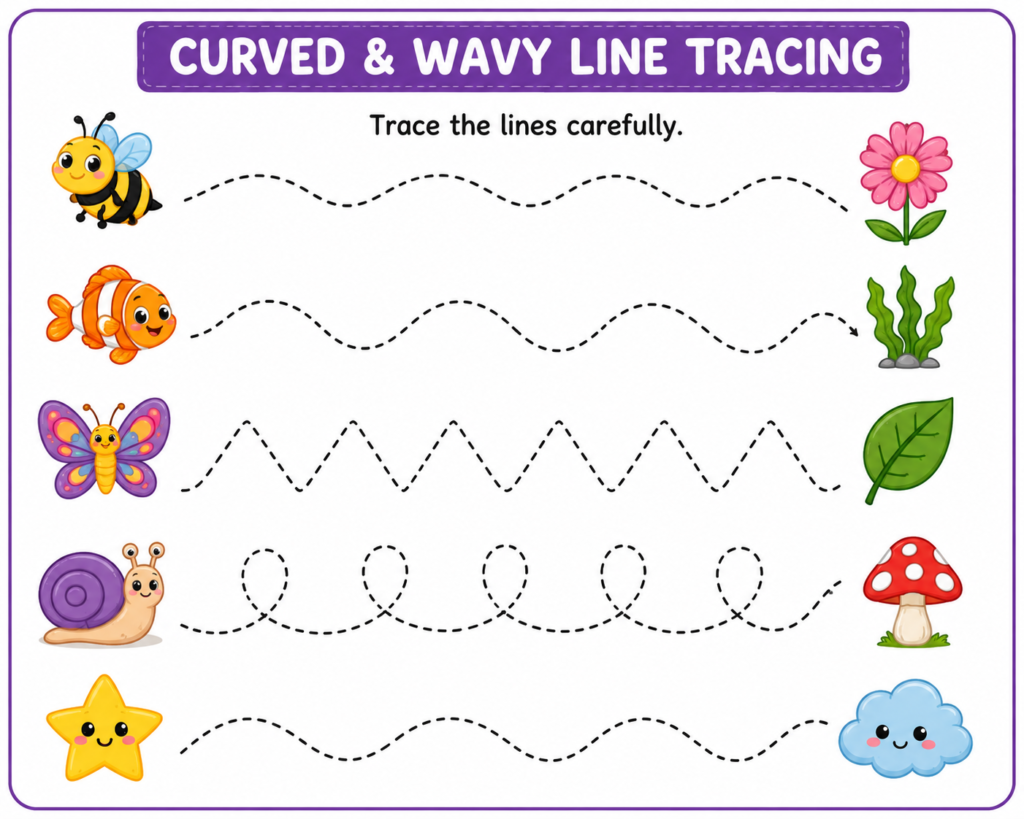
Curved lines require the hand to change direction smoothly. These pages may include arches, rainbows, semicircles, spirals, or gentle bends. Curves are important preparation for rounded letters and numbers.
Start with wide, simple curves before introducing tight loops. Encourage children to move slowly and keep the wrist relaxed. If the child repeatedly stops at each turn, demonstrate the movement in the air before returning to the page.
Wavy Line Tracing Worksheets
Wavy lines combine repeated upward and downward motion. They help children practice rhythm, spacing, and continuous movement. Ocean waves, snake trails, rolling hills, and flying paths are popular themes because the pictures naturally match the line shape.
Use short rows at first. A full page of waves can tire a beginner quickly, and tired hands often lead to rushed movements and frustration. Two or three successful rows are more valuable than a page completed through stubborn negotiation.
Zigzag Line Tracing Worksheets
Zigzag paths introduce sharper direction changes. They are useful preparation for angular letters and for learning how to stop briefly at a corner before moving in a new direction.
Choose large zigzags with only a few turns for early practice. Smaller and more frequent angles can be added later. Mountain paths, lightning bolts, crocodile teeth, and robot routes make good child-friendly themes.
Loop and Spiral Tracing Worksheets
Loops and spirals are more advanced because they require continuous curved movement and close visual attention. These pages support control for rounded writing patterns and decorative drawing.
Introduce loops after the child can trace curves and waves comfortably. Large loops are easier than narrow ones. Spirals should have enough space between lines so the child does not feel trapped in a tiny paper tornado.
Mixed Pattern Tracing Worksheets
Mixed pages combine straight, curved, wavy, zigzag, and looped paths. They are useful for review and for observing which movements are easy or difficult for a child. However, they should come after individual line types have been practiced.
Mixed worksheets are also helpful for kindergarten warm-ups, learning centers, and quick skill checks. Use them as practice, not as a formal test. Children may perform differently depending on fatigue, interest, and how recently they have used a pencil.
Tracing Line Difficulty by Learning Stage
| Learning Stage | Recommended Line Types | Page Design | Suggested Practice Time |
|---|---|---|---|
| Early preschool | Short horizontal and vertical lines | Very thick paths, large start dots, one activity per row | 3–5 minutes |
| Preschool | Straight, gentle curves, wide waves | Large pictures, wide spacing, simple directions | 5–10 minutes |
| Pre-K | Diagonal, zigzag, curves, mixed paths | Medium-width lines with clear start and finish points | 10–15 minutes |
| Kindergarten | Loops, spirals, patterns, simple mazes | Narrower lines and longer paths | 10–20 minutes |
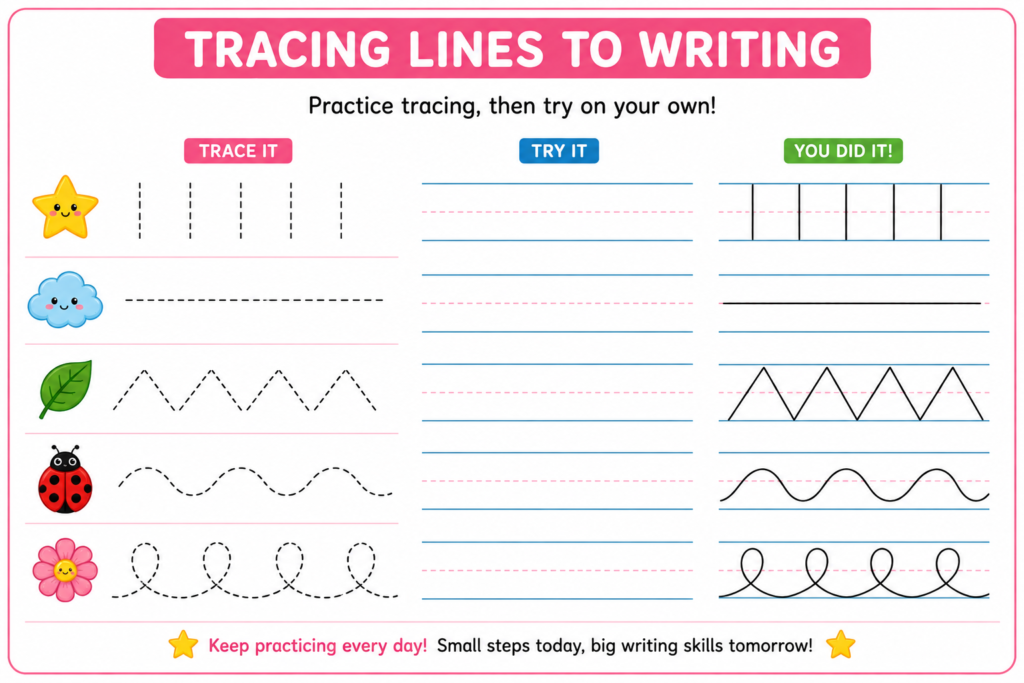
| Handwriting transition | Line patterns connected to shapes, letters, and numbers | Trace-then-copy format with blank practice space | 15–20 minutes |
These stages are flexible. A four-year-old may be ready for zigzags, while an older child may still benefit from thick straight paths. Choose the page according to current ability rather than the number printed on a birthday cake.
How to Use Tracing Lines Worksheets at Home or School
Demonstrate the Movement First
Show the child where to start and how the line moves. Trace the pattern with your finger, draw it in the air, or use a toy car to follow the path. A quick demonstration reduces guessing and helps children understand the direction.
Use simple language such as “start at the dot,” “move across,” “go down,” or “follow the waves.” Long explanations can make a very small worksheet sound like instructions for launching a satellite.
Teach a Comfortable Pencil Grip Without Forcing It
Offer short crayons, triangular crayons, beginner pencils, or washable markers. Short tools naturally encourage children to use their fingers rather than holding the pencil in a fist. The grip should be comfortable and functional, not painfully corrected every few seconds.
Gently model finger placement and let the child try again. If grip or hand use causes ongoing concern, seek advice from an appropriate teacher, pediatric professional, or occupational therapist rather than relying on internet arguments about the one perfect grip.
Begin With Finger Tracing
Finger tracing removes the challenge of controlling a tool. Ask the child to follow the line with one finger, then repeat with a crayon or marker. This approach works especially well for curves, loops, and direction changes.
You can also place the page inside a plastic sleeve and trace with a dry-erase marker. Reusable pages reduce printing and allow children to practice the same pattern several times without creating a paper mountain.
Use Short, Positive Practice Sessions
Stop before the child becomes tired or upset. For many preschoolers, five to ten minutes is enough. One carefully completed page is usually more helpful than five rushed pages.
Praise specific effort: “You started at the dot,” “You slowed down at the corner,” or “You kept the line moving.” Specific feedback teaches children what successful control feels like.
Add Playful Story Prompts
Turn each line into a small story. Help the puppy reach the bone, guide the rocket to the moon, drive the bus to school, or lead the bee to the flower. The tracing movement stays the same, but the child has a reason to complete it.
Keep the story short so it supports the task rather than distracting from it. A thirty-second adventure is enough. There is no need to create a twelve-chapter backstory for the bee.
Best Tracing Lines Worksheets for Beginners
The best beginner pages use thick, high-contrast paths with clear starting and finishing points. They contain only a few lines, large pictures, and plenty of empty space. Horizontal and vertical paths should come before tight curves and complicated patterns.
Choose pages where the child can succeed with limited help. A useful beginner sequence is finger tracing, thick crayon tracing, marker tracing in a sleeve, and finally pencil tracing. Repeating the same movement with different tools keeps the practice familiar without making it boring.
Beginner worksheets are especially suitable for preschool morning work, quiet-time activities, travel folders, homeschool warm-ups, and short one-to-one sessions. Pair them with play dough rolling, sticker peeling, clothespin games, and block building for broader fine motor practice.
Best Tracing Lines Worksheets for Advanced Learners
Children who can follow simple lines confidently may enjoy narrower paths, longer patterns, loops, spirals, mixed strokes, and simple picture mazes. Advanced pages can include trace-then-copy sections where the model appears on the left and the child repeats it in blank space.
Another useful next step is pattern extension. Show two or three repeated movements, then ask the child to continue the pattern. For example, the row may alternate one wave and one zigzag. This combines pencil control with visual pattern recognition.
Advanced does not mean tiny. Pages should still be readable and developmentally appropriate. Making every line microscopic does not create a better learning activity; it mostly creates a child who suddenly needs a snack.
Free Printable PDF Printing and Setup Tips
Print at Actual Size
Choose “actual size” or 100% scale in the printer settings when possible. Automatic scaling can make lines smaller or shift page elements. Check the print preview before printing a full set.
Standard copy paper works for pencils and crayons. Slightly heavier paper is better for markers, repeated handling, or classroom centers. Cardstock is useful for reusable mats but may not be necessary for everyday practice.
Use Reusable Sleeves or Lamination
Place printed pages in dry-erase sleeves or laminate them. Children can trace with washable dry-erase markers, wipe the page, and try again. This is practical for classrooms, sibling use, and repeated skill practice.
Test markers on a small corner first. Some markers leave shadows or stains, especially when they remain on the surface for a long time. A slightly damp cloth usually works better than heroic scrubbing after several weeks.
Organize Pages by Difficulty
Sort worksheets into easy, medium, and challenge groups. Begin with success, then add one harder page. Keeping every worksheet in one giant folder can make it difficult to find the correct level quickly.
Teachers can store pages by line type: straight, curved, wavy, zigzag, loop, and mixed. Parents can keep a small weekly set rather than presenting the entire pack at once.
Common Mistakes When Using Tracing Lines Worksheets
Starting With Lines That Are Too Small
Small paths require more precision than most beginners have. Start large and gradually reduce the width. Children should first understand the movement before they are expected to control it inside a narrow space.
Correcting Every Wobble
Wobbly lines are normal. Constant correction can make children tense and reluctant to try. Focus on direction, effort, and gradual improvement rather than perfect placement.
Using Too Many Worksheets in One Session
Repetition is helpful, but fatigue reduces quality. A child who begins carefully may rush after several rows. Short practice repeated across the week is more effective than one very long session.
Skipping Hands-On Fine Motor Activities
Paper practice should not replace play. Children also need activities that strengthen the fingers, hands, arms, and shoulders. Drawing on vertical surfaces, squeezing play dough, using tongs, building with blocks, and cutting paper all contribute to writing readiness.
Moving to Letter Tracing Too Quickly
Some children are ready for letters early, while others need more time with basic strokes. If letter tracing creates frustration, return to straight lines, curves, and shapes. Building a stronger foundation is progress, not moving backward.
Do NOT Use These Tracing Worksheet Designs
- Overcrowded pages: Too many pictures and paths make visual tracking harder.
- Very thin beginner lines: Narrow trails can cause unnecessary frustration.
- Unclear direction: Pages without start points or arrows may teach inconsistent movement.
- Low-quality images: Blurry or pixelated lines are difficult to follow after printing.
- Distracting backgrounds: Decorative patterns behind the tracing path reduce contrast.
- Long repetitive rows: Excessive tracing can tire small hands.
- Shaming feedback: Never compare a child’s line with another child’s work.
Safety and Comfort Tips
Use age-appropriate, non-toxic art materials and supervise young children, especially when small pencil grips, beads, clips, or other fine motor tools are present. Keep marker caps and small accessories away from children who may place objects in their mouths.
Provide a stable chair and table when possible. The child’s feet should be supported, and the page should not slide around. A relaxed shoulder position makes hand control easier.
Stop if the child reports pain, becomes unusually tired, or consistently avoids using one hand. Worksheets are educational activities, not medical assessment tools. Persistent concerns about motor development, vision, grip, or coordination should be discussed with a qualified professional.
Pros and Cons of Tracing Lines Worksheets
Pros
- Easy to print and use with minimal preparation
- Supports pencil control and hand-eye coordination
- Introduces common pre-writing strokes
- Can be reused with sleeves or lamination
- Works well for home, preschool, kindergarten, and homeschool
- Allows gradual progression from easy to challenging patterns
Cons
- Can become repetitive when used too often
- Does not replace hands-on play or real drawing
- Poorly designed pages may be too crowded or difficult
- Some children need more physical or sensory-based practice first
- Tracing alone does not guarantee independent handwriting
What to Practice After Tracing Lines
Once children can follow basic lines with reasonable control, introduce shape tracing. Circles, squares, triangles, rectangles, and simple picture outlines combine familiar movements into meaningful forms. Our shape tracing worksheets are a natural next step.
After shapes, move to large letters and numbers with clear stroke directions. Use alphabet tracing worksheets for alphabet practice and number tracing worksheets for early number formation. Continue to include blank drawing space so children learn to create marks without always following a dotted guide.
Reading, talking, drawing, and imaginative play should continue alongside paper activities. The National Association for the Education of Young Children offers guidance on developmentally appropriate practice through developmentally appropriate practice principles. Head Start also shares practical information about children’s perceptual, motor, and physical development in perceptual, motor, and physical development.
For educators and families who want evidence-based early learning resources, the U.S. Department of Education’s early learning pages provide additional support through early childhood education resources.
Frequently Asked Questions
Frequently Asked Questions
What age are Tracing Lines Worksheets suitable for?
Simple tracing pages are often suitable for children around ages three to six, depending on readiness. Begin with thick, short straight lines and introduce curves, waves, zigzags, and loops gradually.
How do Tracing Lines Worksheets help preschoolers?
They support pencil control, hand-eye coordination, visual tracking, direction, and the basic strokes used later for shapes, letters, and numbers.
Should children use a pencil or crayon for line tracing?
Beginners may find short crayons, triangular crayons, washable markers, or beginner pencils easier to control. The best tool is one the child can hold comfortably without excessive pressure.
How many tracing worksheets should a child complete each day?
One or two short pages are usually enough. Preschool practice is often most effective in sessions of about five to ten minutes, especially when combined with hands-on fine motor play.
What line type should children trace first?
Start with wide horizontal and vertical lines. Add diagonal lines, gentle curves, waves, zigzags, loops, and mixed patterns as control improves.
Can I laminate free printable tracing lines worksheets?
Yes. Lamination or reusable dry-erase sleeves allow children to trace the pages repeatedly. Use washable dry-erase markers and clean the surface after each session.
What should come after line tracing practice?
Move gradually to shape tracing, simple picture outlines, letter tracing, number tracing, and trace-then-copy activities with blank space for independent marks.
What if a child keeps tracing outside the lines?
Use wider paths, reduce the page difficulty, try finger tracing first, and keep sessions short. Improvement matters more than perfect accuracy. Persistent concerns can be discussed with a teacher or qualified professional.
Final Verdict
Tracing Lines Worksheets are a practical, low-cost way to help young children practice pencil control, direction, visual tracking, and the basic strokes used in handwriting. The most useful pages begin with thick straight paths, add curves and waves gradually, and give children plenty of room to work.
Use one or two pages at a time, demonstrate the movement, and combine printable practice with coloring, play dough, cutting, building, and outdoor play. Reusable sleeves can make a free printable PDF pack last much longer while giving children repeated practice without constant printing.
Most importantly, treat early marks as learning in progress. The line may wobble, the rocket may briefly leave its route, and the bee may take a scenic detour. With short, positive practice, children can build the control and confidence they need for shapes, letters, numbers, and independent writing.