Quick Answer
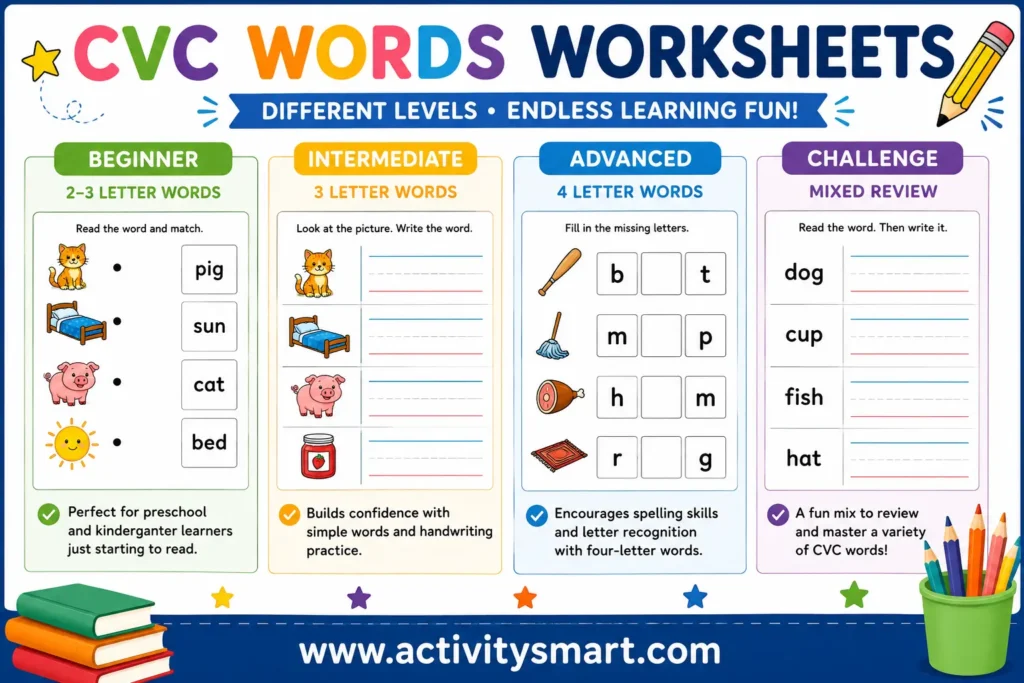
CVC words worksheets help children read, build, spell, and write simple consonant-vowel-consonant words such as cat, bed, pig, top, and sun. A good printable PDF moves from sound matching to blending, word families, picture clues, cut-and-paste work, and independent writing without overwhelming early readers.
Quick Picks
- Best starting page: picture-to-word matching with three choices.
- Best hands-on page: cut, build, and glue each CVC word.
- Best reading check: read the word and circle the matching picture.
- Best writing page: look, say, stretch, and write.
CVC words worksheets are most useful when they turn phonics into a small, clear action. A child sees a picture, says the word slowly, listens for three sounds, blends those sounds, and records the word. That sequence feels simple to an adult, yet it combines phonemic awareness, letter-sound knowledge, decoding, spelling, handwriting, and attention.
This printable set is designed for preschool, kindergarten, first-grade intervention, homeschool lessons, literacy centers, tutoring, and extra practice at home. Children who still need pencil control can first use tracing lines worksheets or strengthen letter formation with free letter tracing worksheets before completing longer written responses.
The pages should not be rushed. One focused worksheet followed by a two-minute word game usually teaches more than a thick packet completed mechanically. The goal is accurate sound-to-letter thinking, not a heroic amount of pencil mileage.
CVC Words Worksheets: What Skills Do They Teach?
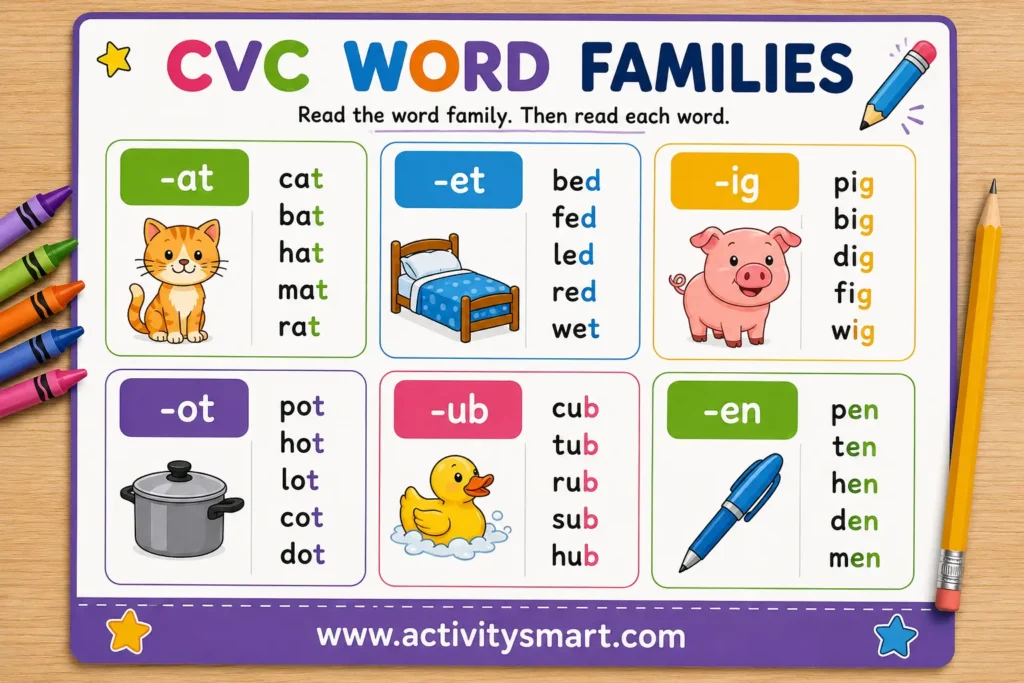
A CVC word has three letters in the basic pattern consonant-vowel-consonant. The pattern gives beginning readers a predictable way to practice short vowel sounds. Common examples include map, hen, sit, log, and cup. Some three-letter words are not regular CVC practice words, so worksheets should focus on words children can sound out using the phonics patterns they already know.
Phoneme segmentation
Before writing dog, the learner must hear /d/ /o/ /g/. Elkonin-style sound boxes, counters, finger taps, or three drawn dots help children separate the word into phonemes. This prevents guessing from the first letter or picture alone.
Blending for reading
Blending joins separate sounds into a spoken word. Encourage children to move smoothly from /m/ to /a/ to /p/ rather than pausing after every sound. Continuous blending is especially helpful because the word remains easier to recognize.
Encoding for spelling
Encoding works in the opposite direction. The child says a word, stretches it, identifies each sound, and chooses the letter that represents it. Reading and spelling reinforce each other, so a balanced CVC words printable should include both.
Short-vowel discrimination
Many errors occur in the middle letter. Children may write pen for pin or bug for bag. Minimal-pair practice and picture sorts help learners compare short a, e, i, o, and u without memorizing isolated lists.
What Is Included in a Strong Printable PDF?
A useful CVC words worksheets PDF should provide a progression rather than twenty pages that repeat the same task. Variety keeps attention fresh, while consistent directions allow children to work with growing independence.
- picture and beginning-sound matching
- three-sound boxes
- missing beginning, middle, and ending letters
- word-family sorting
- read-and-match pages
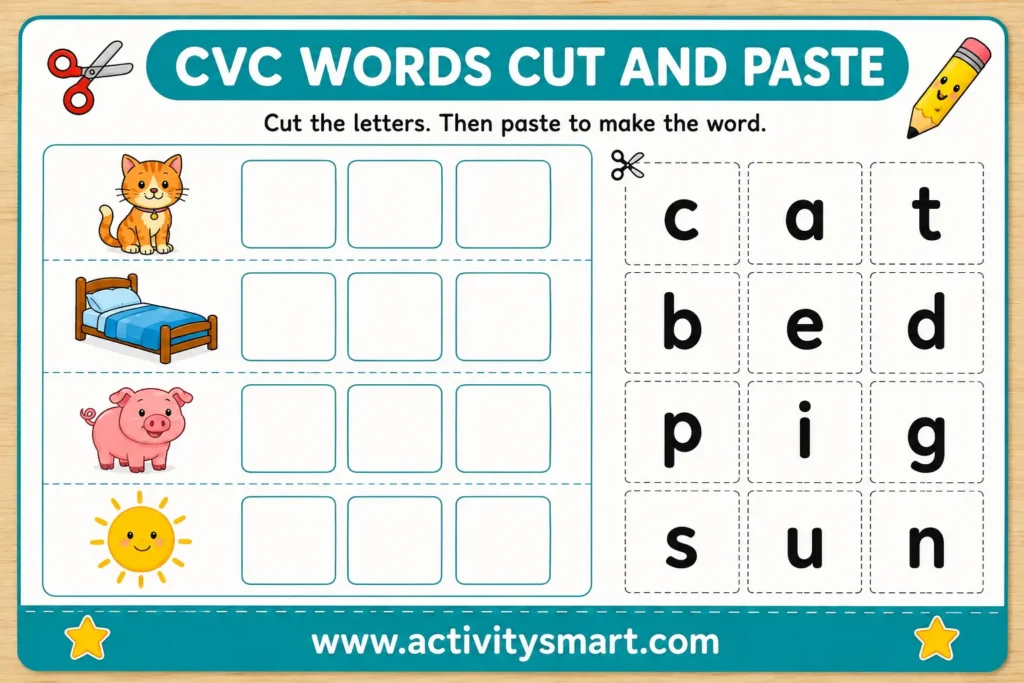
- cut-and-paste word building
- word ladders and one-sound changes
- simple sentence completion
- independent picture labeling
- review pages mixing all five short vowels
For children who enjoy game-like tasks, alternate phonics practice with a printable maze worksheet. A maze can serve as a brief movement break while still requiring visual tracking and persistence.
Recommended Learning Order
| Level | Worksheet Type | Main Skill | Adult Support | Best Sign to Move On |
|---|---|---|---|---|
| 1 | Picture and sound matching | Identify initial and final sounds | High | Child names pictures and hears target sounds |
| 2 | Sound boxes | Segment three phonemes | Moderate | Child taps three sounds accurately |
| 3 | Build and blend | Decode CVC words | Moderate | Child blends without guessing |
| 4 | Missing letters | Short-vowel spelling | Light | Child selects the middle vowel independently |
| 5 | Read and write | Automaticity and encoding | Light | Child reads and spells unfamiliar examples |
| 6 | Sentence application | Use words in context | As needed | Child reads a simple sentence with meaning |
How to Teach CVC Words Step by Step
1. Start with oral sounds
Say the target word without showing letters. Ask the child to repeat it, stretch it, and tap once for each sound. If the child cannot hear three sounds yet, stay oral. Adding print too early can turn the activity into letter guessing.
2. Map sounds to letters
Place three letter tiles under three boxes. Say each sound while moving one tile into a box. Then sweep a finger beneath the completed word and blend it. This makes the invisible sound sequence visible.
3. Read several words in one family
Use a small set such as cat, hat, mat, and sat. Point out the shared ending, but still require children to blend the complete word. Word families should support decoding, not encourage children to ignore the first sound.
4. Mix the pattern
After success with one family, mix words from different vowels and endings. This checks whether the learner reads the letters or simply predicts the pattern. A mixed review page is a better mastery test than a page containing ten nearly identical words.
5. Add writing and a sentence
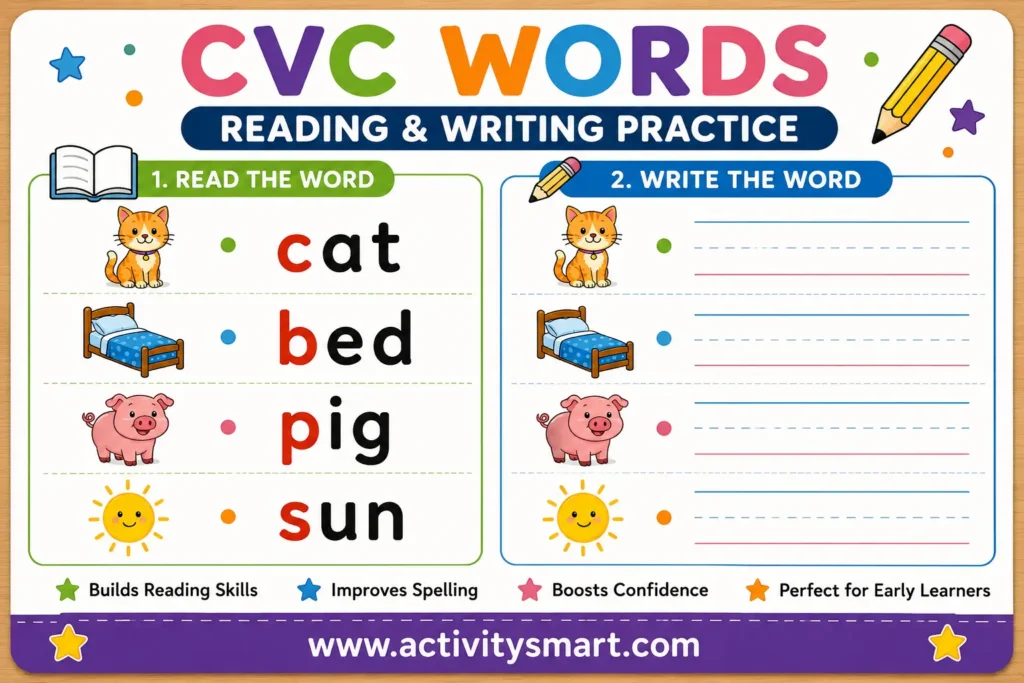
Ask the child to write two or three words from dictation, then use one in a short sentence. A sentence such as “The cat can nap” creates a bridge from isolated decoding to meaningful reading.
Short Vowel Practice Without Confusion
Teach one short vowel clearly, then compare it with another. Many children benefit from beginning with short a, followed by i, o, e, and u, although the exact order may vary. Use familiar pictures and pronounce words naturally rather than exaggerating the vowel into an unnatural sound.
Short A
Practice words such as cat, map, jam, bag, fan, and cap. Watch for confusion between a and e, especially when accents or speech differences affect how a word sounds.
Short E
Use bed, hen, red, net, leg, and web. Short e often needs extra listening practice because its sound can feel less distinct to some learners.
Short I, O, and U
Rotate compact sets such as pig, sit, fin; dog, top, log; and sun, cup, bug. Picture sorts work well because the child must compare the middle sounds rather than copy a visible model.
Best CVC Activities for Beginners
Beginners need fewer choices, larger print, clear pictures, and one direction per page. Start with matching, circling, and movable letters. Use five to eight target words in a session, then repeat those words in a new format.
- Say the picture name and place one counter per sound.
- Circle the first letter, then the final letter.
- Choose the middle vowel from two options.
- Build the word with tiles before writing it.
- Read the finished word aloud and use it orally.
Preschoolers may need broader readiness activities first. The preschool worksheets collection can help you combine phonics with tracing, matching, counting, and visual discrimination rather than making every lesson print-heavy.
Best CVC Activities for Advanced Learners
Once a learner reads regular CVC words accurately, increase thinking rather than simply adding more of the same. Use word chains, nonsense words, sentence editing, timed rereading without pressure, and sorts that require explaining the rule.
- Change one sound: map → mop → top → tip.
- Sort words by vowel and explain the category.
- Read a decodable sentence and illustrate it.
- Correct a misspelled CVC word and explain the fix.
- Write a silly sentence using three target words.
For broader classroom choices, browse kindergarten activities and the main printable worksheets library to create a balanced week of literacy, math, fine-motor, and attention tasks.
Common Mistakes to Avoid
Using pictures as the answer key
Pictures should clarify vocabulary, not let a child skip decoding. Ask the learner to point to each letter and blend before selecting the picture.
Teaching too many words at once
A long page can create fatigue and careless guessing. Short successful practice repeated across the week is more productive than one exhausting session.
Correcting only the final answer
Listen to the process. A child may arrive at the right word by guessing. Ask, “What sound does this letter show?” and “Which sound did you hear in the middle?”
Moving to blends too early
Words such as stop and frog are not simple CVC words. Consonant blends increase the number of phonemes and should follow secure three-sound blending.
Do Not Use These Worksheets as a Test Too Soon
Do not turn every mistake into a score. Early phonics requires experimentation, immediate feedback, and repeated opportunities. Avoid public comparison, speed races, tiny print, ambiguous clip art, and pages packed with unfamiliar vocabulary. A worksheet is a teaching tool first and an assessment only when the skill has already been taught.
Printing, Safety, and Classroom Setup
Print at actual size unless the page includes a special scaling instruction. Use thicker paper for reusable centers, laminate only when needed, and choose low-odor dry-erase markers. Adults should supervise scissors and small letter tiles. Store cut pieces in labeled envelopes so the literacy center does not slowly transform into educational confetti.
Black-and-white pages reduce ink use and let children color after reading. For a calm reward activity, a color by number printable can follow a focused phonics lesson without replacing it.
Pros and Cons of Printable CVC Practice
| Pros | Cons | How to Improve the Experience |
|---|---|---|
| Easy to prepare and repeat | Can become mechanical | Add oral blending and letter tiles |
| Shows progress clearly | Handwriting may hide phonics knowledge | Allow pointing, stamping, or magnetic letters |
| Works in centers or at home | Pictures can encourage guessing | Require sound-by-sound reading first |
| Supports review of short vowels | Too many pages can cause fatigue | Use one page plus a quick game |
Final Verdict
CVC words worksheets are most effective when they follow a thoughtful sequence: hear the sounds, map the sounds, blend the word, write it, and use it in context. Choose a page that matches the child’s current step, keep sessions short, and combine print with spoken practice and movable letters. The printable PDF then becomes a bridge to real reading rather than a pile of completed paper.
Frequently Asked Questions
What are CVC words?
CVC words follow a consonant-vowel-consonant pattern, such as cat, bed, pig, top, and sun. They give early readers a manageable way to practice short vowels and sound-by-sound blending.
What age are CVC words worksheets for?
They are commonly used in preschool, kindergarten, first-grade intervention, homeschool, and tutoring. Readiness depends more on letter-sound knowledge and oral blending than on age alone.
Which short vowel should I teach first?
Many programs begin with short a, but the best order depends on the curriculum and learner. Teach one vowel clearly, then contrast it with another through listening, sorting, reading, and spelling.
How many CVC words should a child practice at once?
Five to eight carefully selected words are usually enough for one focused session. Reuse the words in different activities rather than presenting a very long list.
Should children memorize CVC word families?
Word families can reveal patterns, but children should still blend the whole word. The goal is flexible decoding, not guessing every word from its ending.
What if a child guesses from the picture?
Cover the picture temporarily, point under each letter, and ask the child to say and blend the sounds. Reveal the picture afterward as a meaning check.
Are nonsense CVC words useful?
Yes, after the child understands the routine. Simple nonsense words can show whether the learner is decoding letters instead of relying only on memory.
How often should we use CVC worksheets?
Brief practice three to five times a week works well for many learners. A single page with active sound work is usually better than a large packet completed in one sitting.
For additional evidence-based guidance, review Reading Rockets phonics resources, the What Works Clearinghouse foundational reading practice guide, and the Common Core kindergarten foundational skills.