Quick Answer
Free Printable Alphabet Worksheets give preschool, pre-K, kindergarten, and first-grade learners simple practice with letter recognition, tracing, handwriting, beginning sounds, and uppercase-lowercase matching. The best worksheets use one clear skill per page, large readable letters, and short activities that children can finish without turning the kitchen table into a tiny office cubicle.
Quick Picks
- Best overall: Complete A–Z letter tracing worksheets
- Best for preschool: Picture-based letter recognition pages
- Best for kindergarten: Uppercase and lowercase matching activities
- Best for handwriting: Large dotted-letter practice sheets
- What to avoid: Crowded worksheets with tiny fonts, unclear directions, or five different skills squeezed onto one page
If a child has ever looked at the letter B and confidently announced, “That is an eight,” welcome to early literacy. Learning the alphabet takes repetition, patience, playful practice, and occasionally a pencil that mysteriously disappears under the sofa.
This collection of Free Printable Alphabet Worksheets is designed to help families and educators build letter knowledge without complicated preparation. Print the page, grab a pencil or crayons, and begin. No passwords, no app updates, and no dramatic negotiations with a tablet battery.
The activities are suitable for preschool, pre-K, kindergarten, homeschool lessons, literacy centers, morning work, and extra practice at home. They cover uppercase and lowercase letters, letter formation, beginning sounds, alphabetical order, matching, coloring, and simple handwriting.
Why Alphabet Knowledge Matters Before Children Begin Reading
Alphabet knowledge means recognizing and naming uppercase and lowercase letters, noticing them in print, and understanding that letters are connected to sounds. It is one of the foundations children use when they begin decoding words and writing independently.
A worksheet cannot replace conversations, read-aloud time, songs, games, or real books. However, it can provide focused practice after a skill has been introduced. Think of worksheets as a supporting actor, not the entire movie.
Reading Rockets explains that alphabet knowledge includes recognizing letter symbols and knowing that sounds are associated with those letters. Its guide to alphabet knowledge guide is a useful resource for parents and teachers who want to understand how letter learning connects with later reading.
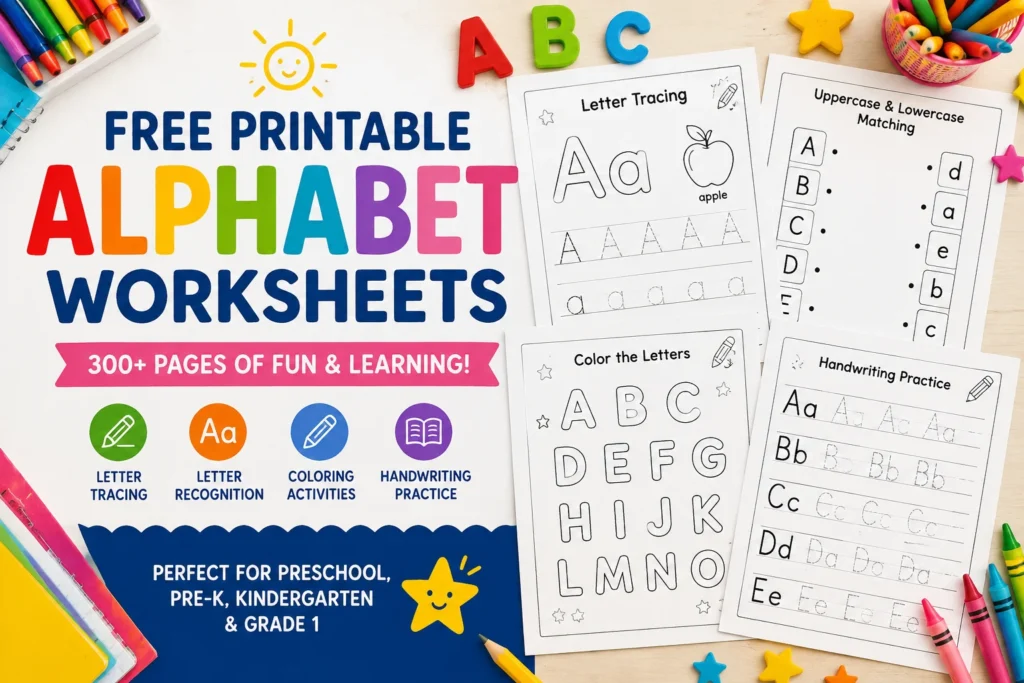
Free Printable Alphabet Worksheets by Skill
Children do not master the alphabet through one activity. Some can sing the alphabet song perfectly but cannot identify the letters when they appear out of order. Others recognize every letter yet struggle to form them with a pencil. A balanced collection should therefore include several types of practice.
Letter Recognition Worksheets
Letter recognition pages ask children to identify a target letter among other symbols. A worksheet might show several letters and ask learners to circle every A, color every M, or match a printed letter with the same letter in a different font.
These activities work well for beginners because they reduce the amount of writing required. Children can focus on visual discrimination: noticing curves, straight lines, orientation, and small differences between letters such as b, d, p, and q.
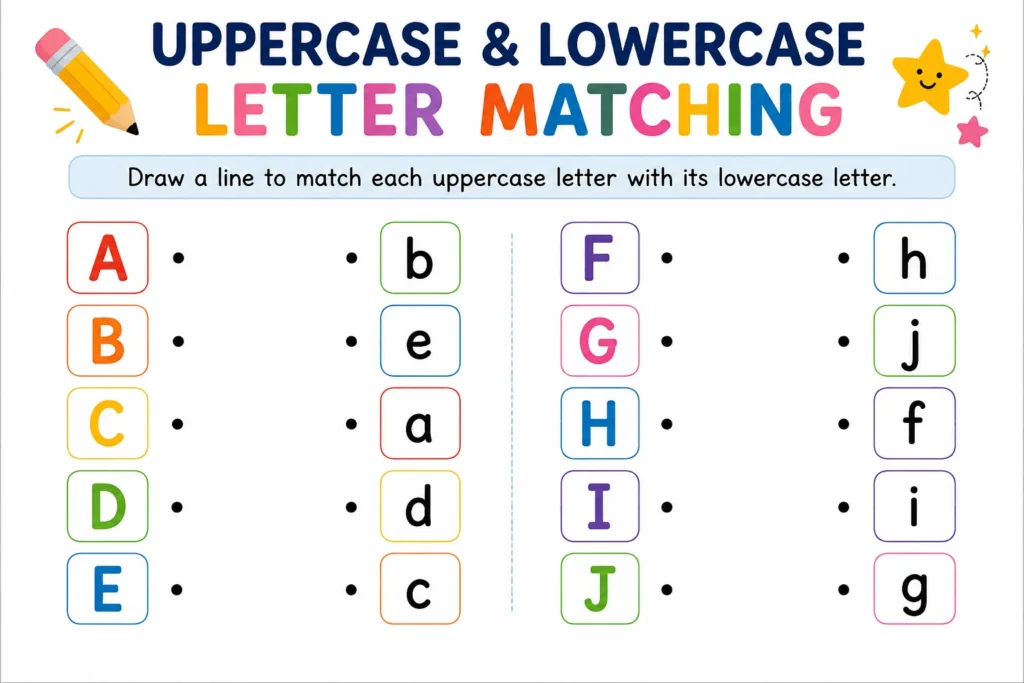
Uppercase and Lowercase Matching Worksheets
Uppercase-lowercase matching helps children understand that A and a represent the same letter even though they look different. This can be surprisingly tricky when pairs such as G/g or R/r appear in unfamiliar fonts.
Useful activities include drawing lines between letter pairs, cutting and pasting matching cards, coloring matching pairs the same color, or connecting letters to pictures whose names begin with the target sound.
Letter Tracing Worksheets
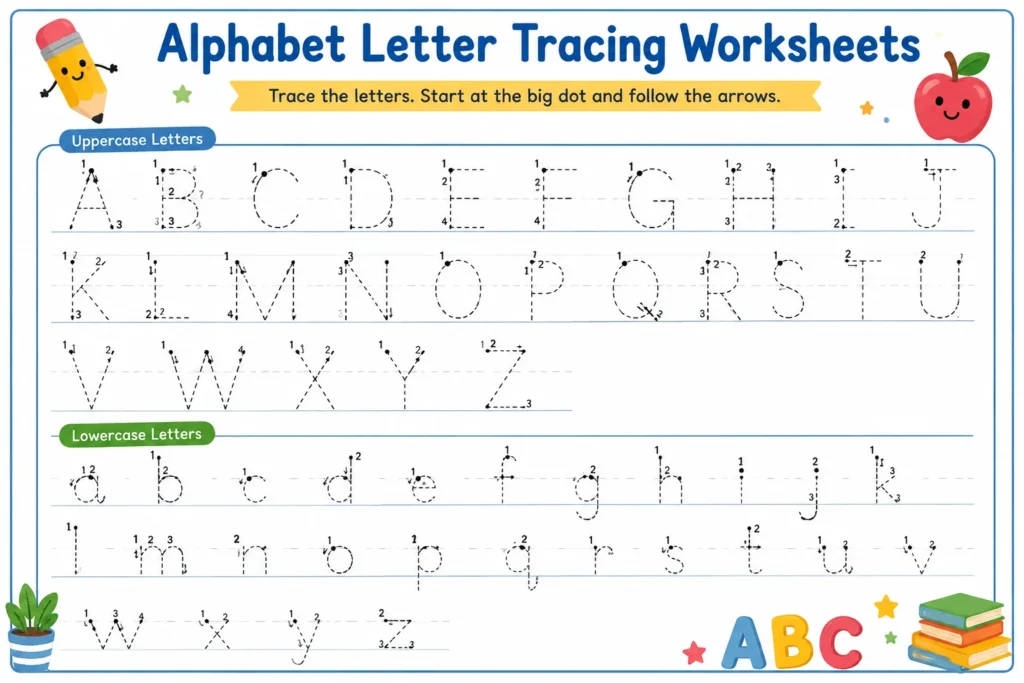
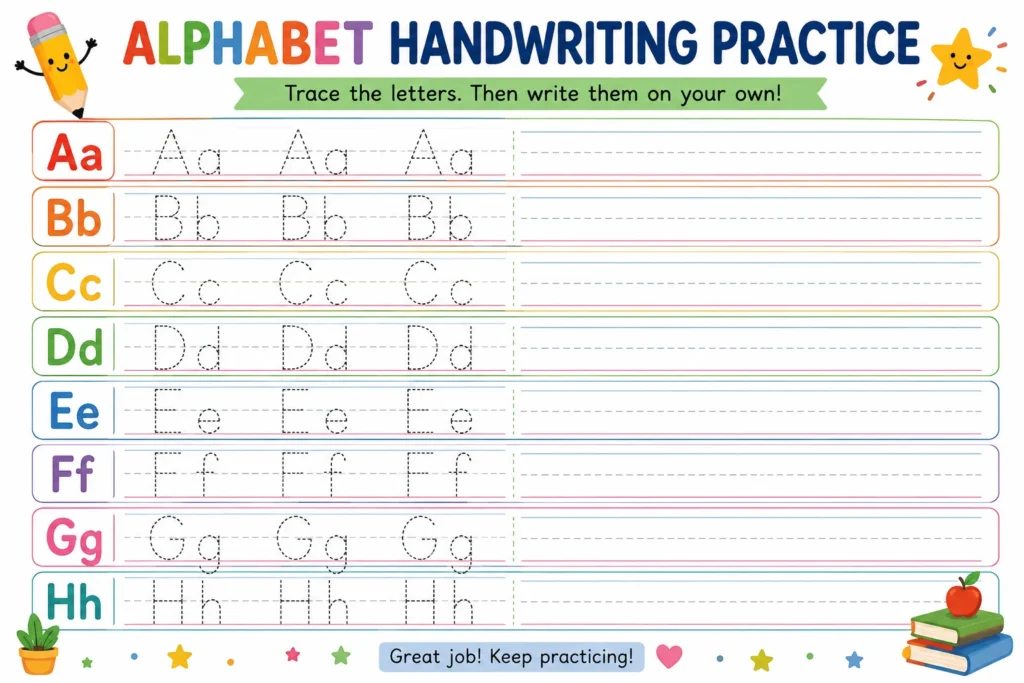
Letter tracing pages give children a visible path to follow. Large dotted letters are especially helpful for young learners who are still developing pencil control and hand strength.
Good tracing worksheets show where to begin, which direction to move, and how many strokes are required. They should also provide blank space for independent practice after tracing. Copying six dotted letters without trying one alone is a little like using training wheels forever: comfortable, but not the final goal.
Beginning Sound Worksheets
Beginning sound activities connect printed letters with spoken language. Children may match B with a ball, circle pictures beginning with S, or decide which letter completes a simple picture word.
Use familiar vocabulary and say each word aloud. Pictures can sometimes be interpreted differently—a child may call a sofa a couch, for example—so adult guidance prevents a phonics activity from becoming an unexpected furniture debate.
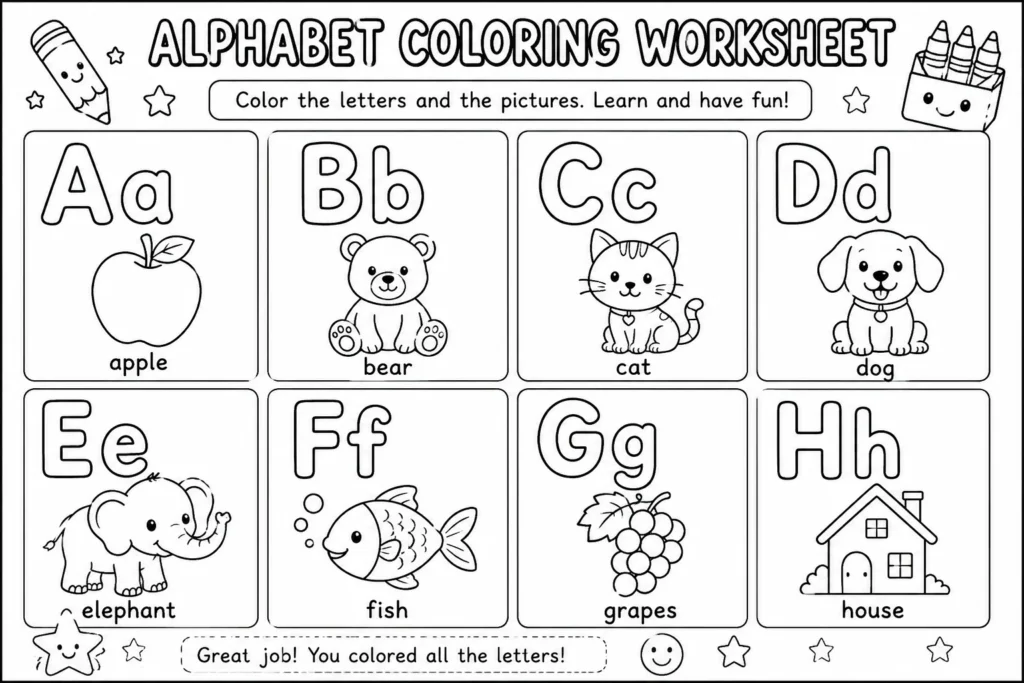
Alphabet Coloring Worksheets
Coloring pages are useful when the artwork supports the lesson rather than distracting from it. A large letter, one or two matching pictures, and a simple tracing line are usually enough.
Coloring strengthens pencil or crayon control while giving children time to look carefully at the target letter. It also provides a low-pressure activity for learners who are not ready for a full handwriting page.
Alphabetical Order Worksheets
Once children recognize individual letters, they can begin arranging letters in order. Early pages may ask them to fill one missing letter in a short sequence. More advanced activities can include arranging letter cards or identifying which letter comes before or after another.
Do not assume singing the alphabet song means a child can locate letters independently. The song is helpful, but many children initially remember it as one long musical word—“elemenopee” included.
Which Alphabet Worksheets Are Best by Age?
| Learning Stage | Recommended Worksheets | Suggested Session |
|---|---|---|
| Preschool | Letter recognition, coloring, picture matching, simple lines | 5–10 minutes |
| Pre-K | Uppercase matching, name letters, beginning sounds, large tracing | 10–15 minutes |
| Kindergarten | Uppercase-lowercase pairs, letter formation, sounds, missing letters | 15–20 minutes |
| Grade 1 support | Handwriting review, alphabetical order, phonics, simple word building | 15–25 minutes |
Age labels are only starting points. Choose activities according to the child’s current skills. A preschooler who already recognizes most letters may enjoy kindergarten matching pages, while an older learner may benefit from returning to large tracing sheets for specific letter-formation difficulties.
How to Use Free Printable Alphabet Worksheets Without Creating Worksheet Fatigue
Teach the Skill Before Handing Over the Page
Briefly introduce the target letter before asking a child to complete a worksheet. Say the letter name, demonstrate its common sound, trace it in the air, and point it out in a familiar word.
A two-minute introduction can prevent ten minutes of confused guessing. Worksheets work best as practice, not as silent instructions delivered by the printer.
Keep Practice Short and Predictable
Young children usually learn more from ten focused minutes than from a long session filled with frustration. Stop while the child is still reasonably engaged instead of waiting until the pencil has become a drumstick.
A simple routine might include one recognition activity, one tracing row, and one playful follow-up such as finding the letter on food packages or in a favorite book.
Use More Than a Pencil
Place the worksheet in a reusable sleeve and use a dry-erase marker. Let children trace letters with crayons, finger paint, dot markers, or small stickers. You can also ask them to build the letter using play dough before completing the paper activity.
These variations make repeated practice feel new while supporting fine motor development.
Connect Worksheets to Names and Familiar Words
Children are often especially interested in the first letter of their own name. Begin with meaningful letters, then gradually introduce the rest of the alphabet.
After completing a page for M, look for words such as mom, moon, milk, or a family member’s name. This shows that letters are useful symbols, not just shapes printed by an enthusiastic adult.
Best Printable Alphabet Worksheet Sets for Different Goals
Best for Complete Beginners
- Large single-letter coloring pages
- Find-and-circle letter activities
- Uppercase letter cards
- Picture matching with familiar objects
- First-letter-of-my-name worksheets
Best for Handwriting Practice
- Pre-writing line worksheets
- Large dotted uppercase letters
- Large dotted lowercase letters
- Trace-then-copy rows
- Letter placement on handwriting lines
Best for Early Phonics
- Beginning sound picture sorts
- Choose the correct beginning letter
- Letter-sound matching
- Sound hunts around the room
- Simple consonant review pages
Best for Homeschool and Classroom Centers
- Reusable laminated tracing pages
- Cut-and-paste matching activities
- Alphabet mini-books
- Letter-of-the-week packs
- Independent review folders
Printable Alphabet Worksheets vs. Alphabet Apps
| Printable Worksheets | Alphabet Apps |
|---|---|
| Support pencil control and handwriting | Provide sound, animation, and instant feedback |
| Reduce recreational screen time | Can maintain attention through interactive features |
| Easy to repeat and adapt | Progress may be tracked automatically |
| Work without internet or devices | Require a charged compatible device |
| Useful for classroom centers and portfolios | Useful for short independent practice |
You do not need to choose one side forever. A child might trace letters on paper, play a short sound game, and finish by finding the target letter in a picture book. Variety is more useful than declaring a winner in the great paper-versus-screen championship.
Do NOT Use These Alphabet Worksheets
Avoid worksheets that are visually crowded, use confusing fonts, provide incorrect stroke directions, include unclear pictures, or expect too much writing from a beginner.
- Tiny letters: Young learners need enough space to control the pencil.
- Decorative fonts: Fancy letter shapes can make recognition harder.
- Too many instructions: One clear objective per page is usually best.
- Endless tracing rows: Repetition helps, but excessive repetition creates fatigue.
- Random difficulty: Pages should progress from recognition to guided practice and then independent work.
- Worksheets used as punishment: Alphabet practice should not become the educational version of washing dishes.
A Simple Five-Day Alphabet Practice Routine
| Day | Activity | Main Goal |
|---|---|---|
| Monday | Introduce the letter and complete a recognition page | Identify the letter |
| Tuesday | Trace uppercase and lowercase forms | Practice formation |
| Wednesday | Match pictures to beginning sounds | Connect letters and sounds |
| Thursday | Complete a coloring or cut-and-paste activity | Review through play |
| Friday | Find the letter in books, signs, and labels | Apply the skill in real life |
Families building a broader early-learning routine can also use preschool worksheets, kindergarten worksheets, and number tracing worksheets alongside alphabet practice.
How Teachers Can Organize Alphabet Printables
Store worksheets by letter or skill rather than mixing every activity in one folder. A useful system might include separate sections for recognition, uppercase-lowercase matching, tracing, beginning sounds, and review.
Print only the pages needed for the week. This saves paper, reduces clutter, and avoids the classic teacher experience of discovering 84 unused worksheets in a cabinet three years later.
For learners who need additional support, provide fewer items per page, larger letters, and opportunities to respond by pointing or matching before requiring handwriting. For children ready for more challenge, add simple word-building and alphabetical-order activities.
How Parents Can Support Alphabet Learning at Home
Use worksheets as one part of a literacy-rich routine. Read aloud, talk about pictures, sing songs, tell stories, and notice print during daily activities. The National Association for the Education of Young Children emphasizes playful, language-rich experiences rather than relying only on drills. Its guidance on playful early literacy guidance can help families balance structured practice with conversation and play.
The Institute of Education Sciences also provides evidence-based recommendations for teaching foundational reading skills in kindergarten through third grade. Educators looking for a deeper instructional reference can review its foundational reading skills practice guide.
Most importantly, respond to effort. A crooked letter written independently can be a bigger achievement than a perfect traced row. Progress is often messy, lightly smudged, and decorated with an accidental green line across the page.
Frequently Asked Questions
Frequently Asked Questions
What age should children start alphabet worksheets?
Many children can begin simple letter-recognition and coloring activities around ages three or four. Readiness matters more than a specific birthday, so start with short visual activities and add tracing gradually.
How many alphabet worksheets should a child complete each day?
One or two short pages are usually enough for preschool and kindergarten learners. Ten focused minutes paired with reading, conversation, or a hands-on activity is often more useful than a large worksheet packet.
Should children learn uppercase or lowercase letters first?
Children should eventually recognize both. Uppercase letters may be visually easier for some beginners, but lowercase letters appear more often in books. Introduce meaningful letters first and begin matching uppercase and lowercase forms early.
Are tracing worksheets good for handwriting?
Tracing can help children learn stroke direction and build pencil control, but it should be followed by independent practice. Choose large letters with clear starting points and avoid pages containing too many repetitions.
Can alphabet worksheets help with phonics?
Yes, when the worksheets connect letters with spoken sounds through familiar pictures and words. Say each word aloud and combine paper practice with songs, books, sound games, and conversation.
What is the best way to reuse printable alphabet worksheets?
Place printed pages in reusable sleeves or laminate them, then use dry-erase markers. This works especially well for tracing, matching, and letter-of-the-week centers.
Are free printable alphabet worksheets suitable for homeschool?
Yes. Homeschool families can use them for short daily lessons, independent folders, skill review, or letter-of-the-week plans. Combine them with read-alouds and hands-on activities for a balanced routine.
What should I do if a child reverses letters?
Occasional reversals are common during early writing development. Provide clear models, large movement practice, and patient repetition. Seek professional guidance when difficulties are persistent or accompanied by broader reading or writing concerns.
Final Thoughts
Free Printable Alphabet Worksheets can make early literacy practice more organized, affordable, and flexible. The strongest pages focus on one clear skill, use readable letter forms, and give children enough space to work comfortably.
Begin with recognition and matching, add tracing when the child is ready, and connect letters with meaningful sounds and words. Keep sessions short, include hands-on play, and resist the urge to print an entire year’s curriculum before breakfast.
Whether these pages are used at home, in preschool, during kindergarten centers, or as first-grade review, the goal is the same: help children see letters as familiar tools for reading and writing. One worksheet will not create a reader overnight, but small, positive practice sessions can build the confidence that makes children eager to try again.