Quick Answer
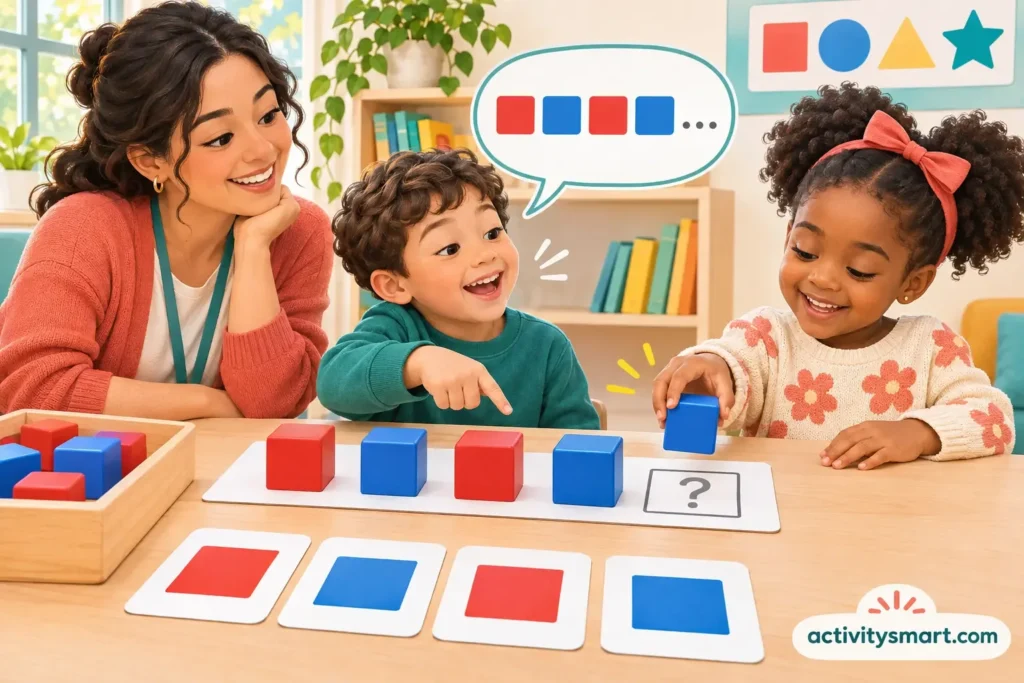
Start pattern recognition activities with two clearly different actions or objects, such as clap–stomp–clap–stomp or red–blue–red–blue. Model the repeating unit, invite a child to copy it, hide the final item, and ask what belongs next and why. When that feels comfortable, let the child invent a pattern and explain its rule.
Quick Picks
- No supplies: clap–tap movement patterns.
- At home: alternate two large, safe blocks or paper squares.
- For groups: make a repeating action circle.
- Ready for a challenge: build AAB, ABB, ABC, then growing patterns.
- Best check: ask children to describe the repeating part, not just guess the next color.
Good pattern play begins with noticing a rule, not memorizing a worksheet. A child who spots how red, blue, red, blue repeats can begin to predict, explain, and create arrangements using sounds, shapes, movement, and everyday objects. These activities can be playful and brief, with no expensive kit required.
Patterning belongs alongside counting, shapes, and mathematical language. The What Works Clearinghouse early-math practice guide recommends teaching patterns through a developmental progression, while identifying the specific evidence for that recommendation as limited. That means adults can use patterns as a useful learning opportunity without promising that one game produces a measured gain in later mathematics.
What counts as a pattern—and what does not?
A repeating pattern has a unit that cycles in the same order. In red–blue–red–blue, the unit is red–blue, often written AB. A growing pattern follows a change rule: one block, two blocks, three blocks increases by one block each step. Both are predictable, but they call for different explanations.
A line of pretty objects is not automatically a mathematical repeating pattern. Red, blue, yellow, green might be a sequence without enough information to establish what repeats. Ask a child to point to the repeating part; if nothing repeats yet, invite them to build a second copy of their chosen unit.
Pattern recognition activities: a gentle teaching sequence
A practical progression is notice → copy → continue → repair → create → explain. It is a teaching sequence, not an age-based checklist. Some children can invent patterns before they can name them; others can chant a sequence but need help identifying its repeating unit.
1. Notice something that repeats
Point to a striped towel, a tiled floor, or a repeated musical beat. Say, “I notice stripe, spot, stripe, spot. I hear the same two things again.” Invite the child to search for the same feature. If the environment is visually busy, isolate a small section with a piece of paper or by pointing.
2. Copy an easy AB unit
Arrange four large paper squares: red, blue, red, blue. Ask the child to make the same line underneath. Keep both colors available and model the first copy if needed. For a child who benefits from movement, say “clap, tap, clap, tap” while doing each action together.
3. Continue and name the unit
Cover the last piece, then ask what comes next. More importantly, ask, “What part keeps coming back?” A child who says “red, blue” and points to repeated pairs is showing more of the underlying idea than one who guesses red correctly.
4. Find a mistake and repair it
Make red–blue–red–red–red–blue and ask whether something looks surprising. This works best after the child has copied a correct example. Invite them to move one square rather than announcing that the pattern is wrong. Two valid repairs may exist if the intended unit is not yet clear; explain the rule you are testing.
5. Make a pattern for someone else
Invite the child to be the designer: “Can you make a rule I can follow?” Have them repeat the unit twice before you guess what comes next. Children can use drawing, dance, sounds, or toy arrangements. Ask them to teach the rule to a partner, and accept pointing or gestures if speech is still developing.
The UK Department for Education guidance on patterns recommends noticing regularities in play and using patterned fabrics, objects, and repeated language. That approach is compatible with guided play: the adult offers just enough support to help a child notice something meaningful while preserving choice and enjoyment.
Choose the right pattern: AB, AAB, ABB, ABC, or growing
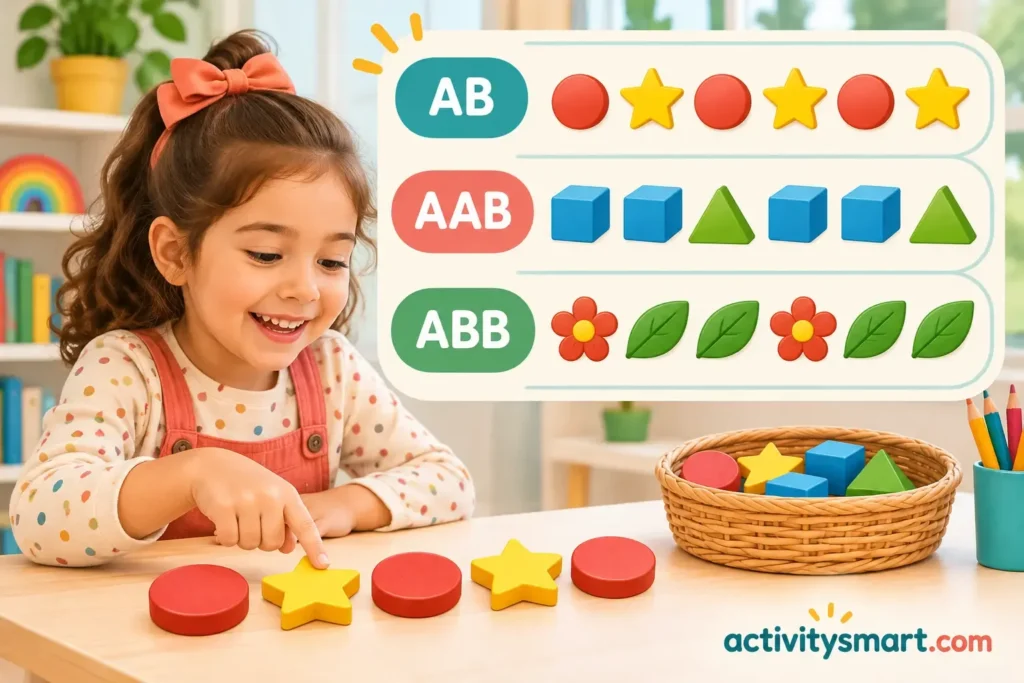
Letter labels describe positions in a rule, not alphabet learning. Each different letter stands for a different object, sound, color, or action. For example, AAB can mean clap–clap–stomp or circle–circle–square. The core rule remains the same even if the materials change.
| Pattern | Example | Try when | Prompt |
|---|---|---|---|
| AB | red–blue–red–blue | Two distinct items feel manageable | What two repeat? |
| AAB | red–red–blue–red–red–blue | The child can extend AB independently | Where is the double? |
| ABB | red–blue–blue–red–blue–blue | They can attend to a three-part unit | Which item appears twice? |
| ABC | red–blue–green–red–blue–green | Three different items do not overwhelm | Can you point to a full unit? |
| Growing | 1 block, 2 blocks, 3 blocks | They notice that quantities can change | How does each step grow? |
This is a teaching-choice table, not a table of measured effectiveness. Use its sequence flexibly. An older beginner may still find AB helpful, while a younger child might confidently copy an ABC beat. Rather than assuming that an age guarantees a skill, observe how the child explains the rule.
For growing arrangements, use a staircase made from sturdy blocks: one on the first step, two on the second, three on the third. Ask, “How many did we add this time?” Growing patterns invite counting and comparison; families can reinforce that distinction with counting objects one at a time.
Ten simple play ideas that actually use the rule
Clap-and-stomp echo
Make a sound/action sequence—clap, stomp, clap, stomp—and invite the child to echo it. Repeat slowly, then pause before the next sound. Change the roles so the child leads. A group can take turns as the conductor, but keep the sequence short enough for everyone to participate.
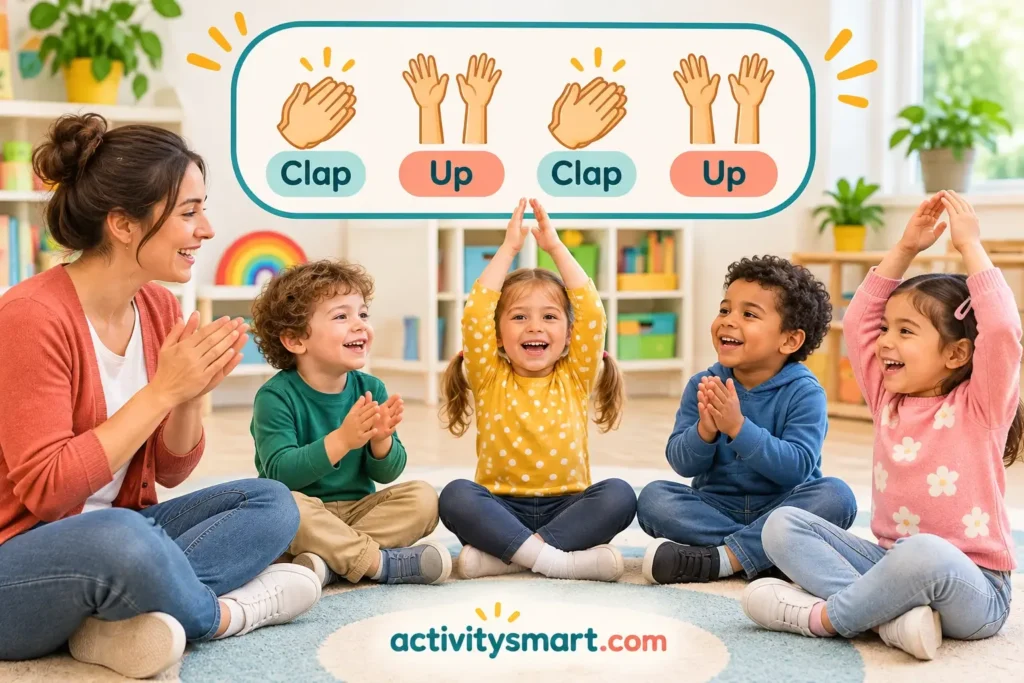
If noise is difficult, substitute silent motions such as hands up, hands down. The mathematical idea is the repetition; loudness and speed are optional. This makes the game suitable for a quiet corner as well as a whole-class circle.
Block-train station
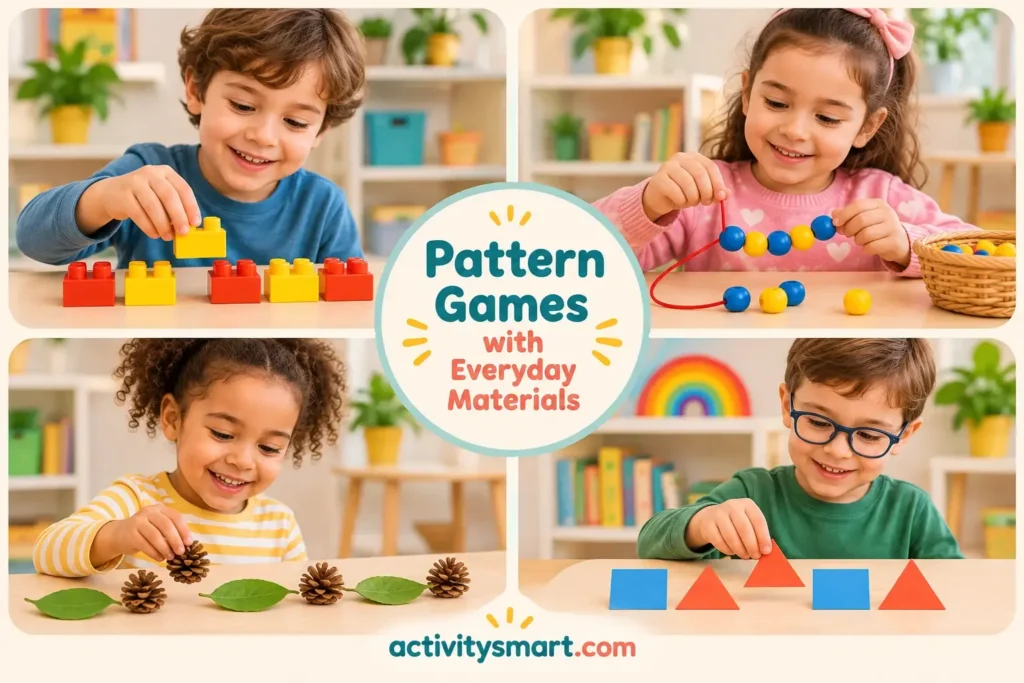
Line up large blocks as carriages: tall, short, tall, short. Ask the child to add two more carriages and then rebuild the same arrangement using different colors. This changes the visual surface without changing the rule. Keep the train on a stable floor rather than a high, easily toppled platform.
Paper-shape path
Cut oversized circles and squares from contrasting paper and lay them on the floor in an AB trail. Walk along it together while naming shapes, then pause at an empty space. Older children can arrange AAB or ABC paths and challenge a friend to continue.
Preparing large paper shapes involves cutting; an adult should handle sharp scissors when appropriate. For children ready to practice cutting themselves, see safe scissor skill practice and choose supervised, age-appropriate tools.
Rhythm detective
Tap a table once, then tap twice, repeating the same sound grouping. Ask whether the next group has one tap or two. You can draw a large dot for a single tap and two dots for a double tap to help children connect sounds to visible marks.
Toy-animal parade
Place safe, large animal toys in an alternating parade—bear, rabbit, bear, rabbit. The child gives the next animal a place in line. Once the pattern is clear, try “bear, bear, rabbit” and let them make a parade for a friend to decode.
A favorite story can give the parade a reason to travel, but do not bury the rule under too many instructions. With children who love books, picture-book conversations offers ways to build language through picture-book discussion while keeping the pattern task separate.
Movement-circle pattern
Invite children to stand with comfortable personal space. Start a repeating movement sequence: reach up, crouch, reach up, crouch. Let children say the rule and decide what comes next. Give seated alternatives, such as raise hands then touch shoulders, so everyone can join.
If a group loses the sequence, stop and rebuild the first two actions together. A confident child can lead the next round. This provides a social challenge, but never require a child to perform alone to prove understanding.
Pattern-print art
Use chunky washable stampers or adult-made sponge shapes to print circle–square–circle–square on a page. Invite the child to finish a border before decorating the middle. Point out the rule before paint covers the shapes; overly elaborate art can hide the structure.
Drawing patterns is a useful bridge to marks and repeated shapes. For related pencil and line experiences, explore pre-writing lines and shapes. Keep the pattern lesson about order, not handwriting neatness or how closely the child reproduces an adult design.
Outdoor pattern hunt
Look for fence panels, brick layouts, window shapes, and repeated garden arrangements. Ask whether a sequence truly repeats or simply contains several different items. Take a sketch or describe it aloud; collecting natural materials is unnecessary.
Dress-up color sequence
Lay out large fabric squares or scarves, perhaps blue–yellow–blue–yellow. Invite children to arrange a pretend costume display. If someone wants to choose different colors, preserve the same two-position rule first and then compare the new sequence.
Use clean, age-appropriate materials; avoid cords around necks and do not cover faces. This game works without dressing up at all: the fabrics can remain flat on a table while children point, sort, and rearrange them.
Build-a-staircase challenge
Arrange sturdy stacks of one, two, and three blocks. Ask how the next step differs from the previous step. Help the child build four, then invite them to invent a new growth rule, such as adding two blocks each time. Use low, stable arrangements that will not fall onto children.
This is a growing pattern rather than a repeating AB pattern. It may be harder because the child has to coordinate counting with noticing change. If counting each piece is still difficult, return to concrete one-to-one matching before introducing larger towers.
A five-day mini-plan for home or the classroom
You do not need a formal lesson to make practice consistent. These sessions can take a few minutes and can stop sooner if a child is tired or happily moves to another activity. Repetition across several contexts makes it easier to see whether a child understands the rule or has merely memorized one familiar arrangement.
- Day 1 — notice: find two repeated designs at home or school; describe what actually repeats.
- Day 2 — copy: build a simple AB line with big blocks, then repeat it with movements.
- Day 3 — predict: hide the ending of an AB pattern and explain why the missing part belongs.
- Day 4 — repair: introduce one misplaced shape and invite a child to correct it.
- Day 5 — create: let the child teach a partner a self-made repeating rule and, if ready, explore AAB.
For a mixed-age classroom, let everyone begin with the same invitation but provide different materials and follow-up questions. One child might copy two colors; another might describe the unit; a third could create a growing sequence. A short shared opening and flexible independent play are often more practical than assigning everyone identical work.
Families can connect these activities to broader school readiness through play. Patterning is one small piece of early learning, alongside language, cooperation, movement, curiosity, and independent problem-solving. A child does not need to master every pattern type before school.
Make the activity easier, harder, or more accessible
If the child is guessing rather than reasoning
Reduce the choices to two noticeably different objects. Make the unit twice, point to each item in order, and say it aloud before asking what comes next. Place a small gap between units if that helps the child see the grouping. Offer support, then slowly remove it as understanding grows.
When a child places the right item, invite a brief explanation without turning it into an interrogation: “Show me the part that repeats.” If the explanation is nonverbal, accept pointing or rebuilding. A correct continuation and a clear account of the rule provide different kinds of information.
If color, sound, or movement creates a barrier
Use tactile or high-contrast shapes rather than relying on color alone. A child with hearing differences can work with visible movements or block sequences. A child with limited mobility can direct a partner verbally, point, or use accessible large cards. Choose the representation that makes the rule available rather than treating one sensory format as essential.
For children who tire quickly, work on a smaller mat and provide breaks. When a child has developmental, vision, hearing, or motor concerns, ask the family or relevant qualified professional about suitable adaptations; a pattern game is not a diagnostic assessment.
If a child is ready for more complexity
Change only one variable at a time. Move from AB to AAB, or from copying to repairing, before mixing colors, sizes, and rotations. Invite the child to translate a sound pattern into a picture pattern. This tests whether the rule is understood across representations rather than attached to one set of toys.
Ask a more advanced learner to compare two proposed rules: “Could this line be grouped another way?” A child may notice that red–red–red–red could be described as A repeated, or as AA repeated. Discuss how the smallest useful repeating unit can make a rule easier to communicate.
Play-based learning versus worksheets: what changes?
Neither format automatically makes a lesson effective. The important question is whether a child can notice, represent, extend, and explain a rule with meaningful support. Play provides movement, choice, and immediate feedback; a simple paper task can make thinking visible or provide a quiet follow-up.
| Approach | Useful for | Watch out for |
|---|---|---|
| Hands-on play | Building and changing rules with real objects | Too many materials can distract from the pattern |
| Songs and movement | Hearing and feeling repeatable sequences | Speed and group noise can obscure the rule |
| Drawing or paper tasks | Recording or checking an understood sequence | Fine motor demands may mask pattern knowledge |
| Guided conversation | Explaining why an item comes next | Questions become unhelpful if adults supply every answer |
The Education Endowment Foundation early-math evidence describes multiple ways to structure early mathematics, including guided play, routines, and brief intentional instruction, without concluding that one structure is invariably superior. This is why a short worksheet is not inherently harmful, but worksheets alone should not replace rich opportunities to manipulate and discuss patterns.
How to observe progress without turning play into a test
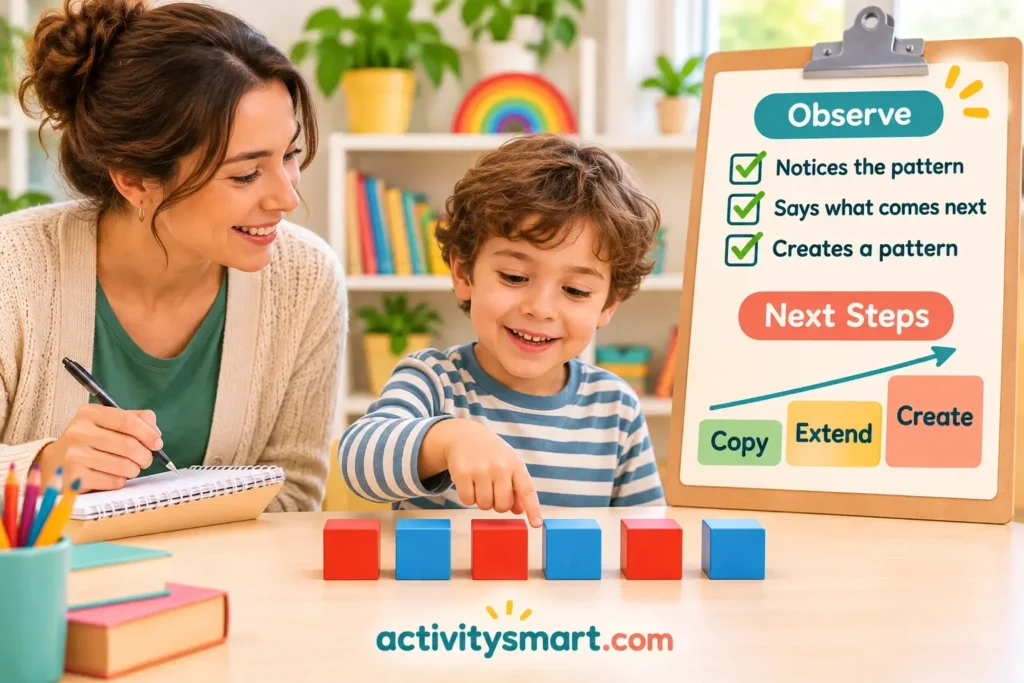
Look for four kinds of evidence: noticing repetition, copying a short unit, extending it independently, and explaining or demonstrating why the continuation works. A child may show these skills differently with objects and sounds. Make a few informal notes if it helps plan the next activity, but avoid scoring or labeling children after one session.
Try recording the prompt and the support needed: “Continued red–blue with a verbal reminder” is more informative than “does not know patterns.” Next week, repeat the idea with different materials. If the child can explain the same rule in a new setting, that may suggest a more transferable understanding.
The IES family resource IES mathematics activities for families encourages observing what children know during everyday routines and building on that knowledge. The New York State early learning patterning examples offers examples of how patterning may appear in the preschool years, but its age examples are not a pass-or-fail diagnostic scale.
Common mistakes and important safety choices
- Teaching only “what comes next”: also ask which part repeats and whether a proposed continuation follows the rule.
- Changing every feature: use strongly contrasting pieces and one clear rule for a new learner.
- Confusing sorting with patterning: grouping all red items together is sorting; alternating red and blue in a repeatable order is patterning.
- Rushing to complex sequences: introduce more elements after the child can explain a simpler arrangement, not because of a birthday.
- Correcting immediately: invite comparison, repair, and a second attempt before supplying the answer.
- Using tiny loose pieces: avoid beads, magnets, button batteries, and other swallowable materials with children who may mouth objects; choose large, age-appropriate items and supervise.
Check toy labels and classroom policies, especially when materials are shared with younger siblings. Keep strings and long scarves away from necks; use child-safe art supplies and manage scissors according to ability and supervision. Food-pattern activities can invite allergy or choking concerns, so nonfood blocks or paper shapes are a simpler choice.
Final takeaway: teach the rule, not the right guess
The strongest next step is simple: begin with a clear AB sequence, repeat it twice, invite the child to continue it, and ask them to show the unit that makes the answer sensible. Change from objects to sounds or actions when the child is ready, and follow their interests. Through small, enjoyable decisions, pattern play becomes an opportunity to notice structure and communicate an idea—not a contest to finish fastest.
Frequently asked questions
What are pattern recognition activities for preschoolers?
Pattern recognition activities for preschoolers are playful tasks in which children notice, copy, extend, or make predictable arrangements. Start with two large objects or simple movements in an AB sequence and invite the child to show the part that repeats.
What is the easiest pattern to teach first?
An AB repeating pattern is usually a practical starting point because it alternates two different elements. Use red–blue–red–blue or clap–stomp–clap–stomp, and let the child copy it before asking what comes next.
How do I explain an AAB pattern to a child?
Explain an AAB pattern as two of one thing followed by one different thing, repeated in the same order. Build red–red–blue twice, point to each three-piece group, and ask the child to make the next group.
Are sorting and pattern recognition the same skill?
No, sorting groups objects by a shared feature, while repeating-pattern recognition identifies an ordered unit that recurs. Sorting red blocks together is different from arranging red–blue–red–blue and explaining the alternation.
Can children practice patterns without buying supplies?
Yes, children can make patterns with claps, taps, steps, gestures, and spoken sounds. Short, predictable action sequences let adults model and discuss repetition without any purchased materials.
When should a child try ABC or growing patterns?
A child can try ABC or growing patterns when simpler patterns are manageable and the next challenge remains enjoyable. There is no single age cutoff; observe whether the child can recognize and explain a rule before adding complexity.
How can I tell whether my child understands a pattern?
Ask the child to point to the repeating unit, continue the sequence, and build the same rule with new materials. A correct guess alone tells you less than a reasoned continuation, so notice what help the child needs.
Are worksheets necessary for learning patterns?
No, worksheets are not necessary for learning patterns because children can explore rules through objects, sounds, movement, and conversation. A short paper task can be an optional follow-up when it suits the child.
What if a child keeps putting the wrong item next?
Make the sequence shorter and more visible, model two full units, and invite the child to copy before predicting. Try a different sensory format or offer a break; repeated difficulty in one game is not a diagnosis.
How can I adapt pattern games for a mixed-age group?
Use one familiar pattern invitation with different levels of support and challenge. Some children can copy AB with large cards, while others explain AAB, repair an error, or construct a growing arrangement.
Sources and further reading
These sources inform the developmental approach and practical examples above; they do not demonstrate that any single game guarantees an academic outcome.