Quick Answer
Pre writing skills are the movements, visual attention, hand coordination and early mark-making experiences children use before forming letters. Begin with big arm movements, scribbling, lines, curves and shapes through enjoyable play. Offer varied tools, model without insisting on copying, and introduce purposeful letter practice when the child shows interest and readiness.
Pre writing skills grow when children draw, move, build and make marks for a reason. A preschooler who paints a winding road, draws a circle for a face or makes a pretend shopping list is exploring foundations for handwriting. Parents and teachers can support this growth with brief, inviting activities instead of long tracing drills or pressure to form perfect letters.
What pre writing skills actually include
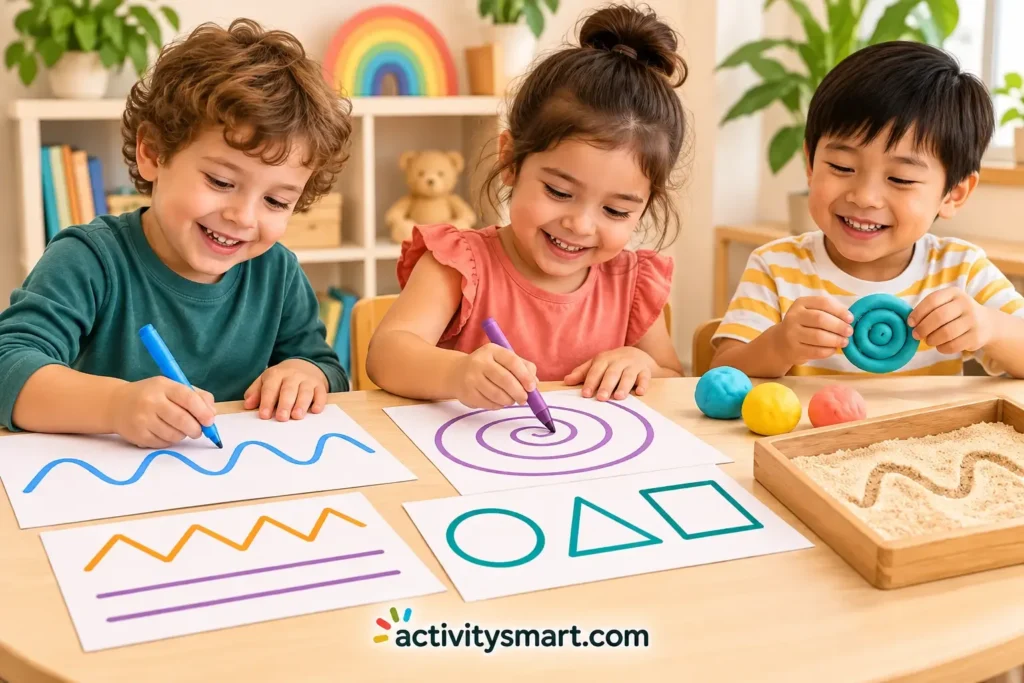
Handwriting is more than holding a pencil. Children coordinate what they see with how their hands move, stabilize paper with one hand while the other draws, adjust pressure, plan a path and discover that marks can communicate. These abilities develop together, not as a single fixed ladder. A child may draw lively pictures while still finding small letter strokes difficult.
Early writing also has a meaning-making side. Scribbles, pretend signs, labels and drawings allow children to act as writers before conventional spelling arrives. Reading Rockets early writing activities describes how scribbling, letter-like shapes and playful writing emerge across the preschool years. Value what the child intends to communicate, not only how neat the mark looks.
Movement, coordination and visual attention
Large shoulder and arm movements help children explore direction and space. Smaller hand and finger adjustments become useful as marks get more precise. Eye-hand coordination helps a child follow a path or connect two points; bilateral coordination helps the non-drawing hand hold paper steady. These are practical descriptions of what a task requires, not separate tests that every child must pass before writing.
You can observe the skills in everyday play: stacking blocks requires positioning; stirring involves repeated circular movements; rolling dough uses pressure; turning a page requires controlled fingers. hands-on fine motor activities offer related ideas for building confidence through varied everyday materials.
The difference between pre writing and handwriting
Pre writing focuses on exploratory marks and control without expecting correct letter shapes. Handwriting instruction adds agreed letter forms, stroke patterns, size, spacing and eventually fluency. The activities overlap: a child can happily copy the first letter of their name while still enjoying scribbles. The aim is to provide a bridge, not to hold back a curious child or rush a hesitant one.
A realistic progression: scribbles, lines, curves and shapes
Development is uneven. Some children enjoy drawing detailed people before they can reproduce a neat square; others prefer building and outdoor movement. Treat the sequence below as a menu of increasing task demands rather than a timetable. The CDC three-year developmental milestones includes drawing a circle after a demonstration among common three-year milestones, but milestone lists are not individual diagnoses or strict teaching deadlines.
Free marks and broad strokes
Offer a large sheet and invite a child to make rain, racing cars, grass or dancing ribbons. Their marks may go in several directions and overlap. Ask, “Tell me about this,” instead of “What is it supposed to be?” When children control the story, they have a reason to continue experimenting.
Try a standing easel or paper taped securely to a wall at a comfortable height. A wide surface gives room for shoulder movements; a tabletop offers different control demands. Avoid assuming that vertical work is inherently better for every child. Change position if the child becomes uncomfortable, and allow left-handed children an unobstructed working space.
Straight, curved and crossing lines
Once a child is interested in making intentional paths, model a road going across the page, a falling raindrop or a climbing vine. Horizontal, vertical, diagonal, curved and zigzag paths each invite a different movement. A child need not master one before being allowed to enjoy another. Begin with wide paths and reduce their width only when it feels manageable.
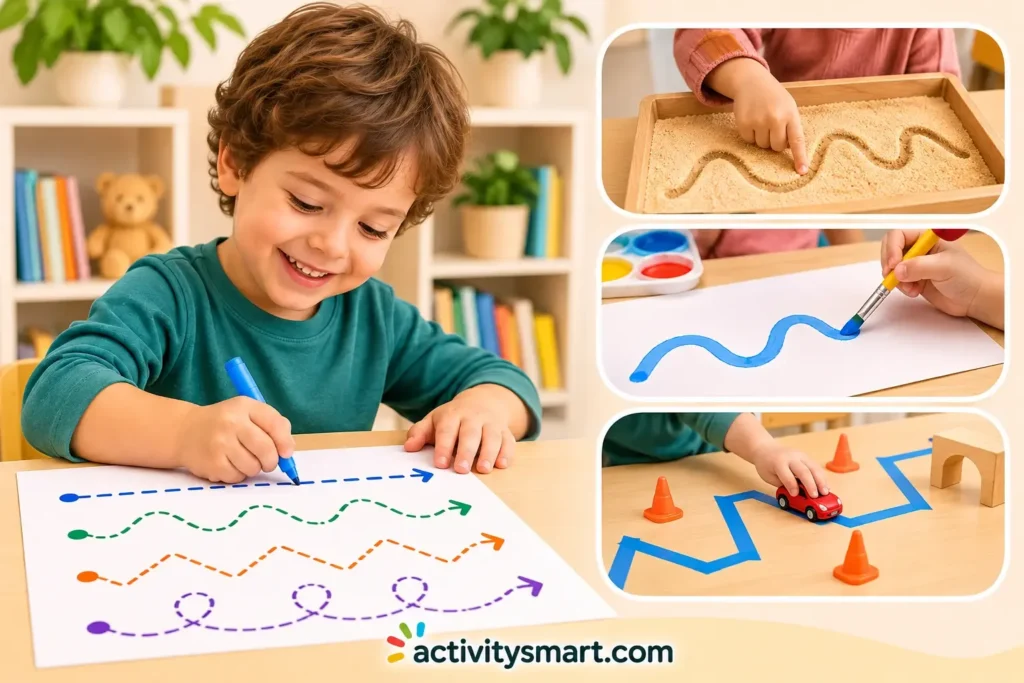
For a practical bridge from free drawing to guided paths, use line tracing practice sheets. Present one sheet as an optional game, not a timed accuracy test. A road with a broad boundary is often less frustrating than a thin dotted line. When a child goes outside the road, say what you notice and invite another attempt only if they want one.
Circles, intersecting strokes and closed shapes
Make circles by tracing around a plate with a finger, rolling dough into a ring or drawing a sun. Crossed lines can become a window, kite string or treasure map. Squares combine changes in direction and corners; they may be harder than a free circle for some children. These are examples of movement challenges, not universal milestones in a compulsory order.
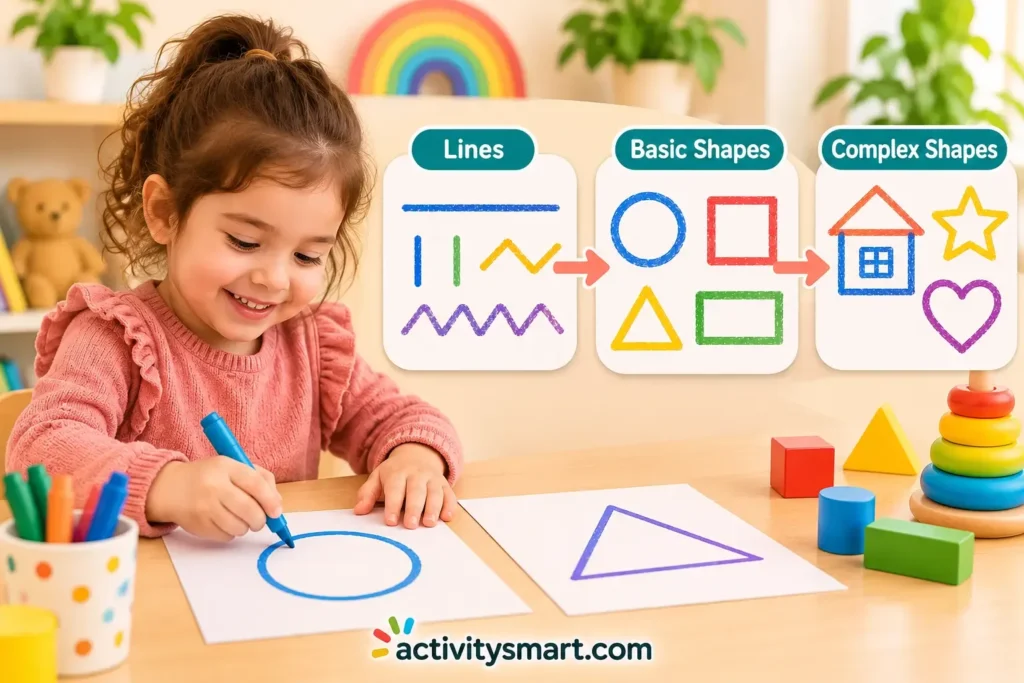
Use shape language naturally: “Your line turned here,” “That loop closed,” or “This side is longer.” Avoid repeatedly erasing imperfect shapes. Ask children to find shapes in signs, blocks and household objects, then draw their own versions. Seeing, moving and naming a shape can make the drawing task more meaningful.
Choose the right activity for the child in front of you
An age label can help adults choose materials, but observed interest, access needs and comfort are more useful for selecting the next task. The following guide describes possible starting points rather than standards that every child should meet.
| What you observe | Good starting activity | Gentle next challenge |
|---|---|---|
| Enjoys big scribbles but avoids small marks | Chalk roads or painting on large paper | Draw a broad path between two pictures |
| Makes lines but struggles to change direction | Drive a toy car around wide curves | Draw a curved road beside the toy route |
| Draws circles and simple pictures | Invent faces, wheels and weather symbols | Add intersecting lines or corners |
| Interested in names and letter-like marks | Make signs and label drawings | Model a meaningful letter with no speed demand |
| Finds tools tiring or uncomfortable | Use a larger tool and short playful turns | Change surface or position and observe comfort |
The table compares task demands and practical choices, not proven superior interventions. No particular path guarantees later handwriting performance. Children with disabilities may use adapted tools, alternative communication or different movement strategies; participation and meaningful expression remain central goals.
Playful pre writing activities with simple materials
Make giant paths with movement
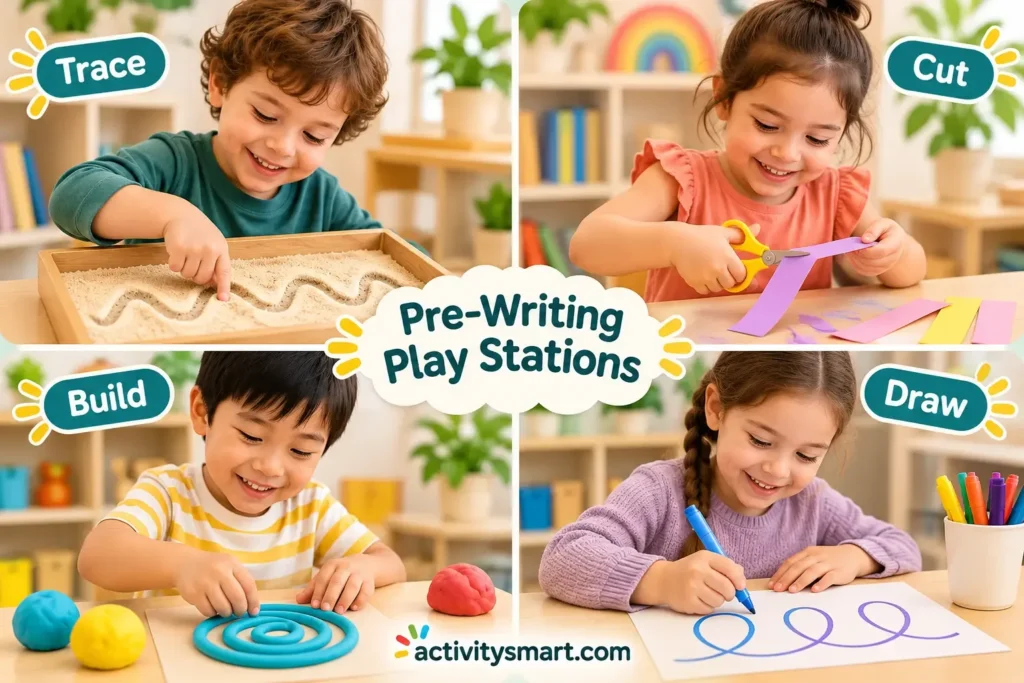
Tape a wide paper road to the floor, or draw a path outdoors with washable sidewalk chalk. Invite a child to walk, roll a ball or move a toy vehicle along it before drawing a similar path on paper. Use words such as around, across, up and down. The movement version helps the child understand the path; the drawing version asks for finer control.
For a group, create separate stations so children are not waiting to use the same narrow path. Let each child choose the route and describe it. If chalk dust or outdoor conditions are unsuitable, draw on a large reusable board. Keep the focus on playful exploration rather than counting perfect repetitions.
Roll, pinch and press dough
Invite children to roll dough snakes, press them into circles, flatten pretend pancakes or build the first letter of a familiar name. Use commercially appropriate child-safe dough and supervise closely. This activity changes hand movements without requiring a pencil. Ask children what they made and add a pretend purpose, such as food for a toy café.
The NAEYC fine motor play guidance recommends everyday tasks and materials including dough, finger painting and drawing as opportunities to use small hand muscles. That supports offering varied practice, but it does not establish that any single dough game directly improves handwriting scores. If a child dislikes the texture, offer a dry alternative such as large blocks or cardboard shapes.
Paint with water, brushes and fingers
A clean brush dipped in water can make temporary marks on a safe outdoor surface. Indoors, use washable paint on a protected table or large paper. Invite long strokes, loops and dots, then allow free pictures. Brushes, sponge dabbers and fingers produce different sensory experiences and require different degrees of control.
Keep paint non-toxic and appropriate to the child’s age. Provide handwashing and avoid materials that irritate skin. Children who dislike wet hands can use a handled brush or marker. Do not force sensory contact to achieve a writing goal; comfort and voluntary engagement are more important than completing a particular medium.
Draw maps, menus and pretend messages
Set up a pretend restaurant with paper menus, a delivery game with address labels or a treasure hunt with a hand-drawn map. Adults can model writing and take dictation while children contribute scribbles, symbols or letters. This creates an authentic reason for marks: they help someone remember, find or communicate something.
The NAEYC writing-through-play suggestions encourages placing writing materials near play and listening to children explain their marks. When a child says a scribble is a shopping list, accept that meaning. You can write their spoken words beneath it if invited. This respects early literacy while gently showing what conventional print can do.
Create pictures from basic shapes
Offer a prompt such as “Can we build a robot from shapes?” Start with a large circle or rectangle and let the child choose details. A house might use straight lines, a flower can use loops and a train can use circles for wheels. Drawing a recognizable picture is optional; imaginative combinations are equally useful for sustained engagement.
For children who enjoy coloring, a butterfly coloring activity can provide a familiar picture to decorate. Coloring inside outlines is one possible choice, not a required prerequisite. Alternate it with blank paper so the child can invent shapes and choose where marks go rather than always following a printed boundary.
A practical ten-minute routine for home or classroom
Short routines can make materials available without turning play into homework. Ten minutes is an example schedule, not a clinically established dose. Stop sooner if attention fades; continue longer if the child is enjoying themselves and the activity remains comfortable.
- Minute 1–2: Invite a movement warm-up: draw a giant circle in the air or trace a path with a finger.
- Minute 3–5: Offer one playful material, such as chalk, dough or a broad marker. Let the child choose a story.
- Minute 6–8: Model one optional challenge: a winding road, intersecting lines or a circle around a pretend pond.
- Minute 9–10: Ask what the marks mean, display or photograph the work with permission, and let the child decide whether to keep going.
In classrooms, prepare materials before children arrive and provide a choice between drawing and another fine motor station. Adults can rotate and offer brief individual prompts rather than making every child complete an identical sheet. At home, connect the activity to an existing moment, such as making a birthday card or a pretend grocery list.
For children who need more structure, show two choices and one short model. For children who need less structure, remove the model and invite an original design. The best routine is one that can adapt without a reward chart for every line or a consequence for stopping.
Tools, grip and setup: comfort before neatness
Provide stable paper, suitable seating and a writing tool the child can control comfortably. Thick crayons or markers can be useful for broad early marks; smaller tools can be introduced as appropriate. A comfortable grip does not have to look identical across children. Avoid repeatedly moving fingers into a prescribed position when the child is successfully drawing without discomfort.
For a closer look at different hand positions and practical choices, see playful pencil grip guidance. Encourage the other hand to steady the page if useful, but do not force a particular handedness. Position paper where the child can see their marks and move freely. A slanted surface or standing position may be an option, not a mandatory correction.
Paper, markers and low-cost alternatives
Large scrap paper, flattened cardboard and washable crayons are enough for many activities. Offer contrasting colors so marks are easy to see. Reuse clean packaging for pretend signs, or write outdoors with water on a safe surface. Expensive workbooks, pencil grips and specialist kits are not required to begin playful mark making.
Keep tools in an accessible container and give children a clear place to draw. If a child repeatedly marks furniture, calmly move the activity to the designated surface and demonstrate the boundary. Make the environment easy to succeed in rather than relying on repeated reminders during every session.
Safety and accessibility during pre writing play
Supervise young children with art materials, especially anything small enough to be mouthed. Check product age guidance, choking hazards, allergies and cleaning instructions. Keep scissors, sharp pencils and small loose pieces away from children who cannot use them safely. For cutting practice, follow supervised scissor skill activities and use appropriate child-safe equipment under adult supervision.
Avoid water or paint on slippery floors, unsecured vertical boards, and sensory bins with tiny items for children who may put materials in their mouths. Use washable, non-toxic products and keep surfaces clear. A child with reduced vision may benefit from bold lines and tactile cues; a child with motor differences may benefit from larger tools or adapted grips chosen with professional input.
Do not restrain a child’s hand to force a stroke, shame messy marks or insist on prolonged repetition through pain. If an activity causes discomfort, stop and adjust. Offer alternatives such as stamping with a large handled tool, using a touch-accessible drawing surface or dictating a story while an adult writes.
Common mistakes and how to replace them
Turning every drawing into a correction session
Correcting every wobbly line can shift attention from communication to avoiding errors. Instead, notice the intention: “You made a long road to the park.” If the child asks how to make a corner, demonstrate one slowly on your own paper. Offer help as an invitation, not as a condition of praise.
Starting with tiny dotted letters too soon
A worksheet full of narrow strokes may overwhelm a child who is still exploring broad movement. Begin with larger paths or free marks and gradually offer smaller tasks when the child is interested. Printed tracing sheets can be useful for some children, but they are one tool among many rather than proof of readiness or progress.
Confusing speed with skill
A child who draws slowly may be planning carefully or managing an unfamiliar tool. Do not compare completion times or reward the fastest page. Observe whether the child can choose a direction, recover from a slip and continue comfortably. Quality of participation matters more than how quickly a worksheet is finished.
Assuming one grip or one sequence fits everyone
Hand preference, movement strategies, attention and interests vary. Some children make recognizable letters before they can copy every geometric shape. Others prefer tactile play to pencil marks. Offer options and consider the task’s purpose rather than enforcing an inflexible checklist.
How to notice progress without testing every day
Save a few samples over time and note the context: tool used, amount of support, child’s interest and whether the task felt comfortable. Compare the child’s own work, not their drawing with a classmate’s. Look for new intentional marks, willingness to try another tool, increased control on a familiar path or richer stories about pictures.
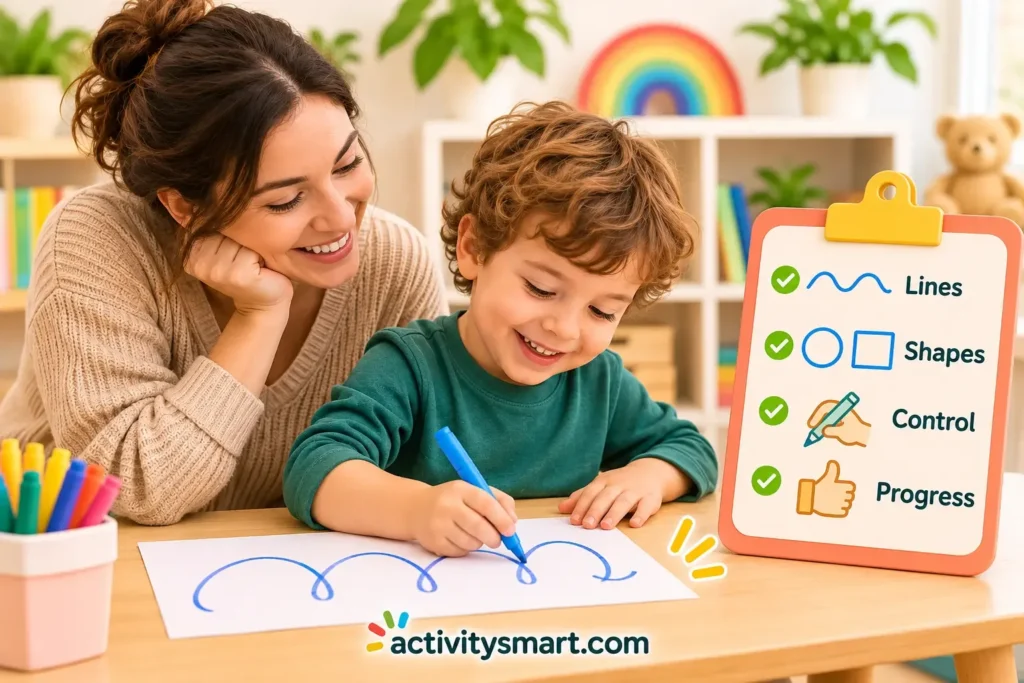
A drawing portfolio should include spontaneous work, not just adult-directed copies. Ask the child to select a favorite piece and explain it. For educators, a brief note such as “drew a curved road after moving a toy car along one” is more informative than a score of good or bad. Revisit activities after several weeks without treating change as a guaranteed linear progression.
When to seek extra support
If a child experiences persistent pain, marked frustration, loss of previously acquired abilities or difficulties affecting many daily tasks, speak with a pediatrician or another appropriately qualified professional. Teachers can share concrete observations with families and discuss whether an occupational therapy assessment or developmental screening may be appropriate. Do not infer a diagnosis from pencil grip or one drawing sample.
The CDC three-year developmental milestones encourages families with developmental concerns to discuss milestones and screening with a healthcare professional. Age-based checklists are conversation starters, not substitutes for individual assessment. Children learning with disabilities may follow different pathways and still participate meaningfully in drawing and writing.
When to introduce letters and name writing
Introduce meaningful letters when a child is curious, while continuing playful lines and shapes. Their own name, a pet’s name or a sign for a pretend shop offers a clear purpose. Model one letter at a time on your own paper and invite a try without demanding an exact copy. Let a child make letter-like symbols alongside conventional letters.
For a next step, use helping children write their names when the child asks to write a name. alphabet practice options can offer additional letter recognition or practice, but a page of letter forms should not replace drawing, talk and imaginative play. Letter formation and spelling require instruction over time; they do not emerge automatically from tracing shapes alone.
Some children are ready for explicit handwriting teaching during school years and still enjoy big movement games. Others benefit from extra time exploring tools. Coordinate expectations with the child’s teacher and adjust for local curriculum, language and individual needs. The goal is meaningful, accessible participation in writing, not an arbitrary date for perfect penmanship.
Final guidance: build a bridge from play to purposeful marks
Begin with what the child already likes, whether that is toy roads, pretend menus, painting or drawing characters. Add a small challenge, then return control to the child. A broad line can become a path, a circle can become a face, and a scribble can become a message. That combination of movement and meaning is the heart of early writing preparation.
Use the examples as adaptable teaching ideas, not a promise of faster handwriting. Children benefit from varied opportunities and supportive adults, while individual development differs. Keep materials safe, offer genuine choices and seek professional advice when persistent difficulties affect comfort or everyday participation.
Sources and further reading
- CDC three-year developmental milestones
- NAEYC writing-through-play suggestions
- Reading Rockets early writing activities
- NAEYC fine motor play guidance
Frequently asked questions
What are pre writing skills?
Pre writing skills are early movement, coordination, visual and mark-making abilities that support later letter formation. They include scribbling, drawing lines and shapes, steadying paper and using marks to communicate.
What should a child practice before writing letters?
A child can explore free drawing, broad lines, curves, simple shapes and meaningful pretend writing before formal letter practice. There is no single checklist that every child must complete first.
At what age should pre writing activities begin?
Pre writing activities can begin whenever a child safely shows interest in age-appropriate mark making, often during the toddler and preschool years. Choose materials and expectations according to the individual child rather than a fixed birthday.
Are tracing worksheets necessary for preschoolers?
No, tracing worksheets are not necessary for preschoolers to explore early writing. Large drawing surfaces, chalk, painting and pretend lists also provide opportunities to practice movements and communication.
Is scribbling a useful stage of learning to write?
Yes, scribbling is a meaningful early form of mark making and can help children explore how marks represent ideas. Adults can ask about a child’s drawing and model writing without insisting on recognizable letters.
Should I correct my child’s pencil grip?
Not every unusual pencil grip needs correction. Prioritize comfort, control and participation; if grip causes pain, fatigue or significant difficulty, discuss observations with an appropriate professional.
What if my child cannot draw a circle yet?
If your child cannot draw a circle yet, offer playful demonstrations and chances to make broad curved marks without pressure. Development varies; discuss persistent concerns or other difficulties with a pediatrician.
How long should a pre writing session last?
A pre writing session can be just a few enjoyable minutes and should end or change when the child becomes tired or distressed. There is no universal required duration for these play activities.
When should we start practicing name writing?
Start practicing name writing when a child shows interest and can engage comfortably with the activity. Model a meaningful letter or invite a signature made of marks while continuing free drawing and pretend writing.