Quick Answer
Teach picture book reading comprehension by reading aloud, discussing illustrations, modeling how to notice clues, and inviting children to explain what happened and why. Before reading, preview the cover; during reading, pause for a few meaningful questions; afterward, retell the beginning, middle, and end. Keep conversation responsive rather than turning story time into a quiz.
Quick Picks
- For ages 3–4: point, name, predict, and act out one event.
- For ages 5–6: connect clues to feelings and retell three events.
- For ages 7–10: explain evidence, compare perspectives, and summarize a theme.
- For any age: prioritize enjoyable discussion over a fixed question count.
Picture book reading comprehension means making sense of a story, not merely identifying the objects in its pictures. A child can understand a sophisticated read-aloud before being able to decode its printed words independently. Everyday books make excellent discussion partners because pictures, dialogue, and events offer several ways to explore meaning.
A useful starting routine is simple: look together, read together, talk together, and revisit one idea. The goal is to notice how children think, then offer just enough support for the next step. This guide gives age-sensitive prompts, a realistic reading sequence, a comparison of approaches, and ways to check understanding without pressure.
What picture book reading comprehension actually involves
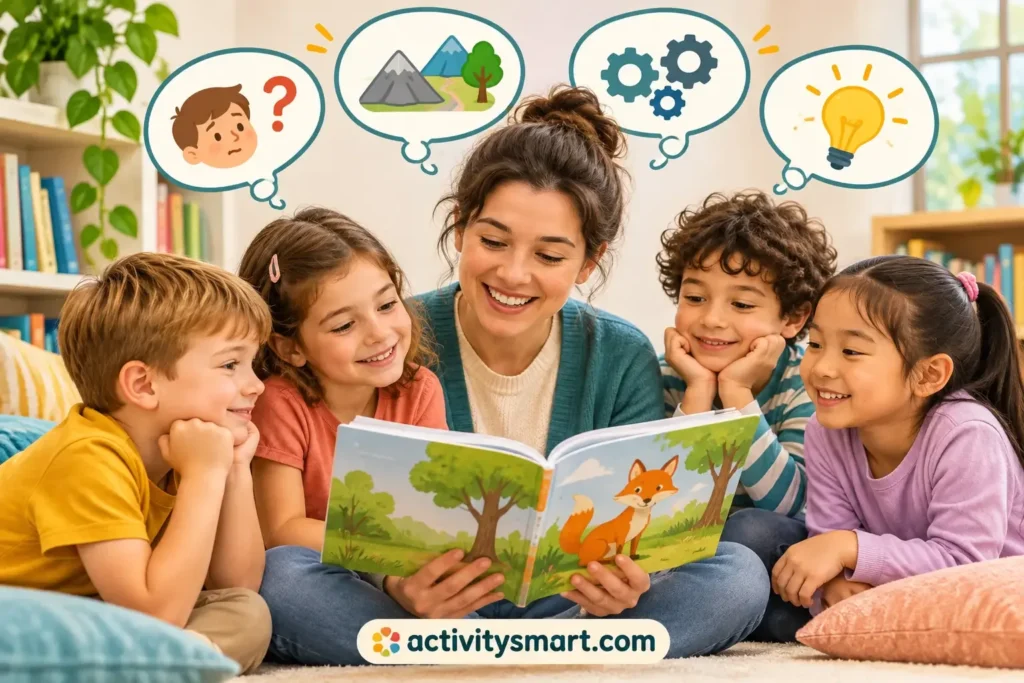
Comprehension combines several related processes. Children follow who is doing what, connect events across pages, understand words in context, infer feelings or motives, and recognize when something no longer makes sense. Pictures can provide evidence, but illustrations sometimes add information that the words never state directly.
Listening comprehension and independent reading comprehension overlap without being identical. When an adult reads aloud, the child can devote more attention to meaning because the adult handles decoding. Once children read for themselves, word recognition and fluency also affect how much meaning they can construct. The US Institute of Education Sciences emphasizes both language knowledge and reading connected text in its foundational reading practice guide.
Understand the story, not just the vocabulary
A child who correctly names a bicycle, a dog, and a bridge may still miss why the dog refuses to cross. Ask what changed between two pictures and what the character wants. This moves discussion from labeling to relationships, causes, and consequences. If the child struggles, point to the relevant pages and model a short explanation before asking again.
Use pictures as evidence, not as answer keys
A frown can suggest disappointment, but context matters: the character may also be worried or tired. Say, “I think she is worried because her hands are shaking and she is looking at the storm. What do you notice?” This demonstrates that a good inference is a reasoned possibility supported by clues, not mind reading.
Choose a picture book that invites real conversation
Choose books with a recognizable sequence, clear but interesting illustrations, and at least one moment worth wondering about. Repetition and predictable patterns are useful for younger listeners; layered motivations and ambiguous endings invite older children to think. A book need not be new, expensive, award-winning, or labeled educational to work well.
Preview the story yourself when possible. Notice one unfamiliar word, a turning point, and a page that reveals a character’s emotion. These three anchors are enough to plan a thoughtful reading. For a mixed-age group, choose a story everyone can follow while offering optional deeper questions to children ready for them.
Fiction, informational books, and wordless stories
Narrative books lend themselves to character, setting, problem, sequence, and resolution. Informational picture books invite questions about how facts connect, what diagrams show, and which claims the page actually supports. Wordless books can be especially inviting because children must describe visual evidence and build a coherent account without relying on a printed narrator.
Match challenge to the child without lowering expectations
A child should understand enough of the story to participate while still encountering something worth figuring out. If nearly every page requires an explanation, choose a more familiar story or provide a short introduction to its setting. If every answer is immediate, deepen the conversation with an inference or comparison rather than simply selecting a harder book.
A repeatable picture book reading comprehension routine
Before reading: connect and predict
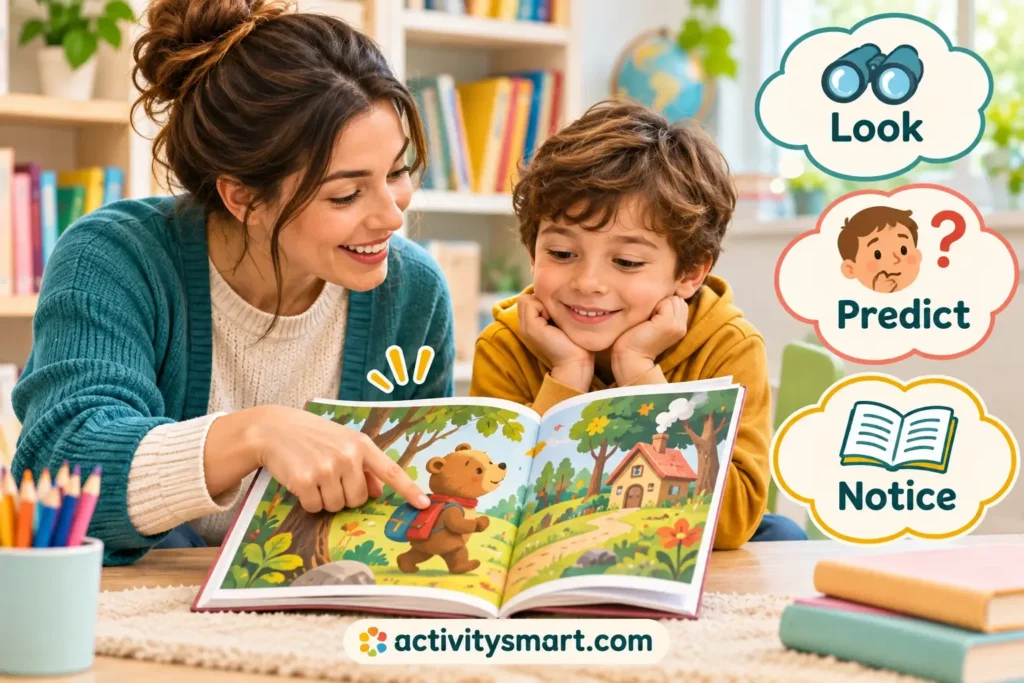
Show the cover and read the title. Invite one observation: “What do you notice?” Then ask one tentative prediction: “What might this character need?” Explain that predictions are ideas we revise when we find new clues. If the setting is unfamiliar, briefly explain one relevant detail so the child can follow the events.
During reading: model thinking, then listen
Read with expression and allow children to enjoy the language. At one meaningful turning point, pause and think aloud: “He promised to help, but now he is walking away. I wonder why.” Ask a question that has more than a one-word answer, and wait long enough for a response. A child may need time to study the picture before speaking.
If the child says, “He is scared,” respond with curiosity: “What makes you think that?” Accept a reasonable alternative supported by the story. When a response does not fit, return to the evidence gently: “Let’s look at the page before this one.” This teaches checking an idea against the text and illustration.
The Reading Rockets PEER approach suggests prompting, responding to what the child says, expanding their language, and revisiting the prompt. It is a flexible conversation tool, not a script that must be performed on every page.
After reading: retell and reflect
Close the book briefly and ask, “What happened first? What changed? How did it end?” Younger children may point to three illustrations instead of producing full sentences. Older children can explain how the ending relates to the initial problem. Reopen the book to check missing steps and celebrate revisions as careful reading.
Finish with one question that invites interpretation: “Would the story have changed if the friend had spoken sooner?” A child does not need to produce a moral lesson. Sometimes the most worthwhile ending is simply talking about a favorite scene and wanting to hear the book again.
A sample ten-minute shared reading
- Minute 1: choose a book, notice the cover, and make one prediction.
- Minutes 2–7: read mostly without interruption, pausing at one or two important moments.
- Minutes 8–9: revisit a picture and ask for a reason or a sequence of events.
- Minute 10: invite a favorite part, an unanswered question, or a playful retelling.
Questions that help children think more deeply
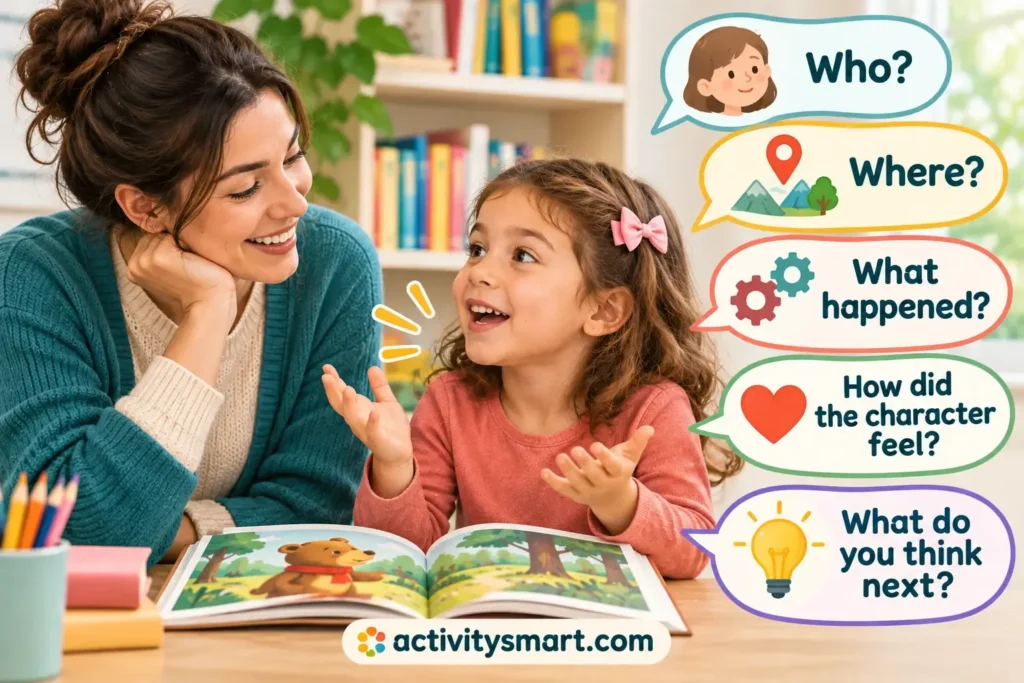
Effective questions serve different purposes. Some locate information, some invite a prediction, and others ask children to connect clues. Start with a question the child can enter confidently, then build toward explanation. The What Works Clearinghouse comprehension guidance recommends teaching readers to use prior knowledge, ask questions, make inferences, monitor understanding, and summarize ideas.
| Purpose | Example prompt | Listen for |
|---|---|---|
| Recall | What did the rabbit lose? | An event or detail from the story |
| Sequence | What happened after the gate opened? | Events in a sensible order |
| Inference | Why might the rabbit hide? | A reason supported by clues |
| Prediction | What might happen next, and why? | A plausible idea that can change |
| Vocabulary | What does “hesitated” seem to mean here? | Meaning inferred from context |
| Reflection | Which choice would you make? | A personal view distinguished from story facts |
Do not ask every question in the table during one reading. Pick a purpose that matches the page and the child’s needs. Recall questions are not inferior; they establish shared understanding. But a session consisting only of “What color?” and “Who is that?” misses opportunities to discuss why events matter.
Use a gentle follow-up rather than repeating the question
When a child gives a short answer, add language without replacing their idea. If they say, “Wet,” you might reply, “Yes, the fox looks wet because the rain started before he reached home.” Then invite them to point to the rain. This is especially useful when children understand more than they can express verbally.
Adapt the same book for ages three through ten
Ages three to four: notice, name, and connect
Use short, concrete prompts and gestures. Invite children to find a character, imitate an action, or point to a change between pages. Retell with two or three pictures, using adult language as a model. Children may participate through movement, single words, home-language responses, or pointing rather than full spoken explanations.
Do not expect every child in this age range to explain motives or track a complex plot. A simple response such as pointing to the character who needs help can demonstrate attention to meaning. Repeated books and playful voices may make conversation more accessible than unfamiliar vocabulary-heavy stories.
Ages five to six: connect events and explain simple reasons
Ask about the story problem, a character’s goal, and how one event caused another. Encourage a beginning-middle-end retelling, but support missing steps by showing relevant illustrations. Introduce useful words such as “because,” “before,” “after,” and “instead” in natural conversation.
Some children this age are beginning to decode independently; others are still developing letter-sound knowledge. Continue rich read-alouds regardless of decoding level. For complementary print skills, ActivitySmart’s guide to teaching letter sounds and explanation of phonemic awareness and phonics address distinct foundations of learning to read.
Ages seven to ten: infer, compare, and justify
Invite children to explain a change in perspective, identify a theme with evidence, or compare how the author and illustrator communicate information. Ask whether a character’s decision was reasonable based on what the character knew at that moment. Encourage more than one defensible interpretation when the story supports it.
Make retelling active without turning it into a test
Retelling is useful because it reveals how children connect events. It is not the same as memorizing every page. Listen for a meaningful sequence, a problem, and a change or resolution. For a simple story, three picture cards or sketches may be enough. For a complex one, children might draw a cause-and-effect chain.
Try placing three sheets labeled “beginning,” “middle,” and “end” on the table. Ask the child to draw one scene on each or choose a matching illustration from the book. Talk through the transitions: “How did the middle problem lead to that ending?” Keep the original book available so the child can verify details.
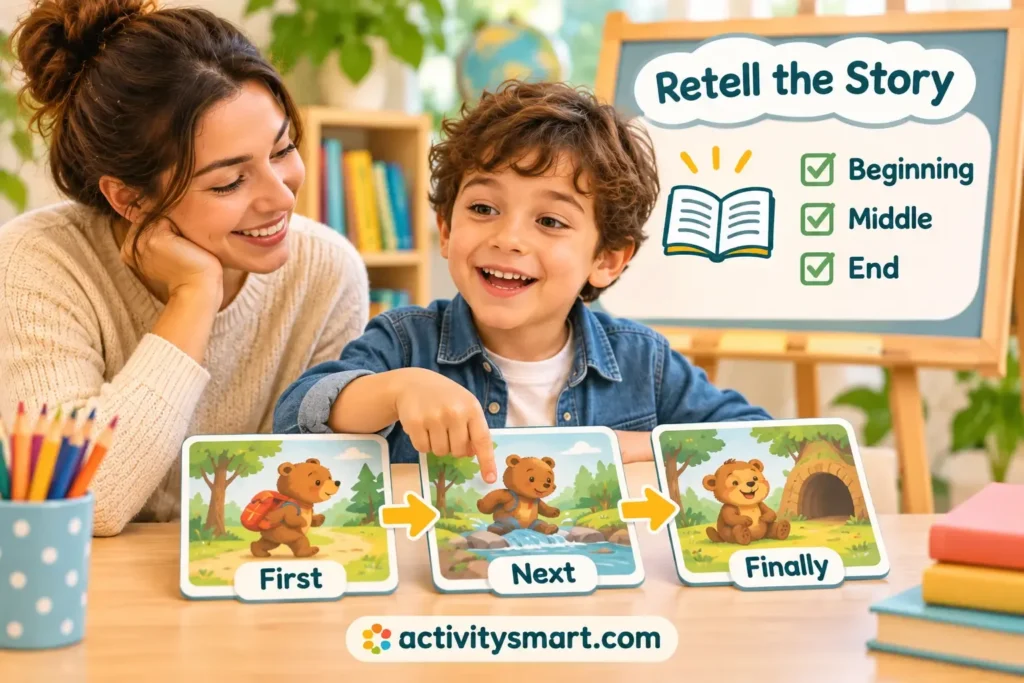
Act it out with simple, safe materials
Use hand gestures, paper character drawings, or a few large classroom props to reenact a turning point. Ask children to explain what their character wants and what happens next. Dramatic play is an optional way to express understanding, not proof that a child has mastered reading comprehension.
Avoid small detachable props for children who may put objects in their mouths, and keep movement activities appropriate to the space. For children who dislike performing, offer drawing, pointing, or quietly telling the story to one adult instead.
Use drawing as a bridge to explanation
A drawing becomes a comprehension activity when the child explains its connection to the story. Ask, “Which moment did you choose?” and “What happened just before it?” Artistic skill is irrelevant. A child may draw a stick figure and still give a thoughtful explanation of the character’s decision.
Compare approaches: conversation, worksheets, and independent reading
Different formats can serve different goals, but they should not be treated as interchangeable. The strongest choice depends on whether the learner needs adult language modeling, a record of understanding, decoding practice, or an opportunity to read alone. The Education Endowment Foundation describes explicit comprehension strategy instruction and gradual movement toward independence in its reading comprehension evidence summary.
| Approach | Useful for | Main limitation |
|---|---|---|
| Interactive read-aloud | Oral language, inference, shared reasoning | Adult support can mask independent difficulties |
| Retelling or drawing | Sequence and story structure | Expression skills can affect performance |
| Written question sheet | Recording selected responses | Writing demands may obscure comprehension |
| Independent reading | Applying comprehension while decoding text | Word-reading difficulty may reduce understanding |
A child who answers orally but not in writing may need writing support rather than another comprehension lecture. Conversely, a child who reads words accurately without understanding may benefit from explicit vocabulary and meaning-making work. Observations across formats are more informative than one score.
Common mistakes and how to correct them
Asking a question after every page
Constant interruptions can fragment the plot and make listening feel like an examination. Choose one or two purposeful pauses for a short book. On a first reading, you may simply enjoy the story and save deeper discussion for a reread. Watch whether the child is still following the narrative rather than counting prompts.
Treating every inference as having one correct answer
A character’s feelings may be open to interpretation. Ask for clues and explain when a claim conflicts with the text. This protects both creativity and accuracy. “What makes you think so?” is usually more revealing than “Are you sure?” because it invites reasoning rather than a guess at the adult’s preferred answer.
Correcting language before acknowledging meaning
If a child says, “Him run because scared,” respond first to the idea: “Yes, he ran because he was scared.” Recasting the sentence offers a language model without interrupting comprehension. When a specific vocabulary word matters, explain it briefly and return to the story.
Assuming an attractive worksheet measures comprehension
Matching pictures or coloring a character can be enjoyable, but these activities alone rarely show whether the child understood the plot or an inference. Ask for a spoken explanation or an evidence-based choice. For independent word-reading practice, resources such as CVC word worksheets have a different purpose from understanding a read-aloud.
Supporting multilingual learners and children who need accommodations
Invite children to think and respond in a language they know well when practical. A bilingual retelling can reveal understanding that an English-only response might hide. Pair speech with pointing, visuals, gestures, or choices between two pictures. Teach a few essential words before reading, then use those words meaningfully in context.
For children with speech or language differences, allow extra response time and accept alternative communication methods. For children with attention or sensory needs, offer predictable routines, a quieter reading spot, movement breaks, or a smaller group. Do not assume that limited eye contact or a brief verbal answer means the story was not understood.
A child who consistently struggles to follow familiar stories despite accessible language and appropriate support may benefit from discussion with their teacher and, when indicated, a qualified speech-language or reading specialist. One book conversation is not a diagnostic assessment. Also consider hearing, vision, and language-access needs rather than attributing every difficulty to motivation.
Check progress through observation, not pressure
Keep a brief note after an occasional session: the book, the kind of prompt, the child’s response, and what support helped. Look for changes over time, such as moving from labeling a scene to explaining why an event happened. A single quiet day is not a setback. Engagement, familiarity, fatigue, and language demands can all influence responses.
Try asking the same kind of question across different books, not repeating the identical question until it is memorized. Gradually reduce prompts: first model a reason, next ask for one clue, and later invite the child to explain independently. This reflects the broader principle of explicit modeling followed by guided and independent practice.
A practical plan for home and classroom
At home: a flexible weekly rhythm
Choose a familiar book on one day and explore its pictures; reread it later with a focus on a character’s problem. On another day, try a wordless book or a short informational title. Let the child occasionally lead by asking you a question. The pattern matters more than a rigid schedule, and an enjoyable shared reading is worthwhile even when no formal prompt is used.
In a classroom: model, pair, and revisit
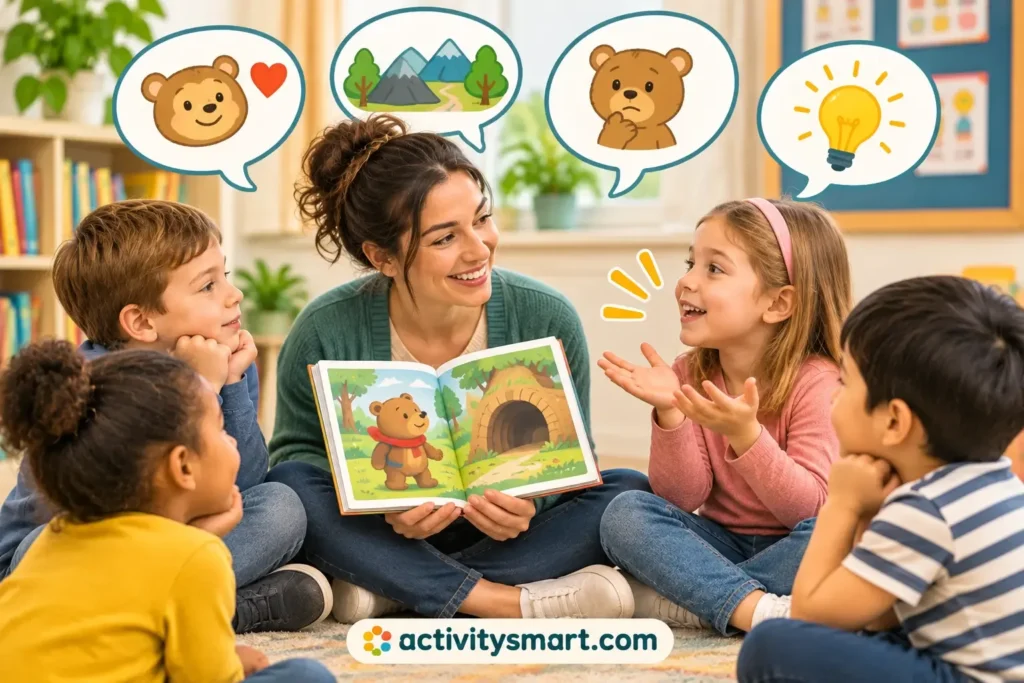
Read one page aloud and demonstrate a think-aloud that names the clue and the conclusion. Invite partners to discuss a second page, then ask several children to share different supported interpretations. Return to the text to resolve uncertainty. Use the same story again to examine sequence or vocabulary, rather than introducing a new skill on every page.
When children need help participating, offer sentence starters such as “I think ___ because ___” and “The picture shows ___.” Remove the starters as children gain confidence. For a child frustrated by a task, the approaches in helping a child with learning frustration can complement a calmer, lower-pressure reading routine.
Safety, balance, and realistic expectations
Shared reading should be emotionally safe and enjoyable. Avoid using story questions as punishment, insisting on disclosure about personal experiences, or treating an imaginative interpretation as misbehavior. If a story includes frightening events or themes that may be sensitive for a child, preview it and offer another choice. Respect a child who prefers not to act out a scene.
Picture-book discussion develops opportunities to practice language and meaning-making; it does not replace systematic instruction in decoding for children learning to read. The IES guidance recommends sound-letter connections, decoding, and reading connected text alongside language development. When a child has persistent reading difficulties, individualized assessment can clarify which components need support.
Final recommendation: keep the book at the center
The most useful routine is not the one with the most questions. It is the one in which children listen, notice, explain, revise ideas, and want to return to stories. Begin with one accessible book, one thoughtful pause, and one retelling opportunity. As the child becomes more independent, ask for clearer reasons and let the child choose which clues matter.
Sources and further reading
- Education Endowment Foundation: Reading comprehension strategies — explicit teaching, modeling, and independent application.
- Institute of Education Sciences: Foundational Skills to Support Reading for Understanding — language, decoding, and connected-text recommendations.
- What Works Clearinghouse: Early Reading Comprehension Tips — questions, inference, summarizing, and engagement.
- Reading Rockets: Use a PEER When You Read Aloud — responsive conversational reading prompts.
Frequently asked questions
Can picture books teach comprehension before a child can read words?
Yes. An adult read-aloud lets children practice understanding events, vocabulary, and motives before they can decode print independently. Continue teaching word-reading skills separately as appropriate.
How many questions should I ask during one picture book?
There is no required number of questions. For a short story, one or two meaningful pauses often preserve the narrative better than questioning on every page; follow the child’s engagement.
What is the best question to ask after reading?
A useful starting question is “What changed from the beginning to the end?” It invites children to connect events; follow with “What in the book shows that?” when they are ready.
Do wordless picture books count as reading comprehension practice?
Yes. Wordless picture books can support narrative understanding, sequencing, and inference through visual clues. They do not, by themselves, teach children to decode written words.
What if a child gives the wrong answer to a story question?
Return to the relevant page and look for evidence together. Model one clue, invite a revised idea, and distinguish plausible interpretations from details that contradict the story.
Should a preschooler retell the whole story?
No. A preschooler can begin by pointing to or describing two or three important events. Adults can model connecting words and gradually invite a fuller sequence.
Can I use the same picture book more than once?
Yes. Repeated readings can make the story familiar enough to discuss new details, vocabulary, and character choices. Vary the conversation rather than demanding identical answers.
How is reading comprehension different from phonics?
Reading comprehension is constructing meaning from language and text, while phonics teaches relationships between letters and sounds for reading words. Children learning to read need support with both.
What if a child understands aloud but struggles with worksheets?
Use an oral retelling or picture-based explanation to explore what the child understands. Writing, attention, and question format may affect worksheet performance independently of story comprehension.
When should I ask for professional support?
Seek guidance from the child’s teacher or a qualified specialist when difficulties understanding familiar stories persist despite appropriate language access and support. One activity cannot diagnose a reading or language disorder.