
Quick Answer
To reduce homework frustration, pause when your child becomes overwhelmed, acknowledge the difficulty, and identify the smallest manageable next step. Check whether the obstacle is understanding, writing, organization, or tiredness. Offer limited help without completing the work, and involve the teacher when distress or excessive homework time keeps recurring.
A child who tears up a worksheet or says “I am stupid” needs more than another reminder to concentrate. Your immediate job is to make the situation manageable and understand what has gone wrong. Finishing the page matters less than discovering why an ordinary assignment has become so difficult.
This guide is for parents and teachers supporting children roughly ages 3–10, with most formal homework examples aimed at school-age children. The suggested scripts and routines are practical options, not a tested treatment program or a timetable every child should follow.

Quick Picks: choose the response that fits tonight
- Already crying or shouting: pause instruction, reduce demands, and offer calm company before discussing the task.
- Unable to explain the directions: clarify one instruction or request a classroom example.
- Understands aloud but struggles on paper: investigate the writing demand and ask which alternative responses the teacher permits.
- Stuck before starting: put out one material and identify one concrete action.
- The same struggle keeps returning: record the pattern and arrange a teacher conversation.
Understand the obstacle before choosing a solution
Homework frustration describes a response, not a diagnosis. The same outward behavior can follow a confusing question, fear of making mistakes, a missing book, or an exhausting day. Avoid deciding that a child is lazy because the difficulty happens at home rather than in class.
When everyone is calm, ask, “Which part gets difficult first?” Offer choices if the question feels too broad: reading the directions, knowing the answer, writing it, or getting started. You are looking for something observable that you and the teacher can investigate, rather than a label for the child.
Check the actual assignment together. A child might know how to add but not understand what “show your thinking” means. Another might understand a story when listening but struggle to read the assigned passage independently. These situations need different support; repeating “try harder” does not clarify either demand.
| What you notice | What to check | A useful first response |
|---|---|---|
| Stops at the directions | Vocabulary, reading demand, missing example | Ask the child to explain the task; clarify one instruction |
| Answers aloud but avoids writing | Hand discomfort, spelling load, amount of copying | Separate knowledge from written production with the teacher |
| Repeatedly erases correct work | Fear of errors or unclear quality expectations | Agree what a sufficient attempt looks like |
| Cannot find materials or begin | Assignment recording and starting sequence | Use a short visible checklist |
| Becomes upset late in the evening | Schedule, hunger, fatigue, competing demands | Review the timing and workload rather than extending bedtime |
These are starting hypotheses, not explanations to impose on your child. Ask what they notice and compare it with classroom observations. Several barriers can occur together, and an adjustment that helps one assignment may not help another.
Respond to homework frustration in the moment
Pause the lesson and acknowledge the feeling
When your child is too upset to respond to an ordinary question, stop explaining the worksheet. Lower your voice and use a short observation: “This feels really hard right now.” You can acknowledge the feeling without agreeing that the child is incapable or that the teacher is unfair.
Offer a simple choice such as sitting nearby or taking a quiet pause together. Avoid turning calming into another performance requirement. A child does not have to complete a breathing exercise, explain every feeling, or apologize before receiving appropriate support.
Keep everyone safe if objects are being thrown or someone is being hit. Move unsafe materials away when you can do so safely, give space, and seek another adult’s assistance when needed. Do not physically force a child to remain at the table for an assignment.
Return through one small action
Once your child can engage again, ask whether they are ready to look at one part. A possible restart is pointing to the first question, finding the example, or telling you what the instructions mean. “Finish your homework” is a much larger demand than “Show me where you got stuck.”
If that small step is still inaccessible, stop cycling through the same explanation. Mark the sticking point and contact the teacher. A pause is useful when it creates a better return; repeatedly restarting an impossible task without changing the support simply recreates the problem.

Build an after-school routine that fits your family
Choose a workable starting point
Some children prefer a break before homework; others find it easier to begin while the school day still feels present. Choose a predictable point that works with meals, transport, siblings, and adult availability. Treat the first arrangement as something to review, rather than a rule that proves the child’s motivation.
The American Academy of Pediatrics’ back-to-school guidance for families recommends a consistent workspace, fewer electronic distractions, and periodic breaks. Use those principles flexibly: a cleared corner of the kitchen table can be more realistic than a separate study room.
Prepare only the materials needed for the current task. If another child needs attention, name when you can help instead of promising constant availability. An older child might begin a familiar item while you support a sibling, with the difficult question saved for your agreed check-in.
Make device transitions predictable
Decide in advance whether a device is needed for the assignment. If it is, open the required page and remove avoidable notifications. If stopping entertainment is the main flashpoint, use a clear transition cue before homework rather than negotiating a new screen rule during every disagreement.
For a separate family discussion, ActivitySmart’s guide to setting screen time boundaries for kids explores that wider routine. A homework session is a poor moment to redesign every household rule at once. Change the barrier that is interfering with learning today.
Break the work into parts without doing it yourself
Define an achievable unit of work
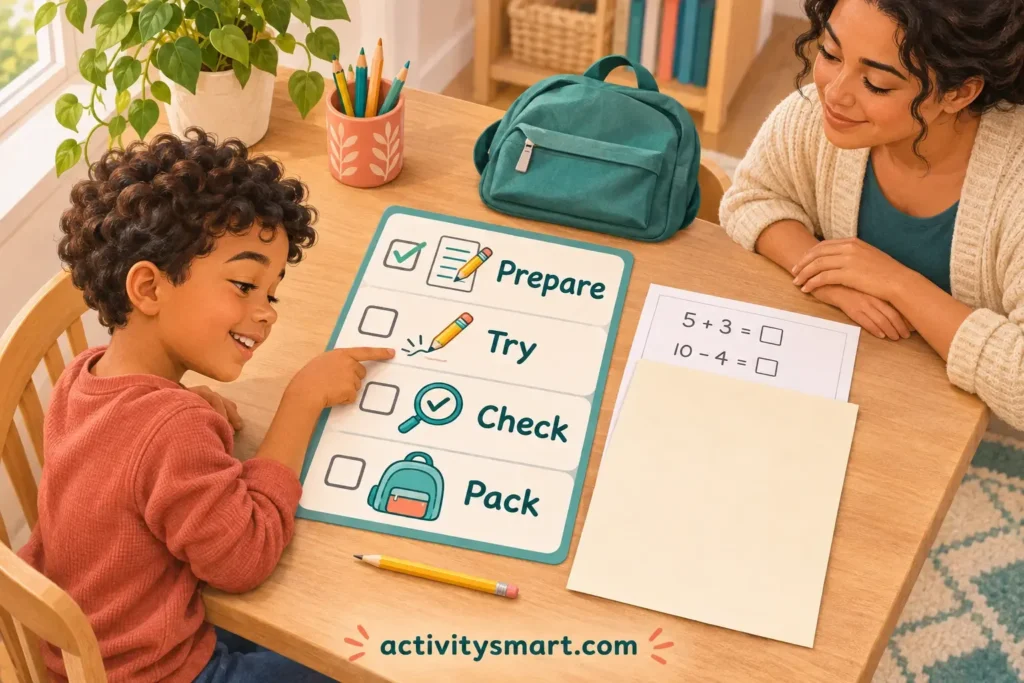
Read the assignment together and separate its components: understand the directions, attempt a small section, check the required feature, and pack the result. Covering the rest of a crowded page with plain paper may make the current section easier to locate. Keep the original assignment intact so nothing disappears accidentally.
A short work period or a few questions can be a trial starting point, chosen around the actual task. These are not evidence-based age limits. Tell your child what will happen next: “We will try these two questions, then see whether you need a pause or a different explanation.”
A timer can make a boundary visible, but it can also create pressure. If your child watches it anxiously or rushes to beat it, use a task-based checkpoint instead. Success means a more workable learning process, not tolerating a particular number of minutes.
Give help that leaves thinking with the child
Try a sequence of support: ask what the child already knows, point to a relevant classroom example, and demonstrate a similar problem if needed. Then invite the child to attempt the assigned item. Wait long enough for a response instead of immediately filling the silence with hints.
For example, if the task is adding two groups, you might model a different pair with large, age-appropriate objects or drawings. Ask the teacher which representation matches classroom instruction. Avoid introducing several competing methods while the child is already confused.
Notice when your prompts have become a script the child merely repeats. If you choose every word and dictate every answer, the finished page no longer shows independent understanding. Send an honest account of the assistance rather than presenting adult-supported work as unaided performance.
Match the support to reading, writing, or organization
When reading hides the real task
Clarify whether the assignment is assessing reading itself or another subject. Reading a math instruction aloud may help reveal mathematical understanding, but reading an entire passage for a reading assessment changes the task. Ask the teacher what assistance is appropriate and record any substantial help you give.
For early literacy questions, the difference between phonemic awareness and phonics can help you describe whether the difficulty involves spoken sounds or printed words. That distinction gives a teacher more useful information than saying that all reading homework is impossible.
If the teacher identifies letter-sound practice as the next step, use ActivitySmart’s letter-sound teaching guide to prepare questions about suitable practice. Do not add a second full lesson after a distressing homework session. Agree which skill matters most and keep extra practice separate from the immediate conflict.
When writing becomes the bottleneck
Ask whether the child knows what they want to say but cannot comfortably get it onto the page. Note complaints of pain, repeated hand shaking, excessive copying, or a large difference between spoken and written answers. These observations deserve discussion; they do not identify a particular condition.
Our guide to pencil grip and comfortable hand control offers a starting point for observing the writing process. Avoid forcing a particular grip or requiring extra copying as a consequence. Persistent pain should be discussed with a qualified health professional.
Ask whether the learning goal permits fewer copied questions, an oral response, typing, or adult transcription. These are possibilities to agree with school, not automatic replacements for every assignment. If writing is the skill being taught, the teacher may choose a shorter, supported writing task instead.
For younger children, playful fine motor activities can provide a separate context for using hands. Such play is not a diagnosis, a guaranteed handwriting intervention, or a reason to postpone help when writing remains painful or unusually difficult.
When the task disappears between school and home
Check the full chain: recording the assignment, bringing materials home, beginning, finishing, packing, and handing it in. A child can complete the learning task yet still struggle with this sequence. Choose one weak link to support instead of creating a complicated reward chart for the entire evening.
A picture reminder may suit a younger child; an older child may prefer a written checklist. Agree where completed work goes and when the bag gets packed. If instructions are repeatedly missing, ask school for a reliable way to confirm assignments rather than making the child reconstruct them from memory.
Adjust expectations across ages and learning needs
For preschool children, do not assume that long seated worksheets are necessary preparation for school. If a setting sends home activities, ask about their purpose and whether shared reading, conversation, or play can meet it. Keep the focus on a suitable experience, rather than comparing a three-year-old with an older sibling.
In the early school years, an adult may need to help interpret directions and organize materials. As children become more familiar with assignments, gradually hand over one part of the process. Age is only one consideration: familiarity, language, disability, and the task itself also affect the support required.
Multilingual families can discuss ideas in the language they use most comfortably, while checking what the school expects for the submitted response. Ask for translated directions or an example if needed. Difficulty interpreting an unfamiliar instruction is not evidence that a family is insufficiently interested in education.
If a child already has a support plan, check how it applies to home assignments. Ask which classroom tools should travel home and who can resolve inaccessible digital tasks. Do not remove established accommodations to make homework look more independent.
Encourage persistence without making mistakes feel dangerous
Use specific feedback about an action: “You noticed the instruction you missed,” or “You asked for an example before guessing.” This tells the child what was useful. General praise for intelligence offers less information about how to approach the next difficulty.
For a child who repeatedly erases, agree on a limited review tied to the assignment’s purpose. If the teacher is checking punctuation, review punctuation rather than rewriting every sentence for style. Ask whether a visible correction is acceptable so neatness does not quietly replace the intended learning goal.
Small, agreed incentives may help with a specific routine, such as bringing the reading book home. Their advantage is clarity; their limitation is that a reward cannot explain unfamiliar content or remove pain. Avoid making food, sleep, affection, or needed support conditional on perfect work or the absence of tears.
Know when to stop and contact the teacher
Stop pressing ahead when distress is escalating, the child cannot access the task despite reasonable clarification, or continuing would regularly displace sleep and essential family needs. Record what was attempted and where help was required. Discuss an agreed stopping procedure with the teacher before the next difficult evening.
Do not treat a grade-based minutes rule as a universal prescription. Ask how long this particular assignment is expected to take, what counts as sufficient effort, and what to return when it is unfinished. Time spent includes interruptions and adult prompting, so explain what your timing represents.
The EEF’s review of homework evidence reports smaller average effects in primary than secondary education and rates the evidence as limited. It emphasizes task quality, classroom connections, and feedback. Those findings do not justify unlimited homework or promise a particular outcome for an individual child.
A useful message might say: “We worked on the first section for about 15 minutes. My child answered orally but needed me to write each response. We paused when they became very upset. Is independent writing the goal, and what adjustment should we use tomorrow?” This is a sample communication, not a recommended time limit.
Ask for the next concrete decision: a worked example, fewer practice items, a different format, targeted instruction, or access to a school homework club. Agree when to review the change. Keep the child involved in age-appropriate ways so the plan feels like support rather than a meeting about their failures.

Recognize when broader support is needed
Seek school support when distress recurs, a particular skill remains inaccessible, or homework requires much more adult help than expected. Contact a health professional for persistent pain, vision concerns, significant anxiety, or other health changes. You do not need to identify a diagnosis before asking for assistance.
Nemours KidsHealth’s guidance on school struggles recommends talking with teachers and a health care provider to explore learning, organizational, emotional, and physical concerns. Formal assessment or support arrangements depend on the child’s needs and local education system.
Keep a brief record of the task, the first sticking point, assistance given, and what helped. Include strengths, such as understanding an explanation aloud or persisting with a familiar activity. A balanced record helps adults plan support without reducing the child to difficult evenings.
Common mistakes and a practical way forward
- Explaining more while distress rises: pause first, then identify a smaller entry point.
- Correcting every error immediately: check the teacher’s purpose and let unfinished understanding remain visible.
- Adding worksheets as punishment: address the barrier instead of increasing the same demand.
- Changing everything each night: try one manageable adjustment and review its effect.
- Comparing siblings: describe this child’s task and needs without ranking children.
The practical verdict is to protect the relationship while making learning difficulties visible. Tonight, choose one helpful change. Across the next few assignments, notice whether starting, understanding, or recovery improves. If it does not, take that information back to school rather than escalating pressure at home.
Frequently asked questions
Why does my child get frustrated with homework?
Your child may be frustrated because of confusing instructions, a difficult skill, writing demands, organizational problems, tiredness, or worry about mistakes. Ask where the difficulty starts and compare observations with the teacher rather than assuming a single cause.
What should I do when my child cries over homework?
Pause the assignment, acknowledge the distress, and offer calm support before trying a smaller step. If the child remains overwhelmed, record the sticking point and ask the teacher how to proceed instead of forcing repeated attempts.
Should I do difficult homework for my child?
No; help the child understand the task without completing the assigned thinking for them. Use a similar example or clarify directions, and tell the teacher when substantial adult help was necessary.
How long should a child spend on homework?
The appropriate time depends on the assignment, the child’s needs, and the school’s expectations, rather than one universal age-based limit. Ask the teacher for an expected duration and an agreed stopping procedure when work becomes excessive or distressing.
Are homework breaks a bad habit?
No; planned breaks can be part of a supportive homework routine. Agree on a manageable checkpoint and a clear return step, then adjust if the break or timer adds stress rather than helping.
Should I punish my child for refusing homework?
Punishment should not replace finding out why the child cannot or will not engage with the task. Set calm expectations, investigate the obstacle, and work with the teacher when refusal is persistent; avoid extra homework as a penalty.
What if my child knows the answer but cannot write it?
Ask the teacher to separate understanding from the demands of handwriting, spelling, and copying. Discuss permitted response options and seek professional advice for persistent pain or substantial writing difficulties.
Does homework frustration mean my child has ADHD or dyslexia?
No; homework frustration alone does not establish ADHD, dyslexia, or any other diagnosis. Persistent difficulties across tasks or settings warrant discussion with school staff and an appropriately qualified professional.
When should I talk to the teacher about homework?
Talk to the teacher when distress recurs, instructions remain unclear, work takes much longer than expected, or regular adult assistance is needed. Bring a specific example and ask for one practical adjustment and a review date.
Sources and further reading
The recommendations above combine general educational guidance with adaptable household examples. They are not a diagnosis or a guarantee of improved grades.
- American Academy of Pediatrics: Back-to-School Tips for Families, especially homework routines and breaks.
- Education Endowment Foundation: Homework, an evidence review emphasizing task design and limitations.
- Nemours KidsHealth: My Child Is Struggling in School. How Can I Help?, reviewed March 2023.
- Nationwide Children’s Hospital: Homework Help: Tips for Families, for practical support matched to a child’s needs.
- Child Mind Institute: Strategies to Make Homework Go More Smoothly, reviewed or updated February 6, 2026, for routines and planning options.