
Healthy screen-time boundaries for kids work best when children know what they may use, when it will finish, and what happens next. Decide those details before a device comes out, choose an ending your child can understand, and respond calmly when stopping feels disappointing. A boundary can stay firm while your response stays kind.
This guide is for parents and caregivers of children approximately ages 3–10, with ideas teachers can adapt for home–school conversations. The goal is fewer repeated negotiations and more room for ordinary childhood activities. No routine guarantees that children will never protest. Learning to stop an enjoyable activity takes practice, and children need different amounts of support.

Start with the day you want screens to fit into
Before choosing a number of minutes, look at your actual weekday. Where do meals, sleep, school, movement, conversation, and unstructured play fit? Then notice where recreational screens currently appear. Include the television running during breakfast and videos watched on an adult’s phone, not only a child’s tablet.
For two ordinary days, jot down the activity, its purpose, and how ending it went. This is a planning exercise, not a scorecard. A video call with a grandparent, assigned reading on a school device, and a stream of entertainment clips serve different purposes. Record them separately so the plan addresses the real pressure point.
The American Academy of Pediatrics explains that healthy digital habits involve quality, context, and conversation, as well as protecting everyday activities. That is a useful starting point for a family discussion: “We want time for your game and time to build the cardboard garage you keep talking about.”
Pick one troublesome moment first. If evenings are mostly manageable but breakfast videos make leaving difficult, begin with breakfast. Changing every screen habit overnight can make it harder to tell which adjustment helped. Keep the first goal observable: devices stay on the shelf until everyone is ready to leave.
Make a small agreement before the next session
Hold the conversation when nobody is trying to finish a show. For a preschooler, a short explanation and two choices may be enough. An older child can help describe what feels difficult about stopping and suggest a practical solution. Adults remain responsible for safety and the final limits.
Write four answers on ordinary paper: what content is allowed, when it can happen, how it ends, and where the device goes. You do not need an app, printed contract, or reward chart. Optional supplies are a kitchen timer, a pencil, a shelf or basket, and a couple of accessible play materials.
- What: an adult-approved episode or a selected game.
- When: a planned leisure window that leaves room for the rest of the day.
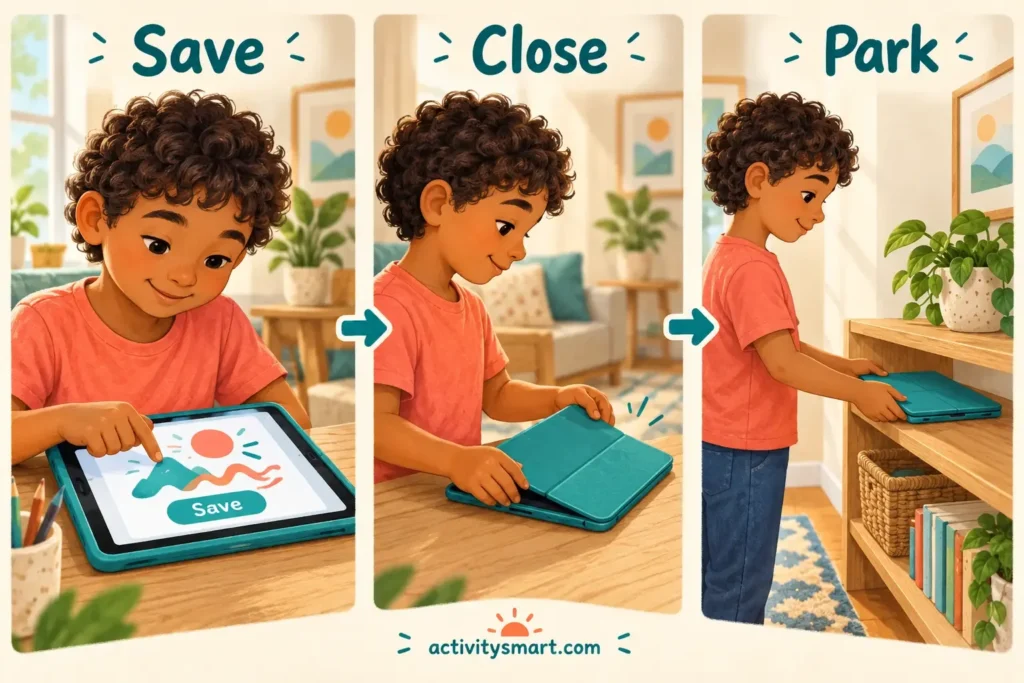
- Finish: the chosen endpoint, with saving or closing included.
- Afterward: park the device and begin the next familiar activity.
A workable example is: “After our snack, you can watch the episode we chose. When its credits start, we turn it off and take the watering can outside.” This gives a young child a concrete sequence. For a school-age player, agree on a session that includes time to save rather than announcing the finish during an unpredictable match.
The AAP’s family media plan guidance recommends rules suited to family routines, including adults’ habits. Use its planning approach as a conversation aid, then keep your household version short enough that another caregiver can follow it.
Choose a boundary you can actually maintain
A rule requiring constant adult supervision may not fit the hour when you are cooking and helping another child. Choose approved content beforehand, use available safety settings, and place the device where you can check in. If close supervision is necessary for a particular activity and unavailable that day, select another activity.
Avoid promising a session before you know there is enough time. “We might watch after the appointment; I will tell you when we get home” creates less confusion than a definite promise you later withdraw. If your plan changes, acknowledge the change directly instead of pretending the original agreement never happened.

Adapt the same principle to different ages
Age bands below are practical starting points, not developmental deadlines or medical prescriptions. A child’s language, interests, support needs, and previous experience may matter more than the age on a birthday card. Keep the expectation understandable and increase adult help when needed.
| Approximate age | Useful support | Example agreement |
|---|---|---|
| 3–5 years | One short sequence, a picture cue, adult help closing | “One selected story, then tablet in the basket and bath.” |
| 6–7 years | A visible endpoint and a choice of next activity | “Finish this planned session, save, then choose blocks or drawing.” |
| 8–10 years | Shared planning, a saving buffer, a later review | “Choose a game that fits before dinner; include time to exit.” |
These examples intentionally do not prescribe one universal daily allowance. Decide what is workable around your child’s needs, relevant age-specific guidance, and professional advice when needed. A schedule that repeatedly pushes bedtime or removes outdoor play needs revisiting even if the timer itself is being followed.
Offer an easier version when stopping is new: one familiar activity with a clear ending and an adult nearby. A harder version is letting an older child prepare the timer, predict the stopping point, and park the device independently while you remain available. Increase independence by changing one responsibility at a time.
For siblings, fairness can mean different arrangements. A younger child may need help with every step while an older sibling saves a project independently. Explain the shared principle—everyone protects sleep, meals, and family commitments—without making one child the example of how the other should behave.
Build the ending into the beginning
Ask “Where will you stop?” before pressing play. A selected episode has a more visible endpoint than an endless feed. A creative app may need a saved page rather than a finished masterpiece. For games, check whether a round can actually fit the available window; do not assume every game pauses.
Make the final action concrete: save the drawing, exit the app, place the controller on its shelf. Include those actions within the session rather than treating them as an unexpected extra demand. Rehearse the sequence once when the device is already off, so the first explanation does not happen during disappointment.
A warning is an option, not a magic solution. Try one calm reminder, perhaps five minutes before the agreed finish, and notice whether it helps. If repeated countdowns increase distress, use one predictable visual cue instead. Avoid asking “Are you ready to stop?” when stopping is not optional.
- Get close enough to speak without shouting across rooms.
- Briefly acknowledge the activity: “You have been building a tall tower.”
- Name the agreed finish: “It is time to save and close.”
- Offer limited help: “Will you press save, or shall I help?”
- Move toward the next activity together when support is needed.
If a game unexpectedly runs long, distinguish a genuine saving problem from a new session. A brief, agreed saving allowance can be reasonable; starting another round changes the agreement. Later, choose a better-fitting game or earlier start. Solve the scheduling problem outside the heated moment.
Respond to protest with fewer words and steady help
A child may understand the rule and still dislike it. Begin with acknowledgement: “You wanted to keep watching.” Then restate the boundary: “Watching is finished.” Finally offer support: “I can sit with you, or we can walk to the kitchen together.” Accepting the feeling does not require changing the decision.
Keep explanations short during a strong reaction. A lecture about eyesight, gratitude, or how other children behave adds material to argue about. The AAP’s advice on screen-time tantrums emphasizes adult calm, brief responses, and planning for transitions. Those principles can guide your response without expecting instant calm from your child.
Consider an everyday exchange. Your child says, “Just one more!” You answer, “You wish there were another. Today’s session is done. The drawing paper is ready.” If the request repeats, repeat the essential message once rather than producing new reasons. Then focus on helping everyone move safely through the transition.
If a child throws objects or hits, prioritize safety. Move other children and breakable items out of reach and stay nearby if safe. Avoid a tug-of-war over the device. Once the situation has settled, discuss what happened and plan the next session with more adult support. Persistent aggression deserves individualized professional guidance.
Reconnect afterward without reopening negotiations
When your child is calm, make the review brief: “Stopping was hard. Tomorrow we will choose the ending before you start.” Ask what might help, such as saving earlier or having you nearby. You can appreciate a useful action—“You put the controller away even though you were disappointed”—without demanding a cheerful reaction.
If you shouted, repair your part: “I spoke too loudly. Next time I will come closer and use a calm voice.” The rule can remain in place. Repair shows how an adult takes responsibility; it does not require either person to pretend that the difficult moment was acceptable or enjoyable.
Prepare realistic alternatives, not a packed activity schedule
“Go do something else” asks a child to invent a plan at the moment they are least interested in switching. Put two simple choices within reach before the screen starts. Choose things your child already knows how to begin: chunky crayons, blocks, a familiar book, or a basket of toy animals.
Offer connection before entertainment when that is what your child needs. A few minutes helping stir a bowl, hearing about a game, or sitting together can be an easier bridge than immediately requesting independent play. You do not have to perform an elaborate craft every time a screen turns off.
For a drawing option, prepare paper and crayons in advance. A child who likes familiar pictures might choose the unicorn above a rainbow coloring page to use on paper. Check any page and printing requirements beforehand; opening a website during the transition may restart the very negotiation you are trying to finish.
Some children prefer practical jobs or movement. Invite them to carry unbreakable cups to the table, sort clean socks, or build a cushion path where it is safe. Keep the invitation small. “Carry these two napkins” is clearer than “Help with dinner,” especially after an absorbing digital activity.
If your child chooses mark-making, the tracing lines resource offers another possible starting point. Use an activity only if it fits the child’s interest and abilities. Replacing every leisure screen session with academic work can make the transition feel like losing play to receive more schoolwork.

Let device settings support the agreement
Turn off autoplay where available, reduce unnecessary notifications, and choose content before handing over a device. Check purchase permissions, downloads, and communication features. These settings are tools for implementing your agreement; they cannot replace knowing what a child is watching or whom they can contact.
Explain restrictions in plain language: “This account lets you use the games we approved. Ask me before adding anything.” Test the shutdown or time-limit feature yourself before relying on it. A surprise lockout that interrupts saving can create a practical problem rather than teaching the intended routine.
Keep a shared charging or parking place outside the bedtime routine. The AAP recommends screen-free family times and spaces, including the hour before bed. If evenings currently revolve around videos, begin by choosing an alternative sequence—wash, pajamas, book, conversation—and arrange the room so those steps are easy to start.
Educational labels do not remove the need for boundaries. Ask what the child actually does, whether an adult can connect it to everyday life, and how it fits the day. ActivitySmart’s discussion of online coloring for kids can support a conversation about digital and paper activities rather than treating the two as interchangeable.
Plan for the situations that usually undo the rule
Homework and creative projects
Name the purpose before opening the device: “This is your assigned reading task.” Keep unrelated entertainment closed. When the task ends, move deliberately into the next part of the day rather than letting homework slide into recreational browsing. Ask the teacher for clarification if required digital work routinely overwhelms the home schedule.
A child using a device to communicate or access learning may need different arrangements from a child watching entertainment. Do not remove essential communication or accessibility tools as a punishment. Separate their purpose from optional leisure use and discuss an appropriate plan with the professionals supporting your child when necessary.
Weekends, travel, and illness
Explain exceptions before they happen when possible: “On this train journey we will watch our downloaded film. At home we return to our usual plan.” An exception is easier to understand when it has a reason and an ending. Avoid describing a demanding travel day as proof that the whole plan failed.
After illness or a holiday, restart the familiar routine explicitly. You may need to practice the ending again. Do not demand that a child infer that yesterday’s special arrangement has disappeared. Say what is available today, help choose content, and make the next activity visible.
Different caregivers and different homes
Share the shortest useful version of the plan with other caregivers: approved content, stopping point, parking place, and a calm phrase. Ask what they can realistically manage. Where households use different rules, explain your own without criticizing the other home. Children can learn different settings when adults make the expectations clear.
Common mistakes and practical repairs
- Announcing the rule while taking the device: explain the next session in advance and rehearse closing.
- Offering repeated extensions: choose an endpoint you can keep, including saving time.
- Using removal for every unrelated problem: address the immediate behavior directly so screen rules remain understandable.
- Expecting a timer to do all the parenting: stay available to support the transition.
- Making screens the only route to comfort: practice other comforting routines during easy moments too.
- Applying rules only to children: identify an adult habit to change alongside the child’s routine.
Also watch for making recreational screens the prize for every meal, worksheet, or quiet moment. That can turn the whole day into bargaining about access. A predictable leisure window gives you another option: necessary tasks have their own support, and entertainment happens at its planned time.
A one-week reset and a daily checklist
Use this as an adjustable practice sequence rather than a deadline. If a step needs longer, repeat it. Start with observation, make one change, and review the result before adding more restrictions.
- Days one and two: notice when use starts, what it replaces, and how it ends.
- Day three: explain one clear boundary and choose a parking place together.
- Days four and five: practice the same ending and prepare two offline choices.
- Day six: ask what helped and adjust one practical obstacle.
- Day seven: keep the useful parts and explain any weekend differences.
Before each session, check: Is the content approved? Is there enough time? Does the child know the endpoint? Is saving included? What comes next? Afterward, notice whether the agreement was clear and whether the transition needed more help. Measure progress by workable routines and recovery, not simply by the absence of tears.

When to seek extra support
These are educational suggestions, not a diagnosis or treatment plan. Discuss persistent concerns with your child’s pediatrician or another appropriate qualified professional, especially when screen-related conflict repeatedly disrupts sleep, eating, friendships, school participation, or safety. Describe specific patterns and bring your brief observations rather than labeling the child “addicted.”
You can also ask a teacher whether similar transitions are difficult at school. A useful conversation focuses on shared supports: advance explanation, visual cues, accessible alternatives, and adult help. Children develop at different rates, and a plan may need adapting to communication, sensory, learning, or emotional needs.
Frequently asked questions
How much screen time should my child have each day?
There is no single schedule in this guide for every child ages 3–10. Use relevant age-specific guidance and consider content, adult involvement, sleep, play, school, and family life. If screens repeatedly displace those needs, adjust the plan and ask your pediatrician for individualized advice when needed.
What if my child cries when screen time ends?
Acknowledge the disappointment, repeat the agreed ending briefly, and offer calm support. Crying does not automatically mean the boundary is wrong. Review the plan later if endings are consistently overwhelming, and seek professional advice when reactions persist or disrupt daily life.
Should I give a five-minute warning?
Try one predictable warning if it helps your child. Some children do better with a visual cue or a clear episode ending than repeated countdowns. Agree on the stopping point before starting and include any necessary saving time.
Does schoolwork on a tablet count the same as entertainment?
Treat required learning, communication, and optional entertainment as different purposes when planning. All device use still occupies time in the day. Keep homework separate from leisure browsing and protect essential communication or accessibility tools.
What should I do when my child says everyone else gets more time?
Listen without arguing about other families. Explain the reason for your household plan and invite a practical suggestion at a calm review time. You can reconsider an arrangement thoughtfully without changing it during every request for more time.
Can we make exceptions for travel or sick days?
Yes. Explain the reason and endpoint of the exception when possible, then clearly restate the usual routine afterward. A special day does not cancel the family plan. Some children need extra practice returning to familiar stopping routines.