Quick Answer
To teach counting with one-to-one correspondence, give each object exactly one number word. Start with a small collection, model touching or moving one item as you say each number, then state the total. Let the child try, watch how words and actions match, and adjust the task before increasing the quantity.
Quick Picks
- First activity: move three large blocks from one mat to another.
- For double counting: separate counted objects from objects still waiting.
- For a child who counts accurately: ask how many there are, then request a particular amount.
- For classroom practice: give one safe resource to each place setting.
A child who recites numbers confidently may still skip objects or count one twice. This guide helps parents and teachers identify the particular task that needs support, rather than simply asking children to count higher. Begin at the child’s current level, whether the learner is in preschool or revisiting foundations in elementary school.
What Counting With One-to-One Correspondence Means
In counting, one-to-one correspondence means assigning one number word to each object, without omissions or repeats. The IES toolkit distinguishes this one-to-one tagging from matching two collections, such as giving one cup to each child. Both involve pairing, but distributing cups does not by itself demonstrate accurate number-word counting.
Three ideas work together: a stable number sequence, accurate tagging, and cardinality, which means understanding that the final number gives the total. A child may manage one component while another remains uncertain. The IES meaningful counting toolkit provides definitions and demonstrations for educators who want to examine these differences.
| Skill | What you can observe | What it does not establish |
|---|---|---|
| Rote counting | Says number names in sequence | Accurate counting of objects |
| Object matching | Places one cup beside each plate | Knowing the number of cups |
| One-to-one tagging | Pairs each item with one number word | Understanding the final total |
| Cardinality | Uses the final count to answer how many | Recognizing the written numeral |
| Numeral recognition | Identifies the symbol 4 | Making a collection of four |
Choose a Starting Point by Observing the Child
Set out three large, similar blocks with clear spaces between them. Ask, “How many blocks are here?” Allow the child to choose a method. Listen to the number sequence, watch which objects receive a word, and notice whether the child answers with a total afterward. Avoid correcting every movement during this initial observation.
Next, offer a small supply and request two blocks. This changes the task: the child must stop at a requested amount rather than count everything available. Record what happened, including any help you gave. “Counted three independently; needed a reminder to stop when giving two” is more informative than “knows numbers.”
Use age guidance cautiously
The Head Start preschool math framework describes emerging coordination with small lined-up groups at 36–48 months and more developed counting during 48–60 months. Its indicators include pairing number words with objects to at least ten by 60 months. These are educational reference points, not a diagnosis or a timetable that every child follows identically.
For younger beginners, select a few easy-to-handle objects. For an older learner, keep the mathematics accessible while using respectful materials: sports equipment, classroom supplies, or construction pieces. Do not require babyish themes as the price of receiving support. The size and presentation of the collection should reflect the observed difficulty.
Model a Clear Counting Routine
Prepare the materials and define the group
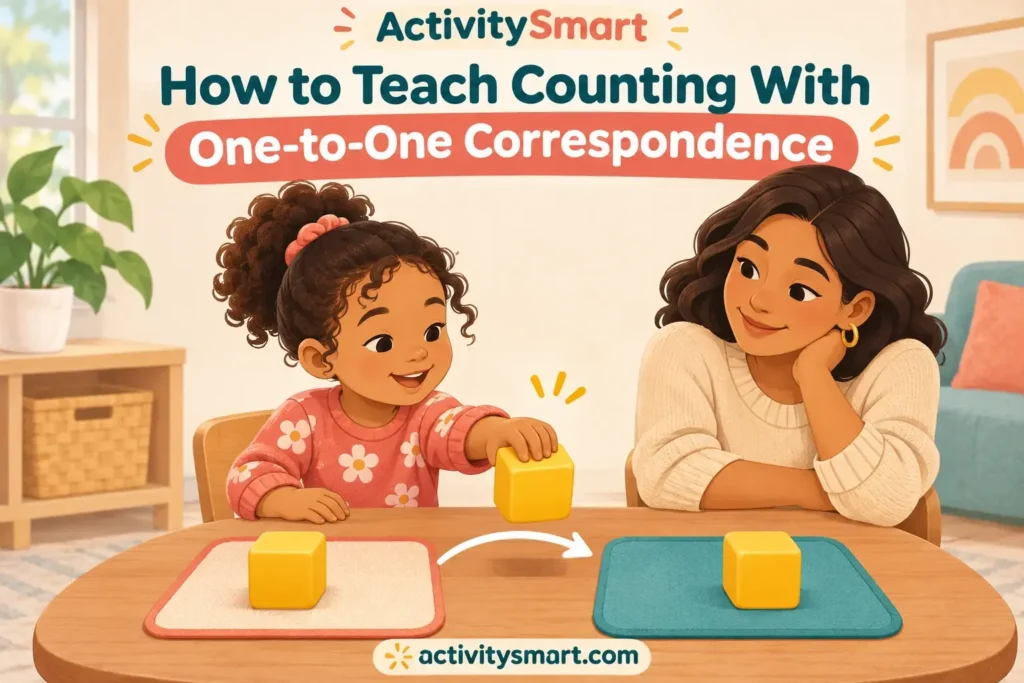
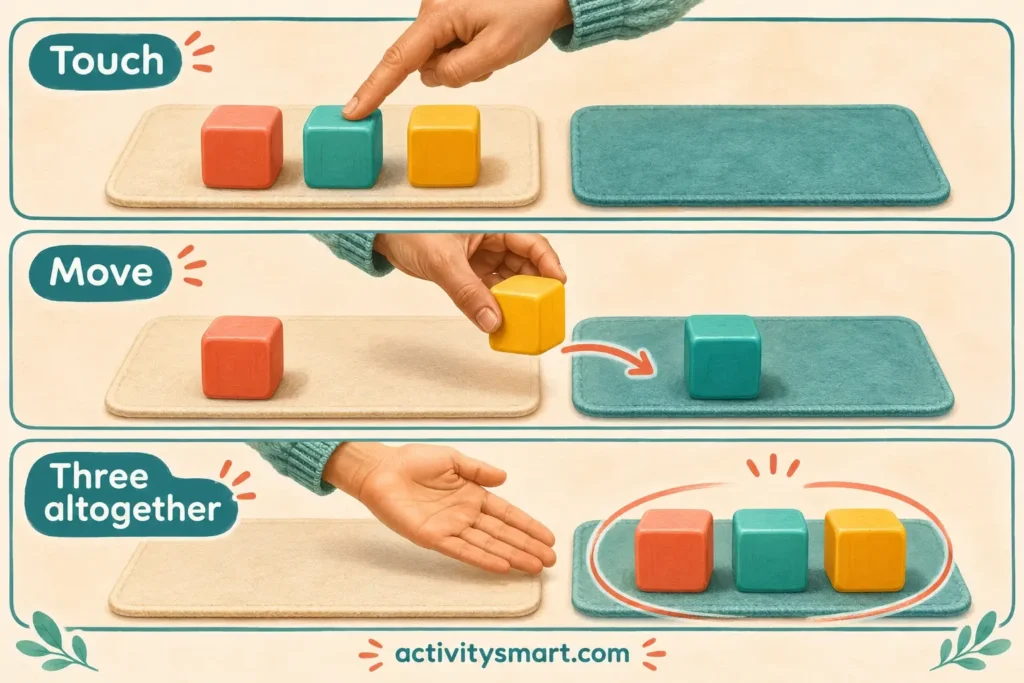
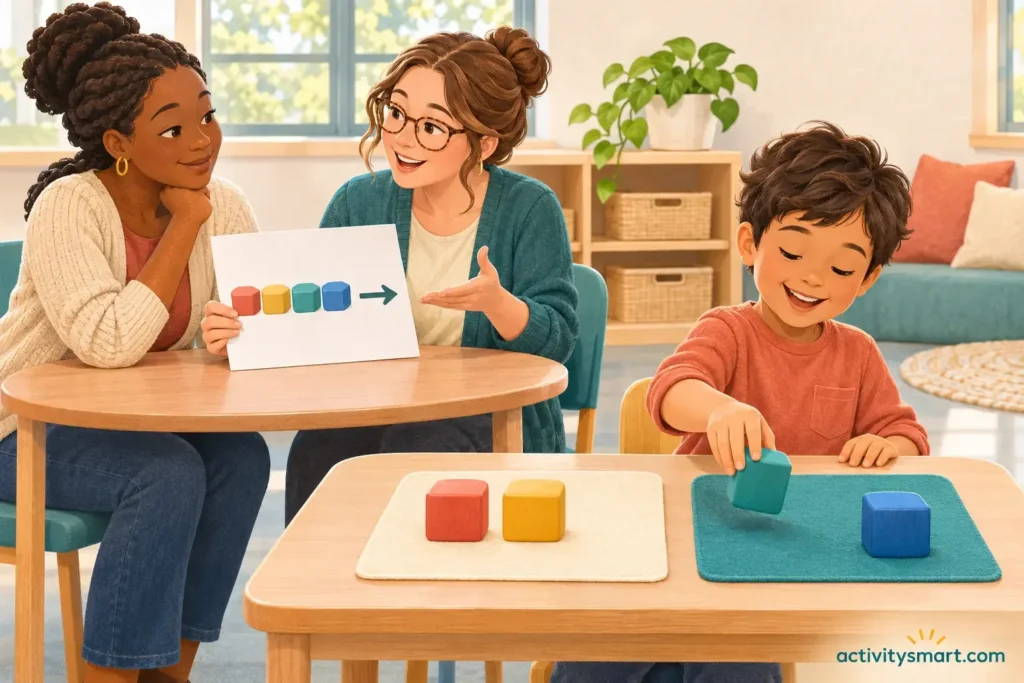
Put three blocks on a plain mat and place an empty mat beside it. Remove unrelated objects from the counting space. Say, “We want to find how many blocks are on this mat.” Defining the collection matters: a child should not have to guess whether nearby toys belong in the count.
Use objects that remain still and are easy to distinguish. If grasping them is difficult, allow pointing, an accessible switch, or directing an adult’s movement. Mathematical understanding should not depend on a successful pinch grip. Our fine motor activity guide offers a separate route for practicing hand skills without making them the counting test.
Synchronize one action with one word
Move the first block while saying “one,” the next while saying “two,” and the last while saying “three.” Keep the pace slow enough that the pairing is visible. Then gesture to the whole collection and say, “Three blocks altogether.” Avoid delivering a long explanation while your hands are carrying out the count.
Offer the child a turn with the same quantity. Wait before adding prompts. If the child succeeds only when you say every number, describe that as supported practice rather than independent counting. Later, reduce your contribution to a brief cue such as “one word for each block,” then try without the cue.
End with the quantity, not just the performance
Ask, “How many blocks did you move?” Accept a spoken answer, a signed number, or the child’s established communication method. If the child recounts, allow it and model the total again. Do not turn the question into a demand to guess what the adult wants.
The IES family counting guidance recommends modeling small sets, pointing during counting, and repeating the final number while indicating the whole group. This connects the counting procedure to its purpose. Increase the collection only when the current task provides useful, manageable practice.
Practical Activities That Make the Pairing Visible
The activities below are teaching suggestions, not a tested program with a promised completion time. Choose one that matches the difficulty you observed. Keep a successful version available when introducing a harder variation, so the child can return to a familiar task without starting the entire lesson again.
Block delivery between two mats
Invite the child to deliver a few large blocks from a supply mat to a building mat. Count one block during each transfer. When the delivery is complete, ask for the total and build something together. The building provides a reason for handling the blocks beyond answering an adult’s question.
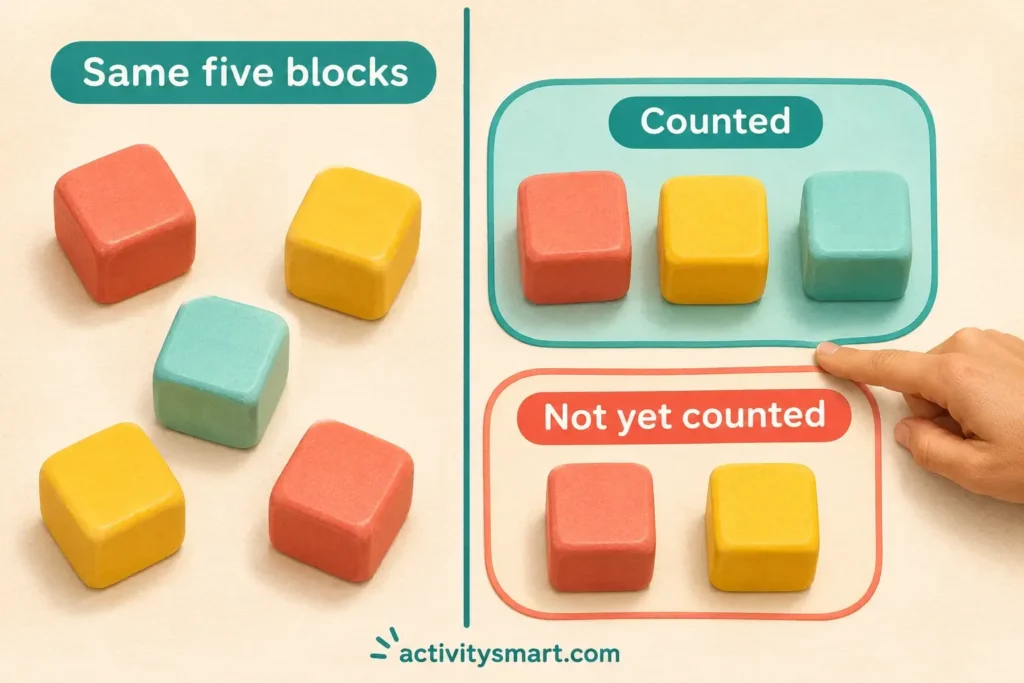
If two blocks move together, reset calmly and offer a smaller collection. If the child counts a block twice, point out the destination mat: those blocks have already been counted. For an extension, request a particular number from a larger supply. Keep the requested amount small enough that stopping remains manageable.
One resource for each place
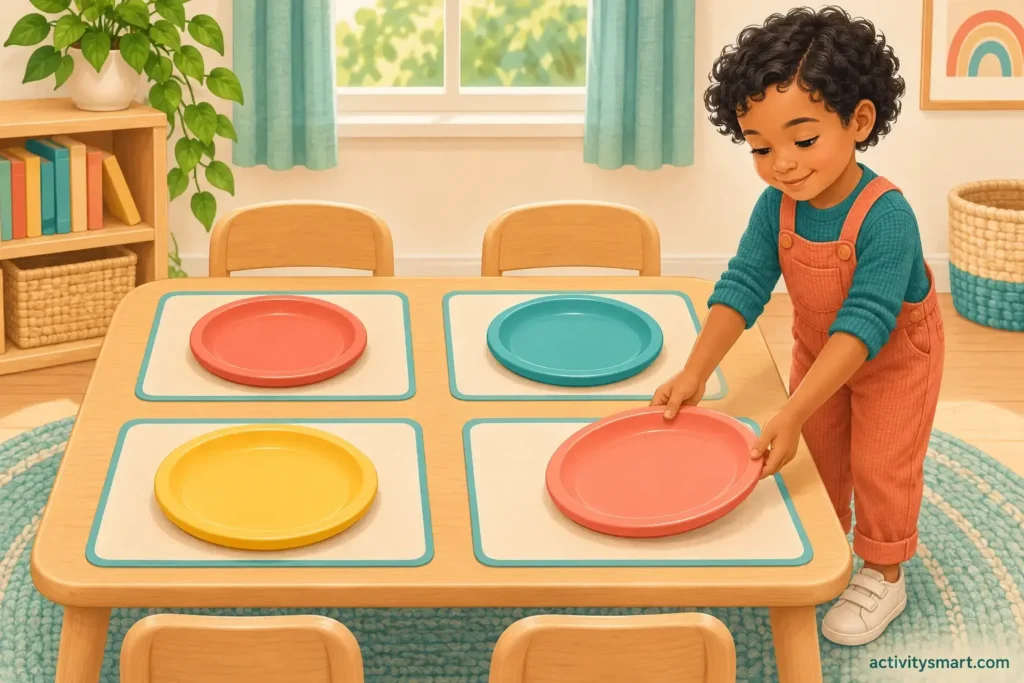
Arrange three or four paper place mats for pretend guests. Ask the child to put one large toy plate at each place. First discuss whether every guest has one and whether any place has two. Then count the plates, giving one number word to each plate.
Separate the two questions: “Does everyone have a plate?” and “How many plates are there?” A correct distribution answers the first without necessarily answering the second. For a classroom variation, distribute large art mats or books, with adult oversight. Count resources rather than labeling children by ability or comparing their speed.
Parking spaces for large toy vehicles
Draw several broad parking spaces on paper and provide age-appropriate vehicles without loose small parts. The child parks one vehicle in each space, then counts the parked vehicles. Keep unused vehicles outside the counting area so the target group is clear.
Change just one feature for the next round. You might add a space while keeping the vehicles familiar, or keep the quantity unchanged while changing vehicle colors. Ask what stayed the same. Do not simultaneously introduce a larger set, new number symbols, a competitive timer, and unfamiliar instructions.
Cover large dots with large counters
Draw a few widely spaced circles on a plain sheet and use large blocks to cover them. Ask the child to place one block on each circle while counting, then identify the total. Avoid sheets crowded with decorations that look like extra countable items.
NAEYC’s dot-card counting games illustrate how covering dots connects one-to-one pairing with cardinality. Adapt the materials for safety rather than copying a small-token setup automatically. An older learner can create a new dot arrangement with the same total and explain the choice.
Count objects in a picture
Choose an uncluttered picture and agree on the category before counting: flowers, birds, or wheels. Point once to each target, or mark counted targets with removable large paper tabs where appropriate. Distinguish separate objects from parts of an object; counting bicycles and counting wheels are different questions.
For example, use the peacock picture to discuss which clearly defined shapes belong in a chosen group before counting. Do not assume every decorative mark represents another feather. If the picture is ambiguous, use physical objects instead of insisting on one supposedly correct answer.
Respond to Counting Errors With a Specific Adjustment
The words race ahead of the pointing
Say, “Let’s make each block get one number,” and model the pairing once. Try moving objects instead of sweeping a finger across them. Eastern Connecticut State University’s one-to-one correspondence demonstration shows why purposeful coordination matters when reciting and handling objects happen at different rates.
Do not keep saying “slower” without showing what should synchronize. Watch for the actual change: does each movement now receive one word? If movement itself absorbs the child’s attention, you can move the items while the child supplies the number words, then exchange roles.
Objects are skipped or counted twice
Make counted and uncounted items visibly separate. Begin with a line rather than a scattered group, and leave enough space to indicate each item clearly. After one successful count, ask which strategy helped. This keeps the feedback attached to an observable action.
With a circular arrangement, agree on a starting point and mark it with a large card. Otherwise the child may keep going around the circle. For printed groups, use a transparent overlay to mark counted items if that suits the setting. Avoid requiring pencil accuracy before allowing a mathematical response.
The number sequence changes
If the child moves each object once but says “one, two, four,” the pairing may be better established than the number sequence. Rehearse the short familiar sequence separately, then return to the objects. More elaborate sorting or tracing will not directly fix a missing number word.
Keep handwriting optional. The tracing-lines activities can belong in a separate mark-making session, but tracing a path is not evidence that a child can count a set. Likewise, copying the written answer should not be the only way to demonstrate the total.
The child recounts or gives an unrelated total
Repeat the final number with the group in view: “Four. There are four altogether.” Then move to another small example rather than asking the same question insistently. Recounting can reflect uncertainty, checking, or an emerging understanding; one response does not establish why it happened.
Stanford DREME’s counting and enumeration observation prompts separate counting a group, producing a requested amount, and explaining a rearranged collection. Use these as different windows on understanding. A correct final answer alone does not reveal the strategy that produced it.
Adapt Practice Without Changing the Mathematical Goal
Language and communication
Use a counting language the child knows well when you want to observe quantity understanding. Introduce English number words separately if those words are unfamiliar. Do not treat searching for an English word as automatic evidence of a mathematical problem.
Agree with the family or teaching team on accessible responses. A child may sign, select a number using a communication system, or direct an adult to move objects. Describe any support when recording the result. The goal is to understand what the child knows, not to make every learner perform the same motor and speech routine.
Attention, vision, and movement
Try a plain background, strong contrast, stable objects, and a comfortable working position. Offer a smaller visible collection if the layout is distracting. Ask the child which presentation is easier instead of assuming that brighter colors or more elaborate manipulatives always help.
If pencils introduce an extra barrier, set them aside for counting. Our pencil grip guidance addresses the separate task of comfortable tool use. Coordinate specific visual, hearing, movement, or communication accommodations with the professionals who know the child when needed.
Extension for confident counters
Rearrange a counted set without adding or removing anything and ask whether the total changed. Invite an explanation, then count again if the child wants to check. Later, begin counting the same collection from a different object and compare totals.
For an older learner, ask for a requested amount, combine two small groups, or organize a larger collection into useful groups. Preserve the purpose of finding quantity. Continuing to demand slow one-by-one counting when a child can explain a more efficient valid strategy can make practice unnecessarily repetitive.
Use Short Observations to Plan the Next Session
Choose one question to investigate: coordinating words and movement, remembering the sequence, or interpreting the total. Use a comfortable collection first, then one small change. Stop when you have enough information to make the next teaching decision; a long worksheet is unnecessary for this observation.
- Materials: what was counted, how many, and in what arrangement.
- Independence: whether the child started and continued without a model.
- Strategy: pointing, moving, grouping, or recognizing a small quantity.
- Response: the count sequence and the answer to “how many?”
- Next step: one adjustment to try, rather than a broad ability label.
Share a concrete example with home or school: “She counted four lined-up blocks alone, but lost track when they were scattered.” Ask whether the same pattern appears elsewhere. Do not compare siblings or turn a progress note into a ranking. If difficulties persist despite accessible teaching, discuss them with the teacher or school support team.
Keep quantity work distinct from other school tasks. The name-writing guide concerns another learning goal; success there does not confirm counting, and difficulty there does not disprove it. Seek pediatric or developmental advice when concerns extend beyond this activity or a child loses previously established skills.
Materials, Safety, and Common Mistakes
Choose sturdy, age-appropriate materials and supervise their use. Avoid loose small objects for children who mouth items or have swallowing risks; supervision does not make an unsuitable item appropriate. Leave magnets, button batteries, coins, dried beans, and loose beads out of a beginner counting setup. Large blocks can serve the same mathematical purpose.
Use a tabletop or another stable space that does not create a trip hazard. If counting sounds or movements, provide a seated alternative and avoid noisy surprises. Food is optional and brings additional allergy, hygiene, and choking considerations; ordinary play materials remove the need to eat anything during the activity.
The main advantage of objects is that the child and adult can inspect what was counted. Their limitation is that handling and visual clutter can obscure understanding. Pictures are convenient but cannot always be moved, while a worksheet may add handwriting demands. Choose the representation that makes the current question clearest.
Avoid racing, demanding a higher number after every success, finishing the count for the child, or correcting with shame. Offer specific feedback: “You moved every block once, so none was counted twice.” If frustration grows, pause, offer a simpler choice, or return later. A calm stopping point is preferable to collecting another forced answer.
Final Verdict: Teach the Connection Before Increasing the Count
Start with a small visible collection, model one word for each object, and connect the last word to the total. Observe which component needs help before choosing the next activity. Accurate, meaningful counting of a few objects offers a clearer teaching target than impressive recitation without an understood quantity.
Frequently Asked Questions
What is one-to-one correspondence in counting?
One-to-one correspondence in counting means giving each object exactly one number word, with no skipped or repeated objects. It is different from merely reciting the number sequence.
Why can my child count to twenty but not count five objects?
Reciting to twenty and accurately counting five objects require different skills. Watch whether number words match individual objects, then practice with a smaller collection and a clear moving or pointing strategy.
How many objects should we start with?
Start with a small collection the child can manage, often one to three objects for an initial demonstration. Adjust from observation rather than treating any starting number as a rule for every child.
Is one-to-one correspondence the same as cardinality?
No, one-to-one correspondence pairs individual objects with number words, while cardinality concerns the total represented by the last number. Observe both the counting process and the answer to how many.
What should I do when my child counts the same object twice?
Separate counted objects from uncounted objects by moving each one to a different mat as it is counted. Model the strategy once, then let the child try with a manageable collection.
Do children need to recognize written numbers before counting objects?
No, recognizing written numerals is not required to begin counting objects. A child can work with spoken or signed number words and real quantities before matching those quantities to written symbols.
Are worksheets necessary for teaching this skill?
No, worksheets are not necessary for teaching one-to-one counting. Large blocks and everyday resources let children move objects and inspect their count; pictures can provide another representation when useful.
Can we practice in a home language rather than English?
Yes, you can use familiar number words in the home language to practice counting. When observing mathematical understanding, distinguish unfamiliar English vocabulary from difficulty coordinating counting words and objects.
When should I seek extra support for counting difficulties?
Seek support when difficulties persist despite accessible, appropriately pitched practice, or when you have broader developmental concerns. Share concrete observations with the teacher or school support team, and discuss loss of established skills with a healthcare professional.
Sources and Further Reading
The linked IES resources explain meaningful counting and family practice. Head Start supplies preschool educational reference points; Eastern Connecticut State University demonstrates one-to-one pairing; NAEYC illustrates dot-card play; Stanford DREME provides observation prompts. The activity variations here are practical adaptations, not promises of measured learning gains or a substitute for individualized assessment.