Quick Answer
Encouraging independent play starts with a safe, familiar space, a small selection of versatile materials, and a predictable transition from playing together to letting your child lead. Stay close enough to respond, start with a manageable interval, and resist directing every choice. You do not need to buy more toys.
Quick Picks
- Best first move: join briefly, then step back while remaining available.
- Best materials: blocks, paper, chunky crayons, containers, and familiar pretend-play props.
- Best environment: one safe spot with a few visible choices.
- Best measure of progress: growing comfort and self-directed decisions, not a stopwatch record.
- When to pause: distress, unsafe play, or a child who genuinely needs connection.
Encouraging independent play is not about persuading a child to entertain themselves for hours. It is about creating small, dependable opportunities to choose an activity, try an idea, and return to you when needed. A child can play independently while you are sitting nearby; independence does not mean isolation.
If your shelves are full but your child still says “Play with me,” start by changing the routine, not the toy collection. This guide offers adaptable steps for children roughly ages three to ten, explains why the same approach looks different across ages, and provides low-cost invitations to play. You can fold these ideas into an after-school routine that protects time for play rather than adding another appointment to the day.
What Independent Play Actually Means
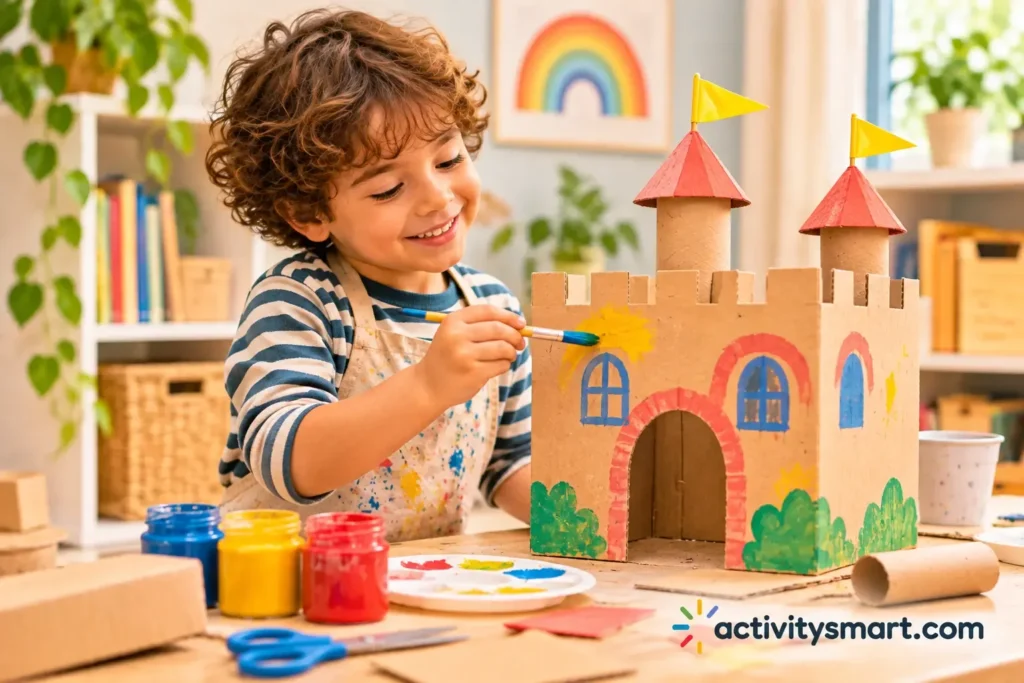
Independent play is child-directed activity in which a child makes meaningful choices without an adult continually supplying instructions, entertainment, or solutions. The adult may still be close, attentive, and ready to help. A preschooler arranging toy animals at the kitchen table while a parent makes lunch is practicing a different form of independence than a nine-year-old designing an elaborate cardboard city.
Play can be solitary, parallel to another person, or intermittently shared. Children may glance toward an adult, describe a creation, or ask for help and then return to the activity. Those check-ins do not cancel the independent part. A useful question is not “Did my child stay silent?” but “Did my child have room to direct what happened next?”
Why connection still matters
The American Academy of Pediatrics emphasizes the value of playful relationships and varied forms of play, including imaginative and physical play. Its discussion of American Academy of Pediatrics explanation of the power of play describes development broadly; it does not prove that a particular five-minute routine will raise attention scores or make every child calmer. Treat independent play as one healthy option alongside family time, outdoor movement, friendships, and rest.
Some children have had fewer chances to initiate play because adults regularly organize their time. Others are unsettled by a new setting or by separation. Their need for reassurance is information, not misbehavior. Offer connection before asking for autonomy, and return to shared play later.
Encouraging Independent Play With a Reliable Start-and-Step-Back Routine
Begin with a short connection ritual
Offer a few minutes of genuine attention first: build the beginning of a tower together, read the first page of a picture book, or help choose which familiar materials to use. Let your child supply the next idea. Say, “I can play for a little while, then I’ll be at the table while you keep going.” A clear transition is kinder than quietly disappearing after a child becomes absorbed.
ZERO TO THREE recommends starting together, keeping the play space safe, remaining nearby, and managing adult expectations in its practical ZERO TO THREE guidance on independent play. The organization gives illustrative timing ideas for younger children, but those are not universal developmental targets. If your child manages only a brief spell comfortably, that is still a place to begin.
Offer a real choice, not an assignment
Place two or three options within reach: blocks, drawing supplies, or dolls with cloths. Ask, “Which would you like to start with?” Avoid “You must build a house for ten minutes,” which replaces self-direction with compliance. Choices can include doing nothing for a moment. A child may spend time observing a scene before changing it.
For a child who freezes at an open-ended invitation, provide a light starting suggestion: “I wonder where the animals might sleep.” Then let the child reject it, alter it, or invent something else. The goal is not your completed project. The goal is a child-owned idea.
Step back without disappearing
Move to a nearby, genuinely necessary task: folding towels, reading, or preparing the next meal. Keep children within appropriate sight or hearing for their age, abilities, environment, and material hazards. Use a simple phrase such as “I’ll be right here if you need me.” A child who checks whether you are there is learning that independent activity and dependable caregiving can coexist.
When your child becomes involved, avoid constantly commenting, photographing, questioning, or correcting. Occasional warmth is welcome; persistent narration can redirect attention toward adult approval. If interrupted, briefly acknowledge your child and return responsibility for the next decision: “You have two ideas. Which will you try first?”
Finish with reconnection, not a score
At the end, notice the experience rather than announcing how many minutes were achieved. Ask, “What happened to your bridge?” or “Would you like to leave the story set up for tomorrow?” Children may appreciate showing their work, yet some prefer to keep play private. Respect either response. Repeat the rhythm often enough that it becomes predictable without turning every afternoon into a performance review.
Change the Play Space Before You Change the Toys
Make a small invitation visible
An overflowing toy bin can make it hard to see a starting point. Try placing a small number of familiar objects on a reachable shelf or mat and storing the rest. There is no scientifically established perfect number of toys for every family. The practical purpose is simple: the child can spot choices and put materials away without an adult managing a mountain of pieces.
Pair items that suggest possibilities without prescribing an outcome: a few blocks beside toy figures; paper next to large crayons; a blanket near stuffed animals. Put the scene where normal family life happens if your child prefers proximity. A cozy corner may work for one child, while another plays best at the dining table within conversation distance.
Use materials with more than one purpose
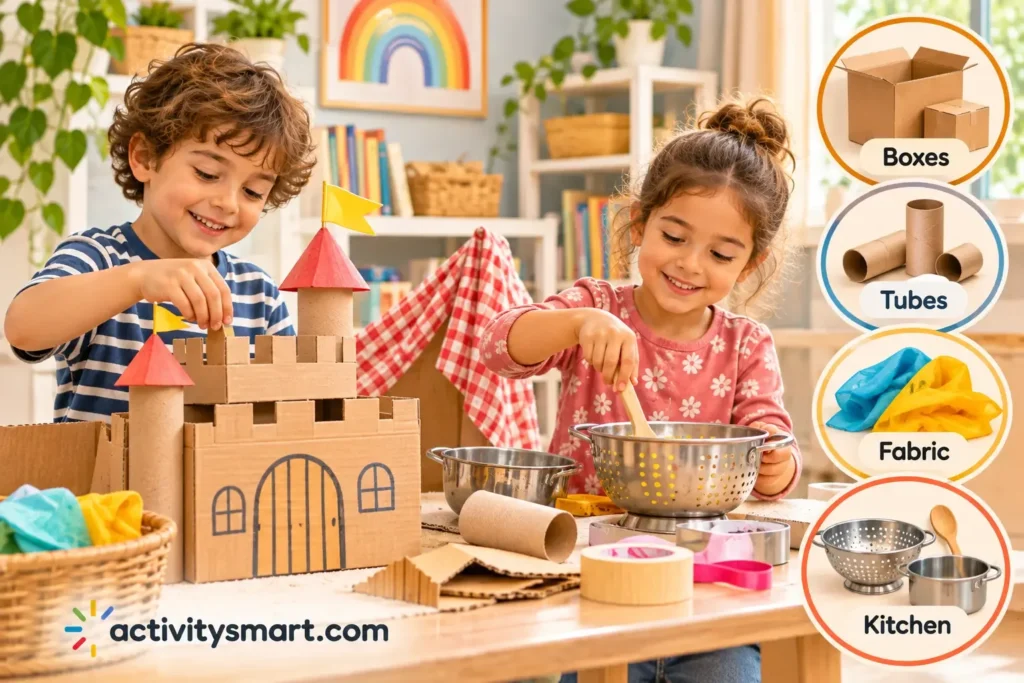
A single cardboard box might be a bus, cave, shop, spaceship, or drawing surface. Large stacking cups become towers, containers, or pretend cooking equipment. NAEYC guidance on open-ended materials explains why simple, open-ended materials invite exploration in different ways. The examples are suggestions, not evidence that household items automatically outperform purpose-built toys.
A good material lets children make several decisions: What is it today? Where does it go? Does it combine with another object? What happens if the plan changes? The best materials are not always the most visually impressive. Familiar objects can be useful precisely because the child already knows how to handle them safely.
Reduce background distractions
Turn off television that nobody is watching and move distracting devices away from the play area when possible. This is not a claim that a silent room is necessary. Some children play well with ordinary household noise or quiet music; others need a calmer corner. Families setting broader routines may also find the screen time boundaries for kids useful. Observe how your own child responds rather than copying an idealized room photograph.
Keep setup and cleanup manageable
Independent play is less appealing if every activity requires elaborate adult preparation. Use a shallow tray for drawing, a low basket for blocks, and a spot for unfinished constructions. Reusable setup matters more than aesthetic perfection. When a project involves cutting, glue, or paint, review the materials and supervise accordingly; do not assume that “independent” means all tools are suitable to leave out.
Independent Play Ideas That Use What You Already Own
These invitations are starting points, not scripted lessons. Offer one or two, then let the child decide what they become. Replace materials based on interest, access needs, and safety, rather than buying a new set whenever an idea feels stale.
Build, balance, and redesign
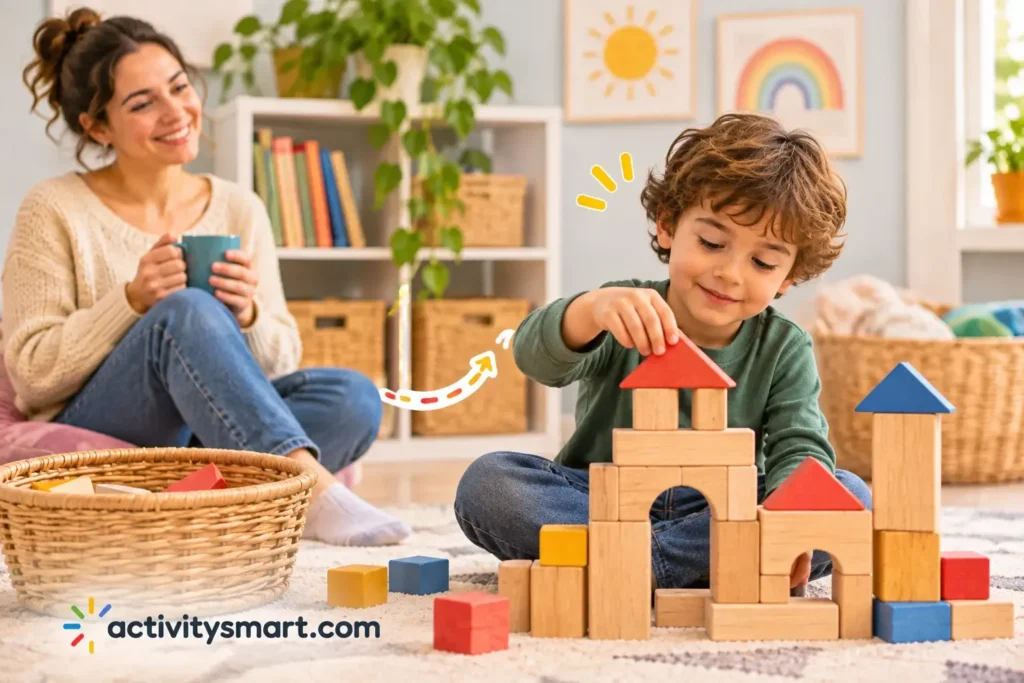
Provide blocks, clean cardboard boxes, or large interlocking pieces. A younger child might stack and knock down a short tower; an older child might design a road system, test which bridge spans a gap, or make a sign for a pretend store. Avoid presenting a photo that has to be copied. A bridge that falls is an opportunity for experimenting, not a wrong answer. For children who enjoy shapes, the site’s pattern recognition activities can inspire an optional next variation.
Invent a story with familiar characters
Gather a small collection of stuffed animals, washable figures, or dolls and a cloth. Your child might run an animal hospital, invent a train station, or make a bedtime routine for the characters. You can offer one opening line and then leave the plot alone. A child who repeatedly acts out the same story may be enjoying mastery, not failing to be creative.
Draw a world rather than finish a worksheet
Put plain paper and appropriate crayons within reach. A preschooler might make roads or circles; an older child might design a map, character cards, or a comic. Drawing is not restricted to making identifiable pictures. If a child wants more hand-movement ideas, connect the activity to pre-writing activities with ordinary materials, while keeping independent play separate from required handwriting practice.
Sort, arrange, and transform
Use large safe blocks, fabric squares, or other familiar pieces to create patterns, imaginary shops, or collections. An older child could invent categories and explain why two objects belong together; a younger child may prefer simply arranging colors. For optional adult-led extensions later, see visual matching and sorting activities. During independent time, let the child decide whether sorting is the game at all.
Make a pretend restaurant from safe kitchen items
Offer clean, unbreakable bowls, large spoons, cloth napkins, and an empty menu card. Children can take imaginary orders, set a table, or cook an invisible meal. Avoid sharp utensils, breakable glass, cords, plastic bags, and tiny pieces that could be mouthed by younger children or visiting siblings. Real food, hot surfaces, and appliances belong in a supervised kitchen activity, not an unattended pretend station.
Create a changeable indoor landscape
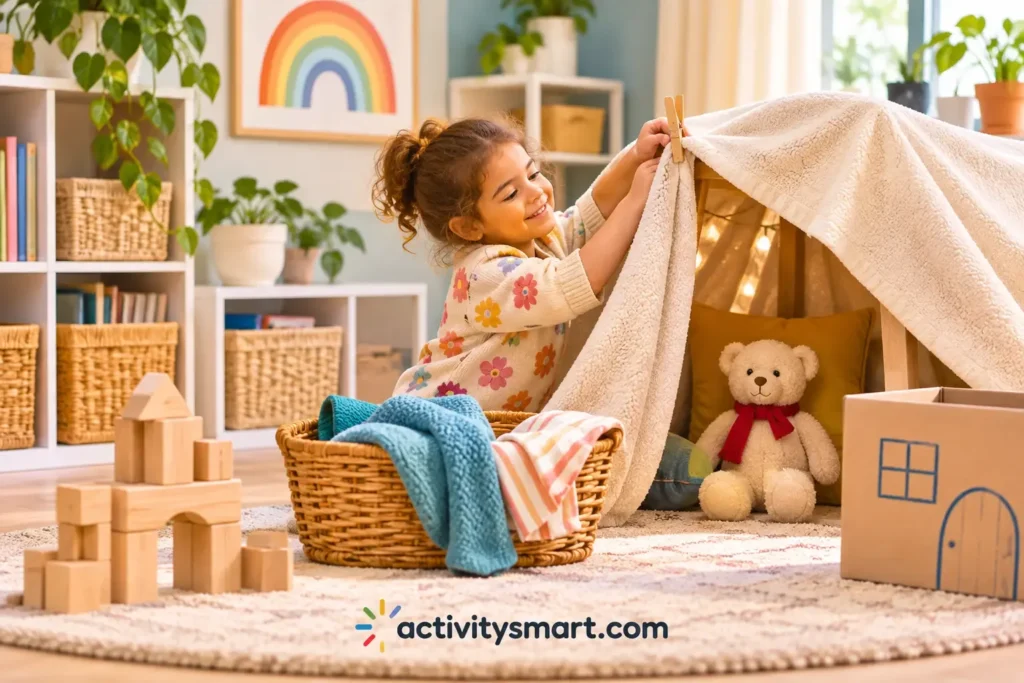
Arrange cushions on the floor and invite a child to imagine islands, a campsite, or a puppet stage. Check stability and avoid arrangements near stairways or heavy furniture that could tip. Do not drape fabrics where they obstruct breathing or create entanglement hazards. Active climbing, forts, and obstacle courses need supervision appropriate to the activity; quiet storytelling with cushions may require less direct help.
Match Your Expectations to Age, Experience, and Temperament
Age provides a starting point, not a timer you can use to grade a child. Children’s abilities vary with fatigue, familiarity, emotional state, disability, interests, and whether an adult is nearby. The CDC developmental milestones at age four include pretend play and growing participation in everyday routines; these examples are developmental context, not a prescribed number of minutes a four-year-old must play alone.
| Approximate age | A useful starting invitation | Adult role and realistic expectation |
|---|---|---|
| 3–4 years | Large blocks, pretend kitchen, stuffed-animal story | Stay nearby; expect frequent checking in and short spells of self-directed play. |
| 5–6 years | Make-believe shop, drawing setup, small construction scene | Offer simple choices; let a child plan a few steps while you remain accessible. |
| 7–8 years | Cardboard town, comic-making, imaginative world-building | Discuss setup and boundaries; allow more decisions and occasional requests for input. |
| 9–10 years | Longer creative projects, models, stories, self-chosen games | Respect privacy and growing autonomy while still applying activity-specific safety rules. |
This table is an editorial guide, not a developmental test. For a broader look at readiness beyond academic drills, explore play-based school readiness skills.
If your child needs more support
Children with sensory differences, communication needs, anxiety, or disabilities may benefit from visual choices, accessible materials, predictable location, a quieter environment, or a trusted person remaining close. Ask what makes the activity comfortable. A child who uses a communication device or needs physical assistance can still direct the play. Independence describes ownership of decisions, not doing every physical step without support.
If you notice loss of previously acquired skills, persistent distress that interferes with daily life, or broader developmental concerns, speak with your child’s pediatrician or an appropriately qualified professional. Do not use independent-play duration as a screening tool or infer a diagnosis from reluctance to play alone.
When Your Child Says “I’m Bored” or “Play With Me”
Respond to the need behind the words
“I’m bored” can mean “I can’t choose,” “I’m tired,” “I want connection,” or simply “Nothing interests me right now.” Start with curiosity: “Do you want a little time together, or would two ideas help?” If your child needs a snack, rest, movement, or reassurance, meet that need before pushing for independent activity. Independence built on repeated disconnection is not the goal.
For a child who wants you to invent every game, try an idea handoff. Say, “I can help you put the first three blocks down. You decide what comes next.” The next day, help with two blocks instead. This gradual reduction is a practical strategy, not a guaranteed behavioral program. If it increases distress, reduce the demand and try again under easier conditions.
Allow a pause without immediately filling it
Adults sometimes rush to propose entertainment when a child stops moving. A brief, safe pause can be part of choosing. You might say, “You can think for a minute. I’ll be here.” However, boredom is not something every child must endure to become creative, and it should not be used to dismiss a request for comfort. Remain responsive and flexible.
Offer support during frustration
If a structure collapses or a drawing goes differently than expected, first acknowledge what happened: “The roof fell and that is frustrating.” Ask whether the child wants a hint, a pause, or help. Solving every problem immediately removes opportunities to experiment, but withholding needed assistance turns play into a test. The related guide to supporting big feelings during learning offers additional language for difficult moments.
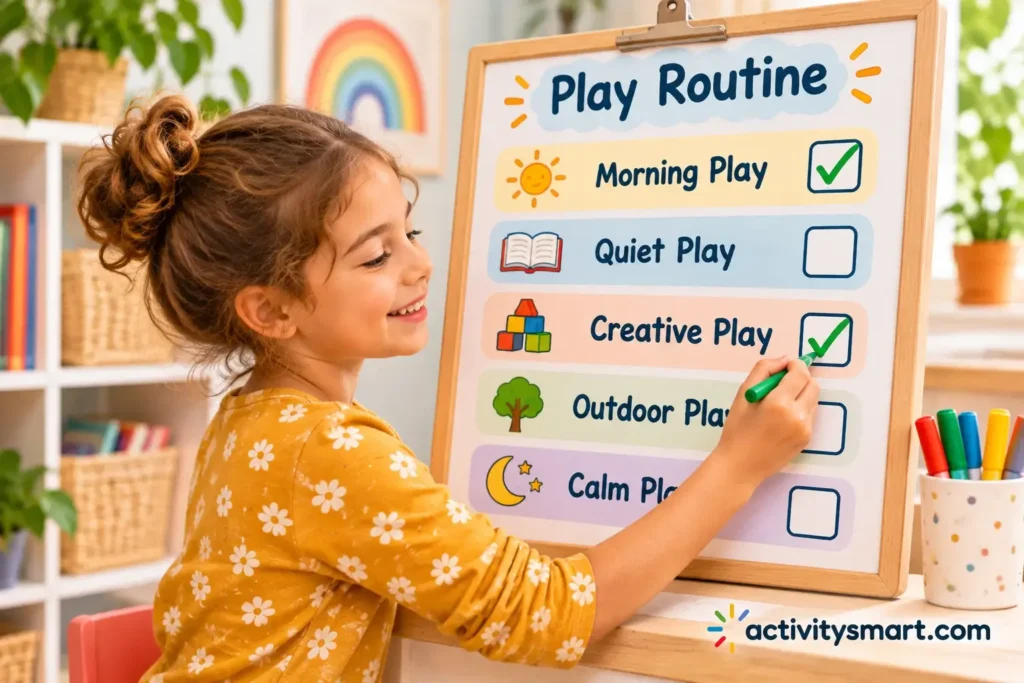
A Gentle One-Week Practice Plan
Choose a calm moment, use familiar materials, and begin with shared play. Then shift to a nearby activity while remaining responsive. Repeat the same transition a few times before changing the materials or asking for more autonomy. A child who needs extra connection can start with you beside them. Each later opportunity can offer one more choice: which materials to use, where to build, or whether to continue tomorrow. Track comfort and initiative, not minutes. This is a flexible family routine, not a developmental assessment or a treatment program. Stop and reconnect whenever play becomes distressing.
Common Mistakes and Better Alternatives
Buying a new toy whenever interest dips
Novelty can be enjoyable, but it may not solve the underlying difficulty of choosing or starting. Rotate a small selection of existing toys, combine familiar items differently, or play together briefly. There is no need to make the home permanently minimalist: the aim is accessible choices, not a strict possession count.
Turning playtime into a timed exam
A timer may reassure some children by making the routine predictable; others find it distracting or pressuring. Consider a gentle transition cue instead. Do not tell a child that playing alone for longer proves they are “big” or “good.” Children also need to practice asking for help and connection.
Directing every detail
When an adult insists that a tower be symmetrical or a picture use realistic colors, the activity becomes adult-led. Save explicit instruction for moments when the child requests it or safety requires it. During free play, curiosity is more useful than correction. For parents who want structured skills sessions too, fine motor play ideas offers separate fine motor ideas that can be introduced at another time.
Confusing independence with lack of supervision
Leaving a preschooler alone with unsafe objects is not an independence-building practice. A parent can prepare dinner nearby while a child uses safe large blocks, but should not treat playtime as permission to ignore water, choking hazards, unstable furniture, pets, or outdoor access. See the safety guide below before setting materials out.
Safety and Boundaries for Low-Prep Play
Review the room from the child’s level. Secure furniture that could tip, remove accessible medications and cleaning products, cover or manage electrical risks, and block unsafe access to stairs, windows, and water. Check materials for broken edges, loose magnets, button batteries, and small parts. Consider younger siblings who may enter the space even if the activity is intended for an older child.
Use age-appropriate, nontoxic art materials; supervise scissors, adhesives, and tools according to your child’s skills and the manufacturer’s directions. Household packaging can conceal staples, plastic film, sharp edges, or choking-sized components. Clean and inspect boxes before use. Sensory bins with dried beans, beads, or water are not default independent activities for young children because they can create choking or drowning hazards; use safer alternatives and direct supervision when needed.
How to Tell Whether the Routine Is Helping
Notice whether your child begins making choices, returns to a project, and seems comfortable asking for help. If play ends in conflict, check whether the materials are too difficult or the child needs rest or connection. Keep time for shared and outdoor play too. The goal is flexible, supported independence, not a competition to play alone for the longest period.
Final Takeaway: Keep the Toys, Change the Invitation
Encouraging independent play works best as a responsive habit: connect first, offer a few accessible materials, step back predictably, and stay available. More toys are optional; thoughtful access to the ones you have is usually a better starting experiment. Allow children to use materials differently from how you imagined, and let their comfort guide the pace.
Preserve room for shared stories, playground games, family rituals, and real rest. A child who occasionally asks you to join is not failing at independence. When the environment is safe and the adult relationship remains secure, even a brief child-led moment is worth making space for.
Frequently Asked Questions
How do I start independent play if my child always asks me to join?
Start by playing together briefly, then move to a nearby task while your child continues with familiar materials. Explain where you will be and return when help is needed; build comfort before extending the interval.
How long should a three-year-old play independently?
There is no single required duration for a three-year-old to play independently. Begin with a short, comfortable opportunity and adjust for temperament, fatigue, development, and the presence of a trusted adult.
Do children need more toys to play independently?
No, children do not need more toys to begin independent play. A small selection of safe, familiar, open-ended materials can provide many possibilities; extra purchases are optional.
Should I leave the room during independent play?
No, leaving the room is not necessary for independent play. Stay within an appropriate supervising distance, especially for younger children or activities involving materials that need monitoring.
What if my child says they are bored right away?
First check whether your child needs connection, rest, food, or help choosing. Offer one or two gentle starting ideas, then leave space for the child to decide without treating boredom as a discipline problem.
Can siblings play together and still be independent?
Yes, siblings can engage in child-directed play without an adult controlling the activity. This is collaborative rather than solitary play, and it still offers meaningful choices and practice negotiating ideas.
Are cardboard boxes and household items safe play materials?
Some household items are useful, but they are safe only after you check their condition and suitability for your child. Remove staples, loose plastic, sharp edges, small parts, and any access to hazardous tools or appliances.
Should I use a timer for independent play?
A timer is optional rather than essential. It may help a child who likes clear transitions, but use a gentle verbal cue instead if countdowns create pressure or interrupt engagement.
What should I do if my child becomes upset playing alone?
Respond and reconnect when your child becomes upset. Identify what felt difficult, help as needed, and try a smaller, more supported opportunity later rather than forcing the child to continue.
Does independent play replace playing with parents or friends?
No, independent play complements rather than replaces shared play. Children also benefit from responsive relationships, peer interaction, physical activity, and time to rest.
Sources and Further Reading
These resources provide developmental context and practical play guidance; the activity examples and routine in this article are suggestions rather than individually tested interventions.