
Quick Answer
A simple after school routine starts with connection, water and a snack, then offers time to unwind and play before a manageable homework or household task. Keep the sequence predictable but the minutes flexible. Protect a realistic bedtime, invite children to help choose play, and adjust the plan to their energy, age and school demands.
Quick Picks
- Just arrived: greet, wash hands, drink water, and eat if hungry.
- Next: give a child a choice of quiet or active play.
- Later: use a short, supported homework block if homework was assigned.
- Evening: prepare tomorrow’s essentials without cutting into sleep.
- Hard day: make connection and recovery the priority, not perfect timing.
The best after school routine is not a miniature workday. For children roughly ages three to ten, it is a reliable path from the noise and demands of school or childcare into the comfort of home. A few familiar steps can remove repeated decisions while leaving enough freedom for imagination, movement and relationships.
This guide shows how to build that sequence, how to decide whether play or homework comes first, what a realistic afternoon can look like, and how to handle late pickups, sibling differences and difficult transitions. The suggested times are examples, not developmental targets or a universal prescription.
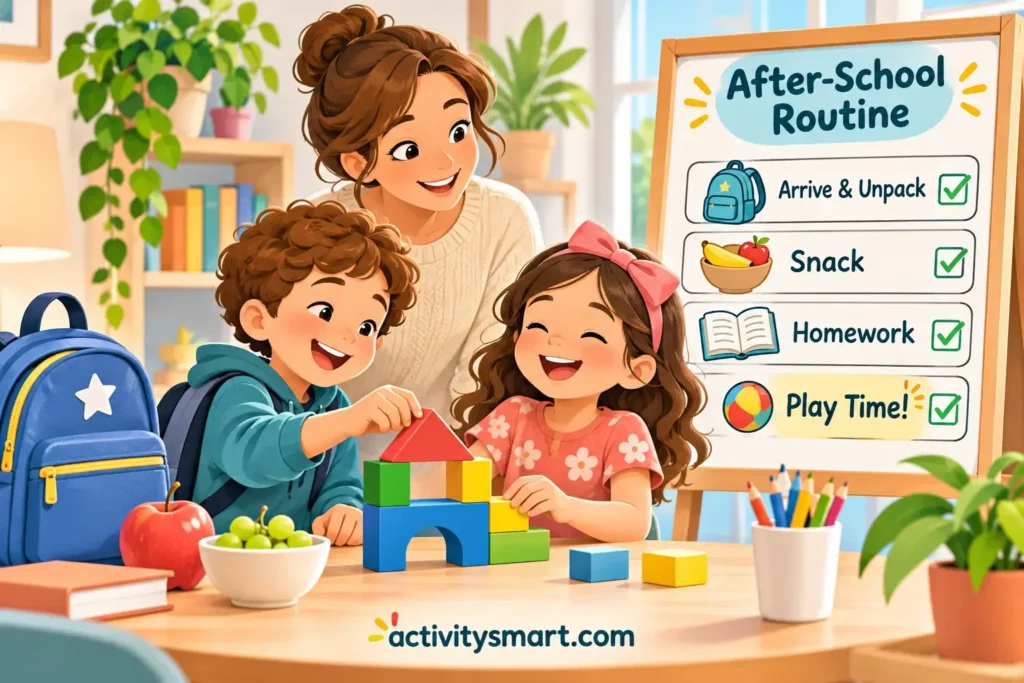
Why an after school routine should protect play
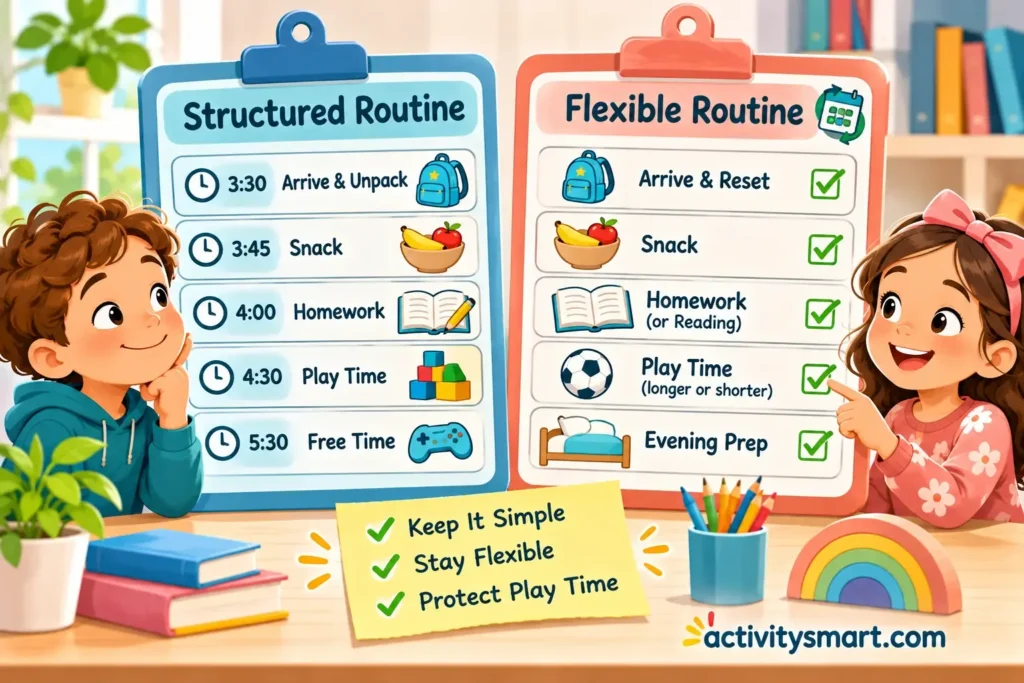
A routine is a predictable order of events; a schedule assigns an exact clock time to every event. Families often need the first without the second. A child who knows that a snack is followed by outdoor time and then a short responsibility has less to guess about, even when dismissal, commuting or caregivers change.
The American Academy of Pediatrics describes an after-school pattern that can include food, movement, relaxation and study in the order that suits the child. Its AAP guidance on family routines emphasizes that children need opportunities for active play after a long school day. This is guidance to adapt, not proof that one fixed sequence improves every child’s grades or behavior.
Play is not simply the reward for finishing everything else. The American Academy of Pediatrics report on play describes links between developmentally appropriate play and social, emotional, language and self-regulation skills. Those benefits do not mean every minute must teach a skill. A child building an imaginary shop, climbing safely, or chatting with friends can be enjoying play for its own sake.
Think in anchors rather than a countdown
Choose three or four reliable anchors: arrive and reconnect, refresh and play, handle necessary responsibilities, then shift toward the evening. You might describe them with words or simple pictures. The exact timing can move when a bus is late, a child is tired or the weather is beautiful. If the plan requires constant reminders and stopwatch negotiations, it is probably too complicated.
Build the routine in five manageable phases
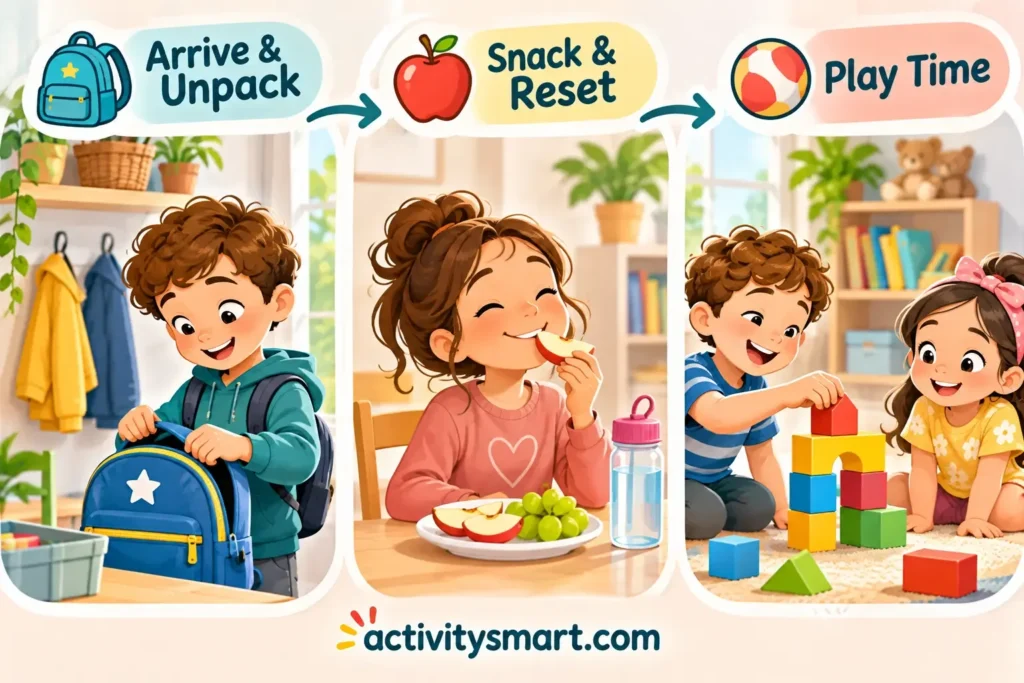
Arrival: make contact before asking for a report
Start with a simple greeting rather than a rapid interview: “I’m glad to see you. Want a hug, some quiet, or to tell me one thing?” Some children talk on the way home; others need to watch the scenery or sit silently. There is no requirement to summarize an entire school day at the door.
Create one landing spot for bags, coats, notes and lunch containers. A low hook and a clearly marked basket are more useful than a complicated organization system. Offer help when the child is overloaded; independence grows with practice and accessible tools, not with criticism about what was forgotten.
Refuel: meet basic needs without making a second dinner
Handwashing, a drink of water, and a familiar snack can make the transition more comfortable. Offer choices that work for your household, taking account of allergies, dietary needs and the timing of dinner. A child who ate just before pickup may not be hungry; a child with a long bus ride might be. Avoid turning a suggested snack window into a demand to eat.
Recover: offer a genuine choice of play
Place two accessible options in front of the child: “Would you rather draw quietly or play outside with me?” That kind of choice gives agency without turning the entire afternoon into a negotiation. For another child, alone time with blocks or a pretend game may be the better reset. Do not assume a busy child needs the same activity as an exhausted one.
Aim to include plenty of unhurried play across the afternoon, rather than prescribing a scientifically proven number of minutes. It might be ten minutes before an appointment and much longer on a free day. The meaningful distinction is whether play is a real, protected part of family life or something that disappears whenever a task runs late.
Responsibilities: keep the next task small and visible
If homework is assigned, check what actually needs doing before setting a timer. A single worksheet or reading conversation is not the same as a demanding project. Divide tasks into small parts, provide a clear starting point and ask the child what help is needed. If the child is overwhelmed, contact the teacher rather than stretching the assignment across the evening.
Evening: create a gentle landing toward bedtime
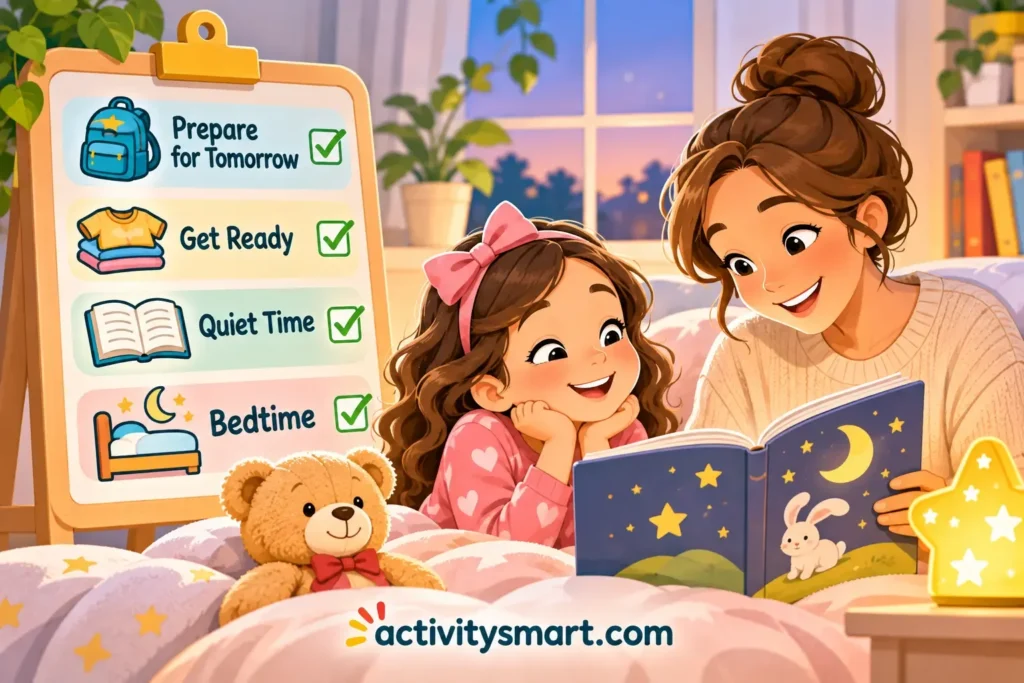
Dinner, a brief tidy-up and calm family connection can lead into bathing, reading or another preferred wind-down ritual. Prepare bags and clothes at a moment when adults have capacity; do not make a tired child manage a large checklist at the last possible minute. Families using a consistent morning setup may also find a calmer morning routine helpful.
Sleep limits the afternoon more reliably than an arbitrary homework deadline. The CDC guidance on sleep by age gives general daily sleep recommendations of 10–13 hours for ages three to five, including naps, and 9–12 hours for ages six to twelve. Individual needs vary. If the household is regularly pushing bedtime later to squeeze in more tasks, reconsider the load rather than shortening sleep.
Sample after-school schedules for different days
Use the examples below as adjustable sequences beginning at arrival. Durations are illustrative household choices, not research-backed minimums. For children in aftercare, “arrival” may mean getting home in the early evening; keep the routine shorter rather than attempting to replay the whole afternoon.
| Situation | First steps | Play opportunity | Responsibility and evening |
|---|---|---|---|
| Preschool or kindergarten, no homework | Greet, wash hands, snack or water | Open-ended play outdoors or indoors while supervised as needed | Small helper job, meal, story and bedtime routine |
| Early elementary with light homework | Connect, snack and decompress | Free movement or quiet creative time before or after a short assignment | One clear homework block, dinner, pack up, wind down |
| Late pickup or aftercare | Reconnect and check hunger | Brief but protected child-chosen play or connection | Only essential tasks, calm evening and sleep |
| Sports or activity day | Snack, change and travel | Small pocket of unstructured play or social time | Simple dinner and streamlined preparation |
A family might try 20 minutes to reconnect and eat, 30 to 45 minutes of play, and a brief homework session; another might reverse play and homework. Neither sample guarantees better concentration. Look instead at the child’s mood, completion of genuine obligations, time for relationships and ability to settle at night.
Should homework happen before or after play?
Neither order is automatically best. Some children are ready to finish a small task immediately and then relax. Others have spent the day staying still, listening carefully and managing social expectations; a period of movement or solitude may help them approach homework more willingly. Start by observing the child rather than defending a household rule that repeatedly fails.
When play first is a sensible choice
Try play before homework when the child arrives restless, irritable, hungry or reluctant to sit down. State the sequence without presenting play as a bargaining chip: “We can head outside now. When we come in, we’ll look at what school sent home.” Use a visible cue, such as putting shoes by the door, so the transition does not rely only on an unexpected alarm.
When homework first may be easier
A child who likes to clear an easy assignment before going to the park may prefer homework first. Check whether this is their choice or a response to anxiety about getting in trouble. Keep the workload realistic, provide a break and ensure that play will still happen. “Finish this short reading and then we have the rest of the afternoon” should only be said when the promise is true.
Choose play that fits the child, not a checklist
Outdoor movement and active play
Walking, playground games, safe cycling, dancing and simple chasing games let children use their bodies in different ways. Supervise according to age, setting and abilities, and use suitable protective gear where appropriate. An outdoor option does not require a long trip: sidewalk chalk in a safe area or a ball game in a permitted space may be enough.
On days with unsafe weather, no accessible outdoor space or a child with limited mobility, adapt the goal. Indoor movement, a gentle stretching game or accessible active play can provide a welcome change. Do not imply that a child must run to deserve rest, or that a family without a garden cannot build a good routine.
Quiet imagination, making and reading
Some children recover through drawing, pretend play, music, construction toys, picture books or simply being alone. Offer materials the child can use safely without an adult conducting a lesson. A pretend restaurant or a paper collage does not need learning objectives, a photograph for social media or an evaluation afterward.
For a child who asks for ideas, try pattern games with everyday materials or hands-on fine motor activities as optional inspirations. These can be playful, but the adult should not turn every activity into required skill practice. A child who has worked all day may reasonably choose a simple, familiar game rather than the most educational-looking option.
Social play and connection
Sibling games, a neighborhood friend, a shared card game or a few minutes of one-on-one attention can be part of the afternoon. Set clear boundaries around physical safety, consent and respectful language. Invite rather than require social contact: a child who spent the day in a crowded classroom may prefer space before engaging with siblings.

Adapt the plan by age, temperament and needs
Ages three to five: keep the sequence visible and simple
For many preschoolers, a picture sequence showing “home, snack, play, dinner, bath, book” is easier to grasp than clock times. Use just a few pictures at first and let the child move a marker when a step is finished. The CDC examples of flexible family routines offers examples ranging from detailed routines to general family patterns, recognizing that households need different levels of structure.
A preschooler may need adult help washing up, choosing a snack, finding play materials and ending activities. Expect occasional disappointment rather than treating it as a failure of the chart. Make room for rest or naps where needed, and avoid assigning academic work merely because an older sibling has homework. For other everyday readiness ideas, see play-based school readiness skills.
Ages six to eight: build ownership one step at a time
Early elementary children may enjoy choosing between two play activities or deciding whether a small reading task comes before or after the park. Put school notes in one location and allow the child to check off a short routine with help. Review the system together once a week instead of correcting it every few minutes.
When reading is assigned, distinguish practice from punishment. Read together, take turns or choose an inviting book when allowed. If the child is becoming reluctant, the ideas in encouraging a reluctant reader can support a more welcoming relationship with books. Follow teacher guidance about actual assignments, and keep space for reading purely for enjoyment.
Ages nine and ten: invite planning, preserve downtime
Older elementary children often have additional interests, friendships and responsibilities. Offer them a role in deciding the order of events, where a backpack belongs, and how to remember a club or project. They still benefit from adult help with unrealistic workloads, transportation, conflict and bedtime planning. Independence does not mean managing everything without support.
Temperament matters across ages. A sociable child may want to talk immediately; a child who is sensitive to noise may need a quiet corner. A child with a disability or a developmental difference may benefit from more consistent cues, accessible materials or individualized support. Do not compare siblings as though one family timetable should fit everybody.
Make transitions calmer without over-controlling them
The difficult moment is often not the activity but the switch. “Stop playing, do homework, wash up, set the table” contains several demands at once. Replace it with a clear first step and, when possible, advance notice: “When this round is finished, we’ll wash hands for dinner.” Follow through calmly, and acknowledge frustration without giving up every boundary.
Use choices inside boundaries
Adults set non-negotiable safety and family needs, while children choose manageable details. For example: “Homework is due tomorrow. Would you like to start after snack or after we walk?” That is a genuine choice only if both options are available. Offering fictional options creates more arguments, not collaboration.
Notice the difference between needing help and refusing. A child who cannot locate a notebook, understand directions or begin a writing task may appear defiant while actually being stuck. Sit alongside, find the first manageable action and step back as they can proceed. Keep your tone especially gentle when the child has had a hard school day.
Screens, activities and the hidden time squeeze
Screen use is one choice among many, not automatically the enemy of a healthy afternoon. Families can agree when digital games, videos or communication fit without displacing essential sleep, school obligations, relationships and opportunities for movement. A predictable ending and an appealing next option may work better than surprise device removal. For a related approach, see setting predictable screen time boundaries.
After-school clubs can be enriching and enjoyable, yet every scheduled activity comes with transportation, equipment, waiting and recovery time. Look at the entire week rather than one packed afternoon. Ask whether the child has any unscheduled time to invent games, rest and simply be with family. A calendar full of valuable activities can still feel exhausting.
Caregivers juggling shifts, commuting or several children may not be able to supervise a long outdoor play session every day. The goal is not to imitate an idealized family timetable. Use whatever safe opportunities are realistic: a game at the kitchen table, independent imaginative play while dinner is prepared, or a visit to a nearby park when circumstances allow.
Common routine mistakes and better alternatives
- Scheduling every minute: protect a sequence but leave room for the unexpected, especially travel delays and emotional needs.
- Using play only as a reward: give play a genuine place even on days when homework is challenging.
- Asking too many questions at pickup: reconnect first and let conversation emerge in a comfortable moment.
- Giving several instructions at once: identify the next action and offer needed support.
- Changing rules without warning: explain unusual days in advance where possible, using a simple visual or conversation.
- Assuming one child’s plan fits another: adapt to age, interests, accessibility and energy.
- Keeping too much in the evening: protect sleep and talk with teachers about consistently excessive homework.
For additional strategies on ways to respond to homework frustration and supportive classroom transitions, consider individual transition needs. If the routine causes arguments every day, do not respond by adding more stickers, alarms and consequences. Simplify it. Ask which transition is hardest and change one element. Often a missing snack, a task that feels impossible, or too little unstructured time explains more than a lack of motivation.
Safety and when to seek additional support
Choose activities and spaces appropriate to the child’s age and abilities. Young children need suitable supervision near roads, water, tools, playground equipment and food preparation. Follow specific allergy, health and accessibility guidance already provided to the family. When several children are playing together, check that the older child is not being made responsible for safety beyond their capacity.
Ordinary frustration after school can happen, but persistent distress, marked changes in behavior or sleep, fear about school, repeated physical complaints, or overwhelming homework merit a supportive conversation with the teacher or a qualified health professional. These signs do not establish a diagnosis. Listen carefully to the child’s account and seek individualized advice instead of relying on a routine chart to solve a broader concern.
Some children experience significant demands from sensory environments, bullying, disability-related barriers or insufficient school support. A home routine should not be used to conceal these problems. When needed, work with the school and relevant professionals on accommodations and a realistic transition plan. A child’s safety and well-being take priority over keeping the timetable perfectly intact.
Try a seven-day routine reset without making it another project
On the first day, ask your child what feels easiest and hardest after school. Observe the current afternoon without scoring their behavior. On the second day, select the three or four anchor steps and put essential items within reach. On the third, protect a clear play window and resist using it to complete chores that could wait.
Midweek, test the homework position if there is an assignment and record what made starting easier. Later, check whether your evening preparation is stealing sleep or family connection. At the end of the week, ask: “What should we keep? What should we change?” There is no need to count compliance percentages or promise a dramatic transformation.
Final takeaway: predictability with breathing room
A simple after school routine works best as a flexible rhythm: connection, basic needs, meaningful play, manageable responsibilities and a calm evening. The precise order can differ by child and by day. When competing priorities arise, protect safety, relationships and sufficient sleep instead of insisting that every task fit an ideal timetable.
Start with one small change tomorrow. Invite your child to choose what play will look like, make the next transition understandable, and keep the plan light enough that everyone can actually live with it. A routine should make afternoon life easier, not become another assignment.
Frequently asked questions
What is a good after school routine for elementary school children?
A good after school routine includes a warm welcome, a chance to eat or drink, unhurried play, necessary responsibilities and a predictable bedtime. Adjust the order to the child’s energy and school workload.
Should my child play before doing homework?
Yes, play can come before homework when it helps your child reset, provided there is still a realistic time for assigned work. Some children prefer to finish a small task first, so observe which sequence is sustainable.
How long should after-school play last?
There is no single evidence-based number of minutes that fits every family. Make play a meaningful part of the day while considering pickup time, safety, assigned work, meals and sleep.
What if my child is upset or silent after school?
Offer connection, food or water if needed, and space without demanding an immediate explanation. If distress is persistent or intense, speak with the child, school and an appropriate professional about possible causes.
How can I make a routine for a preschooler?
Use a few familiar steps with pictures or simple words, such as home, snack, play, meal and bedtime. Provide hands-on help and allow time for rest rather than imposing elementary-school homework expectations.
What if we do not get home until early evening?
Use a shortened version that keeps reconnection, a little child-chosen play and essential evening tasks. Avoid recreating an entire afternoon of activities at the cost of sleep.
Should screens be allowed after school?
Screens may fit within a family’s plan if their use does not crowd out sleep, connection, physical activity and other needs. Agree on predictable boundaries and transitions instead of making every screen session a battle.
How do I handle homework that takes the whole evening?
Contact the teacher to clarify the intended workload and identify where your child is struggling. Break tasks into manageable pieces, support the starting step and avoid routinely sacrificing sleep or play.
Can siblings follow different after-school routines?
Yes, siblings can share household anchors while having different play, rest and homework needs. Age, temperament, disabilities and school demands may require individualized choices.