
Quick Answer
Build a family reading routine by choosing one predictable moment, keeping appealing books nearby, and reading together for five to ten enjoyable minutes when possible. Let children help choose what to read, use stories or pictures to start conversations, and keep a shorter backup option for hectic days. Consistency matters more than finishing a book or reaching a rigid daily timer.
Quick Picks
- Little time: share one picture, poem, or short chapter before a usual transition.
- Mixed ages: read aloud together, then offer individual books at different levels.
- Tired evenings: use a daytime anchor or choose an audio story with a brief chat.
- Resistant child: offer two genuine choices and stop before it becomes a battle.
A full calendar does not mean books must become another task to manage. For families with work shifts, sports, school pickup, younger siblings, or unpredictable evenings, a small reading habit can fit into the margins. The goal is a dependable invitation to share language and stories, not a perfect nightly performance.
This guide gives parents and caregivers a plan they can adapt to children roughly ages three through ten. It explains how to choose an anchor, fit books around competing demands, read differently with emerging and independent readers, and adjust when motivation changes. The American Academy of Pediatrics literacy-promotion policy encourages shared reading as a regular, enjoyable family activity; it does not require every household to use an identical schedule.

Why a family reading routine works better when it is flexible
Children tend to understand familiar patterns: after shoes come off, after dinner dishes are cleared, or just before turning out the light. Placing a book next to an existing event removes the need to negotiate a new time every day. It is a planning strategy rather than a claim that one exact schedule improves reading scores.
Reading aloud exposes children to vocabulary and storytelling, while conversation about characters and pictures gives them an opportunity to explain ideas. Shared books also give caregivers a low-pressure way to connect. Reading Rockets family read-aloud guidance recommends child choice, discussion, and regular reading; the advice focuses on the quality of interaction as well as frequency.
Choose connection before measurement
A timer may help adults protect a small window, but it should not be the child’s scorecard. When an ending is natural, stop there. A child who wants to inspect one illustration for five minutes is still engaging with a book. A child who prefers a familiar story may be practicing language and prediction through repetition rather than making no progress.
Ask yourself after a week: Did we find an occasion that felt calm? Did my child have a say? Could I repeat it on a difficult day? These questions reveal more about sustainability than tracking pages completed. If your household already has competing commitments, build on a flexible after-school routine instead of adding an entirely separate obligation.
Build a family reading routine in five practical steps
Find an anchor that already happens
Write down three existing transitions: breakfast cleanup, waiting at pickup, coming in from the playground, washing up, or getting ready for bed. Pick the one that is usually predictable and has a few minutes of calm. Bedtime is popular, but it is not mandatory. A parent on an evening shift might read at breakfast while another caregiver reads after supper.
Try this cue: “After we put our cups in the sink, you choose a story.” The cue works because it names a familiar event rather than an abstract time on a clock. If weekends look different, use a separate weekend anchor, such as a library visit or reading after lunch.
Start smaller than your ideal
Choose a starter amount your family can manage on a busy day: one page, one poem, or five minutes. Some children will ask for more; follow their interest when time allows. The purpose of a small baseline is to prevent an ambitious target from becoming another source of stress. This is a practical starting point, not a clinical recommendation or an established threshold for learning gains.
Make books easy to reach
Place a small rotating selection where the routine occurs. A soft basket near the couch or a few books by the breakfast table can work better than storing everything in another room. Use borrowed library books, secondhand copies, existing favorites, or printable text from legitimate sources. New purchases are not necessary to begin.
Share control of the book and the pace
Give two reasonable options: “Shall we read about a dragon or a garden?” Let children turn pages, describe pictures, ask questions, or listen quietly. Repeating one favorite book can be comforting and offers chances to notice new details. You can also alternate who chooses a book, especially when siblings disagree.
Avoid using the routine to quiz children about every sentence. A friendly prompt such as “What do you notice?” usually feels different from a test. If the child is immersed in the story, keep reading. More questions are not automatically better. Interactive reading guidance from Reading Rockets interactive reading prompts specifically recommends using prompts when the child is engaged, not on every page.
Create a backup plan for chaotic days
Write one sentence your household can remember: “When our usual time disappears, we will read a favorite page or talk about one picture.” A short backup could happen in a waiting room, at a bus stop when safely seated, or after a meal. For shared reading while traveling, adults should never read while driving; use audio only when it does not distract the driver.
If several nights pass without books, restart at the next workable anchor rather than making up missed minutes. Kids benefit from seeing adults adapt plans calmly. Pair the reading window with a calmer morning routine if mornings are reliably quieter than evenings.

Choose reading moments that fit your actual schedule
The best time is a time an adult can usually be present and the child can engage. Some families have open mornings; others share a short window after dinner or during childcare pickup. Compare the options by the demands of your household, not by whether they sound like a traditional bedtime story.
| Reading moment | Useful when | Possible obstacle | Flexible adjustment |
|---|---|---|---|
| Before school | Evenings are unpredictable | Rushed departures | Choose one poem after breakfast |
| After school | A child needs reconnection | Hunger or fatigue | Offer a snack and rest first |
| Before bed | Evenings are calm | Late activities or tiredness | Stop at a natural page break |
| Weekend or library visit | Weekdays vary with shifts | Long gaps between sessions | Add occasional short weekday reads |
| Waiting or travel time | Small gaps occur often | Distractions and noise | Use a pocket book or discuss pictures |
For households that already use practical screen-time boundaries, consider keeping one optional screen-free moment available for books. This does not mean books must replace all digital media, and an occasional carefully chosen e-book can also support reading. What matters is having an adult and child able to attend to the text together.
Match the reading experience to ages and abilities
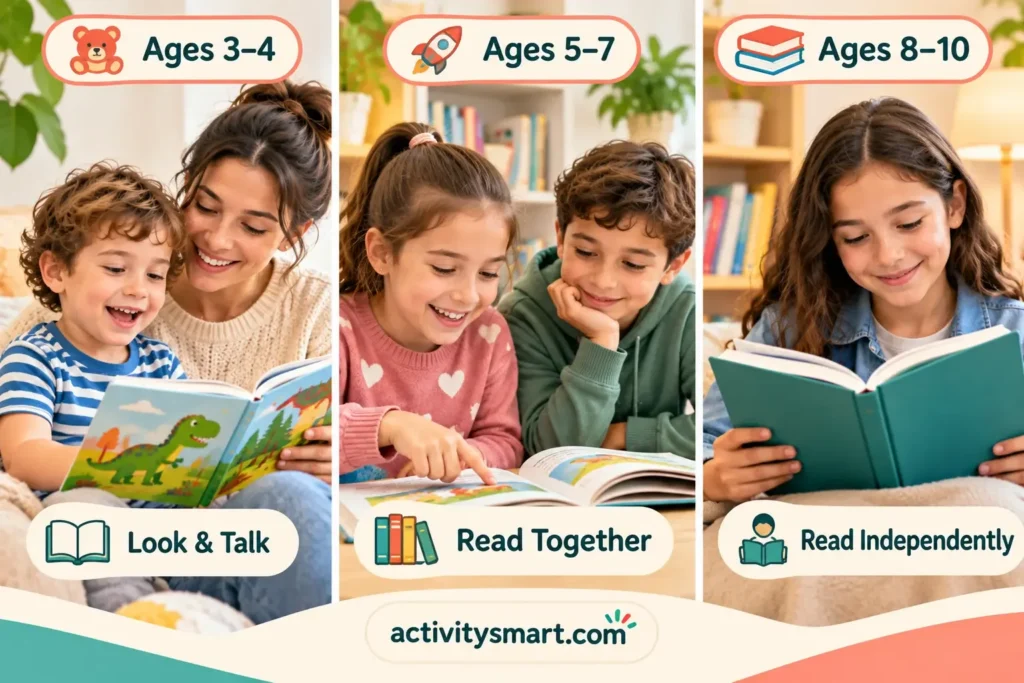
Ages three to five: pictures, rhythm, and conversation
Preschoolers do not need to decode printed text to participate. Read expressive stories, name what is happening in pictures, pause for a funny prediction, and welcome a child’s invented version of events. Rhymes and repetitive phrases can make participation easy without turning the activity into a lesson. A child may move around while listening; comfortable attention looks different across children.
Choose books with clear illustrations, manageable amounts of text, and topics that reflect the child’s interests and experiences. You can support school readiness beyond worksheets through talking, play, and shared books, without insisting that a preschooler master reading before kindergarten. For children showing curiosity about sounds in words, playful ways to introduce letter sounds offers ideas; keep those activities separate from pleasure reading when the child wants only a story.
Ages six to eight: share the work without taking over
Children learning to decode may find aloud reading hard after a demanding school day. An adult can read most of the text while inviting the child to tackle a familiar phrase, a speech bubble, or a page they volunteer for. Alternating pages is an option, but do not turn it into a requirement. Reading together can remain valuable while formal decoding instruction develops elsewhere.
If a child makes a mistake, decide whether correction matters for understanding. For independent reading practice, accurate decoding matters, and a teacher can help explain suitable strategies. During a cozy family story, constant interruption may overwhelm the purpose of the moment. The distinction between listening comprehension and print decoding is described in the difference between phonemic awareness and phonics; one should not be mistaken for the other.
Ages nine and ten: make room for independence
Older children may prefer to read on their own, but shared stories still have a place. Offer parallel reading—each person with a different book—and finish with one optional sentence about an interesting part. Another choice is to read a more complex book aloud that a child enjoys hearing but would not yet choose for independent reading.
Make reading interactive without turning it into homework
A helpful middle ground is to read naturally and invite occasional conversation. With a younger child, point at a character and ask, “How do you think they feel?” With an older child, notice a surprising decision and ask what they might have chosen. Let the response be short or long. When a child does not want to answer, reading can continue.
Interactive approaches, sometimes called dialogic reading, involve the adult listening as the child describes parts of the book. Reading Rockets describes a PEER sequence: prompt a response, acknowledge it, expand with a little information, and revisit the idea. You do not have to perform all steps in every interaction; child interest should guide the conversation.
Three conversation moves that fit into a short read
- Notice: “I see the character carrying an umbrella on a sunny day. What do you notice?”
- Connect: “That bus looks like the one we took last weekend.”
- Wonder: “What might happen if the puppy opens that gate?”
For school-age children, vary the invitations: ask what was confusing, which character changed, or whether the ending seemed fair. One thoughtful exchange can be enough. Additional examples are available in our picture-book comprehension conversations. Try not to ask only questions with one correct answer; conversation makes room for multiple interpretations supported by the story.
Use familiar books for deeper talk
Rereading a known story makes it possible to talk about details you skipped before. First, enjoy the plot. Next time, ask how a character knew what to do. Another day, compare the book with a real-world experience. There is no need to schedule these as separate lessons. When children ask for the same book repeatedly, the repetition can serve both comfort and conversation.
Build a small book collection without spending much
Start with the books already at home. Separate a handful into a reachable basket and refresh the basket when interest fades. If your library offers borrowing, ask about picture books, beginning-reader series, books in home languages, and accessible formats. Borrowing makes it easier to follow changing interests without buying a new title for every phase.
A useful selection contains varied lengths rather than strictly levels: one very quick option, one familiar favorite, one high-interest nonfiction choice, and something an adult enjoys sharing. Choice matters because the child is more likely to approach a book that feels personally relevant. For caregivers with multiple children, keep at least one book each child can select.
When digital books are the practical option
An e-book can help when traveling, when large print or adjustable text is needed, or when a library offers digital lending. Reduce competing alerts, sit together when possible, and talk about the story just as you would with paper. If animated features interrupt the narrative, choose a simpler reading mode. The decision is not paper versus technology in the abstract; it is whether the format helps your child enjoy and attend to a story.
Audio stories are another way to share narratives during a busy week. They give children access to language and plot, but listening alone is not identical to practicing print decoding. You can combine listening with a related book later, or ask the child about a favorite character after the story ends.
Adapt the routine to different family situations
Two or more children at different levels
Choose a shared read-aloud accessible to younger children but interesting enough for older siblings, then allow each child to browse an individual book. Older children may volunteer to read to younger siblings, but should not be assigned the job every day. Rotate book selection fairly; one child’s favorite does not need to become the permanent family favorite.
Caregivers working shifts or in separate homes
Create a routine that travels with the child rather than depending on one adult. The cue might be “after the first evening meal together” or “before leaving for school,” with each caregiver choosing a realistic moment. A phone or video read-aloud with a trusted family member can help when separated, but should follow family privacy and device rules.
Children who dislike sitting still
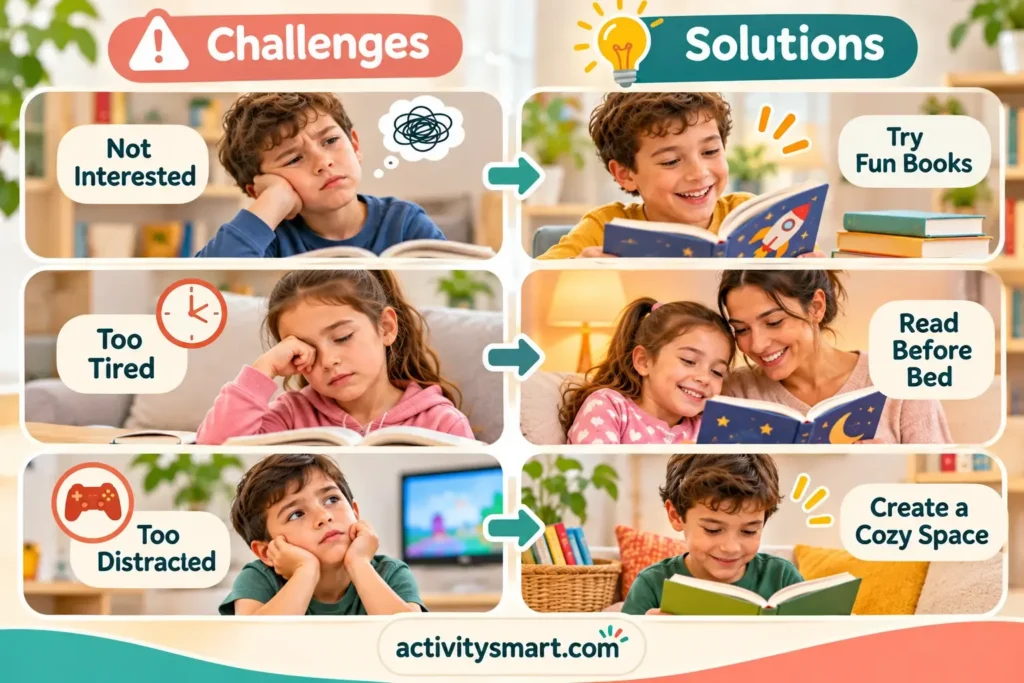
Allow a child to listen while drawing, holding a soft toy, or changing position, provided the activity is safe and the book still has a chance to be heard. Try short humorous books, wordless picture books, or stories related to a strong interest. For some children, a short daytime reading window is more comfortable than a late-night expectation.
If refusal continues, explore ways to support a reluctant reader for gentler ways to make books appealing. Persistent distress around reading should not lead to punishment or labeling a child as lazy. It may be useful to speak with the child’s teacher about the level and type of reading being offered.

Common mistakes that make reading feel like a chore
- Starting with an inflexible target: a thirty-minute rule can be unrealistic after a long day. Begin with a window you can repeat.
- Correcting every word during pleasure reading: separate gentle skill practice from a relaxed story when possible.
- Using books as a punishment: do not make reading the consequence for an unrelated behavior.
- Counting pages instead of noticing interest: lingering over illustrations is not wasted time.
- Removing child choice: give real options within your available time.
- Comparing siblings: different ages and literacy profiles call for different approaches.
- Demanding questions after every paragraph: interruptions can reduce enjoyment and flow.
- Abandoning the routine after missed days: restart from the smallest version.
The point is not that every educational question or decoding correction is harmful. Instruction has an important place, and children sometimes welcome help. Problems arise when every shared book becomes an assessment or when family connection depends on performance. In moments of frustration, approaches in responding to big feelings during learning may help keep an adult response calm and supportive.
Avoid rewards that accidentally replace enjoyment
When reading difficulty needs more than a routine
A family reading habit can support language exposure and enjoyment, but it does not replace explicit literacy instruction or assessment. If a child repeatedly struggles to recognize taught letter-sound relationships, avoids print because it feels unusually difficult, or shows a persistent gap relative to classroom expectations, talk with the teacher. Bring specific observations such as which tasks are hard and when the difficulty appears.
If hearing, vision, speech, or broader developmental concerns arise, ask an appropriately qualified professional. Do not diagnose dyslexia, an attention condition, or a language disorder based on a child’s behavior during one family story. A calm conversation with a teacher or pediatrician can help determine whether screening or additional support is appropriate.
For children who already receive educational support, ask how to make home reading enjoyable without duplicating exhausting instruction. A teacher may recommend suitable independent texts while the family continues a separate read-aloud book. The two activities can meet different needs and should not be confused.
Respect safety, access, and comfort
Choose books and physical arrangements suited to the child. Keep books with detachable small parts away from younger children who mouth objects, follow age guidance for accompanying accessories, and supervise use of small reading lights or electrical devices. Good lighting and an accessible position matter more than an elaborate reading nook.
Children with motor, vision, hearing, or communication differences may use large print, tactile or audio formats, sign-supported storytelling, picture communication, or other adaptations. Ask the child and relevant specialists what helps them participate. Family reading should be welcoming, not restricted to one mode of sitting, speaking, or seeing.
A sample seven-day starter plan for busy families
Use this as a menu rather than an assignment. The proposed minutes are flexible planning examples, not minimum standards that have been tested against learning outcomes. Change the anchor whenever it stops working.
| Day | Simple plan | If time disappears |
|---|---|---|
| Monday | Child chooses a picture book after dinner | Look at the cover and one page |
| Tuesday | Read a short poem at breakfast | Repeat a favorite rhyme |
| Wednesday | Share a nonfiction spread about an interest | Talk about one illustration |
| Thursday | Reread a favorite and notice a new detail | Read the favorite ending |
| Friday | Offer quiet independent or parallel reading | Tell each other a favorite book title |
| Saturday | Borrow or browse books together | Choose from books already at home |
| Sunday | Let a child choose the next week’s basket | Pick only tomorrow’s book |
Final take: keep the invitation easy to accept
A sustainable family reading routine starts with an everyday anchor, a small achievable session, accessible books, and room for child choice. It changes as children grow and schedules shift. Read aloud to emerging readers, keep sharing stories with capable readers, and separate formal skill practice from the pleasure of being together when that distinction helps.
If this week is crowded, choose one moment and one book. Notice how your child responds, then adapt. The goal is not to manufacture an impressive reading streak; it is to make returning to stories feel possible. For additional evidence-informed encouragement, see HealthyChildren reading encouragement advice.
Frequently Asked Questions
How many minutes should a busy family read together?
There is no single required number of minutes for every family. Start with a short, enjoyable window such as five minutes and expand when your child wants to continue; regular opportunities and positive interaction matter more than enforcing a rigid timer.
Is bedtime the best time for a reading routine?
No, bedtime is only one useful option. Breakfast, after school, or another predictable transition may work better if evenings are exhausting or household schedules vary.
Should I still read aloud after my child can read independently?
Yes, reading aloud can remain part of family life after a child learns to decode independently. Shared books offer conversation and access to stories that may be more complex than the child wants to tackle alone.
What if my child wants the same book every night?
It is fine to reread the same favorite book. Familiar stories can invite prediction, comfort, and new conversation; offer other options gently without making novelty a requirement.
What if my child refuses to read with me?
Do not force a reading session when your child refuses. Offer a choice of interesting books, shorten the moment, or try another time; if distress or difficulty is persistent, discuss it with the child’s teacher.
Can audiobooks count as family reading time?
Audiobooks can be a valuable way to share stories and discuss language, particularly on busy days. They do not replace every aspect of practicing printed-word decoding, so use them alongside suitable print experiences when possible.
How can I read with children of different ages?
Choose a shared story that several ages can enjoy and give each child additional choices suited to their interests and reading abilities. You can also use short separate sessions or parallel reading instead of forcing everyone into one level.
Do I need to ask comprehension questions after every story?
No, children do not need a quiz after every book. Occasional open-ended questions and natural comments can deepen conversation, but quiet listening and shared enjoyment are also legitimate ways to participate.
What should I do when we miss several days?
Restart with the shortest version of your routine at the next practical moment. There is no need to make up pages or time; notice why the previous anchor failed and adjust the plan.
Sources and further reading
These sources discuss shared reading, early literacy, family encouragement, and interactive conversation. They support the general guidance above; the sample times and schedules in this article are adaptable suggestions, not research-derived prescriptions.