Quick Answer
Visual discrimination activities help children notice which objects, shapes, pictures, and symbols look alike or different. Start with matching two familiar items, move to sorting by one visible feature, and then try simple spot-the-difference puzzles. Use clear examples, relaxed conversation, and increasingly varied materials rather than timed tests.
Quick Picks
- First try: matching pairs of large, familiar pictures or toys.
- For preschool groups: sorting oversized shapes by color, then by shape.
- For older learners: comparing two detailed scenes and explaining the differences.
- Low-prep materials: socks, blocks, homemade picture cards, and books.
- Best adjustment: reduce visual clutter before making the rules harder.
Visual discrimination activities are simple games of noticing: Which mittens belong together? How is this triangle different from that one? What changed between two drawings? For children ages three to ten, matching, sorting, and carefully comparing pictures provide concrete practice in looking for useful details. They also open up conversations about color, shape, size, position, and patterns.
You do not need a purchased kit, a stopwatch, or an elaborate worksheet. The goal is thoughtful observation, not a perfect score. This guide shows how to choose a starting level, give a clear prompt, adapt a task when it becomes frustrating, and connect the game to ordinary play without presenting it as treatment for a learning difficulty.
What visual discrimination means for children
Visual discrimination is the ability to recognize similarities and differences among visual features. A child may distinguish two shapes by their outlines, notice that two pictures have different numbers of windows, or recognize a familiar symbol amid other symbols. It is one part of visual perception, a broader process of interpreting information seen by the eyes. It is not identical to visual acuity, which concerns how clearly someone sees.
Children also draw on attention, vocabulary, past experience, and memory while playing these games. A child who misses an item may be distracted, unfamiliar with the object, unsure of the instructions, or uncomfortable with a crowded page. One performance does not isolate the cause. The NHS overview of visual-perception skills explains why visual perception and eyesight are related but distinct and why vision checks may be appropriate when concerns persist.
What children are actually comparing
Useful visual features include color, geometric shape, size, orientation, number, pattern, and small identifying details. Start with highly visible differences, such as a red circle beside a blue square. Next compare red circles of different sizes, or a square and rectangle in the same color. Later, invite children to notice which way an arrow points or which character in a story picture wears a different hat.
The important move is to ask for evidence: “What did you notice?” or “Show me the part that changed.” A verbal description is helpful but not mandatory; pointing, pairing, moving, or selecting can communicate the same observation. If language makes the task difficult, model a short description without making speech a condition for participation.
How it fits with early literacy and mathematics
Matching and sorting are useful early mathematical experiences because they invite children to classify objects using attributes. The IES guidance on early mathematics recommends progressing through shape and other mathematical ideas with opportunities to describe what children notice. Visual comparisons also appear when recognizing printed forms, but matching cards alone does not teach decoding, phonemic awareness, or fluent reading.
To connect play with literacy, name a letter while noticing its distinctive features, then teach its associated sound explicitly using teaching letter sounds. To connect with mathematics, sort shapes, describe why they belong together, and explore pattern recognition through playful sequences. Avoid claiming that any one puzzle guarantees better school performance.
Matching games: begin with a clear success
Same-object pairs with everyday materials
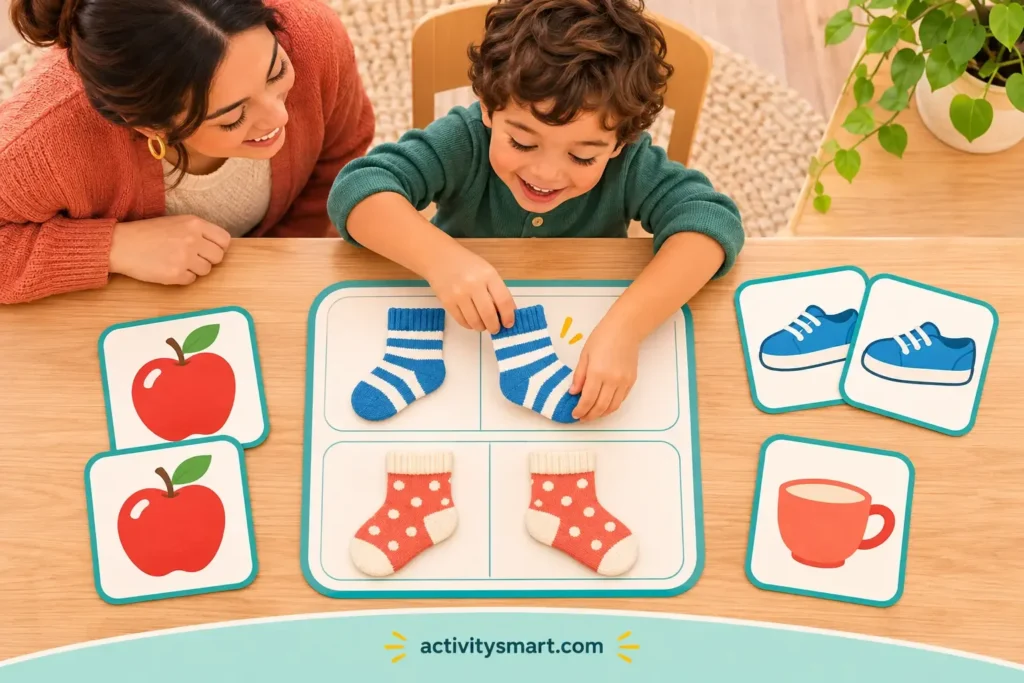
Choose three pairs of clearly different, child-safe objects: two large blocks, two matching cloth napkins, and two toy vehicles, for example. Put one item from each pair on a mat and hand the child a match. Ask, “Can you find its partner?” Begin with two choices if needed. Once the child understands the game, offer three or four choices and invite a reason such as “both are blue” or “both have wheels.”
Real objects are often easier to compare than small printed pictures. Their size and texture provide additional clues, and a child can physically place them together. That is not cheating; it is a scaffold. If the child guesses repeatedly, simplify the display, show one model pairing, and let the child complete the next one. Save a difficult all-picture version for later.
Picture-card matching and memory variants
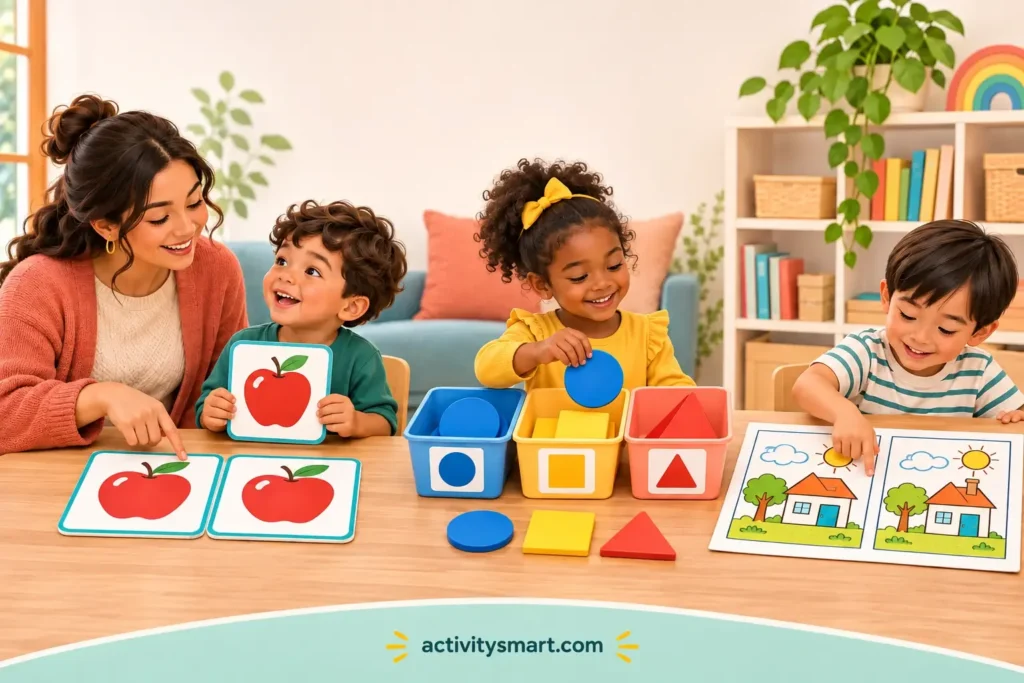
Make two copies of several simple drawings, photographs, or large printed icons. Lay them face up and start with matching identical images. Then try matching two pictures of the same category that are not identical, such as different shoes, while explaining the new rule. This changes the cognitive demand: matching identical pictures is not the same as classifying related examples.
A face-down memory game adds remembering locations as well as noticing whether images match. Use only a few pairs at first and describe the game accurately: it practices visual comparison alongside memory and turn-taking. For a child who finds recall frustrating, return the cards face up. For a playful literacy connection, pair a scene from a favorite story with a matching object while using talking about details in picture books.
Match in the room, not only on the table
Ask a child to find another striped cushion, a picture with the same animal, or a shoe that matches one by the door. Outdoors, compare broad leaf shapes or similarly colored flowers without picking unknown plants. Movement offers a change of pace and allows children to notice visual details in a less artificial setting. Talk about the exact feature that counts as a match rather than changing the rule unexpectedly.
Sorting activities: teach the rule, then vary it
Sort by one feature first
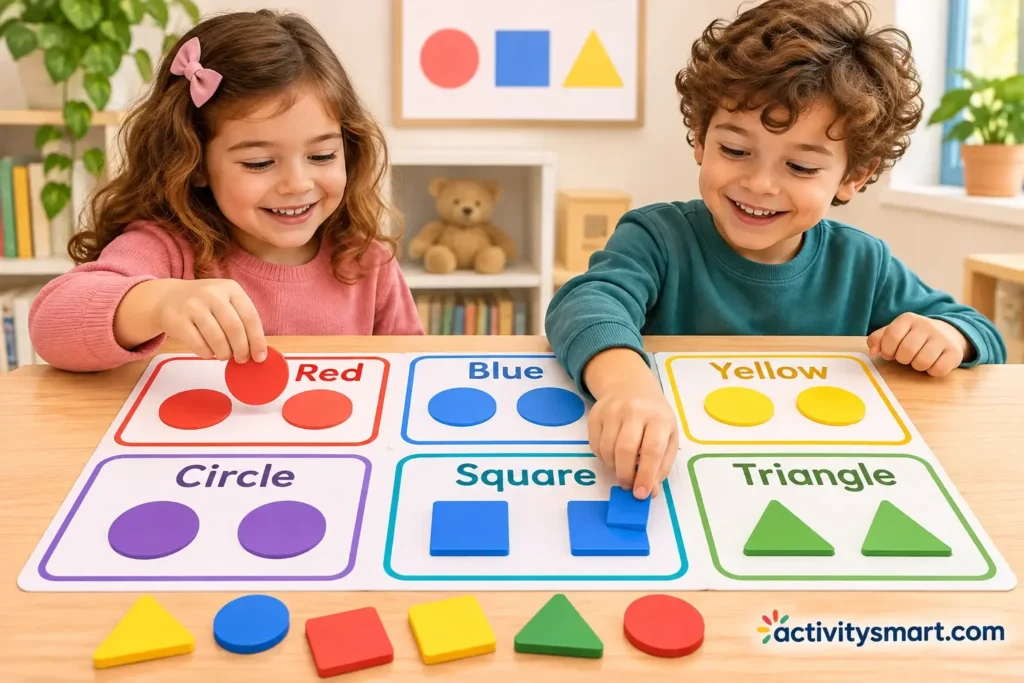
Put out six to ten large shapes or blocks in two colors. Place two baskets or paper circles on the table and model one sort: “Blue goes here, yellow goes there.” Invite the child to finish, then describe the groups together. If several features differ at once, some children will choose shape while you expected color. State the rule clearly and treat that response as useful information, not carelessness.
Once a child can follow a rule comfortably, reverse the challenge: “Can you think of another way to group them?” Sorting by size, shape, function, or a shared property can lead to thoughtful explanations. The NAEYC examples of sorting and classifying describes opportunities for children to sort collections using different attributes and discuss sets. For more everyday mathematics, pair sorting with one-to-one counting practice when children are ready to count each group.
Resort the same collection
Offer a mixed collection of large paper shapes: circles and triangles in two colors and two sizes. First group by color; then mix them up and group by shape. Ask what changed and what stayed the same. A child may need to see you demonstrate the second rule before attempting it independently. This is a useful teaching moment because one item can belong to different groups under different rules.
For older children, add a two-feature challenge such as “Find the small blue shapes.” Keep the number of pieces manageable. Invite children to check their own groups and explain any unusual choice. When an item could fit several interpretations, talk through the classification instead of insisting there is only one defensible answer.
Sorting with stories, clothes, and classroom supplies
Sorting is especially practical when it solves a real problem. Pair clean socks by pattern, organize thick and thin crayons, or group picture cards of vehicles and animals. In a classroom, sort labeled classroom materials so children learn where to return them. A kitchen activity might involve grouping large, unbreakable containers by their lid shapes while an adult handles anything heavy or sharp.
Spotting differences: move from obvious to subtle
Two pictures with one visible change
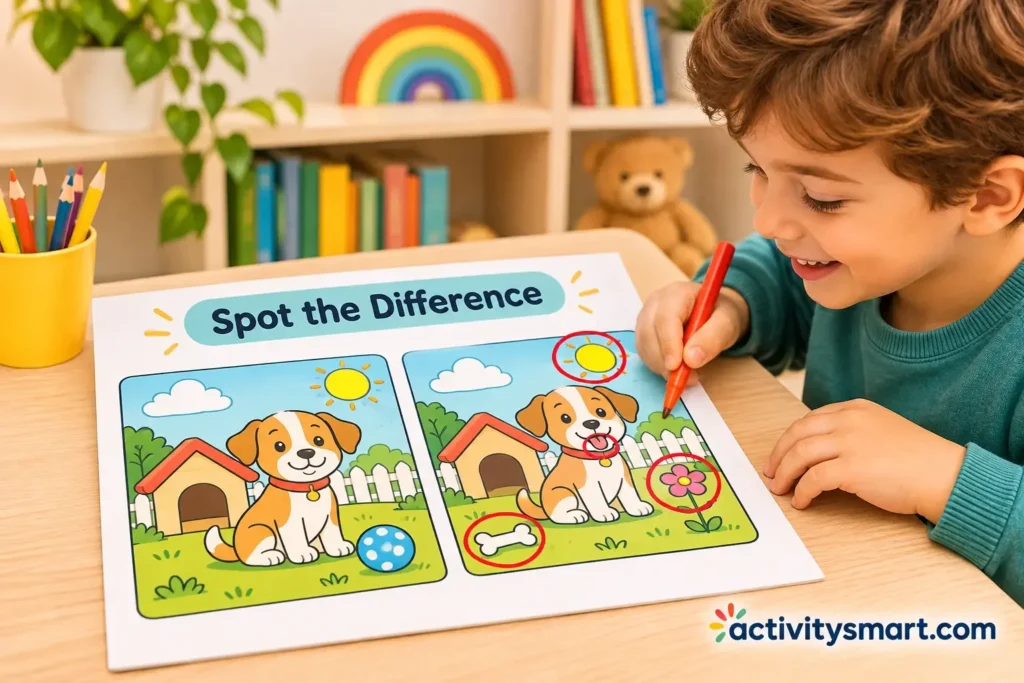
Draw two simple houses: both have the same outline, but only one has a chimney. Place them side by side and ask, “What is different?” If the child struggles, point to one region of each picture and compare that part. A second pair could show a tree with three apples versus four. Confirm the exact difference and let the child point instead of requiring a complete sentence.
Start with one or two changes and uncluttered drawings. Gradually add more objects, smaller details, or differences in orientation. Avoid creating misleading puzzles in which a supposed difference is too faint to perceive. A printable can be enjoyable, but the activity works just as well with sketches, classroom objects, or a pair of photographs.
Odd one out, explained with evidence
Show four large shapes: three circles and one triangle. Ask which one is different and why. Next try four objects where more than one rule is possible, such as three blue shapes and one red shape, with two different shapes represented. Accept multiple answers if the child names a consistent rule. This develops explanation rather than simply guessing the answer that the adult had in mind.
What changed on the tray?
Arrange four safe, familiar objects on a tray. Let the child study them; then ask the child to look away while you remove one. The child identifies what changed. This variation includes visual memory as well as discrimination. Begin with very different objects and allow a second look if needed. Later, swap the positions of two objects or replace one with a visually similar item, making the new demand explicit.
The NHS pediatric visual-perception activities suggests matching, searching, and spot-the-difference tasks among practical visual-perception activities. These are practice ideas, not diagnostic tests. If you want a movement-based version, change the position of two large picture cards posted at the child’s eye level.
Choose the right task for the child, not just their age
The age bands below are flexible starting points, not milestone thresholds or promises about what every child must do. Previous exposure, vision, language, attention, interests, and accessibility needs change how a task feels. Watch what a child can do with a brief demonstration, then change only one difficulty factor at a time.
| Starting point | Try first | When ready, increase challenge | Watch for |
|---|---|---|---|
| Approximately 3–4 years | Two or three obvious object pairs or two-color sorting | More choices and simple picture pairs | Understands the rule and can point to a match |
| Approximately 5–6 years | Sorting one feature; simple odd-one-out scenes | Resorting by a new feature and two picture differences | Can explain or demonstrate the shared feature |
| Approximately 7–8 years | Comparing pattern and orientation in clear pictures | Multiple changes and mixed-attribute sorting | Uses a search strategy without rushing |
| Approximately 9–10 years | Detailed scene comparison or independent classification | Ambiguous categories with reasoned explanations | Justifies a rule and checks for alternatives |
Simplify without making the activity feel childish
For an older child who needs a simpler start, use age-respectful materials such as sports logos, maps, book covers, or familiar game icons. Keep the number of options low while preserving an interesting theme. A child may manage intricate video-game graphics yet still find tiny printed symbols tiring; that difference may reflect the design, expectations, or prior familiarity.
Offer choices about sitting or standing, pointing or moving pieces, working alone or collaboratively. A teacher can prepare two difficulty levels using the same theme. This allows students to share the experience without being required to solve an identical sheet at identical speed.
Increase one challenge at a time
Difficulty can come from the number of choices, similarity of items, amount of background clutter, number of rules, whether objects rotate, or how long the child must remember what they saw. Change one element while holding others steady. If a child easily matches three shapes, try five shapes before adding overlapping shapes and a countdown timer all at once.
The same logic applies to pre-writing lines and shapes: offer recognizable strokes before asking learners to copy complicated forms. Hands-on selection can reduce demands on drawing or pencil control so you can see whether the child understands the visual comparison.
A practical ten-minute session for home or classroom
Warm up, compare, and explain
Start with two minutes of easy matches using familiar materials. Follow with roughly four minutes of sorting by a visible rule. Spend another three minutes comparing simple pictures or finding an odd one out. Finish by asking the child to choose a favorite example and explain, point out, or show what made it match or differ. These times are an optional planning example, not a prescribed dose.
Record observations, not scores alone
A useful note might read: “Matched identical animal cards independently; needed a color cue when sorting by shape.” That describes the task and support. “Poor visual skills” would be an unsupported conclusion from the same activity. Teachers can use brief observations to plan the next lesson, a principle consistent with the progress-monitoring advice in IES guidance on early mathematics.
Try the same game on another day with familiar materials and note whether the child starts to identify features more easily. Do not interpret a single good or bad round as a measured improvement in clinical visual perception. Children may get better at a game simply because they have learned its rules.
How to make activities accessible and enjoyable
Reduce clutter and support communication
Use high-contrast, clearly drawn objects and generous space between choices. Avoid visually noisy backgrounds or faint differences, particularly when beginning. Check whether lighting creates glare and offer larger cards when small details are hard to see. If the child uses another language or communicates nonverbally, demonstrate the task and accept pointing or sorting as an answer.
For children with color-vision differences, never make success depend on color alone; include clear differences in shape, position, texture, or markings. If the child has a known visual impairment, ask their family and relevant specialists which modifications fit their needs rather than assuming one enlarged worksheet is sufficient.
Connect with movement and hands-on learning
Place pairs of large cards around a room and invite children to walk to the matching picture. Build two towers that differ by one block and let learners find the difference. For a fine-motor extension, children can move larger pieces with their hands or create groups with washable crayons. Compare with hands-on fine motor activities to decide when physical manipulation or drawing should be the main learning focus.
Common mistakes and safety considerations
Avoid confusing speed with understanding
Fast answers are not necessarily thoughtful ones. A timed race can turn a relaxed comparison into a test of reading instructions, motor response, and stress management. Give children time to scan both images and encourage them to explain a difference before moving on. If you use friendly competition, make it optional and ensure nobody is embarrassed by a slower response.
Avoid too many changes or vague sorting rules
Do not ask a beginner to distinguish tiny symbols in a crowded scene, then conclude that the child lacks a skill. Choose large, obviously different forms and provide a model. State whether objects should match by color, shape, size, or category. After children understand that rule, invite alternative answers and explanations as a separate, more open-ended challenge.
Use age-safe materials and respond to concerns
For young children, avoid loose buttons, small beads, coins, magnets, and other choking or ingestion hazards. Use large paper cards, oversized blocks, or sewn cloth pieces instead. Adults should handle cutting tools and supervise any scissors, glue, or craft equipment according to a child’s abilities; safe scissor practice provides additional scissor-practice context. Avoid sharp edges, breakable pieces, and materials with unknown safety properties.
Difficulty with puzzles or letters does not itself establish a visual or learning disorder. If a child persistently squints, has headaches, struggles to see, or has ongoing difficulty that affects everyday participation, discuss this with a qualified eye-care professional or pediatric clinician. An occupational therapist may evaluate visual-perceptual concerns when appropriate. The NHS guidance on understanding visual information distinguishes visual discrimination from other visual-processing activities and suggests home strategies; it does not make a home game a diagnostic test.
Turning observation into broader learning
From visual matches to words and numbers
Use a small set of letter cards to compare outlines, then return to explicit instruction about sounds and print. When sorting picture objects, let children count each group and compare which has more. During a read-aloud, ask which two illustrations show the same character and what changed between pages. These connections make the visual task meaningful while keeping the larger literacy or math objective clear.
Parents can also connect the games to school readiness through play without treating them as a prerequisite that must be mastered before school. Shared attention, playful conversation, curiosity, and opportunities to try again matter more to the experience than collecting completed worksheets.
Know what the evidence can and cannot show
NHS children’s therapy resources commonly list sorting, matching, puzzles, and difference-finding as practical visual-perception activities. Early mathematics guidance supports discussing and sorting by attributes. However, these recommendations do not establish that a short home game will independently improve reading attainment or treat a visual-perceptual condition. Benefits depend on the child, the specific task, how it is taught, and the outcome being measured.
Use the activities for accessible practice, observation, and enjoyable interaction. If a child needs tailored support, professionals may recommend strategies based on assessment rather than on a universal worksheet sequence. This distinction helps families avoid false promises while still making good use of simple games.
Final verdict: which visual discrimination activities should you use?
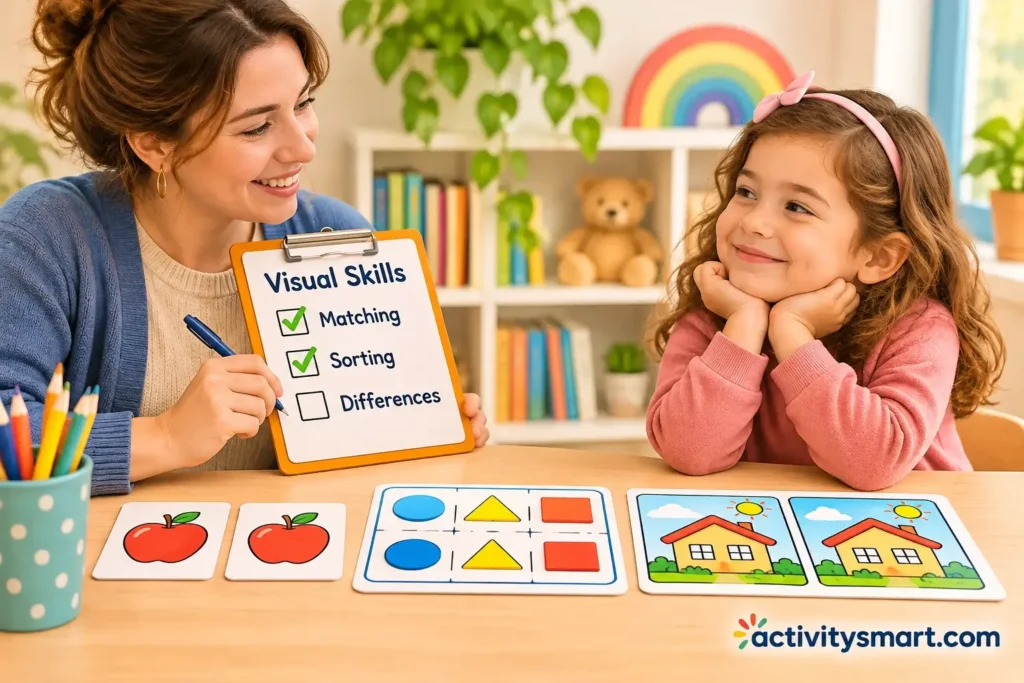
Choose matching when a child is beginning to look for shared features, sorting when they can follow and explain a grouping rule, and spot-the-difference tasks when they are ready to compare details systematically. Start with clear, familiar examples; increase one demand at a time; and allow children to point, move, or describe their reasoning. An enjoyable five-minute game is more useful than a difficult worksheet that creates avoidable frustration.
Keep an eye on engagement and accessibility. Mix table play with everyday observations, and revisit tasks in different contexts. The best next step is the one that gives the child a manageable challenge and a clear opportunity to explain what they see—not the activity with the most complicated graphics.
Frequently asked questions
What are visual discrimination activities for kids?
Visual discrimination activities are games that ask children to recognize similarities and differences among visible features. Matching picture pairs, sorting shapes, and comparing two scenes are straightforward examples. They can be adjusted for ages and interests.
What is the difference between matching and sorting?
Matching identifies items that correspond under a chosen rule, while sorting organizes several items into groups sharing a feature. A child might pair two identical socks, then sort a basket of socks by color or pattern.
How can I teach a three-year-old to notice differences?
Start with two large, familiar items that differ obviously in one feature. Model how to look, let the child point to the changed part, and keep the game brief. Avoid tiny details and complicated sheets.
Are spot-the-difference worksheets better than real objects?
No, neither format is universally better. Real objects allow movement and hands-on exploration, while clear pictures make it easy to compare visual details. Choose the format that suits the child and your aim.
Do visual discrimination games teach children to read?
No, visual discrimination games alone do not teach reading. They can offer practice noticing printed forms, but children also need appropriate instruction in oral language, letter-sound relationships, decoding, and comprehension.
What should I do if a child keeps choosing the wrong match?
Reduce the number of choices, remove distracting details, and demonstrate one example. Check that the child understands the rule and can see the materials clearly. Repeated difficulty across everyday tasks warrants discussion with an appropriate professional.
Can a child sort by more than one rule?
Yes, children who understand simple sorting can learn to regroup the same items by another attribute. Try sorting shapes by color, mixing them up, and then sorting by shape; explain each rule before switching.
How long should a visual discrimination activity last?
There is no single required duration for every child. A few engaged minutes may be enough, especially for younger children. Stop when fatigue or frustration rises, and revisit the activity later.
When should I ask for professional advice about visual difficulties?
Seek professional advice when visual concerns persist, cause distress, or interfere with daily activities or learning. An optometrist can check eyesight, while a pediatric clinician or occupational therapist may help determine whether further assessment is appropriate.
Sources and further reading
These resources inform the activity suggestions and limitations above. They offer educational or clinical guidance; they do not demonstrate that any single game guarantees a developmental result.