Quick Answer
School readiness skills include communicating needs, playing with others, handling routines, noticing feelings, trying again after setbacks, moving confidently, and exploring early language and math. Families can practice these abilities through stories, pretend play, household jobs, outdoor movement, and simple games. No child needs to master every skill before starting school; supportive classrooms also help children develop them.
Quick Picks
- For connection: pretend school or shop, with roles that children choose.
- For self-regulation: a short stop-and-go movement game.
- For language: retell a picture book with toys or drawings.
- For independence: practice opening a lunch container and asking for help.
- For early math: set the table and count one object for each person.
School readiness skills are broader than knowing the alphabet. A child who can explain a problem, join a game, seek support, and recover from disappointment has valuable tools for participating in a classroom. Reading and number experiences matter too, but they belong alongside relationships, movement, curiosity, and everyday independence. The aim is not to turn home into a miniature school. It is to make ordinary play more intentional without removing its joy.
This guide is for families preparing for preschool, kindergarten, or the first years of elementary school. It offers observable examples rather than a pass-or-fail checklist. Children develop unevenly; language background, disability, opportunity to practice, and school expectations all influence what readiness looks like. If a skill raises concern, ask the school what supports are available instead of assuming a child is unsuitable for school.
What school readiness skills really include
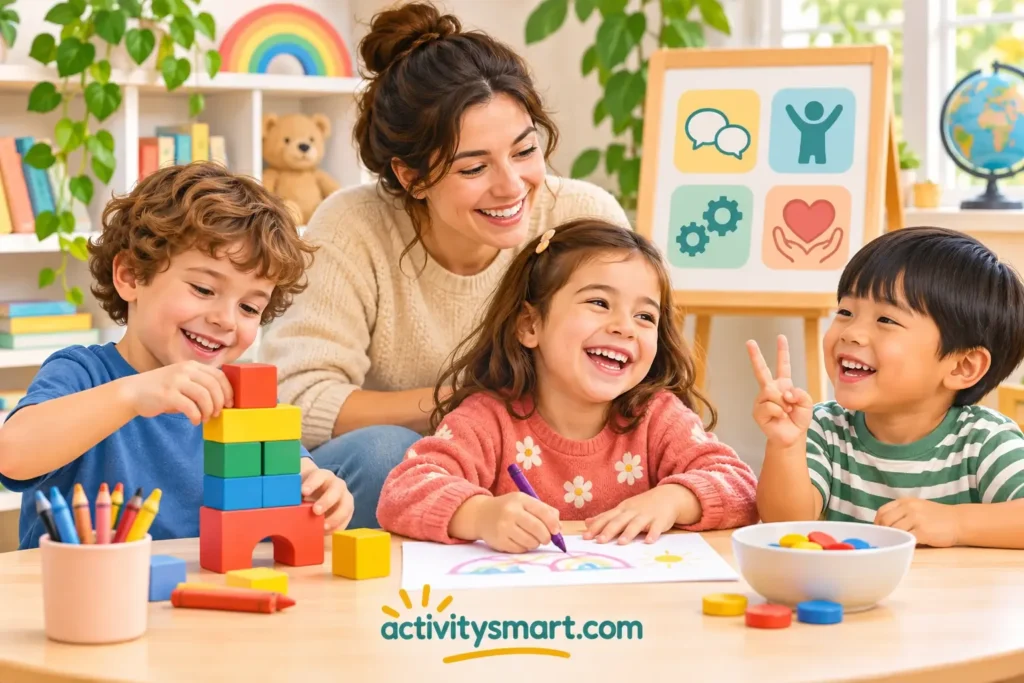
The Head Start approaches to learning guidance describes approaches to learning through curiosity, initiative, creativity, attention, and regulation. Its framework places these alongside language, social-emotional development, thinking, and physical development. That broad view explains why a child who knows many letters may still need help waiting for a turn, while another child who recognizes fewer letters may be a capable problem-solver and enthusiastic collaborator.
The NAEYC developmentally appropriate practice guidance emphasizes teaching that reflects each child’s strengths, culture, language, and abilities. A useful family question is therefore not “Can my child perform like every other five-year-old?” but “What experiences will help my child participate, communicate, explore, and feel secure?” The second question leads to practical support rather than unnecessary comparison.
| Readiness area | What you might notice | Low-pressure play idea |
|---|---|---|
| Communication | Explains wants, listens, asks questions | Puppet conversations |
| Social connection | Negotiates roles, notices others | Pretend shop |
| Self-regulation | Pauses, changes plans with support | Freeze-and-move game |
| Independence | Tries personal routines, asks for help | Practice lunch setup |
| Early literacy | Enjoys stories and sounds | Picture-book retelling |
| Early math | Sorts, compares, counts real objects | Table-setting game |
| Motor skills | Moves, draws, manipulates tools | Obstacle path and art |
These are examples of opportunities, not universal entry requirements. A child may show a skill at home but not yet in an unfamiliar classroom. The reverse can also happen when peers provide motivating models. Observe patterns across settings and ask teachers what they notice before drawing conclusions.
Practice communication through stories and conversation
Invite real back-and-forth talk
Conversation helps children practice listening, explaining, and responding to another person. At snack time, ask an open question such as “How could we carry these cups without spilling?” Wait for an answer and follow the child’s idea. If the child uses a short phrase, model a slightly fuller sentence without demanding repetition. A conversation can happen in any home language; understanding and being understood are the goal.
For a child who speaks little in a group, start with a familiar adult, two toys, or a picture. Give choices such as “Should the bear ask or point?” Accept gestures, pictures, or communication devices when appropriate. Avoid treating eye contact, speaking volume, or one communication style as the sole proof of attention or understanding.
Retell a story without a reading test
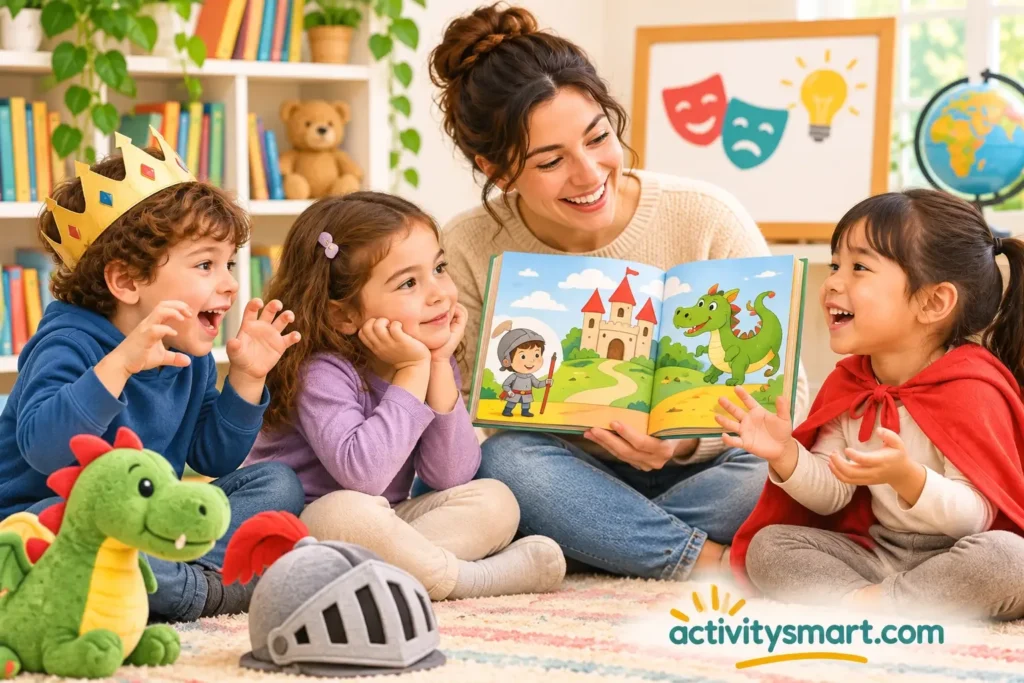
Read a picture book and invite your child to choose three scenes: beginning, something that happened, and ending. Use stuffed animals to act them out. Ask “What changed?” rather than testing every detail. If the child invents a different ending, welcome the creativity and distinguish it from what happened in the original story. These conversations can also introduce sequencing words such as first, next, and finally.
The CDC milestones by age five lists telling a story with at least two events and answering questions about stories among common five-year milestones. Milestones describe what most children do by an age; they are not a school admission exam. Families can build on the story experience with introducing letter sounds playfully when a child shows interest in the relationship between speech and print.
Build social confidence without forcing sharing
Practice joining, inviting, and repairing play
Set up a pretend café with two customers and one cook. Model short phrases: “Can I play?” “You can be the cashier.” “I want a turn after you.” When two children want the same prop, help them name the problem and brainstorm options: another prop, a timer, or taking different roles. The goal is flexible problem-solving, not making one child surrender immediately whenever an adult says “share.”
Some children prefer parallel play or need quiet breaks. A successful social experience might be playing near another child, exchanging one idea, or observing before joining. Respect personal space and consent. Rather than announcing that a shy child must become outgoing before school, create manageable opportunities to practice with familiar peers and supportive adults.
Use games to make turns visible
Roll a soft ball back and forth or play a simple matching game. Put a marker in front of the person whose turn it is, then move it after each turn. Say what is happening: “I am waiting. Now it is your turn.” Short games are better than long competitions for children who are still learning to wait. When someone loses, model “I feel disappointed; I can try again” without insisting the child instantly feels cheerful.
The CDC identifies following rules or taking turns in games as a common milestone around age five. That does not mean every child will manage it independently when tired, hungry, or overwhelmed. Practicing with an adult who can simplify the game offers a gentler starting point than a large, fast-moving group.
Strengthen attention and flexible thinking through movement
Try stop, switch, and remember games
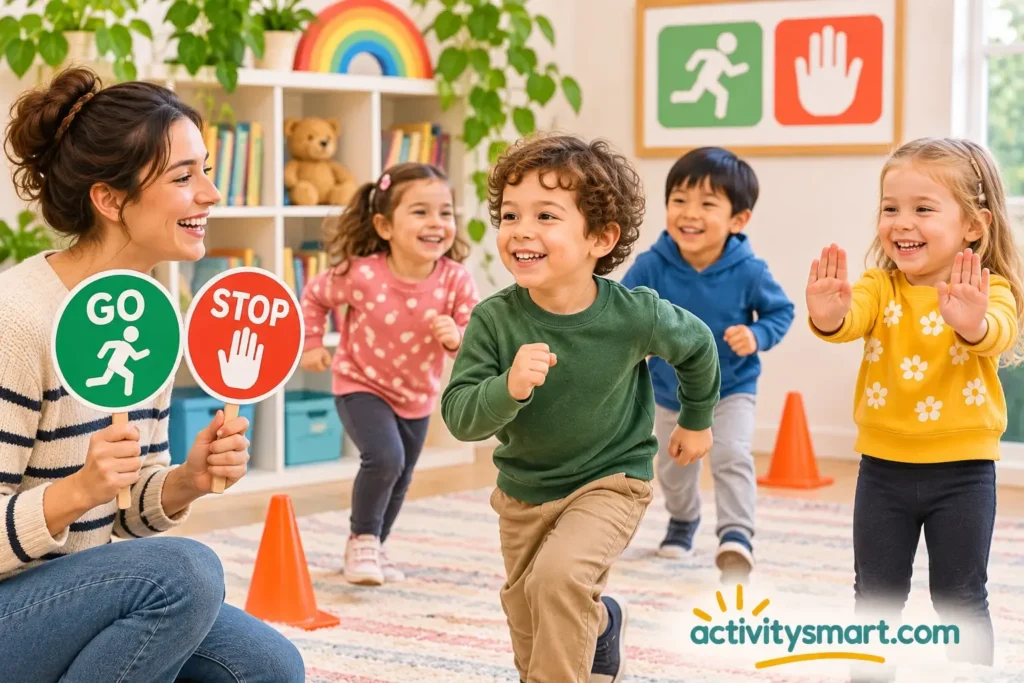
Play “traffic lights” with green for walking and red for stopping. Once the child understands, add yellow for slow motion. Later, let the child invent a new signal and teach it to you. This creates opportunities to hold a rule in mind, pause an action, and adapt when a rule changes. Keep rounds brief and stop while the activity is still enjoyable.
For a quieter option, hide three familiar objects under a cloth, remove one, and ask what is missing. Make the challenge easier by using only two objects or showing pictures. Make it harder by changing the order, not by demanding that a child sit motionless. The Harvard executive function activities guide offers age-banded games for practicing executive function, including attention and self-control, without suggesting that a single game produces a guaranteed improvement.
Help children recover from frustration
When a block tower falls, name the disappointment and offer a small next step: “That was frustrating. Do you want to rebuild the base together or take a break?” Practice simple coping choices during calm moments, not only during a meltdown. A child may need adult co-regulation—comfort, predictable words, reduced demands—before they can choose a strategy independently.
Avoid praise that makes mistakes seem shameful or frames persistence as never stopping. Sometimes a sensible response is to change the task, ask for help, or rest. Families dealing with repeated difficult learning moments may find supporting children when learning feels frustrating useful for keeping practice supportive rather than adversarial.
Grow independence through everyday routines
Rehearse the steps, not a perfect performance
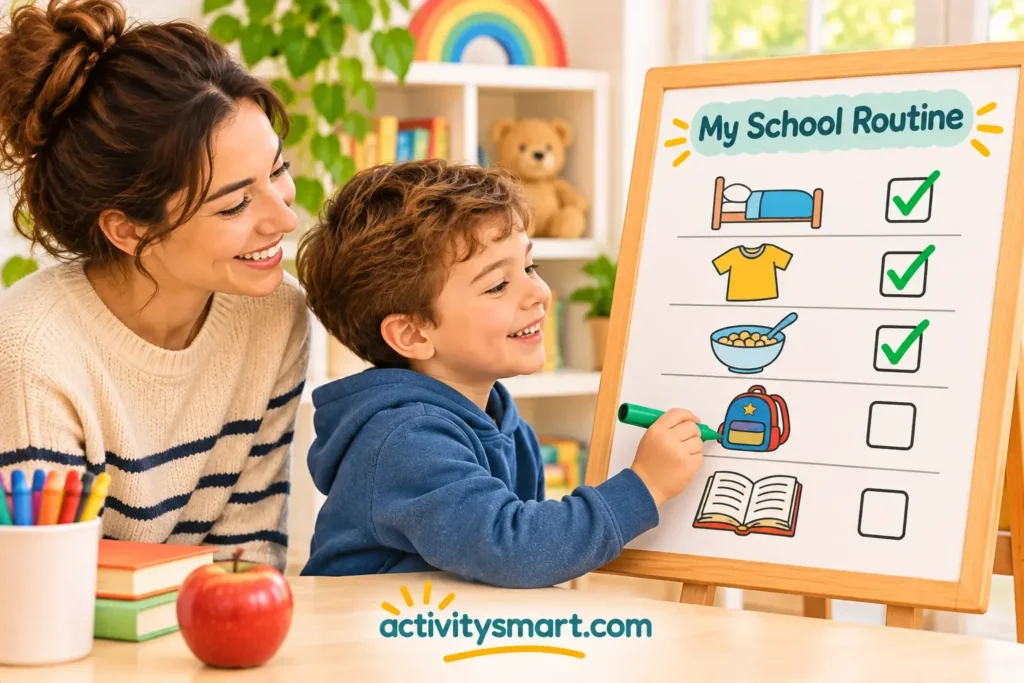
Try a pretend school morning on a relaxed day. Let your child choose clothes, pack an empty backpack, wash hands, and place a lunch container on the table. Talk through the sequence: “First shoes, then bag, then goodbye.” If a task is hard, break it into smaller actions and let the child complete the part they can manage. An illustrated routine can reduce the amount of spoken prompting needed.
Practice asking for help as an independence skill. Teach phrases such as “I cannot open this yet” or “Please show me.” For children who communicate differently, rehearse a gesture, picture card, or device message. Being ready for school does not mean never needing assistance; it means increasingly knowing how to access it.
The CDC includes doing simple chores and buttoning some buttons among common five-year milestones. Those examples describe development, not mandatory prerequisites. For practical routines, a predictable morning routine can help families build predictability while leaving enough time for connection and unhurried transitions.
Make separation predictable and respectful
Create a short goodbye ritual: a hug if wanted, a phrase, and a clear statement about who will return. Practice with brief separations from trusted caregivers when feasible. Do not disappear without saying goodbye as a strategy to avoid tears. Ask the school how arrivals work, whether comfort items are permitted, and what staff do when a child needs extra reassurance.
If distress is intense or persistent, collaborate with teachers and a qualified professional rather than extending separation drills indefinitely. Families should also consider changes such as a move, illness, language transition, or recent loss that may affect adjustment. Readiness is a shared responsibility between the child, family, and school environment.
Explore early literacy and math in meaningful contexts
Notice sounds, signs, and names naturally
Point out the first sound in a familiar name, clap syllables in playful words, and read signs on a walk. If a child wants to write their name, offer chunky crayons and a model they can copy. Do not insist on correct pencil formation during every drawing session. name-writing activities offers more ways to respond to interest in name writing without turning art into a handwriting drill.
Sound awareness and phonics are related but not identical. Hearing that two words rhyme does not require seeing letters, while phonics links letters with speech sounds. Families who want a clearer distinction can use the difference between hearing sounds and reading letters to choose an activity that fits the child’s interests. Singing, storytelling, and enjoyable books remain worthwhile even when the child is not ready for formal decoding.
Count, sort, and compare what matters
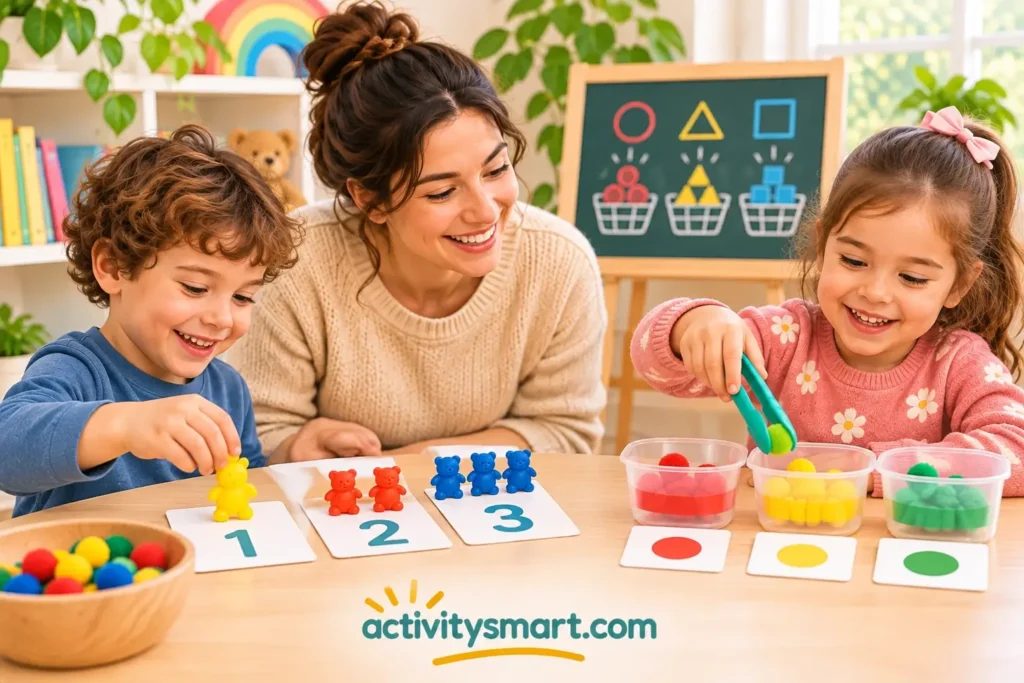
Invite your child to place one spoon beside each plate, then count the spoons while touching each one. Ask whether there are enough for everyone. Sort socks by owner or size, and compare which pile has more. These activities connect number words to quantities and everyday decisions. If the child skips an item or counts one twice, demonstrate slowly rather than announcing failure.
For more targeted practice, counting objects one at a time explains why matching one count word to one object matters. Simple board games with a die can also offer opportunities to count moves, compare quantities, and practice turns. Avoid making speed the measure of mathematical understanding: a thoughtful count is more informative than a rushed recitation.
Include movement, hands, and sensory comfort
School participation involves more than desk work. Children may carry materials, climb playground equipment, open containers, draw, cut, or manage clothing. Create a safe indoor obstacle route using cushions and floor tape, then offer drawing, play dough, or large construction blocks. Let children choose activities that feel comfortable and adapt materials for different mobility or sensory needs.
Fine motor play can be supported through playful fine motor activities. If children want to cut paper, use appropriately sized child-safe scissors with adult supervision and the staged ideas in safe beginning scissor practice. Do not use small loose items with children who still mouth objects; check choking risks, sharp edges, allergies, and the environment before setting up activities.
For sensory-sensitive children, reduce background noise, offer predictable transitions, and allow breaks. A child who avoids a texture may still explore the same idea with tongs, gloves, or a different material. Never force contact with an unpleasant sensation to prove readiness. Talk with the child’s care team or school about accessibility supports that preserve participation and dignity.
Choose activities for the child, not just the age label
Age bands are rough planning guides. A three-year-old may enjoy pretending to serve food with an adult; a five-year-old may take orders and count plates; a seven-year-old might write a menu and compare prices. The same playful theme can remain interesting across ages because adults adjust language, materials, complexity, and responsibility. Follow the child’s current abilities and preferences rather than assuming older always means better.
| Starting point | Make it accessible | Add challenge when welcome |
|---|---|---|
| Joining play | Offer two roles and model an invitation | Let children negotiate a new role |
| Listening game | Use one clear movement cue | Introduce a second cue or rule switch |
| Storytelling | Choose one picture and name actions | Connect three events and explain why |
| Counting | Match one object to each person | Predict what changes when one is added |
| Self-care | Complete the final step with support | Plan the sequence independently |
Watch for engagement rather than requiring a fixed number of minutes. If a child repeats an activity happily, repetition can be useful. If they disengage, shorten the task, add a choice, or return later. The CDC mentions attending for five to ten minutes to an activity as one common five-year milestone, but this is not a universal target for every game or every child.
A flexible one-week play plan for busy families
This plan uses brief invitations that can fit around family routines. Five to fifteen minutes may be enough for a single activity, but the exact duration is a convenience rather than an evidence-based prescription. Repeat favorites, skip days, or combine ideas. Child-led play, rest, outdoor time, and ordinary family conversation do not need to be replaced by a rigid schedule.
- Monday: Pretend café. Practice greetings, requests, roles, and counting cups.
- Tuesday: Picture-book theater. Act out two or three events with toys.
- Wednesday: Stop-and-go movement. Take turns inventing a signal.
- Thursday: Lunchbox practice. Open, close, and ask for help with containers.
- Friday: Sock sorting. Match pairs and discuss how groups differ.
- Weekend option: A playground visit or family walk with conversation about what you notice.
At the end of the week, ask which activities the child wants again. Notice small changes: a clearer request, a willingness to try a second strategy, or more confidence with a container. Do not turn these observations into a scorecard. A child may be developing a skill even when progress is not visible every day.
Common mistakes families can avoid
Treating readiness as an alphabet test
Letter recognition is useful, but it does not represent every domain of development. A narrow focus on worksheets can crowd out play, conversation, and movement. Keep books and letters available while also offering social games, physical exploration, and time to imagine. A child’s curiosity about print is a better invitation to extend literacy play than pressure to memorize a list.
Comparing children without context
Children vary in experiences, language exposure, disability-related support needs, and comfort in new settings. Compare a child’s current participation with their own earlier experiences rather than a sibling or neighbor. Ask teachers about classroom accommodations and expectations; schools should be prepared to support diverse learners, not simply select those who already resemble one ideal.
Making every game an assessment
Frequent quizzes can turn play into a performance. Instead, join the activity, describe what the child is doing, and ask a question only when it adds interest. Allow a child to lead, repeat a favorite action, or stop. The point is to create conditions in which skills can be practiced, not to collect proof after every turn.
Safety, developmental concerns, and school partnership
Choose materials that suit the child’s developmental abilities and supervise scissors, outdoor movement, and any objects that could pose choking hazards. Check play areas for unstable furniture, cords, and slippery surfaces. Never use a game to push a child through pain, panic, or sensory distress. If a task consistently causes discomfort, adapt it or choose another route to the same learning opportunity.
The CDC milestones by age five explains that developmental milestones reflect skills most children can do by a given age and are not substitutes for standardized screening. If you notice loss of previously acquired skills, persistent communication difficulty, or other concerns, speak with your child’s pediatric clinician and the school; ask about developmental screening or relevant specialist support. Do not wait for school entry to raise a concern, and do not diagnose a condition from one missed activity.
Ask the teacher how children communicate needs, access bathrooms, handle transitions, and receive support during play. Share your child’s strengths, preferred language, helpful routines, and accommodations. The most productive readiness plan often involves adjusting the environment as well as helping the child practice. If digital activities are part of family life, setting workable screen time boundaries can help preserve time for sleep, movement, and shared play without treating screens as the sole explanation for behavior.
Final takeaway: connection before performance
Families can nurture school readiness skills by making space for conversations, pretend play, flexible thinking, independence, movement, stories, and real-world counting. Start with an activity your child already likes and add one small opportunity to practice a new action. Encourage effort without requiring perfection, and work with teachers to make the transition welcoming.
There is no single home checklist that can certify a child as ready for every school. A useful sign of progress is growing participation with appropriate support: expressing a need, finding a way into play, trying again, or asking a trusted adult for help. Keep the relationship secure and the learning meaningful; the classroom can continue the work.
Frequently asked questions
What are the most important school readiness skills?
The most important school readiness skills span communication, social connection, self-regulation, independence, early language and math, and physical participation. Their relative importance depends on the child and school setting; no single alphabet or counting test captures readiness.
Does my child need to know the alphabet before kindergarten?
No, knowing every letter is not a universal prerequisite for kindergarten. Entry expectations vary, and schools teach early literacy; shared reading, conversation, and playful sound activities are helpful starting points.
How can I practice school readiness without worksheets?
You can practice school readiness through pretend play, picture books, movement games, household routines, and counting real objects. Choose activities your child enjoys and invite conversation, choices, and problem-solving.
What if my child struggles to take turns?
Start with very short turn-taking games and model whose turn comes next. Use a visual marker, offer support during disappointment, and gradually increase complexity instead of demanding perfect waiting immediately.
How long should school readiness activities last?
There is no required daily duration for school readiness activities. A few enjoyable minutes can fit into routines; follow your child’s interest and stop or adapt when fatigue or frustration rises.
Are school readiness milestones the same for every five-year-old?
No, developmental milestones describe patterns among many children, not identical performance in every child. Language, context, disability, and opportunity matter, and concerns deserve discussion with a qualified professional.
What should I do if my child cries at school drop-off?
Use a predictable, brief goodbye and coordinate a supportive arrival plan with school staff. If distress is severe or continues, discuss the situation with the teacher and a qualified clinician rather than blaming the child.
Can children practice readiness skills in their home language?
Yes, children can practice conversation, storytelling, problem-solving, and play in their home language. Families can also coordinate with educators about communication supports and the language used at school.
When should I ask for developmental support?
Ask for developmental support whenever you have persistent concerns, notice lost skills, or see difficulties affecting everyday participation. Speak with a pediatric clinician and the school about screening and available services rather than relying on a single online checklist.
Sources and further reading
The following primary resources explain developmental patterns and play-based teaching principles. They provide general guidance, not an individualized assessment.