Quick Answer
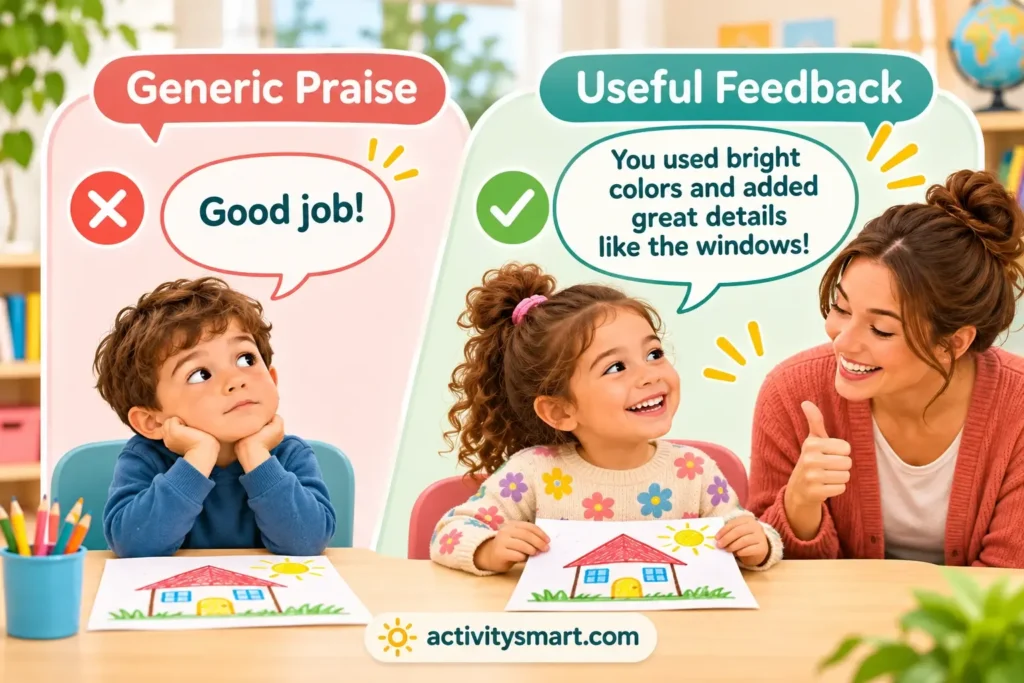
Useful feedback for young learners names what a child did, connects it to a learning goal, and offers one doable next step when needed. Instead of stopping at “Good job,” try “You checked each block while counting; now touch each one once and count again.” Keep it kind, brief, truthful, and appropriate to the child’s task.
The best response is not a long speech. A preschooler building a tower, a kindergartner listening for initial sounds, and a third grader revising a paragraph need different kinds of information. This guide gives real phrases teachers and parents can adapt, including ways to correct errors without embarrassment and ways to let children decide what to try next.
What Makes Feedback for Young Learners Useful?
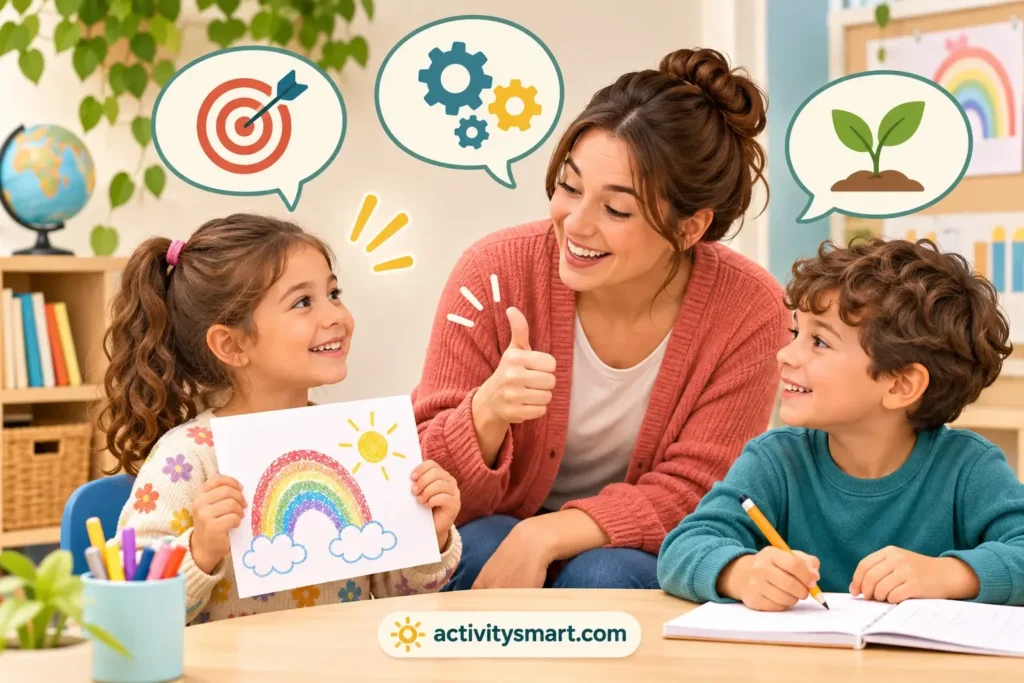
Praise communicates warmth and approval; instructional feedback adds information that helps a child understand or improve a specific action. Both can belong in a caring relationship. A delighted “I love seeing you” is not a failed teaching move, and “Good job” is not forbidden. The missed opportunity comes when approval is the only information a learner receives about a skill they are trying to develop.
The EEF guidance on teacher feedback advises schools to start with clear instruction and checks for understanding, deliver feedback that moves learning forward, and plan opportunities for pupils to act on it. Its report focuses on ages five and above, so applying these principles to preschool play requires shorter language, greater flexibility, and no expectation that a child will manage a lengthy correction independently.
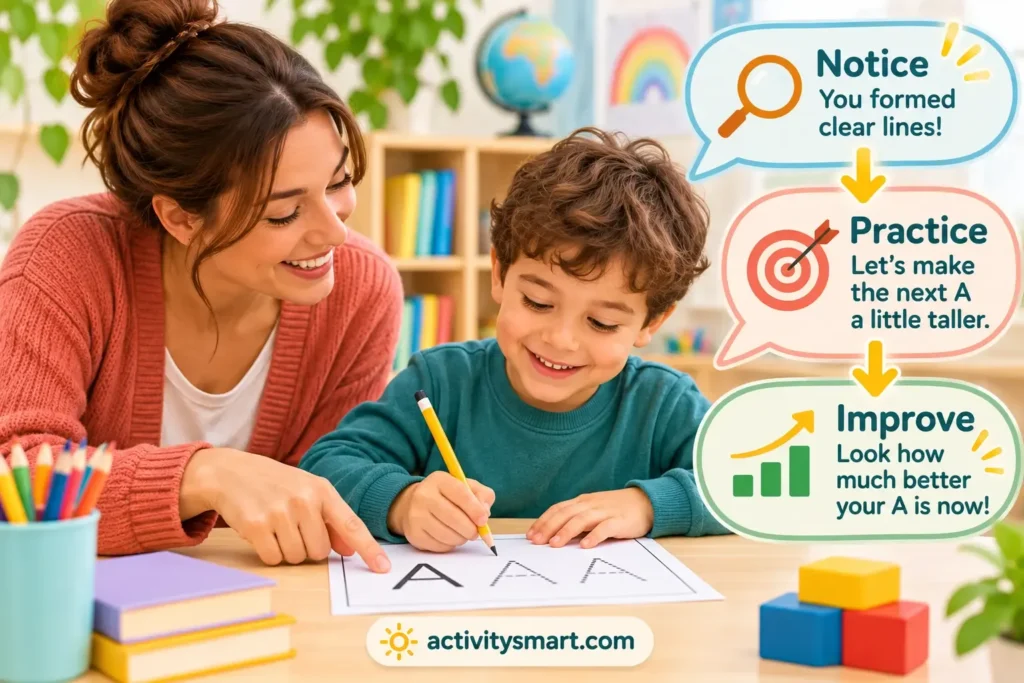
For young children, a practical feedback sentence often includes three parts: notice what happened, name why it matters, and nudge toward a manageable next step. You do not always need all three. Sometimes naming a successful strategy is enough; sometimes a quiet question is better than a correction.
A simple notice–name–next-step routine
- Notice: “You put a counter beside each picture.” This tells the child which action the adult observed.
- Name: “That helps you keep track while counting.” This connects the action to a learning purpose.
- Next step: “Can you check whether any picture has two counters?” This gives a small, observable action rather than a vague demand to improve.
Specific Praise, Feedback, and Correction: What Is the Difference?
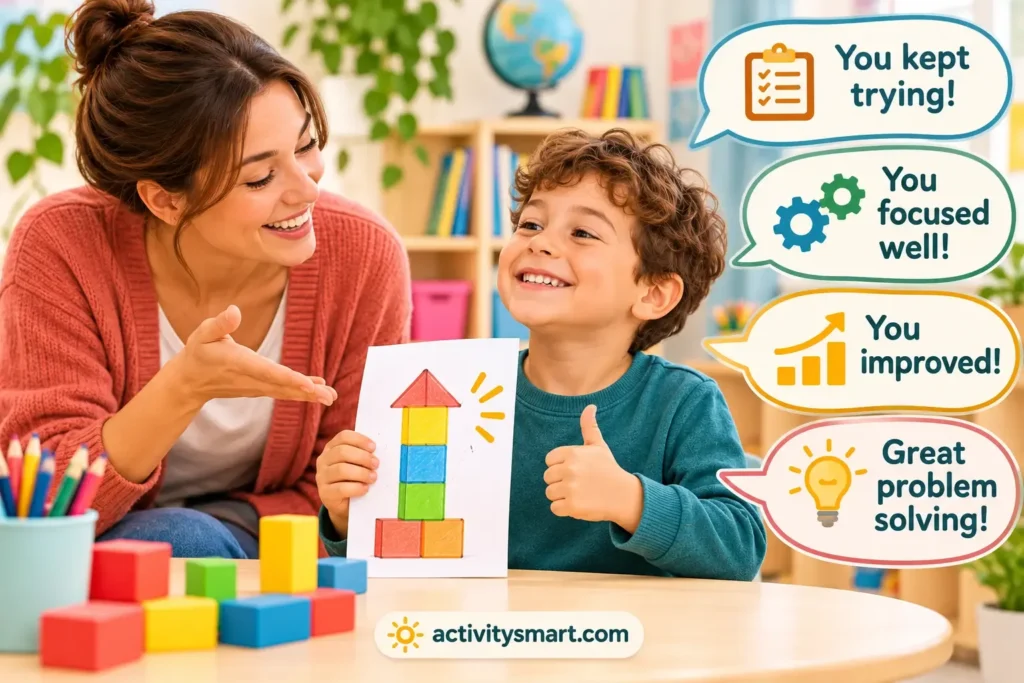
These are related but distinct tools. Specific praise recognizes a behavior or effort you genuinely value. Task feedback describes evidence of success or a gap relative to a goal. Corrective feedback identifies an error and supports repair. Reflection prompts help children notice and choose a strategy themselves. Mixing them up can leave children pleased but unsure what they learned, or corrected but unclear how to proceed.
| Adult response | What it communicates | Useful example | Best moment |
|---|---|---|---|
| General encouragement | Warmth or approval, without detail | “I’m glad we tried this together.” | Connection or celebration |
| Specific praise | The behavior that was noticed | “You waited until your partner finished speaking.” | When reinforcing a helpful behavior |
| Task feedback | What the work currently shows | “You matched four sounds to the right letters.” | When checking a defined learning goal |
| Corrective prompt | A concrete way to reconsider an error | “Look at the last word again. Does it match the picture?” | When a child is ready to revise |
| Reflection question | Invites children to explain their choice | “What helped you solve the tricky part?” | When a learner can describe a strategy |
These rows are a practical editorial comparison, not experimentally ranked interventions. The EEF evidence summary on feedback reports that feedback is more useful when it focuses on the task, the underlying strategy, or self-regulation, while purely personal judgments tend to provide less direction. The method—spoken, written, or visual—matters less than whether the learner can understand and use the message.
Ready-to-Use Feedback Phrases for Everyday Learning
Use the examples as adaptable conversation starters, not lines to recite mechanically. Always look at what actually happened before naming it. If a child did not check their answer, do not say they checked carefully just because the compliment sounds positive. The sentence should describe real evidence or offer an honest invitation to investigate.
When a child tries a new strategy
- “You started with the biggest piece; tell me how that helped your puzzle.”
- “I noticed you looked at the picture before choosing the word.”
- “You used your finger to keep your place. Is that helping?”
- “You tried another way after the first plan did not work.”
When early reading or language work is partly correct
- “You heard the /m/ sound at the beginning. Let’s listen for the ending sound too.”
- “Your story tells me who was there. What happened next?”
- “You pointed to the picture that matches your idea. Which word gave you the clue?”
- “You remembered what the character wanted. What changed at the end?”
During shared reading, link comments to meaning before asking for more detail. The picture-book discussion prompts can provide ways to invite evidence from pictures and conversation. For explicit sound work, connect a response to the planned objective and model a sound clearly rather than guessing from a child’s pronunciation. See our guide to teaching letter sounds for a sequence of supportive practice.
When children count, sort, or solve a math problem
- “You moved each block as you counted. That helped us see which ones were already counted.”
- “Both groups have three objects. How can we check they match?”
- “You found one more than five by adding another counter.”
- “We got two different totals. Let’s arrange the counters in a line and try again.”
These are observations and prompts rather than a claim that a certain phrase improves test scores. With concrete quantities, children can verify a suggestion immediately. If a child repeatedly loses track while counting, return to one-to-one counting practice instead of repeating “pay attention.” For a broader progression, explore hands-on number sense instruction.
When children draw, write, or build
- “Your drawing has two different shapes. What would you like to add?”
- “I can read the first letter you formed. Let’s try making the next one a little larger.”
- “You left spaces between several words. Find one place where a space might help.”
- “Your bridge fell in the middle. What support could you test underneath?”
For creative work, separate personal expression from the teaching target. If the task is free drawing, “Tell me about your picture” may be better than suggesting improvements. If the explicit task is a repeated shape pattern, a precise observation makes sense. Adults can support early mark-making with pre-writing activity ideas without turning every picture into handwriting assessment.
When a child works with another child
- “You asked your partner what they thought before choosing.”
- “You gave your classmate room to finish explaining.”
- “I saw two ideas. How could you test both fairly?”
- “You told your partner which part you could help with.”
Collaboration feedback should describe behavior rather than label a child as naturally good or bad at sharing. Do not publicly highlight one child as an example if doing so would embarrass either learner. If group movement is the sticking point, pair clear instructions with the predictable cues in smooth classroom transitions.
How to Correct Mistakes Without Making Children Feel Small
A useful correction protects both the learning goal and the relationship. Begin by identifying the precise difficulty: a skipped object, an unsupported claim, a mixed-up letter, or a misunderstanding of instructions. Then pick one repair that the child can actually attempt. “This is all wrong” tells the learner almost nothing; “Count the last three blocks again while touching each one” suggests an action.
Show the mismatch, then offer a choice of help
Try a neutral observation: “We counted seven blocks, but I can see six.” Pause so the child can inspect the arrangement. If the child cannot see the discrepancy, offer a demonstration: “Would you like me to show the first two, or shall we try together?” A child may benefit from a visual example, a slower pace, or a shorter task; resistance alone does not tell you which support is needed.
The IES practice guide on explanation and learning includes research-informed recommendations for worked examples, concrete representations, and explanatory questions. It is not evidence that one specific counting phrase works for every preschooler. Rather, it supports the broader idea of making thinking visible and giving learners material with which they can check an answer.
Do not confuse accuracy with a child’s worth
Avoid phrases such as “You’re not a math person,” “That’s easy,” or “Your sister already knows this.” Even well-meant “You’re so smart” centers a personal label instead of making the successful step visible. Better: “You compared the two shapes by looking at their corners.” Keep consequences for behavior separate from explanations about academic work.
A child who is crying, overwhelmed, or refusing to continue may need emotional support before instructional feedback. A calm “We can stop for a moment” preserves dignity. For home tasks that repeatedly become conflict, the ideas in responding to homework frustration help families reduce pressure while staying connected to a learning goal.
When Should You Give Feedback—and When Should You Wait?
Timing is a decision, not a stopwatch rule. Immediate feedback can prevent repeated practice of a misunderstanding, especially when a child is learning a new routine or a potentially unsafe procedure. Waiting may be better when a learner is explaining, exploring possible solutions, or deeply engaged in imaginative play. A well-timed pause gives a child room to notice and self-correct.
During the task: brief cues
Use a short cue if it will help the child continue independently: “Check the first sound,” or “Look at the corner of the pattern.” Avoid hovering over each move or interrupting a child in the middle of a sentence. If many children are working, a simple shared reminder can help, but it should not reveal an individual learner’s difficulty.
After the task: one reflection and a next step
During play: sometimes description is enough
A preschooler exploring pretend food or building a road may not need a lesson inserted into every exchange. Try noticing: “You made a long road and a short road.” Follow their lead if they want to respond. The CDC guidance on specific praise explains that adults can use specific praise and description to recognize behaviors; it does not mean every moment of child-led play needs to be evaluated.
Choose the Right Words for Ages Three to Ten
Chronological age offers only a rough guide. Language comprehension, prior instruction, disability-related support needs, emotional state, and familiarity with the activity all affect what a child can use. Start with concrete language and expand when the learner demonstrates understanding. No age band below is a developmental cutoff or a diagnosis.
Preschool, roughly ages three to five
Keep comments short, physically anchored, and closely linked to the action: “One cup for each bear,” or “You put the red piece next to the red piece.” Demonstrate if needed and ask at most one follow-up question at a time. A child developing language may show understanding by pointing, moving an object, or gesturing rather than explaining verbally.
A simple smile, choice, or shared moment may be more supportive than repeated assessment. The wider goal is participation and comfort with trying. Families exploring learning through play may find our school readiness through play helpful for choosing everyday tasks that invite interaction without demanding early academic perfection.
Early elementary, roughly ages six to eight
Make the target clear and invite one manageable revision: “Your sentence tells us where the story happens. Add who is there.” Children can begin comparing examples, but do not assume that “check your work” communicates what to check. Say what a successful check would look like: “Read the last sentence and see whether it has a full stop.”
When a child can respond, follow with a small check for understanding: “What will you try first?” They might point to a sentence or move a counter. A quick demonstration of the requested step is more informative than asking the child to promise to work harder.
Older elementary, roughly ages nine to ten
Invite greater ownership without removing scaffolding: “Your explanation names the answer. Which example supports it?” Older learners may compare drafts or choose among strategies, yet still appreciate a concrete prompt. If you give two suggestions, ask them which one they will address first and ensure the other can wait.
Make Feedback a Two-Way Conversation
Children are not passive recipients of adult judgments. Feedback becomes more practical when the child can answer, revise, demonstrate, or disagree respectfully. Ask “What did you notice?” before telling them everything you noticed. A learner who says “I wanted it to look like that” may be expressing an artistic choice rather than misunderstanding an instruction.
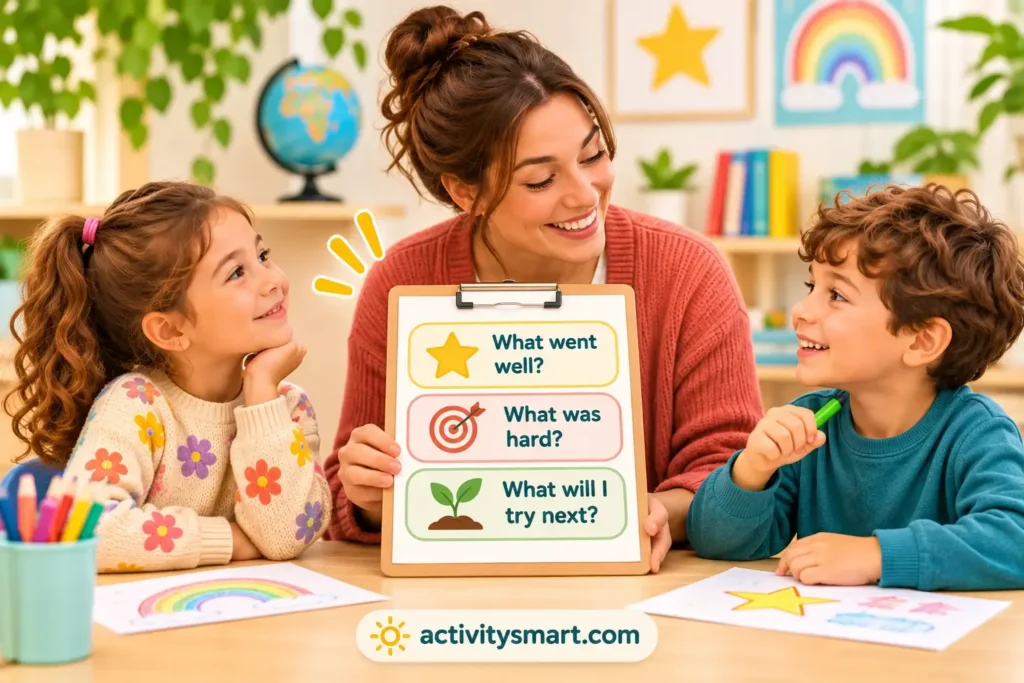
Use three questions, not an interrogation
- What was the goal? “We wanted each animal to get one plate.”
- What happened? “Which animal has no plate yet?”
- What could we try? “Where should this plate go?”
Use a quick revise-and-show cycle
After offering a suggestion, leave space for the child to act. In a counting task, have them recount. In writing, ask them to change one sentence. In a block design, invite one small test. Close by describing the revision: “Now every picture has one counter.” This helps the learner connect the adjustment to its result without creating a second long lecture.
How to Use Feedback in Small Groups and Busy Classrooms
One-to-one conferences are helpful but not always practical. Teachers can choose a single success criterion for a session and look for it during brief check-ins. For example, during a sound-sorting activity, listen for whether children identify the initial sound; do not try to correct posture, pencil formation, attention, and pronunciation in one encounter.
Plan one visible success criterion
Before the activity, tell children what they are practicing in familiar language: “Today we will explain how we grouped the shapes.” Then notice an actual example: “You grouped these because both have curved edges.” If students do not yet know the vocabulary, model it. Feedback should clarify the purpose of the task, not become a surprise test with hidden expectations.
Use partners carefully
Peer comments can work when the format is simple and modeled: “I noticed …” or “I wonder …” For younger learners, an adult may need to demonstrate what respectful, accurate feedback sounds like and monitor any unkind remarks. Never ask children to rank one another, offer personal judgments, or share private learning difficulties in front of the class.
Record the next move, not a label
A teacher might note “matches 4 of 5 initial sounds; revisit /sh/ with two picture choices” instead of “weak reader.” A brief record can guide the next activity and reduce repeated vague feedback. Avoid public scoreboards that identify learners who need support. Share learning notes only through the school’s appropriate privacy and family communication channels.
Common Feedback Mistakes and Better Alternatives
- Only saying “Great work.” Add evidence when there is a teachable skill: “Your diagram shows all three steps.”
- Correcting everything at once. Choose the most relevant mistake and return to other issues later.
- Praising effort regardless of outcome. Notice genuine effort but still teach a new method when an approach is not working.
- Using questions as disguised criticism. “Were you even listening?” is not a learning prompt; offer a clear restatement instead.
- Comparing children. Compare the work with the learning goal or the learner’s prior attempt, not with a sibling or classmate.
- Giving feedback with no chance to act. Reserve a minute to adjust the work, demonstrate the idea, or schedule a meaningful revisit.
Safety, Inclusion, and Emotional Respect
Feedback should never involve shaming, threats, withdrawing affection, or making a learner perform a correction in front of peers as punishment. Offer private support for sensitive work. Make language simple enough to understand and adapt response options for children with speech, hearing, attention, motor, or other support needs. A learner may demonstrate progress differently from classmates.
For children with disabilities or individualized learning plans, align comments with the goals and accommodations set by the family and relevant professionals. Do not interpret one difficult task as a diagnosis or assume a child is unmotivated. Where learning or distress concerns persist, coordinate with the child’s teacher, school support team, or qualified health professional as appropriate.
A child can be proud of a creative choice that does not match an adult’s original expectation. In expressive art, imaginative play, or personal stories, ask what the child intended before proposing changes. The aim is to protect agency while helping with clearly defined skills. Never make approval conditional on producing flawless work.
A Five-Minute Feedback Routine for Tomorrow
A simple routine can be used at a kitchen table or during a short classroom station. Pick one learning goal that the child understands. Prepare a concrete material, such as six counters, a picture book, or a short writing sample. Then use the following process with flexibility rather than treating the times as a strict prescription.
- Show the goal: “We are checking that each object gets counted once.”
- Watch a real attempt: let the child try before giving a judgment.
- Name one observation: “You moved these four counters into a row.”
- Offer one next step: “Touch them again as you count.”
- Let the child act: allow enough time to demonstrate or revise, then recognize the specific change.
Final Takeaway: Make the Next Step Visible
Useful feedback helps a child see a real action, understand its connection to a learning goal, and decide what to do next. Warmth and encouragement still matter: “Good job” can be a genuine celebration. But when teaching a skill, one honest observation and one achievable prompt often provide clearer guidance than a stream of praise or correction.
Start with the task directly in front of you. Listen to the child, choose one relevant detail, and make room to use the feedback. When the next learning task is unfamiliar, a short demonstration or shared practice may help more than another comment. Effective feedback supports a growing learner; it is not a verdict on the learner.
Sources and Further Reading
- Education Endowment Foundation: Teacher Feedback to Improve Pupil Learning — research-based principles for school feedback; guidance published June 2021.
- Education Endowment Foundation: Feedback evidence summary — evidence synthesis distinguishing task, subject and self-regulation feedback.
- Centers for Disease Control and Prevention: Tips for Praise, Imitation, and Description — specific praise and description for young children; updated August 2024.
- Institute of Education Sciences: Organizing Instruction and Study to Improve Student Learning — practice-guide recommendations including worked examples and explanatory questions; 2007.
Frequently Asked Questions
What can I say instead of “good job” to a young learner?
Say exactly what the child did and why it mattered, such as “You checked every counter before telling me the total.” If the work needs revision, add one small next step rather than another vague compliment.
Is saying “good job” bad for children?
No, “good job” is not inherently harmful and can express genuine warmth. It simply offers less information about a learning goal than a specific observation or actionable prompt.
How do I correct a child without discouraging them?
Name the specific mismatch calmly and offer one achievable way to check or repair it. Give the child time to try again, avoid public embarrassment, and pause if they are overwhelmed.
Should feedback focus on effort or results?
Feedback should describe genuine effort, effective strategies, and the actual result when each is relevant. Effort alone does not tell a child which approach to keep or change, so connect encouragement to a useful learning action.
How often should teachers give feedback?
Teachers should give feedback when it can help a learner understand or improve, not on a rigid timetable. Short prompts during practice and a later chance to revise can both be useful, depending on the activity.
What feedback works best for preschool children?
Short, concrete descriptions and simple next-step prompts are often easiest for preschoolers to use. Point to visible actions, model when necessary, and allow a child to respond with movement or gestures as well as words.
Can I give feedback during free play?
Yes, but feedback during free play should usually be light and responsive to the child’s interests. A description or curious question may be more appropriate than correcting a creation that has no assigned learning target.
How can children use feedback independently?
Children can use feedback more independently when the next step is clear and they have time and materials to act on it. Ask them to show a revision, explain a choice, or choose which small change to try first.
What if a child gets upset when receiving feedback?
Pause the correction and respond to the child’s feelings before returning to the task. Make the goal smaller, offer help or a break, and seek individualized school or professional support if distress is persistent or significant.