Quick Answer
Bilateral coordination activities help children practice using both sides of their body together. Start with tearing paper, rolling a towel, holding a bowl while stirring, catching a soft ball, or clapping patterns. Choose large, safe materials, demonstrate the movement, and adapt difficulty to each child rather than expecting identical skills at the same age.
A child holding paper steady while drawing, pulling apart a cardboard tube with two hands, or passing a ball from one side to the other is practicing coordination in ordinary play. These activities require no specialist kit. For children around ages three through ten, begin with one simple action, notice which hand stabilizes, and offer gradual choices. The goal is comfortable participation, not perfect symmetry or a timed performance.
What bilateral coordination means in everyday life
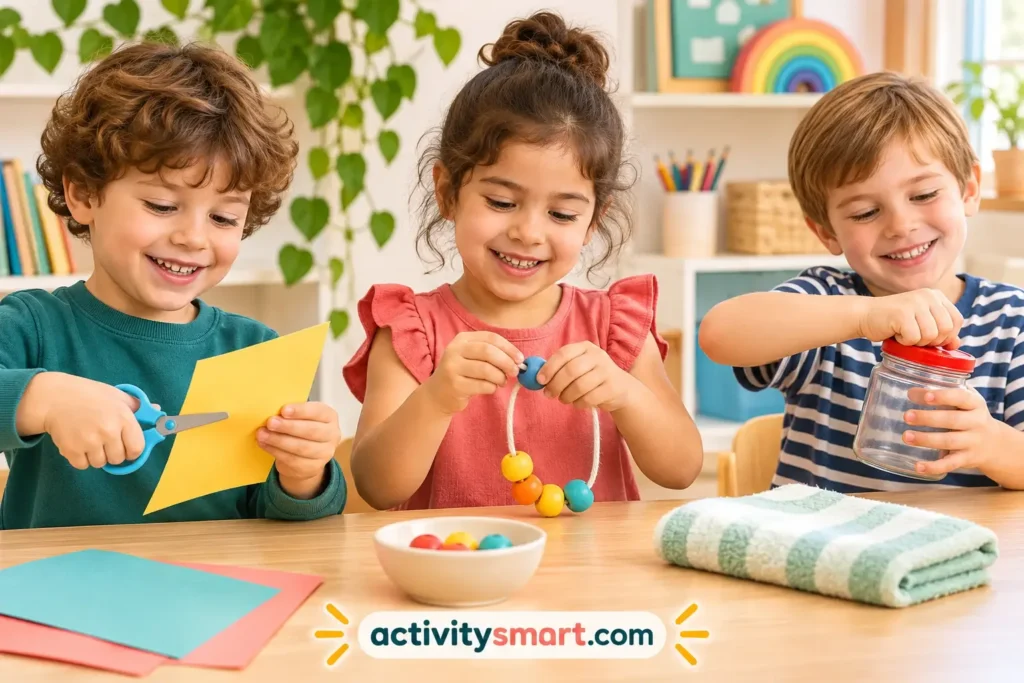
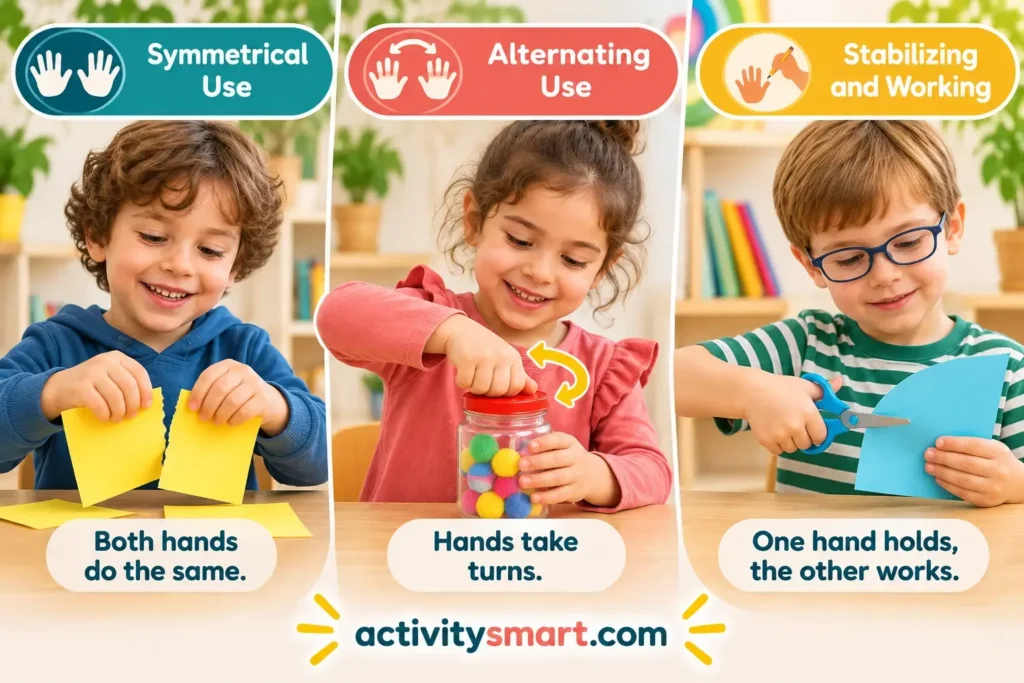
Bilateral coordination means coordinating the right and left sides of the body within one activity. Sometimes both hands do the same action, such as squeezing a rolled towel. Sometimes they alternate, as in marching. Often one hand performs a precise action while the other supports it, such as holding paper while drawing. Alberta Health Services bilateral coordination guide explains the role of two-handed skills in dressing, feeding and play.
Children also develop the ability to reach across the imaginary line dividing the body into left and right halves. This is called crossing the midline. Reaching across to collect a toy is one example, but it is not a required feature of every two-handed game. A child may switch hands, turn their body, or move the object instead; observe the context before interpreting the behavior.
Coordinating two sides is not the same as being equally skilled with both hands. Many tasks naturally involve a more precise working hand and a helping hand. You do not need to choose a dominant hand for a young child or insist that both hands perform identical movements. Allow a comfortable preference to emerge and keep activities accessible for left-handed children.
Three useful movement patterns
- Same action together: both hands pull open a folded towel, press a sponge, or push a big ball.
- Alternating action: hands take turns tapping knees, moving an imaginary steering wheel, or passing an object.
- Different jobs together: one hand steadies a container while the other places large objects inside, or one holds paper while the other marks it.
These are useful ways to vary play, not a formal developmental test. A child might find a two-handed squeezing task easy and still need practice keeping a page still while coloring. NHS Devon play and hand skills resource describes a similar progression from shared movements toward different movements with each hand.
Quick picks: choose an activity by the child’s needs
| What you notice | Everyday activity | Easy adjustment |
|---|---|---|
| Both hands rarely join a task | Pull a large towel from opposite ends | Use a shorter, softer towel |
| Paper slides during drawing | Hold a large stencil while tracing | Tape the sheet down first |
| Alternating movements are confusing | Tap left knee, then right knee | Slow down and model one tap |
| Reaching across is awkward | Move large cards across a tabletop | Bring targets nearer the center |
| A child dislikes messy textures | Fold paper or stack large blocks | Offer dry, familiar materials |
Use this table as a menu, not a diagnostic checklist. The same activity may work beautifully in one setting and feel overwhelming in another. Children can participate while seated, standing, or using adapted equipment. If an activity involves physical support, follow any advice already provided by the child’s clinician or school support team.
Bilateral coordination activities using paper and cardboard
Tear-and-build paper roads
Give the child a sheet of ordinary paper and invite them to tear long strips. Show how one hand holds the paper while the other pulls away; then switch where you place the hands so both sides can participate. Lay the strips on a table to make roads, rivers or tracks. With younger children, begin with a small pre-cut notch or wide paper strip so the starting motion is manageable.
For an older child, ask them to create three strips of different lengths and arrange them into a bridge or maze. The extra planning adds interest without turning this into a race. If a child pulls with both hands at the same time, that is still a valid entry point. Introduce the hold-and-pull action later when they are ready. Paper edges can be uncomfortable; stop if the child experiences pain or distress.
Fold a message and slide it into an envelope
Start with a large sheet and a simple half-fold. One hand aligns the corners while the other presses the crease. Then ask the child to open the envelope with one hand and gently slide the folded paper in with the other. A large envelope is easier than a tiny one, and a pre-folded starting crease reduces the challenge. Invite the child to add a drawing for a friend, using ideas from pre-writing play.
Cardboard steering wheel and hand switches
Use a large clean cardboard plate or a cardboard circle with smooth edges as a pretend steering wheel. Hold it with two hands and turn slowly left and right. Follow with a game in which one hand holds the wheel at the top while the other moves to the side. Play seated on the floor so no running or collision is involved. Avoid staples or sharp cut edges.
Towel, sock and household fabric games
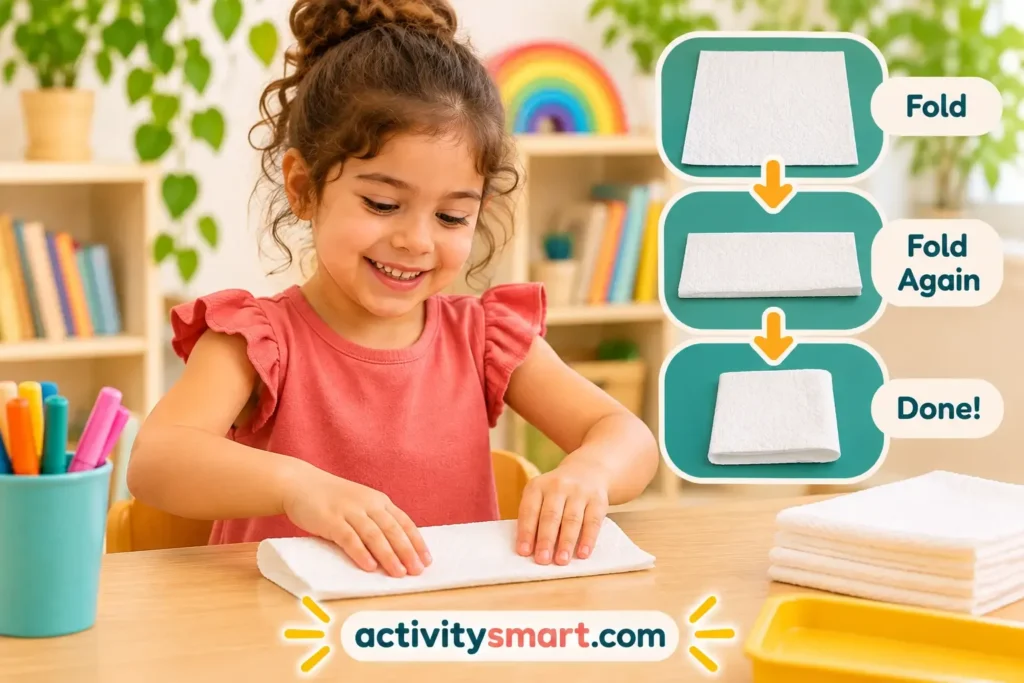
Roll a towel into a giant snack
Lay a hand towel flat on a clean surface. Ask the child to use both hands to roll it toward themselves, keeping the ends roughly aligned. Pretend the towel is a giant wrap, telescope, or sleeping bag for a toy. Unroll it slowly and try again in the opposite direction. Starting with a short towel can make the first attempt more successful than using a large beach towel.
Sock sorting and matching pairs
Place clean, large socks in a small pile. The child selects two, lays them side by side, and folds one over the other. Show how one hand holds a pair in place while the other tucks the fabric. Use obviously different colors at first. Older children can sort by size or pattern, which brings visual comparison into the game without requiring additional equipment; see visual matching activities.
Kitchen-table play with safe everyday tools
Hold the bowl, stir the pretend soup
Set an empty, lightweight bowl on a nonslip mat. Invite the child to steady it with one hand and stir using a blunt spoon with the other. Add large dry cloth pieces as pretend ingredients if desired. A real food-preparation version might involve mixing cool, safe ingredients under adult supervision. Never use boiling liquids, sharp kitchen tools or an unstable glass bowl for this activity.
Begin with a wider bowl and slow, visible circles. If the bowl rotates, consider a silicone mat or have the adult provide brief support. Older children can change stirring direction, scoop between containers or hold a measuring cup while pouring a small amount of water. Pouring requires care with spills; keep water shallow and clean it promptly to prevent slipping.
Sponge squeeze and transfer
Place a slightly damp, large sponge in a tray. Have the child hold it with both hands and squeeze over a second shallow tray. Then change to an alternating rhythm: squeeze, relax, transfer. If the child enjoys sensory play, repeat with plain water and a small cloth. Choose a sponge too large to mouth, use clean water, and supervise closely, especially around younger siblings.
Open, close and pass a container
Use a clean, wide plastic container with an easy-fitting lid. One hand stabilizes the base as the other lifts the lid. Then reverse the action to close it. Place a large, safe object inside and pass the container between two people. Choose a lid that does not snap tightly enough to pinch fingers. Small caps, magnets and tiny items are unnecessary.
Movement and rhythm: bilateral games away from the table
Clap, tap and echo a pattern
Sit facing each other. Start with two claps together, then pat both knees. Ask the child to copy a short pattern they can hear and see. Later use an alternating version: right knee, left knee, clap. Keep the sequences short enough that the movement, rather than remembering a long pattern, stays manageable. The adult can slow the pace or join in as a partner.
Rhythm games use body movement and timing, but a child’s performance can also depend on hearing, attention and familiarity with the instructions. Do not use a missed pattern as evidence of a motor difficulty. The Children’s Minnesota bilateral coordination information resource lists clapping and ball play among possible coordination activities, while cautioning that its therapy home program is intended for professional guidance.
Soft ball roll, catch and side pass
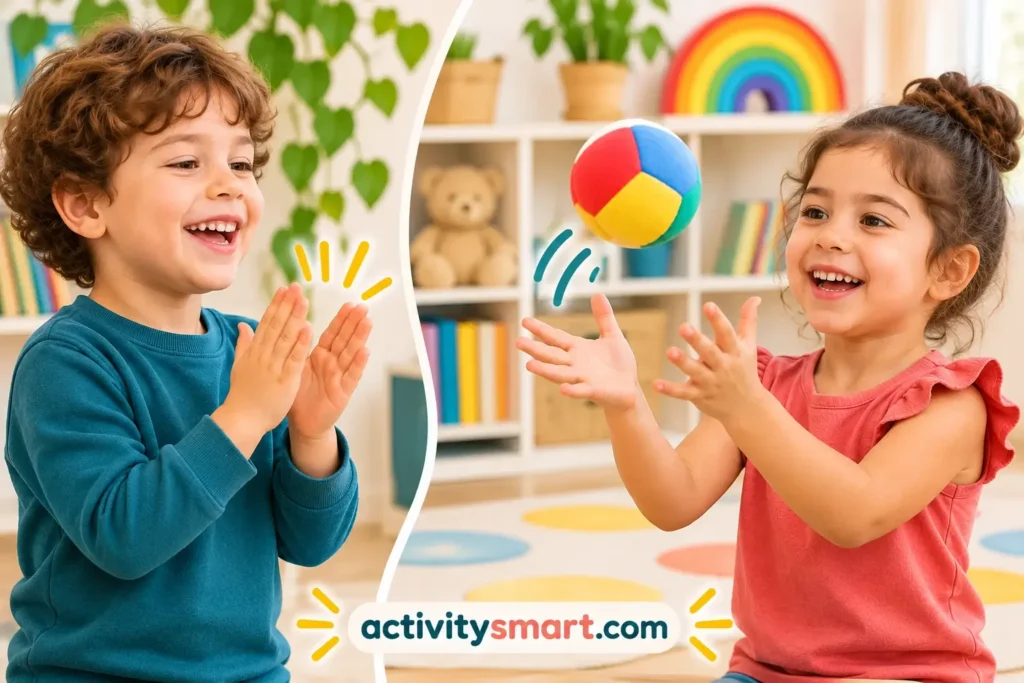
Use a large, soft ball. Sit on the floor across from one another and roll it with both hands. The child catches or stops it with open hands, then rolls it back. Next place the receiving partner slightly to one side so the child gently rotates to pass. A slow rolling ball is a reasonable alternative for children who are not yet comfortable catching in the air.
The CDC milestones for four-year-olds identifies catching a large ball most of the time as one common milestone around age four; it does not make that an entrance requirement for play. For a child who needs support, bring the ball closer or use a lighter, slower ball. Avoid small hard balls, throws near faces and games in crowded spaces.
March, pause and cross-body reach
Mark a safe standing spot with a large floor mat. March slowly, allowing arms and legs to move naturally. Pause, then reach one hand across the body toward a large picture placed within comfortable distance. Repeat on the other side if the child wishes. Keep the target at an easy height and never force twisting, balance loss or painful range of motion.
Two-hand tasks that support classroom participation
Hold paper steady during drawing
When children color, trace or write, one hand can anchor the sheet while the other moves the pencil. Invite the helping hand to rest flat on the page rather than gripping its edge with tension. Use larger paper, thick crayons and a broad work surface at first. A nonslip mat or a small piece of removable tape can provide temporary stability while the child learns the role of the helping hand.
This works well alongside pencil control through play and name-writing preparation. The goal is not to force a textbook grip or hurry children into letter writing. Watch whether the paper is stable, the child can make marks comfortably and both hands have a useful role. If writing is frustrating, return to large arm movements, short drawing turns or shared projects.
Simple cutting: one hand cuts, one turns
With appropriate child-safe scissors and close adult supervision, the working hand opens and closes the blades while the other hand holds and slowly rotates the paper. Start with narrow strips and one short snip. Progress to straight lines only when the child can position fingers safely. Keep faces and classmates away from the cutting path, and store scissors immediately after use.
A child might need help just keeping the paper at an appropriate angle, rather than making the cutting motion. Teach the roles separately, then combine them. The beginner scissor practice guide can support gradual scissor practice, but paper tearing is a good blade-free option when scissors are not appropriate. Do not ask a child to cut while standing or walking.
Build and separate large connecting pieces
Choose age-appropriate oversized construction pieces that click together without excessive force. The child uses both hands to press them together, then stabilizes one piece while gently pulling another away. Build a short wall, bridge or pretend creature. Place pieces on a firm table and let the child position them freely. Avoid tiny building parts for children who mouth objects or share space with younger siblings.
Age-based starting points without rigid milestones
The ages below describe possible entry points, not expectations every child must satisfy. Previous experience, disability, language, movement preferences, sensory comfort and fatigue all affect participation. Offer the easiest successful version first, regardless of age. School-age children often enjoy making the challenge more creative rather than simply repeating preschool activities.
| Approximate age | Starting invitation | If ready for more |
|---|---|---|
| 3–4 | Clap together, roll large ball, tear wide paper strips | Try holding paper still while tearing |
| 5–6 | Fold large paper, mix pretend food, make simple patterns | Rotate paper during supervised cutting |
| 7–8 | Fold envelopes, build structures, sequence alternating taps | Combine movement with an easy planning goal |
| 9–10 | Follow a short craft design or prepare a cool snack | Choose tools and explain helping-hand roles |
For broad developmental context, the CDC describes skills commonly observed at specific ages, including catching a large ball and unbuttoning some buttons around four years. These are population-based reference points, not scores for this activity list. If you have questions about milestones or a loss of previously used abilities, speak with the child’s healthcare professional.
How to teach bilateral coordination activities without pressure
Model one action, then gradually share control
Rather than giving three instructions at once, demonstrate a single clear action: “This hand holds the paper; this hand pulls.” Allow the child to imitate or invent an alternative. If the first attempt is difficult, make the paper wider, start the tear or shorten the distance to the object. Describe what worked: “You kept the bowl steady while you stirred.” This makes feedback concrete and avoids comparisons with other children.
Observe a useful action rather than a perfect product
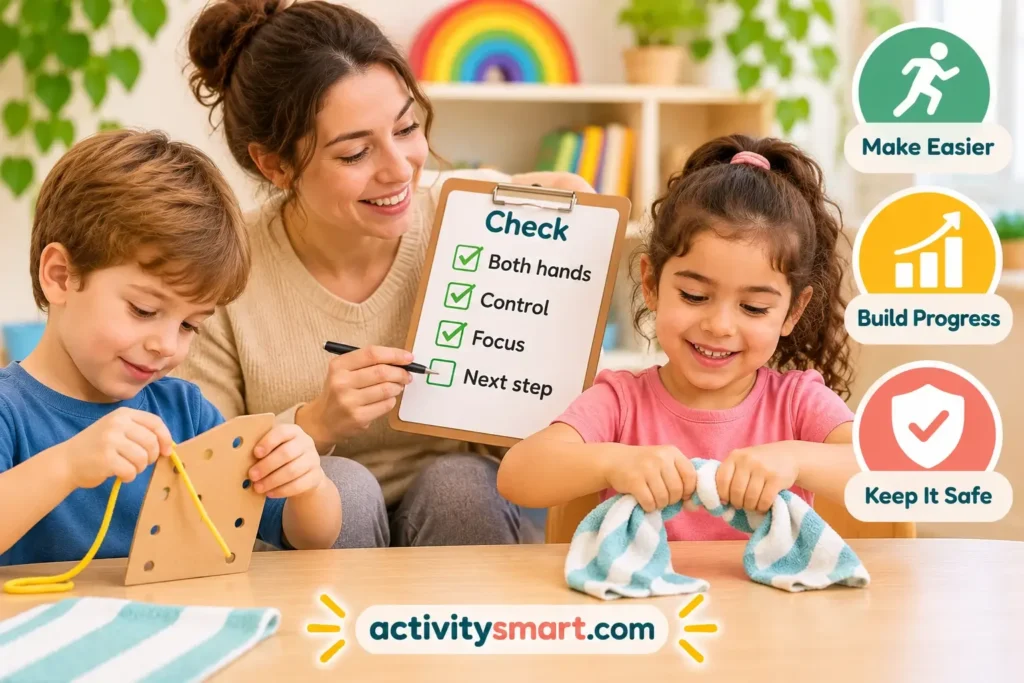
Ask whether the child joined both hands, used a supporting hand, managed a comfortable reach or found a safe way to ask for help. A crooked fold or uneven paper road is not a failure. If an adult does every stabilizing step, the activity may look beautiful but provide little independent practice. Give the child a meaningful role, even if the finished project is simple.
Common mistakes and what to do instead
- Insisting on identical hand use: a helper hand and a working hand often have intentionally different jobs.
- Using tiny objects too early: start with large pieces, then change size only if safe and useful.
- Increasing speed before control: slow movements often make a role easier to understand.
- Ignoring posture and furniture: put tools within comfortable reach and support stable sitting or standing.
- Turning each activity into a test: praise attempts, invite choices and stop when the child is tired.
- Confusing cross-body reaches with every bilateral task: crossing midline is related but not required in every game.
An easy way to check your setup is to ask, “Can the child see the goal, reach the materials, and complete one safe action?” If the answer is no, change the setup before asking for more effort. Connecting two-handed work with everyday school-readiness abilities makes sense when the child is interested in getting dressed, organizing supplies or helping with snacks.
Safety, access and when to ask for advice
Always supervise activities involving scissors, water, food, glue, cords, plastic bags or small parts. Use clean household materials, blunt edges and containers that will not shatter. Keep choking hazards away from children who mouth objects and from younger siblings. Never use blindfolds, restraints, forced stretches, risky climbing or painful resistance to make an exercise harder.
A child who uses one side differently may have a personal movement pattern, an injury, or a disability requiring thoughtful access rather than correction by a worksheet. Adapt by enlarging materials, providing a stable mat, using a seated position, inviting an adult partner or following an established occupational therapy plan. Seek individualized guidance if a child consistently struggles with everyday tasks, has pain, shows a marked new asymmetry, loses a skill, or becomes distressed by routine hand use.
A pediatrician or appropriately qualified occupational therapist can help assess functional concerns. General play ideas cannot diagnose or treat a coordination disorder and should not replace a professional program. Children’s Minnesota explicitly frames its bilateral coordination home program as something to use under professional guidance; the everyday games here are recreational suggestions, not a prescribed therapeutic dosage.
A flexible five-day play plan
If choosing activities feels overwhelming, rotate one manageable task each day: on Monday make paper roads; Tuesday roll towels; Wednesday stir pretend soup; Thursday play seated ball roll; Friday fold a message. Offer a choice of two variations, and stop whenever attention or comfort fades. On a later week, repeat a favorite with one small change, such as using a larger sheet or adding a second step.
Final takeaway: useful two-hand practice belongs in daily play
The most practical bilateral coordination activities use familiar objects to give each hand a role: pull and hold, steady and stir, fold and press, catch and pass. Pick one task the child wants to try, make the first step easy, then vary the challenge as confidence grows. For related ideas, explore fine motor play ideas or return to simple paper games when the child wants a reset.
Frequently asked questions
What are bilateral coordination activities for children?
Bilateral coordination activities are games or daily tasks that ask children to use both sides of the body together. Examples include tearing paper, rolling a ball with two hands, and holding a bowl while stirring. The aim is meaningful participation rather than identical hand movements.
What is the difference between bilateral coordination and crossing the midline?
Bilateral coordination means organizing both sides of the body for an activity; crossing the midline means reaching across the body’s imaginary center line. A child can use both hands together without crossing that line. Many everyday games offer opportunities for both skills.
Can I use household objects instead of therapy equipment?
Yes, ordinary items such as towels, paper, large containers and soft balls work well for recreational two-handed play. Choose materials based on safety and the child’s abilities. If a therapist has prescribed specific exercises, follow that individualized guidance rather than replacing it.
How do I make an activity easier for a three-year-old?
Begin with big, lightweight materials and one clear movement at a time. Roll a large soft ball on the floor, clap slowly, or start a tear in wide paper. Demonstrate the action and allow adult assistance without demanding a finished craft.
Are these games useful for older children too?
Yes, older children can use the same coordination patterns in more complex crafts, food preparation and building projects. Add planning or sequencing only when the basic two-hand movement is comfortable. Keep the task interesting and respectful of the child’s preferences.
Should I make a child switch hands during every task?
No, you do not need to force hand switching during every task. Many activities work best when one hand leads and the other steadies an object. Allow natural preferences and offer both hands meaningful roles when comfortable.
How long should children practice each day?
There is no single daily duration that guarantees a particular result for every child. Brief, enjoyable opportunities within play and household routines are reasonable. If a clinician has recommended a specific schedule for a child, prioritize that plan.
What should I do if my child refuses messy play?
Offer a dry alternative such as folding a towel, stacking large blocks or rolling a ball. The coordination goal does not depend on handling wet or sticky materials. Avoid forcing unwanted textures and let the child choose a comfortable way to participate.
When should I ask an occupational therapist about coordination?
Ask a pediatrician or qualified occupational therapist when hand-use difficulties consistently affect daily activities, cause pain, involve a new marked difference between sides, or follow a loss of skills. A professional can evaluate the full context; one awkward craft is not a diagnosis.
Can bilateral coordination games improve handwriting automatically?
No, bilateral games do not guarantee better handwriting on their own. Holding paper still can support the mechanics of drawing and writing, but handwriting also involves instruction, visual-motor control, practice and individual needs. Use two-hand play as one useful option rather than a promised cure.
Sources and further reading
These sources explain coordination patterns and offer age-sensitive context. Their clinical resources should not be interpreted as an individualized treatment plan: