Quick Answer
Big feelings during learning are best met with calm connection, a brief pause, and a smaller next step—not pressure to finish immediately. Notice the feeling, keep everyone safe, offer a manageable choice, and return to the activity when the child is ready. Frequent struggles may signal that the task, timing, or support needs adjusting.
Quick Picks
- In the moment: lower your voice, acknowledge the feeling and pause the demand.
- For a stuck learner: model one tiny step, then offer a choice.
- For recurring distress: review task fit, fatigue, transitions and needed support.
- For unsafe behavior: prioritize safety and seek appropriate help.
Supporting children through big feelings during learning begins with an important distinction: a child can be upset about a task without being unwilling to learn. Tears over a crooked letter, anger at a puzzle piece, or silence during reading may tell us that the current demand feels too hard, too public, too rushed, or simply too much right now.
For children roughly ages three to ten, the practical goal is not to eliminate frustration. It is to help them feel safe, recover enough to think, and experience a next step they can realistically manage. This guide gives parents and teachers language to use, ways to adjust activities, and signs that extra support may be needed.
Why learning activities can bring out big emotions
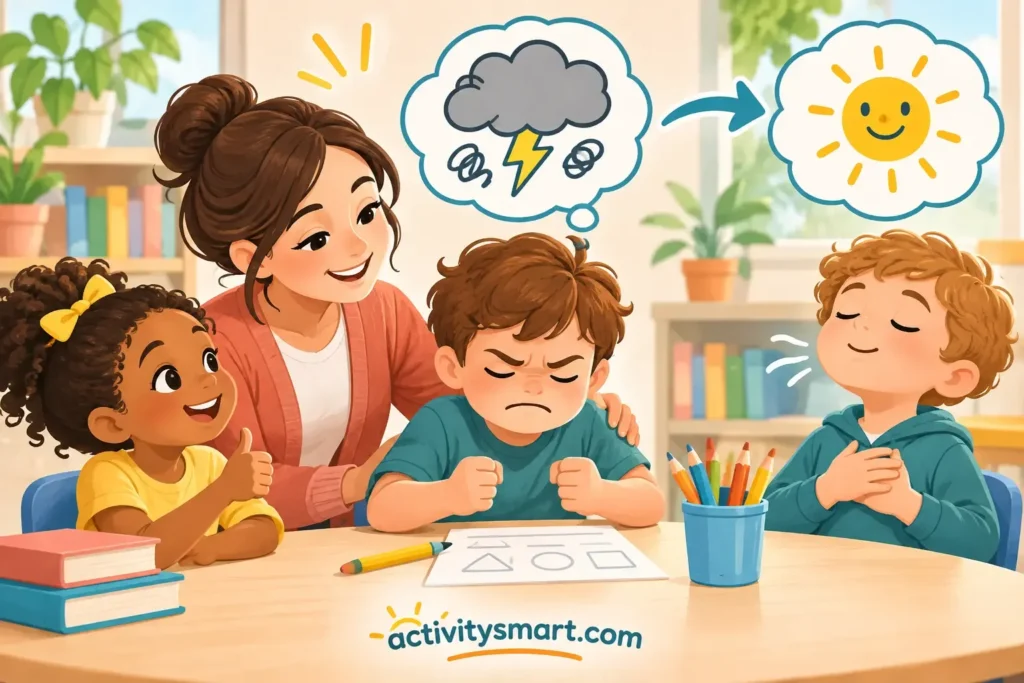
Learning asks children to attempt unfamiliar things and expose mistakes. A child who can confidently build with blocks may feel vulnerable when asked to draw the same shape; another child might read fluently at home but freeze when asked to read aloud. These reactions do not automatically indicate a disorder, lack of effort, or poor parenting. Context matters: the size of the challenge, the audience, the child’s energy, and previous experiences can all influence how a task feels.
Frustration, disappointment, worry and overload are different
Frustration often sounds like “It will not work!” Disappointment may appear when a project does not match the picture in a child’s head. Worry can look like repeated reassurance-seeking, avoiding a turn, or erasing every answer. Overload may appear as covering ears, leaving the table, or no longer responding to instructions. The same behavior can have several explanations, so treat these as clues rather than labels.
Why a calm adult response matters
The American Academy of Pediatrics advises caregivers to connect with children under stress, acknowledge feelings, and work toward problem-solving after they feel safer and calmer. This is a practical sequence, not a promise that every upset will stop quickly. Some children want reassurance; others need physical space. Asking “Would you like me beside you or a little farther away?” respects that difference.
A calm response does not mean permitting hitting, throwing objects, or hurting other people. You can validate anger while holding a clear boundary: “You are angry. I will keep the scissors safe. We can try again when your hands are ready.” The feeling is acceptable; unsafe actions still require protection and guidance.
A simple response to big feelings during learning
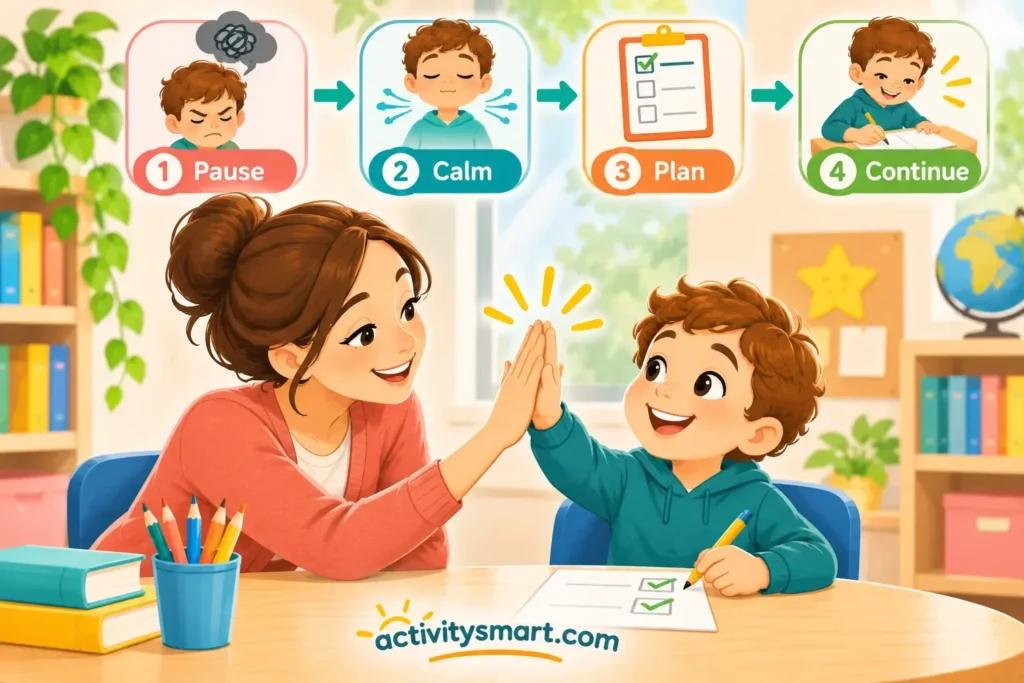
Use a flexible sequence: notice, connect, reduce the demand, then re-enter the task. It is not a rigid four-minute technique. The order matters more than the clock because asking a distressed child to explain the mistake or complete a worksheet immediately may add another demand before they are ready.
Notice the change before it becomes a battle
Watch for a tight grip on a pencil, rushing, repeated “I cannot,” abrupt joking, pushing materials away, or a child suddenly growing very quiet. You might say, “That last part got really tricky,” rather than, “You are making a fuss.” Keep your description observable and tentative. Children can correct you: “No, I am mad because he laughed.”
Connect with one short sentence
Try “I see this feels hard,” “You wanted it to turn out differently,” or “You do not have to figure it out alone.” Avoid speeches about the value of persistence while tears are falling. If a child rejects your guessed feeling, acknowledge that and listen: “Thanks for telling me. What part bothered you?”
Offer a real pause without turning it into punishment
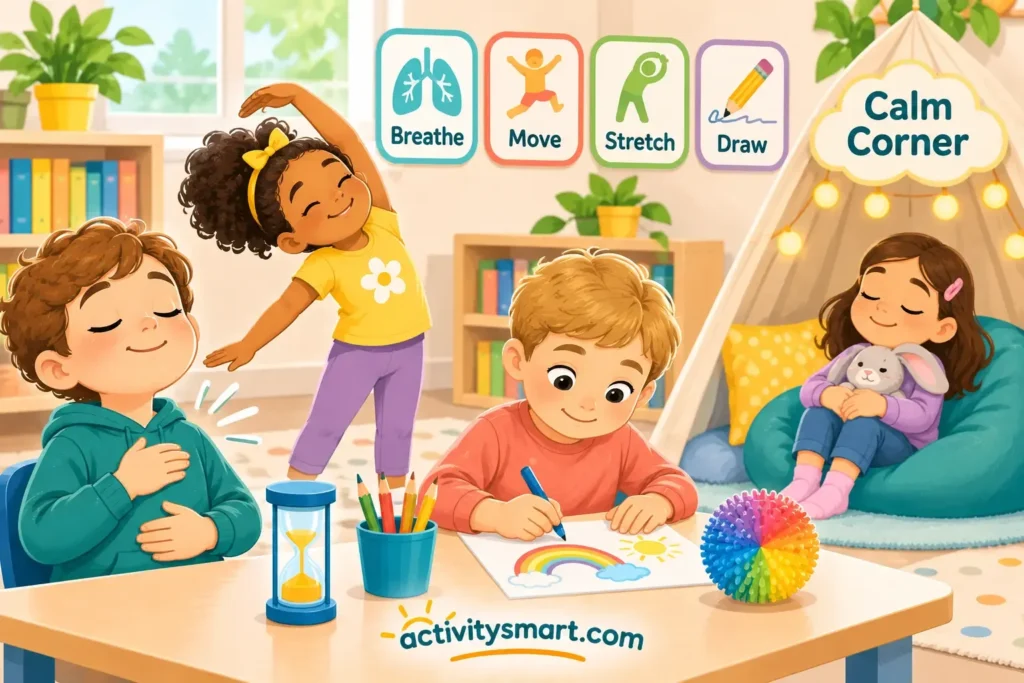
A pause can mean getting water, stretching, looking outside, sitting quietly beside a trusted adult, or switching briefly to a familiar activity. It should not be a forced isolation or a public “calm-down consequence.” Keep the choice small enough to understand: “Water or a short stretch?” If a child does not want to use breathing exercises, another quiet strategy may suit them better.
When the child is calmer, ask whether they want to watch one example or try the first step together. Some tasks can be postponed; others need a gentle return because school routines continue. A pause is a bridge back to participation, not a bargaining reward for getting upset.
Make the next action smaller and visible
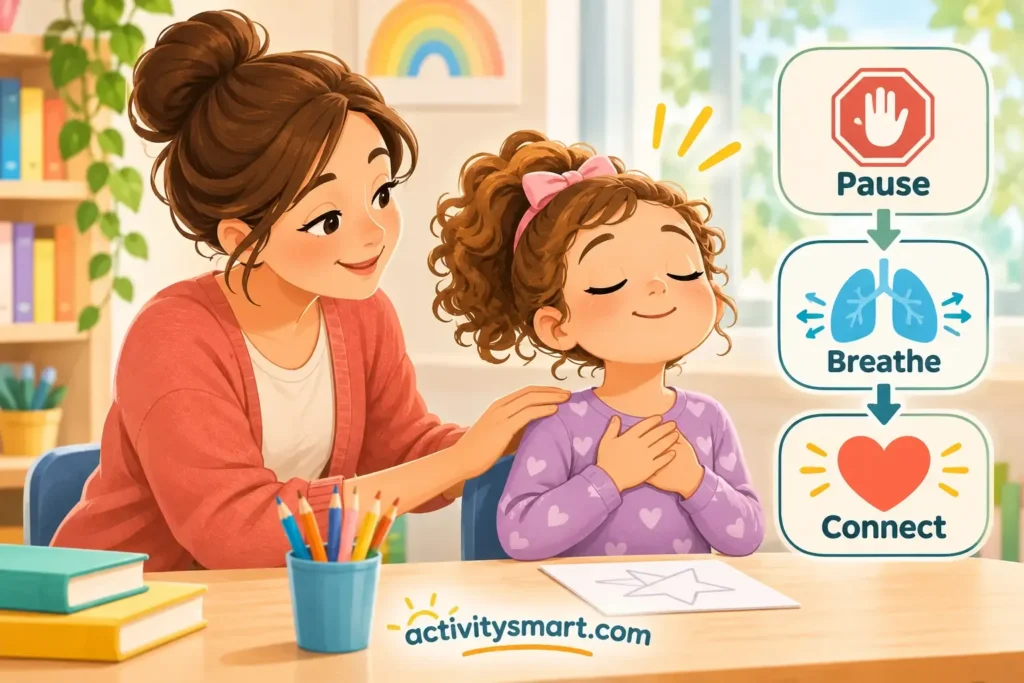
Instead of repeating “Finish the page,” cover most of the worksheet and point to one item. For a puzzle, set aside the complicated pieces and look for one edge. For writing, offer a broad line or larger surface before asking for neat letters. These are changes to the learning demand, not a verdict about the child’s ability.
Match your support to the child and the task
Age alone does not determine how much help a learner needs. Language development, attention, sensory needs, prior teaching, disability accommodations and familiarity with the task all influence the right response. The following examples are starting points, not developmental milestones or deadlines.
| Situation | First adult move | Gentle return to learning |
|---|---|---|
| Preschooler upset by a tricky shape | Validate and offer a larger drawing space | Trace one line together, then invite a choice |
| Early reader afraid of mistakes | Remove the audience and listen | Read alternating sentences or explore pictures |
| Child angry during math practice | Pause timed work and check understanding | Use objects to model one problem |
| Group member overwhelmed by noise | Reduce stimulation and offer a quieter place | Rejoin with a clear role or short turn |
For ages three to five: keep language concrete
A young child might show what they need before they can describe it. Point to two simple options, demonstrate one movement, and allow time to respond. “We can make a big circle or a small circle” is often clearer than “Use your coping skills.” Keep early attempts playful, especially when a task involves hand control that is still developing.
For example, if cutting paper sparks tears, put the scissors safely away, show tearing strips as an alternative, and revisit scissor use in a supervised practice session. The goal is to preserve curiosity while respecting safety. Our guide to practicing early scissor skills offers a useful related progression.
For ages six to ten: invite reflection after calm returns
The Education Endowment Foundation describes how explicit planning, monitoring and reflecting can support learning when taught within normal lessons. This research concerns broader metacognitive and self-regulation teaching, not proof that a single emotion-management script will raise achievement. Translate the principle into small questions: “What is our plan?” “Is it working?” “What could we change?”
Find the hidden difficulty instead of increasing pressure
Strong feelings are sometimes a reasonable response to a mismatch between what the adult asks and what the child can currently do with the available support. Before deciding the child needs more motivation, check whether the activity is clear, accessible, appropriately challenging, and possible in the available time. The same child can need a different level of help on different days.
Check instructions and prerequisite skills
If a child cannot start a pattern task, show one completed repeat and invite them to copy it before extending it. If handwriting causes distress, check whether the child can comfortably make basic lines and shapes. Our pre-writing activities with lines and shapes describe ways to practice those foundations without immediately requiring a finished written product.
A child learning number facts may be upset because the symbols have moved ahead of their understanding. Return to objects, groups, and spoken explanations. The hands-on introduction to number sense can help adults identify a smaller mathematical step. Do not insist on speed as evidence of understanding.
Check comparison, perfectionism and public mistakes
A classroom display that celebrates only the neatest work may unintentionally increase pressure for a child who finds drawing difficult. Offer examples of revision, show that adult drafts are imperfect, and praise a concrete choice or strategy rather than declaring that every attempt is amazing. “You checked the pieces and tried a different corner” tells a learner more than “You are so smart.”
Check the day around the lesson
Long transitions, hunger, little movement, and an overloaded after-school schedule can make a manageable activity feel impossible. Briefly review what happened before the task. If the struggle always occurs right after school, try food, connection and movement before a learning request. The after-school routine guide offers ways to make that transition more predictable.
For classrooms, consider the instructions given during transitions. A child who already spent considerable effort stopping one activity may not be ready for a three-part instruction immediately. See practical classroom transition routines for complementary planning ideas.
Teach coping strategies when everyone is calm
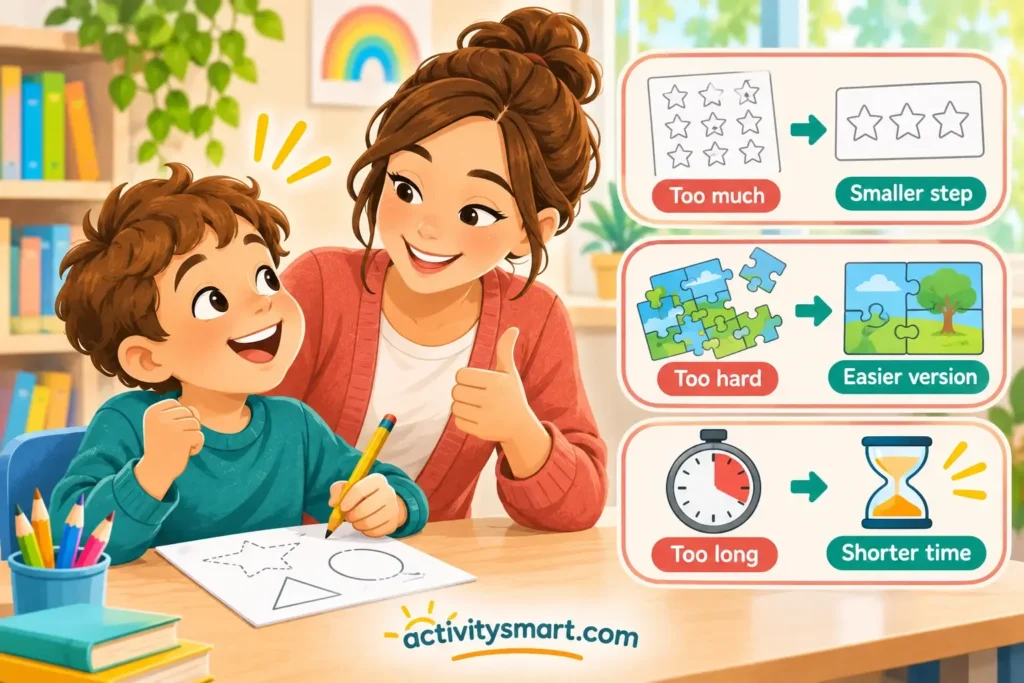
The middle of a meltdown is rarely the best time to introduce a new coping routine. Practice during low-stakes games and playful mistakes. Make it clear that a strategy is an invitation, not a test the child can fail. Different children prefer different supports; do not require a breathing exercise, emotion chart or sensory item simply because it works for somebody else.
Use playful practice with manageable mistakes
Build a slightly wobbly block tower and narrate a kind response: “Oops, it fell. I can try a wider base.” Draw a shape that needs correcting and show how to start again. In a sorting game, deliberately test an incorrect category and ask what clue could help. When the adult makes normal errors without embarrassment, the child sees that mistakes are information, not a loss of worth.
Build a small menu of support choices
Work with the child to choose two or three realistic options: ask for a hint, take a water break, move to a quieter seat, watch one example, or say “I need a minute.” Draw the choices as simple symbols for emerging readers. Put them where they can actually be used, rather than high on a wall as decoration.
Return to the original goal without demanding perfection
After a child settles, choose whether to continue the same task, adapt it, or revisit it later. Set a modest re-entry goal: read one paragraph together or solve one problem with manipulatives. If the work remains inaccessible, more prompting is not the solution; reassess instruction and expectations. Children should not have to produce a perfect result to receive warmth, respect or a break.
A child upset by a story discussion may feel better drawing a scene first. Our picture-book comprehension activities provide other ways to discuss meaning. For a child avoiding books entirely, the reluctant-reader support guide explores how choice and reduced pressure can make books more inviting.
What parents can say in common learning moments
Short, genuine language works better than a rehearsed lecture. You do not need the perfect sentence. Pay attention to your pace, facial expression, and whether the child wants to talk. These examples are prompts you can adapt, not magic words guaranteed to resolve distress.
- When a child says “I am stupid”: “This part is difficult right now. Let us work out what you already know.” Avoid arguing about intelligence while ignoring the confusing task.
- When a drawing is ripped up: “You are disappointed. We can put the pieces aside and decide what to do next.” Do not require an immediate replacement drawing.
- When the child refuses to read: “We can read together or you can listen to me start.” Keep genuine choices available without turning them into threats.
- When mistakes trigger shouting: “I can listen when we use safe voices. I will help you make space.” If there is danger, move to safety first.
- When a child is quiet and frozen: “We can take our time. You can point, show me, or tell me when you are ready.” Silence is not automatically defiance.
Support groups and classrooms without singling anyone out
Teachers need options that protect the whole group as well as the individual child. Make a quiet help signal available to everyone, explain how to get materials, and normalize asking to see a worked example. Predictable routines lower unnecessary uncertainty, but they should leave room for disabilities, language differences, and individual support plans.
Plan the environment before a difficult task
Preview the activity with a concise visual sequence: first look, then try together, then choose an independent step. Prepare a place where a child can briefly reset without losing supervision or becoming isolated. When introducing a challenging task, show one model and explain what students are allowed to do if they get stuck. The behavior you want is help-seeking and safe participation, not silent endurance.
Respond to disruption and preserve boundaries
If objects are thrown or someone is at risk, move others away from the immediate danger and follow school safeguarding and behavior procedures. Use short instructions and avoid physical restraint except where lawful, necessary, and performed by appropriately trained staff under applicable policy. Never frame dangerous behavior as merely a learning style or rely on a child to manage a crisis alone.
Common mistakes that unintentionally increase distress
- Calling a child lazy: it turns a solvable learning problem into a judgment about character.
- Repeating instructions louder: volume does not fix unclear wording or an inaccessible task.
- Asking “why” repeatedly during tears: save reflective questions for a calmer moment.
- Comparing siblings or classmates: public ranking often distracts from individual progress.
- Using breaks as prizes: teach appropriate pausing rather than requiring distress to earn one.
- Overhelping: completing the entire project for the child can remove useful practice; model one step and gradually give control back.
- Ignoring a repeating pattern: recurring distress deserves a review of support, not a more forceful version of the same task.
Another common mistake is assuming that validating feelings means giving up all expectations. You can keep a reasonable goal while adapting the route. “We still need to practice our sounds; we can do it with cards instead of a timed sheet” combines warmth with a clear learning purpose. If a child repeatedly cannot access that goal, the educational plan itself may need to change.
When big feelings need additional attention
Occasional tears or anger during learning are common. Seek further advice when reactions are intense, prolonged, increasingly frequent, or interfering with school, relationships, sleep, or daily life; when a child persistently fears making mistakes; or when you notice a notable change from their usual behavior. Also consider an assessment if repeated struggles cluster around reading, writing, language, attention, or sensory demands despite appropriate teaching and adjustments.
Start with a respectful conversation with the child’s teacher and, when appropriate, a pediatrician or qualified child mental health or learning professional. Bring specific observations: tasks that trigger distress, what support helped, the child’s strengths, and how long the pattern has continued. A professional can consider context and whether further evaluation or accommodations would be useful. This article cannot determine whether a child has a mental health condition or learning difference.
Take statements about self-harm or threats to others seriously. If there is immediate danger, follow local emergency procedures and obtain urgent professional help. In less urgent situations, take the child’s words seriously, stay with them when safety is a concern, and seek prompt qualified advice rather than dismissing the statement as attention-seeking.
A practical plan for the next learning session
Before starting, select one achievable objective and choose materials that fit current skills. Tell the child how long the activity will approximately last without making the timer a race. Agree on a simple help signal and decide where a brief break could happen. Begin with a short shared example so the first task is not a leap into uncertainty.
During the activity, notice effort and strategy rather than speed. If frustration rises, reduce language, validate briefly, and offer a pause or smaller step. Afterward, ask one reflective question when the child is ready: “What helped when it became tricky?” Write down a useful observation for yourself, not a score for the child. One calm, achievable attempt is a more useful starting point than forcing completion at any cost.
If your child is preparing for school, the school-readiness skills overview can help place emotional confidence alongside play, communication and foundational learning. For homework-specific problems, see strategies for homework frustration; the same compassionate principles apply, but home assignments introduce additional time and family pressures.
Sources and further reading
The following sources inform the guidance about connection, emotional support, adult modeling and learning strategies. They do not establish that every suggested script works for every child.
- American Academy of Pediatrics: Why Kids Act Out
- American Academy of Pediatrics: Creating Calm
- American Academy of Pediatrics: Modeling Behavior
- Education Endowment Foundation: Metacognition and Self-Regulation
Final perspective: connection and meaningful challenge can coexist
A child can be supported through strong emotions and still be invited to learn. Look for a calmer connection, a task that is genuinely accessible, and a next step that preserves agency. Some days that means a successful return to the original activity; on others, it means stopping, recording what went wrong, and planning better support tomorrow. Progress is measured in growing confidence and practical skills, not in the absence of tears.
Frequently asked questions
Should I stop a learning activity when my child cries?
Pause the demand and check what the child needs before deciding whether to continue. If the child settles, offer one smaller, supported step; if distress persists, it may be better to revisit the activity later.
How can I tell frustration from a child refusing to try?
You usually cannot tell from one behavior alone, so look at the task demands, what happened just before the reaction, and whether clearer instructions or help changes the response. Avoid treating a guess about motivation as a fact.
What should I say when my child calls themselves stupid?
Acknowledge that the work feels hard and point to a specific next step rather than debating intelligence. For example, say, “You are stuck on this part; let us find what you already know.”
Are breathing exercises necessary for a child to calm down?
No, breathing exercises are one optional strategy and some children prefer quiet, movement, water, or proximity to a trusted adult. Offer a small choice rather than insisting on a technique.
How long should a calming break last?
There is no single correct length for every child or situation. Keep the break safe and supportive, then check readiness to rejoin instead of using a timer as a punishment.
How can teachers help without disrupting the whole class?
Teachers can use discreet help signals, visual instructions, a supervised quiet option, and brief modeled steps. Clear group routines and preplanned supports reduce the need for a public intervention.
Does frustration during reading mean a learning disability?
No, frustration during reading alone does not establish a learning disability. If difficulties are persistent despite appropriate instruction and support, discuss specific patterns with the teacher and a qualified professional.
Should I praise my child for trying even when the answer is wrong?
Yes, specific feedback about a useful strategy or effort can support continued participation, but also give clear guidance about the next step. Avoid vague praise that ignores what the child needs to learn.
When should I seek professional help for big reactions to learning?
Seek qualified advice when reactions are persistent, severe, worsening, or interfere with daily functioning, and seek urgent help when there is immediate danger. Share concrete examples of triggers, strengths, and supports already tried.