Quick Answer
To learn how to teach letter sounds, begin with a few useful letter–sound pairs, say each sound clearly, and let children hear, identify, and use it in spoken words. Model first, invite a short response, revisit familiar sounds, and gradually connect them to blending simple words. Keep practice playful, explicit, and responsive to the child.
Quick Picks
- First activity: hear /m/ at the start of moon, then match it to m.
- Simple materials: two letter cards, familiar objects, and a picture book.
- For preschool: brief, playful oral sound games with gentle letter introductions.
- For kindergarten: systematic letter–sound practice followed by guided blending.
- Progress check: ask for the sound when showing the letter, not only its name.
Learning letter sounds is the bridge between hearing language and reading print. A child who knows that the printed letter m can represent /m/ is beginning to connect a visible symbol with a sound in speech. That connection matters more than reciting the alphabet in order.
This guide gives parents and educators a realistic sequence, examples of what to say, ways to adapt practice, and signs that a child needs a different kind of support. The aim is confident, accurate sound recognition—not racing through twenty-six flashcards.
How to Teach Letter Sounds Step by Step
Teach the connection explicitly: point to a letter, pronounce its sound, and show where that sound occurs in a meaningful word. Then let the child respond with guidance before asking for independent recall. A predictable routine makes it easier to notice whether the child recognizes the sound or is guessing from a picture.
Step 1: Start with a small, useful set
Choose two or three easily distinguishable letters, such as m, s, and a, rather than the entire alphabet. Introduce a few consonants and a short vowel early enough that children can eventually combine them. The precise sequence should follow your school’s systematic phonics program if one is in use; there is no universally mandatory first-letter order.
Show lowercase forms prominently because children will meet them frequently in books. Mention uppercase partners without turning each lesson into a four-way memory test. Keep a review card from yesterday beside the new card so the child learns to distinguish rather than merely repeat.
Step 2: Model a clean sound
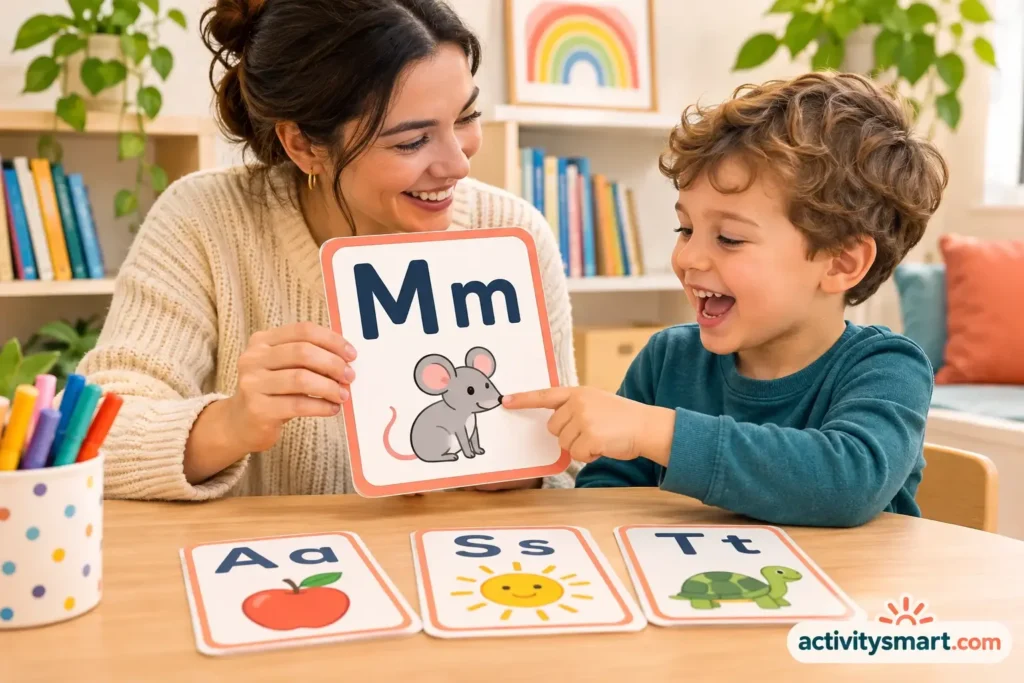
Point to m and say /mmm/, as in moon. Avoid adding an unnecessary vowel: /muh/ can make later blending harder because the child may try to combine extra sounds. Some sounds, such as /b/ and /t/, are naturally brief; model them as clearly as possible without demanding an unnatural prolonged pronunciation.
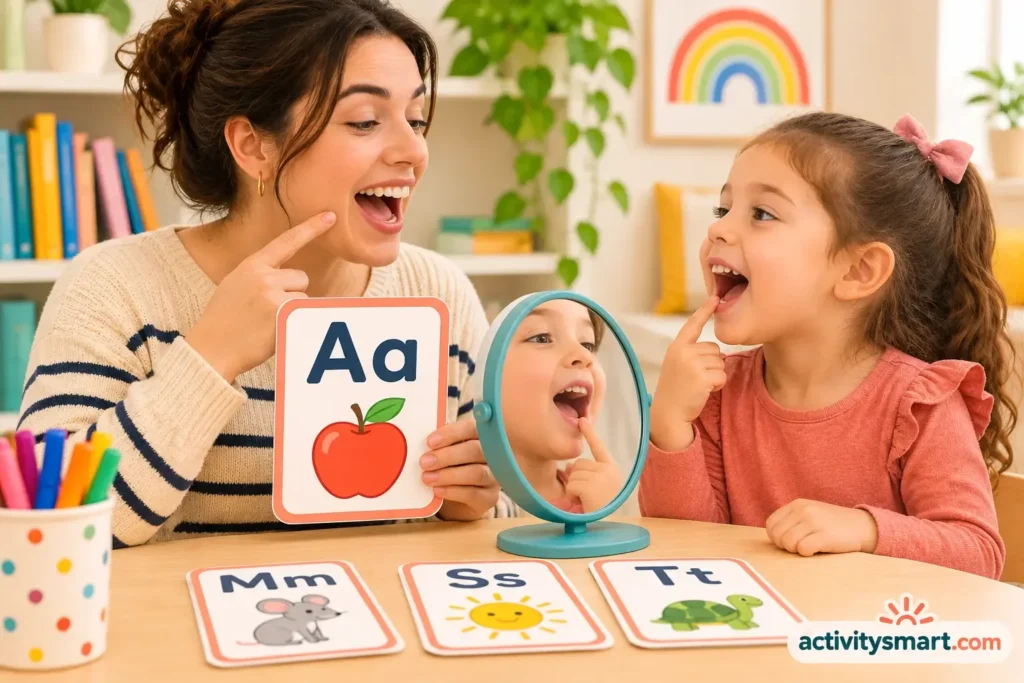
Invite the child to watch your lips or feel their own mouth move. Say, “My lips touch for /m/. Listen: /mmm/.” Mouth cues can make a sound more concrete, but they supplement rather than replace hearing, saying, and recognizing the sound in words.
Step 3: Hear the sound before hunting for the letter
Ask, “Do you hear /m/ at the start of moon or sun?” Say the words naturally, then emphasize the target once. If the child is unsure, contrast two obvious examples and answer together. Beginning-sound identification is often easier than identifying a sound in the middle of a word.
Keep sound play separate from spelling for a moment. Children can clap syllables, notice rhymes, and hear the first sound in familiar names without seeing print. For a deeper explanation of these connected but different skills, see phonemic awareness and phonics.
Step 4: Connect the heard sound to print
Place m and s cards on the table. Say /m/ and ask the child to touch m. Next, point to m and ask what sound it represents. These are different tasks: recognizing a letter from a spoken sound and retrieving a sound from a written letter. Practice both, because one may develop before the other.
Use a brief, specific correction when needed: “That is s; it usually says /sss/. This is m; it says /mmm/. Show me m.” Follow the correction with another opportunity to succeed. Avoid repeatedly asking a question after a child has clearly shown they do not know the answer.
Step 5: Revisit and apply
Mix yesterday’s letters with today’s, change their positions, and ask for sounds in a different order. Once the child knows a few consonants and a short vowel, model how the sounds work together in simple words. Recognition is not fully secure if a child succeeds only when the cards appear in a memorized sequence.
Letter Names, Letter Sounds, and Phonemic Awareness
A letter name is the conventional label, such as “em” for m. A letter sound is a speech sound that the letter can represent, such as /m/. Phonemic awareness is the ability to notice and manipulate individual sounds in spoken words, even without written letters. Phonics links those sounds to written symbols.
These abilities support one another, but they are not interchangeable. A child may sing the alphabet and still be unable to tell you the sound represented by a letter. Another child may hear /s/ in sock while not yet recognizing printed s. Teach both sides deliberately rather than treating alphabet-song fluency as proof of decoding readiness.
| Skill | Example prompt | What success shows |
|---|---|---|
| Letter naming | “What is this letter called?” | Recognizes its conventional name |
| Letter–sound correspondence | “What sound can m represent?” | Connects print to a speech sound |
| Phonemic awareness | “What is the first sound in map?” | Notices a sound without needing print |
| Blending | “Put /m/ /a/ /p/ together.” | Combines sounds into a spoken word |
The IES foundational reading practice guide recommends developing awareness of sound segments and explicitly linking them to letters, then teaching children to decode and recognize words. Its recommendations are research-informed guidance, not a timetable requiring every child to master each skill at the same age.
Which Letter Sounds Should Come First?
Begin with a manageable sequence that supports early word building and minimizes confusing contrasts. Letters such as m, s, t, a, p, and i can eventually form simple practice words, but that example is not a replacement for a school’s chosen program. Consistency between home and classroom is usually more helpful than competing lists.
Use sounds that children can hear and produce
Continuant consonants such as /m/, /s/, and /f/ can be held briefly, making them convenient for modeling and blending. Stop consonants such as /p/ and /t/ need crisp demonstrations. Introduce short-vowel sounds with concrete spoken examples, and be alert to accent differences. For instance, the vowel in a sample word may not sound identical across English dialects.
Introduce visually confusable letters carefully
Letters b and d can be confused by beginning learners. Teach one clearly in several words and contexts before expecting the child to distinguish both rapidly. Add the contrasting letter later and give side-by-side practice. Occasional reversals during early learning do not, by themselves, establish a learning disorder.
Explain that one letter can represent more than one sound
Early instruction uses a common, dependable sound for each letter so children can begin decoding. Later, children learn additional correspondences: c may represent /k/ in cat and /s/ in city, while vowel spellings vary widely. Do not tell a child that a letter has only one possible sound forever; say, “This is the sound we are learning for this letter today.”
Use printable alphabet worksheets selectively for matching, tracing, or quick review, rather than asking children to complete many pages before they can identify sounds orally.
Seven Playful Letter-Sound Activities That Still Teach Explicitly
Choose one or two activities per sitting. Each can be adapted for movement, drawing, or quiet work.
1. Sound-and-object basket
Place a mug, sock, and toy sun near two letter cards. Model /s/ and invite the child to choose something beginning with that sound. Name each object clearly before asking; unfamiliar vocabulary should not be the hidden challenge. Swap objects when the child can explain the choice without watching your eyes for clues.
2. Letter-card treasure hunt
Hide three large paper letters in safe, visible places. When a child finds one, say its sound together and name a word beginning with it. For preschoolers, let the adult read the letter first. For kindergarteners, ask for the sound independently and then check with a familiar example.
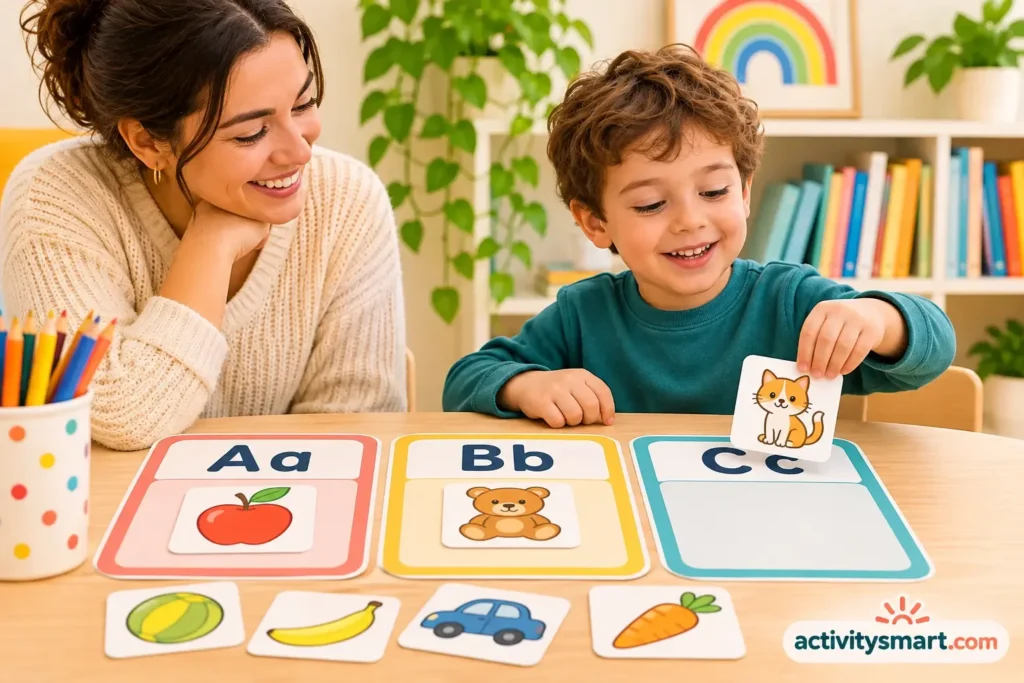
3. Two-picture sound sort
Draw or print a moon and a sun. Say their names and ask which begins with /m/. Start with clearly contrasting initial sounds. Later, add more pictures and ask the child to sort by initial sound, explaining a choice aloud. Do not use pictures whose names are ambiguous without first agreeing what each picture represents.
4. Mirror-mouth detectives
Use a shatter-resistant mirror or simply face one another. Compare /m/, made with lips together, with /f/, made by touching upper teeth to the lower lip. The aim is to notice how a sound is produced, not to correct a child’s speech by force. If speech production itself is persistently difficult, consult a qualified professional.
5. Letter path on the floor
Place large paper cards on a clear floor and say a sound. The child steps beside the matching card, then says a word with that initial sound. Use non-slip materials, remove tripping hazards, and allow pointing instead of stepping for children who need a seated option. The learning target remains sound identification, not speed.
6. Picture-book sound spotting
Read a familiar page for meaning first. Then select one target sound and ask, “Can you hear /s/ in sun?” Point to the printed letter only when it is present and relevant. Keep the story enjoyable; stopping to quiz every word can interrupt comprehension and conversation.
7. Make, say, and check
Invite the child to form a letter with dough, a finger on a textured card, or a washable marker. Say its sound as the shape is made, then cover the model and show the printed letter again. Letter formation may strengthen attention to its shape, but writing practice should not crowd out hearing and blending activities. For children developing control, see helping a child write their name and early tracing activities.
Move from Individual Sounds to Blending Words
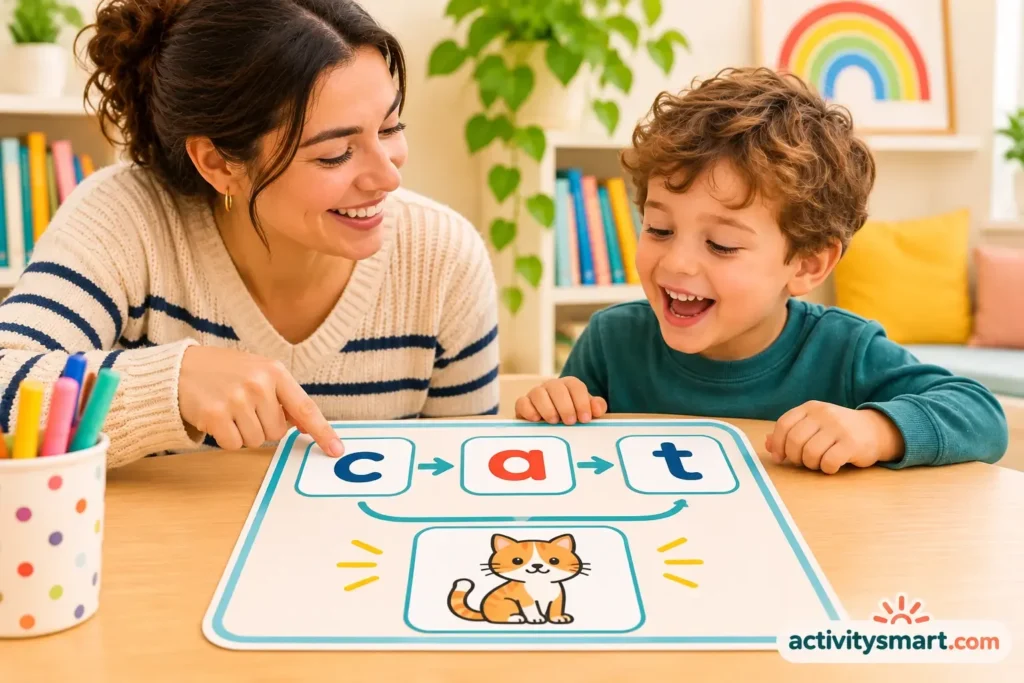
Once a child recognizes several correspondences, show how sounds combine. Use familiar, regular consonant-vowel-consonant words such as map, sat, and sit when their component sounds have already been taught. Point from left to right while saying each sound, then repeat them more smoothly and say the whole word. Do not require a child to memorize the picture or guess from the first letter.
Model before independent blending
Place m, a, and p in a row. Say, “Watch me: /m/ /a/ /p/—map.” Move a finger under the letters while blending. Then build the word again with the child. If the child says each sound correctly but cannot combine them, you can model continuous blending and gradually shorten the pauses. This is a new skill, not proof that the individual sounds were never learned.
Use word building to make the connection visible
Change map to mat by replacing p with t. Ask what changed at the end and read both words. Later, change the first sound while keeping the rest stable. The physical swap helps children see that changing a written letter can change a spoken word. Keep examples decodable with the correspondences already taught.
Know when to slow down
If a child is guessing, remove extra cards and return to two familiar sounds. If the child can identify sounds orally but not match letters, spend time on the printed symbols. If the child can match letters but not hear the first sound in spoken words, use more listening games. The IES preschool preparation practice guide recommends intentional preschool teaching of letters and sounds while also supporting language and shared reading.
When blending begins to work, CVC word practice sheets can provide additional simple-word practice. Select only pages whose spellings match the child’s current knowledge; a worksheet is not an assessment of everything a child ought to know.
A Short Lesson Plan for Home or Classroom
A predictable routine can fit into a few focused minutes, with the length adjusted to attention and interest. The sequence below is an example, not a clinical recommendation or fixed daily requirement. It works with a small group, one learner, or a parent sitting beside a child.
- Reconnect: show two known letters in random order and invite their sounds. If one is forgotten, model it without a lengthy test.
- Introduce: display one new letter, say its most useful sound, and name two familiar words containing that sound at the beginning.
- Listen: say two words and ask which begins with the target sound. Use clear contrasts before close contrasts.
- Match: show the new letter beside a known one; alternate between “find /m/” and “what sound is this?”
- Apply: use a picture, brief movement game, or simple word building if the child has enough known sounds.
- Close: ask for one successful response, tell the child what they did accurately, and stop before frustration dominates.
In a classroom, rotate a small set of cards across partners while listening to individual responses. A chorus can be lively, but it can conceal who is unsure. In a home setting, use the same routine in the kitchen, during a book, or before a short drawing activity. Frequent, meaningful revisiting matters more than an elaborate display.
Adjust for preschool and kindergarten
For younger preschoolers, prioritize oral language, playful sound noticing, books, and low-pressure exposure to print. Some children are ready for explicit letter–sound matches; others need more opportunities to hear and talk about words. Kindergarten instruction can be more systematic, with guided practice, blending, and checks for independent recognition. Age labels are starting points, not individual deadlines.
The EEF phonics evidence review describes systematic phonics as an evidence-supported part of early literacy, while emphasizing that phonics alone does not guarantee comprehension. Pair decoding work with stories, conversation, vocabulary, and enjoyable reading.
How to Check Progress Without Turning Practice into a Test
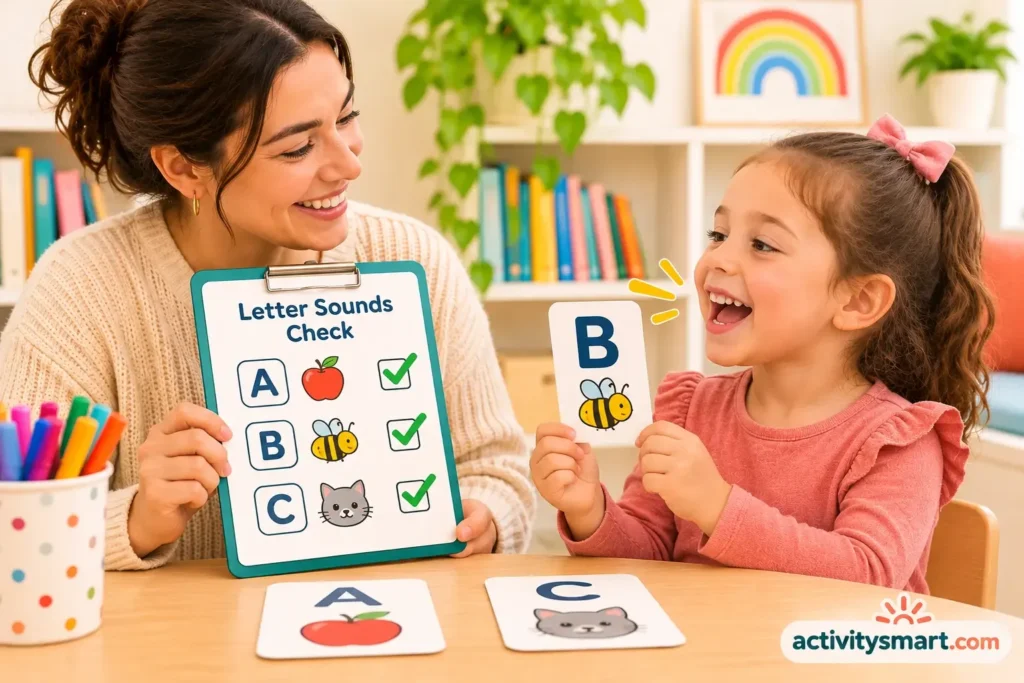
Show a few learned letters individually in a mixed order and ask for the sound. Record whether the child responds independently, after a prompt, or after a model. On another day, say a sound and ask the child to choose its letter from two or three options. Compare these tasks because they measure related but distinct knowledge.
Listen for consistent responses across settings. A child may answer correctly at a familiar table but struggle when a letter appears in a book or a different font. That is a cue to vary examples, not automatically to introduce harder material. Keep observations short and factual: “Recognized m and s independently; needed a model for a.”
What to do with the results
If recognition is accurate, introduce a small next set and continue review. If one sound is uncertain, reteach it with clearer modeling and more contrasting examples. If several sounds remain difficult, reduce the number of targets and ask the teacher which sequence the class uses. Track progress over repeated opportunities rather than interpreting one distracted afternoon as a stable skill level.
Writing can sometimes support letter recognition, but a child with limited hand control should be allowed to point, say, or select a card instead. The ActivitySmart guide to comfortable pencil control offers related ideas for motor practice without making handwriting a prerequisite for phonics.
Common Mistakes and How to Fix Them
Teaching only letter names
Alphabet songs and name games can be enjoyable, but they do not automatically teach the sounds needed to decode. Ask “What sound does this letter represent?” alongside naming questions, and demonstrate the answer when it is new.
Adding an extra vowel to consonants
Pronouncing /m/ as “muh” or /s/ as “suh” can create unnecessary sounds when blending. Model the sound itself as closely as natural speech allows, then demonstrate the complete word. Do not criticize a child for copying an unclear adult model.
Introducing too many letters at once
Rapid exposure can look productive while leaving little time for recall. Teach a small set, mix it with familiar letters, and add more when the child can respond in varied contexts.
Using pictures as the only cue
Picture cards are useful for vocabulary and hearing sounds, but a child might remember “moon” without recognizing m. After the example, hide the picture and ask for the sound from the letter alone. Later, put the same letter in a different word.
Correcting through repeated guessing
When a child is stuck, repeatedly asking “Are you sure?” can make learning feel unsafe. Give the correct model, compare two choices, and invite a fresh response. Praise a specific strategy—“You listened for the first sound”—rather than calling every answer perfect.
Safety, Inclusion, and When to Ask for Support
Use age-appropriate materials. Small loose letters, beads, and magnets can be choking or swallowing hazards for young children; choose large pieces and supervise according to the child’s developmental needs. Keep movement games away from stairs, cords, and slippery surfaces. Never require a child to touch another person’s mouth to learn articulation.
Children who are learning English alongside another language may know different words or produce sounds differently across languages. Check that they understand the example vocabulary before judging their awareness of a sound. Respect dialect differences, and coordinate with the school’s language-of-instruction goals rather than treating every pronunciation difference as an error.
Some learners benefit from visual supports, slower pacing, smaller groups, or additional explicit instruction. If difficulties persist despite well-matched teaching, discuss observations with the classroom teacher and, when appropriate, a qualified reading specialist, speech-language pathologist, or pediatric professional. A single letter reversal or missed sound is not a diagnosis. Concerns about hearing or speech clarity deserve professional evaluation rather than more drilling alone.
Sound games can also sit beside other playful learning routines, such as hands-on counting routines; variety is helpful, but a math activity does not substitute for explicit letter–sound teaching.
Final Takeaway: Teach a Sound, Hear It, Use It, Revisit It
Effective early letter-sound instruction is clear and cumulative. Model a small number of useful correspondences, help children hear those sounds in words, match them to print, and revisit them in changing contexts. As knowledge grows, guide children into blending and word reading while continuing stories, talk, and vocabulary development.
For a parent, the next step may be two cards and one familiar object. For a teacher, it may be checking which children can retrieve sounds without a chorus. Both approaches keep the focus on what a child can actually hear, recognize, and use—not how many pages they have finished.
Frequently Asked Questions
Should I teach letter names or letter sounds first?
Teach letter names and sounds together when appropriate, but explicitly practice the sounds children need for early decoding. Knowing the alphabet song alone does not show that a child can connect print to speech.
How many letter sounds should I introduce at one time?
Introduce a small number of new letter–sound pairs at a time and review familiar ones. Two or three may be manageable for an introductory activity, but adjust to the learner and the school’s phonics sequence.
What is the best first letter sound to teach?
There is no single best first letter sound for every child. Start with clear, useful correspondences in a systematic sequence that will soon allow simple word building.
How do I teach a child who knows the alphabet but not the sounds?
Show one printed letter, model its sound, connect it to a familiar spoken word, and practice identifying the sound from the letter. Check the sound independently instead of relying on alphabet order.
When should children start blending letter sounds?
Children can begin guided blending after they recognize enough consonant and vowel sounds to form simple decodable words. Model left-to-right blending first and continue teaching individual correspondences as needed.
Is it normal for a child to mix up b and d?
Yes, b and d confusion can occur during early letter learning. Teach each shape and sound clearly, then practice distinguishing them; persistent broad difficulties warrant discussion with an educator.
Can worksheets teach letter sounds effectively?
Worksheets can reinforce letter–sound knowledge, but they should supplement clear modeling, listening, spoken responses, and feedback. A completed page does not necessarily demonstrate independent sound recall.
What if my preschooler refuses letter-sound practice?
Stop the pressured task and try a shorter, playful activity later. Read together, notice sounds in familiar names, and offer simple choices without making participation a battle.
When should I seek extra help with letter sounds?
Seek advice when a child continues to struggle despite consistent, appropriately paced instruction, especially if hearing, speech, or wider language concerns are present. A teacher or qualified specialist can help identify suitable next steps.
Sources and Further Reading
The teaching approach above draws on the IES foundational reading practice guide, the IES preschool preparation practice guide, and the EEF phonics evidence review. These resources support explicit, systematic instruction and attention to individual progress; they do not prescribe one universal lesson length or letter order.