Quick Answer
Balance worksheets and hands on play by starting with a real object or playful task, using a short worksheet only when it clarifies or records the idea, and returning to play to apply it. Choose activities by your child’s interest and readiness, not by a fixed paper-to-play ratio. Protect time for child-led exploration.
A worksheet can help a child notice a pattern or practice a familiar symbol. A kitchen sorting game, pretend store, building project, or conversation can make the same idea tangible. At home, the useful question is not which format wins; it is what the child needs to understand, practice, and enjoy learning today.
Why worksheets and hands on play work differently
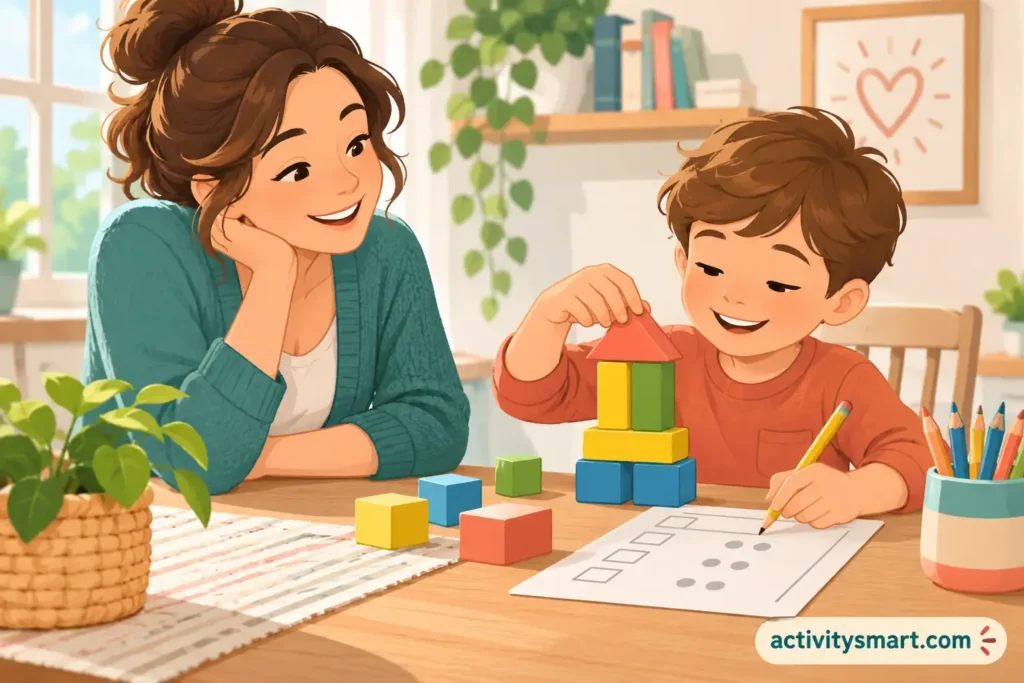
Paper tasks and physical play offer different kinds of participation. A tracing page constrains where marks go; making roads with tape lets children plan shapes at a larger scale. A page of pictured coins can introduce a symbol; a pretend shop asks children to exchange objects, count, negotiate, and correct a mistake. Neither single activity demonstrates everything a child knows.
The National Association for the Education of Young Children’s principles of developmentally appropriate practice describe a continuum from child-directed play through guided play to explicit instruction. Their guidance cautions against treating either unguided play or predominantly direct instruction as a complete early-learning approach. That is a rationale for variety, not scientific proof that every worksheet should be followed by a particular number of play minutes.
What a worksheet can do well
A carefully chosen page can focus attention on one specific feature: which letter looks different, where to draw a line, or how to record a count. It can also leave a visible sample that an adult and child discuss later. The benefit depends on what the child understands and whether the work is accessible. Completing many identical items is not the same as gaining a transferable concept.
Keep instructions short and show one example without doing the thinking for the child. Where possible, let the child point, explain, use a stamp, dictate, or mark a response in another accessible way. If handwriting effort overwhelms the mathematics or language goal, change the response format instead of assuming the child lacks understanding.
What hands-on and pretend play add
Handling objects allows children to compare weight, shape, quantity, and movement in ways flat pictures cannot. Pretend play can invite conversation, planning, and role changes. These are opportunities, not automatic outcomes: the quality of interaction and the child’s participation matter more than merely placing toys on a table.
Harvard’s brain-building through play resources suggest games that exercise attention, working memory, and self-control across childhood. The recommendations support making playful experiences available, but they do not establish that a specific homemade game will raise test scores. For a quieter child, exploring materials independently may be more welcoming than a heavily narrated adult-led game.
Why the connection matters
A child who sorts socks by color understands the act of grouping before they see the circles to color on a worksheet. A child who points to a letter on paper can look for that letter on a food label. Crossing between concrete action and symbols gives adults a chance to ask whether a concept carries over to a new setting.
Choose the activity based on the learning goal
Before printing, name one observable goal: compare two amounts, hear the first sound in a word, recognize a pattern, or control a tool safely. Then select the lightest activity that helps you see that skill. This keeps a worksheet from becoming a substitute for a conversation and stops play from turning into a disguised quiz.
| Goal | Possible worksheet | Hands-on option | What to notice |
|---|---|---|---|
| Counting | Circle a set of five | Set five cups for a pretend picnic | One count word per object |
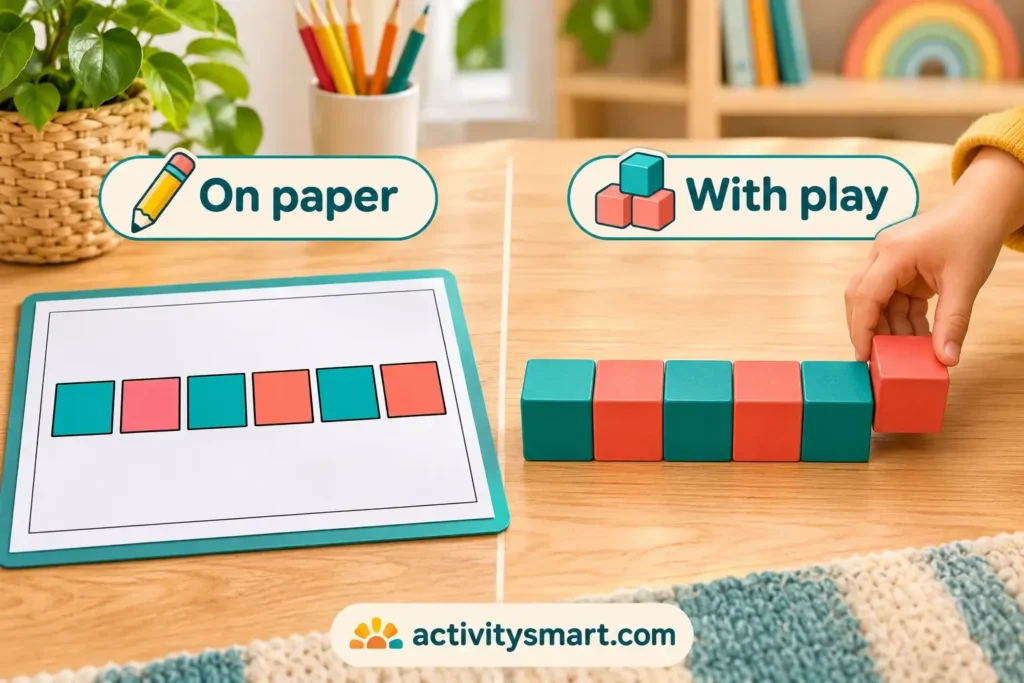
| Patterns | Complete a printed AB pattern | Repeat colors using blocks | Can the child explain what comes next? |
| Early writing | Trace a broad path | Draw roads in sand or with a brush | Comfort and control rather than neatness |
| Story skills | Sequence three pictures | Act out a familiar story | Beginning, event, and ending in the child’s words |
| Shapes | Match printed outlines | Build shapes from craft sticks | Notice sides, corners, and differences |
Use this table as a menu, not a developmental checklist. Children may understand a concept but find its printed representation confusing, or succeed on paper without using the idea in daily life. For a concrete counting progression, see hands-on ways to develop number sense.
A simple home routine that does not feel like extra school
Start with the child, not the printer
Observe what is already happening. If your child lines up toy animals, ask how many fit in a shelter. If they are building a tower, wonder aloud how to make it steadier. The goal can emerge from an interest, reducing the need to persuade a reluctant child to begin. Sometimes the best first step is a snack, outdoor movement, or rest.
The Education Endowment Foundation’s guidance on supporting learning at home emphasizes practical, supportive family engagement. It is not an instruction to turn every household moment into a formal lesson. For households whose evenings are already full, a flexible after-school routine can help preserve downtime alongside necessary school tasks.
Offer one short, meaningful paper task
If a page supports the goal, choose a modest portion, explain its purpose, and allow the child to stop when the useful practice is finished. Rather than completing an entire sheet of repeated shapes, a child might mark three examples and then build those shapes. The amount should respond to stamina and engagement; no universal minute limit fits every child and task.
Invite the child to explain a choice: “How did you know these two belong together?” A brief discussion can reveal reasoning that a checked box cannot. For early writers, work from large comfortable movements toward small marks when appropriate; the pre-writing skills guide offers ideas beyond pencil practice.
Move into purposeful play
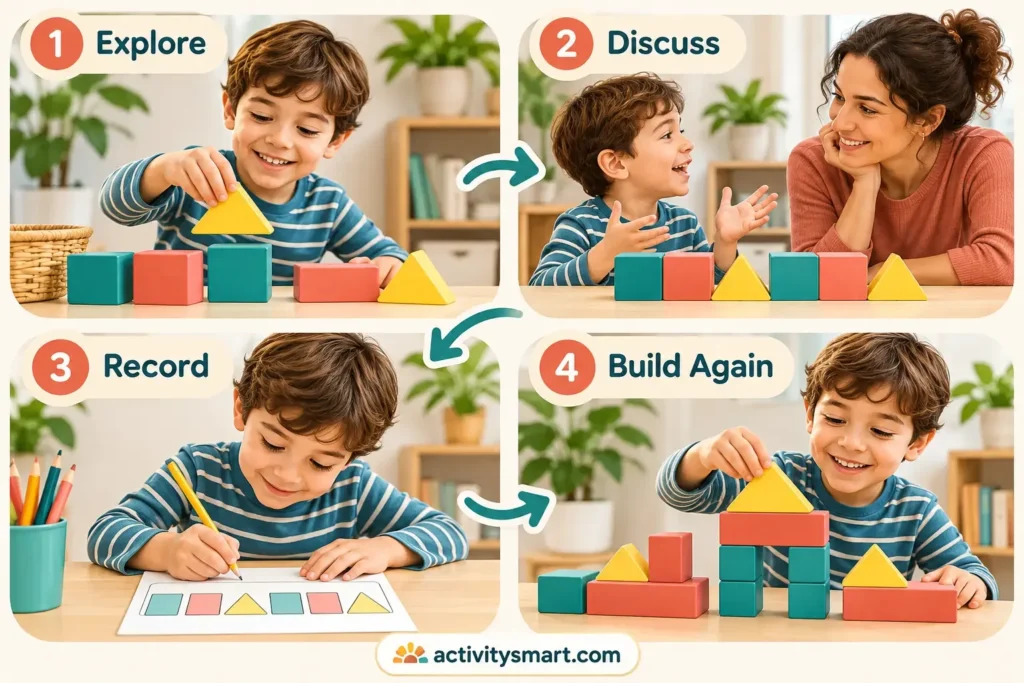
Translate the page into a game with real materials. After matching shapes, hunt for shapes around the home. After counting pictures, count spoons while setting the table. After sequencing pictures, use stuffed animals to recreate the order. Let the child change the scenario while you hold the learning goal lightly in mind.
End with noticing, not grading
A closing conversation might be “What surprised you?” or “Show me the part you changed.” Record a brief observation for your own planning, such as “counted objects reliably but skipped one picture.” Do not label a single evening as proof of mastery. The next day, offer a different context to see what the child can do without prompting.
When a child wants to keep playing, it is usually reasonable to let the activity continue if the materials and timing are safe. An unfinished worksheet need not become a conflict. Independence also has value; ideas in encouraging independent play can help adults step back gradually.
Practical activity pairs you can set up with household materials
Letters: from page to meaningful print
Use a simple letter-identification page only after a child has opportunities to hear, say, and notice the target sound. Then hunt for that letter in a familiar name, sign, or food package. For older beginners, select just a few letters that commonly get confused and compare their distinctive features. Avoid making random letter hunting the entire reading lesson: recognizing a letter form and connecting letters to sounds are related but different tasks.
An optional extension is to form a letter with dough, finger movements, or strips of paper and say its associated sound while looking at familiar examples. For children already reading, use short meaningful words instead. Families wanting more structured practice can consult how to teach letter sounds rather than expecting a decorative worksheet to teach phonics by itself.
Math: count, make, and check
Draw three boxes on a page and invite the child to predict which has more objects. Next, place one bead, block, or large counter in each matching real container and compare the groups. Put the objects in a different arrangement; ask whether the amount changed. This creates an opportunity to distinguish appearance from quantity without turning the moment into a timed test.
For older children, pose a pretend shopping problem: “We have six tokens and want two things that cost three each.” They can move counters to test a solution and record it with a drawing. If abstract notation is familiar, add a number sentence afterward. The concrete objects are a thinking aid, not a reward withheld until a paper problem is finished.
Stories: sequence, retell, and improvise
Choose a short familiar picture book and sketch or print a few sequence cards. Let your child place the cards in order and explain what happened between them. Then act the story with puppets or objects. A child who remembers different details may be showing interpretation, not simply making an error.
Add a “what if?” ending and discuss how a character might respond. If the child needs support, model one sentence and invite an alternative. This works with a home language as well as English; rich talk and shared reading matter more than forcing one-word written answers. A family reading routine can keep this kind of conversation regular without making every book a worksheet.
Art and fine-motor control: move large before small
Try an easy line-tracing page as one option among finger painting, chalk paths, threading large safe pieces, tearing paper, and building with reusable materials. The goal is control and enjoyment, not a perfect product. A child whose hands tire quickly may show more ability when drawing a wide line on a vertical surface than when filling tiny boxes.
If you use scissors, provide suitable child-safe tools, supervise closely, and choose paper thickness the child can manage. Keep small loose parts away from children who may mouth them, including visiting younger siblings. For developmentally varied ideas, see fine motor skill activities.
Science: predict, explore, record
Ask whether a household object will roll on a gentle ramp, then test with safe items such as large blocks and toy cars. A simple recording sheet can have “prediction” and “what happened” columns with drawing space. Compare the material or shape of each object, and change only one feature if your child wants to investigate further.
Adapt the balance for ages, abilities, and preferences
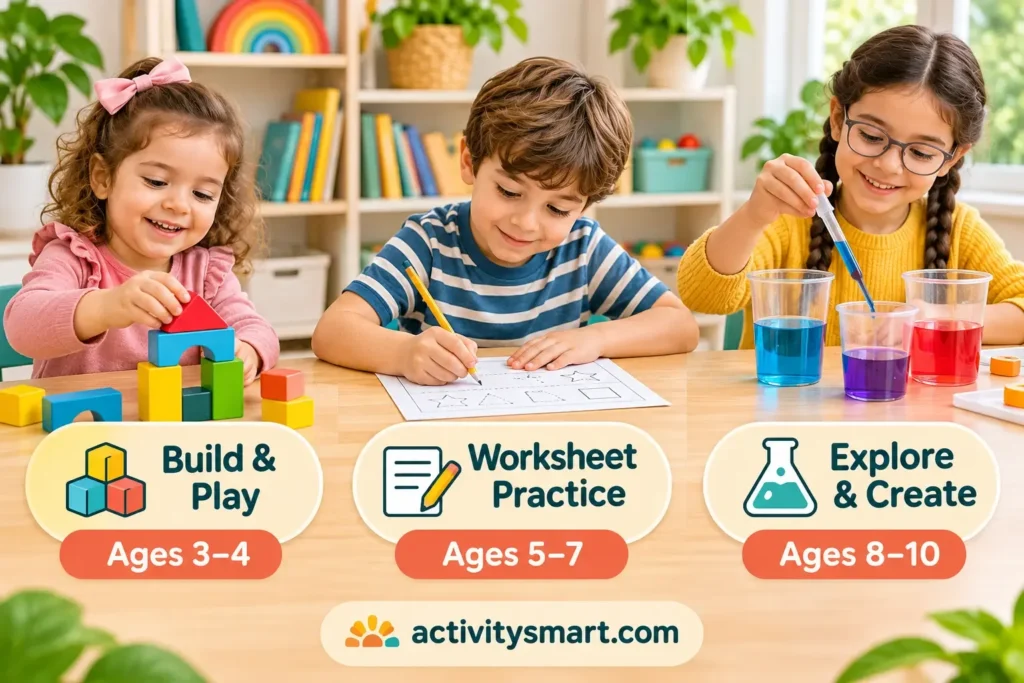
Ages 3–4: prioritize exploration and talk
Many children in this range benefit from big movements, sensory exploration, pretend situations, and short back-and-forth conversations. A page can be optional: point to a picture together, add a sticker, or scribble a response. There is no developmental requirement to finish a daily stack of worksheets. Consider the child’s actual skills, interests, and tolerance for seated tasks instead of applying a rigid age rule.
Use washable materials and large pieces, and remain close enough to supervise. Songs, sorting laundry, stacking, and noticing signs can all create learning opportunities. When attention shifts, changing activity may be more productive than trying to extend a task simply to reach a planned duration.
Ages 5–7: connect concrete models to symbols
Some schoolwork begins to demand printed letters, numerals, or written responses. Support the same idea with blocks, spoken stories, and drawing before asking for notation. A child who can solve a problem with counters but struggles on the page may need help interpreting symbols or making marks—not more identical problems.
Choose a page for a skill the child is ready to practice, then check transfer in a playful scenario. Children develop unevenly; age bands describe possible options, not thresholds. If a school has assigned specific work, coordinate with the teacher before replacing or changing required tasks.
Ages 8–10: use projects to deepen practice
Older children can sometimes benefit from short independent written practice after a concept has been introduced, particularly when the purpose is clear and feedback is available. Pair it with meaningful design problems: plan a garden on graph paper, calculate pretend recipe quantities, write instructions for a board game, or research a question that arose during building.
Offer choice between two ways to demonstrate learning where requirements permit. A child might first sketch a model and then explain the written answer. This is not a claim that every child learns best in a particular “learning style”; varying formats gives multiple chances to show understanding and participate.
Adaptations for different access needs
Children with motor, language, sensory, attention, or learning differences may need modifications that alter the demand without changing the goal. Use larger print, fewer items per page, a stable writing surface, visual directions, movement breaks, verbal answers, or assistive tools when relevant. Ask the child what feels manageable, and follow recommendations from their educators or clinicians when available.
Do not interpret refusal, fatigue, or uneven performance as laziness. If significant difficulties persist across settings or interfere with daily functioning, discuss observations with the child’s teacher and an appropriately qualified professional. This article offers educational ideas, not screening, diagnosis, or treatment.
Signs the balance needs adjusting
Watch for the mismatch between effort and learning. If a child can explain an idea with objects but freezes on paper, reduce print demands. If they enjoy drawing the answer but cannot make a concrete example, return to manipulating real quantities or acting out the problem. If all activities create distress, investigate timing, expectations, basic needs, and the task itself before increasing practice.
- Too much paper: repetitive answers without explanation, hand fatigue, avoidance, or conflict around completion.
- Too much adult control during play: constant questions, scripted outcomes, and little opportunity for a child to choose materials or strategies.
- Too little focused practice for a known goal: a child enjoys an activity but rarely encounters or revisits the specific skill they want or need to learn.
- Good fit: the child can participate, discuss the idea in some form, and try it again in another situation without undue pressure.
Emotional signals are useful information, not scores. When frustration rises, a genuine break and a calmer reconnection may be more helpful than insistence. See supporting big feelings during learning for ways to respond without turning practice into a struggle.
Common mistakes families can avoid
Treating completion as evidence of understanding
A neat page shows that marks were made where expected; it does not necessarily show reasoning. Ask the child to demonstrate the idea with a new example. You can also vary the order or materials rather than giving a nearly identical second worksheet.
Replacing all free play with disguised lessons
Not every block tower needs a geometry question. Child-directed time has its own value for choice, experimentation, and relationships. The American Academy of Pediatrics discusses play as an important context for social-emotional, language, and cognitive development in its clinical report on the power of play. This is not a reason to turn play into a performance measure.
Using rewards to force a long session
“Finish three pages and then you may play” frames play as a prize rather than part of learning. Instead, be transparent about what must be completed for school and what is optional. Offer a small choice over timing or format; acknowledge effort without implying that mistakes mean failure.
Comparing siblings or setting universal ratios
A flexible week of learning without a worksheet pile
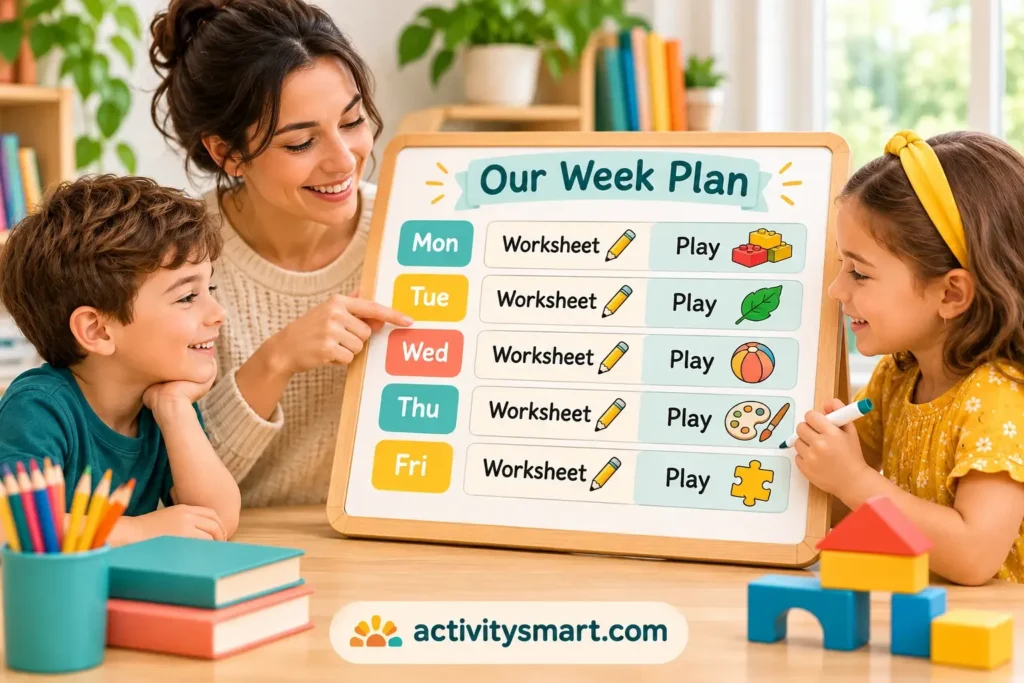
Use the following sample as an idea bank, not a prescribed schedule. A day with school homework, sports, appointments, or difficult emotions may call for no additional structured practice. Unstructured indoor or outdoor play can remain part of every day.
| Day | Optional paper moment | Hands-on continuation |
|---|---|---|
| Monday | Mark a repeating pattern | Build a pattern with blocks or socks |
| Tuesday | Sketch a story beginning | Act out a new ending |
| Wednesday | Record a small count | Count plates at dinner |
| Thursday | Draw a map or route | Build the route with tape or cushions |
| Friday | Draw one observation | Explore a rolling ramp with safe objects |
| Weekend | No page required | Child-chosen building, pretend play, books, or outdoor exploration |
You might repeat a favorite activity rather than offering a new one daily. Familiar play can become richer as children modify rules, tell more elaborate stories, or solve problems that previously required help. The guide to adapting one activity for different learners offers another way to use shared materials with children at different stages.
Safety, consent, and realistic expectations
Inspect materials before play: choose pieces appropriate to the youngest child who can reach them, supervise scissors and any liquids, avoid sharp tools and easily swallowed items, and clear movement space of trip hazards. Follow product labels and local safety guidance. Sensory materials need particular care when a child has allergies, a tendency to mouth objects, or sensitivity to textures.
Respect a child’s ability to opt for a different safe approach when the learning activity is optional. Do not force touch-based materials, prolonged sitting, or public performance. Provide quiet choices for children who dislike mess or noise, and remember that home learning time should also allow connection, leisure, and rest.
Educational play is not a substitute for individualized instruction or support. If a teacher reports a specific difficulty, ask what concept is being taught, how progress is evaluated, and what home practice is genuinely useful. Adapt materials jointly where possible instead of adding unsupervised drills that increase stress.
Final takeaway: use paper as a tool, not the timetable
A healthy balance is a responsive sequence rather than a fixed percentage: notice a child’s interest, explore a concept with real materials, use a short page when useful, and revisit the idea through conversation or play. Some days the worksheet is unnecessary; other days a school task needs focused attention. Your best indicator is whether the child can engage and use the idea meaningfully, not how many boxes were filled.
For further reading, consult the NAEYC play and instruction guidance, Harvard age-based playful activity resources, and the EEF family-learning guidance. These resources provide context for decisions; none requires a universal worksheet quota.
Frequently asked questions
Should I stop using worksheets with my preschooler?
No, you do not need to stop using worksheets with your preschooler. Offer a brief, accessible page only when it serves a clear purpose, and make ample room for movement, conversation, pretend play, and exploration.
What is the best worksheet-to-play ratio at home?
There is no evidence-based universal worksheet-to-play ratio for every child. Decide from the learning goal, attention, energy, school requirements, and the child’s response rather than following a rigid percentage.
How long should a worksheet session last?
A worksheet session should last only as long as it remains useful and manageable for the child. Start with a small task, watch engagement and fatigue, and stop or change formats when practice becomes repetitive or distressing.
Can hands-on play teach early math without worksheets?
Yes, hands-on play can support early math ideas such as counting, grouping, comparing, and patterns. Real-object activities offer opportunities to explain reasoning, while written notation can be introduced when it helps represent a familiar concept.
What if my child likes worksheets more than games?
It is fine for a child to enjoy worksheets more than a particular game. Keep preferred paper activities available while offering varied, low-pressure ways to move, talk, create, and apply ideas in daily life.
What if my child refuses a worksheet?
First check whether the worksheet is necessary, understandable, and appropriately demanding. If it is optional, replace it with a different route to the goal; if school-assigned, discuss manageable adaptations with the teacher.
Do worksheets help a child learn to write?
Worksheets can offer targeted marking practice, but they are not the only route to early writing control. Drawing, manipulating materials, and making meaningful marks can complement appropriately sized writing tasks, with adaptations for fatigue or motor difficulty.
How can I tell whether play is actually supporting learning?
Notice whether your child uses a concept, explains a choice, or tries a new strategy during or after play. One observation is not a formal assessment; revisit the idea in a different setting before drawing conclusions.
Should I use more worksheets for children aged eight to ten?
Not automatically; older children may use written practice more independently, but quality and purpose still matter. Combine required work or targeted practice with projects, discussion, movement, and leisure according to the child’s needs.
What if my child struggles with both worksheets and play activities?
Reduce the demands, offer an accessible alternative, and observe what specifically gets in the way. If difficulties are persistent or interfere broadly with functioning, consult the child’s teacher and a qualified professional rather than diagnosing from one task.