Quick Answer
For formative assessment early elementary teachers can use mini-whiteboards, picture-based exit tickets, short observation notes, partner explanations, sorting tasks, and one-question checks. Start with a clear learning goal, collect responses from every child when possible, notice the specific misunderstanding, and adjust the next explanation, practice task, or small group. These are learning checks, not high-stakes tests.
Quick Picks
- Fastest whole-class check: mini-whiteboards with one carefully chosen problem.
- Best for emerging writers: draw, point, sort, or explain rather than requiring sentences.
- Best for finding misconceptions: a multiple-choice question with plausible wrong answers.
- Best for tomorrow’s planning: one focused exit ticket and a three-pile sort.
- Best principle: decide what instruction changes after you see the response.
Simple formative assessment ideas for early elementary classrooms work because they make student thinking visible while there is still time to respond. In kindergarten through grade three, a child may show understanding by moving counters or explaining a drawing long before they can write a polished answer. A useful check should match both the lesson goal and the learner’s way of communicating.
This guide focuses on practical, low-preparation routines for reading, writing, and math. It also explains how to interpret evidence without labeling children, how to plan the next teaching move, and how to make checks accessible to multilingual learners and children with disabilities. For closely related language, see our guide to specific feedback for young learners.
What formative assessment early elementary classrooms really need
Information that changes teaching
Formative assessment is a process, not a particular worksheet or app. The teacher identifies what students should learn, gathers evidence of what they understand, interprets the evidence, and responds. A thumbs-up can show confidence, but it does not establish whether a child can regroup numbers or recognize the main event in a story. To learn about the skill, ask for a response that actually demonstrates the skill.
The OECD discussion of formative assessment and feedback emphasizes the cycle of goals, eliciting thinking, feedback, and instructional adjustment. This distinction matters: collecting ten exit tickets that nobody reads is not the same as using their answers to decide tomorrow’s lesson. Keep the loop short enough to be usable during a busy school day.
How strong is the evidence?
An Institute of Education Sciences review of elementary-school research reported positive average achievement differences for students receiving formative assessment in the reviewed studies. The findings varied across subjects and who directed the activity; they do not establish that any single traffic-light card or exit-slip format causes a particular gain. The evidence supports thoughtful assessment-informed teaching more strongly than any magic routine.
The Education Endowment Foundation feedback guidance similarly places clear learning intentions and assessment of gaps before effective feedback. Treat these research summaries as support for the overall teaching process. The activities below are adaptable ways to enact that process, not individually validated interventions with guaranteed outcomes.
Choose a check that matches your learning target
Before preparing a card, ask what a successful response would show. If the objective is counting objects accurately, a child must coordinate number words with items. If the objective is identifying the story problem, a child needs to name or point to the difficulty the character faces. An attractive activity can still measure the wrong thing.
| Learning target | Useful quick check | Evidence to notice | Possible next action |
|---|---|---|---|
| Count a small set | Move one counter for each number word | Skipped or double-counted objects | Model one-to-one matching with fewer objects |
| Understand a story event | Draw and orally explain what happened | Retelling versus guessing from pictures | Reread the key page and model a response |
| Identify a phonics pattern | Choose the word matching a sound or spelling | Which distractor students select | Contrast two patterns explicitly |
| Explain a shape property | Sort shapes and defend one choice | Use of sides, corners, or irrelevant color | Compare examples of different sizes and orientations |
Think about whether the task requires extra skills unrelated to the target. A long written response could hide oral language understanding in a student still learning letter formation. Conversely, asking children to identify a correct answer by pointing cannot tell you whether they can explain a multi-step method. Vary how evidence is collected while preserving the thinking you want to see.
Eight low-preparation formative assessment ideas
Mini-whiteboard reveal
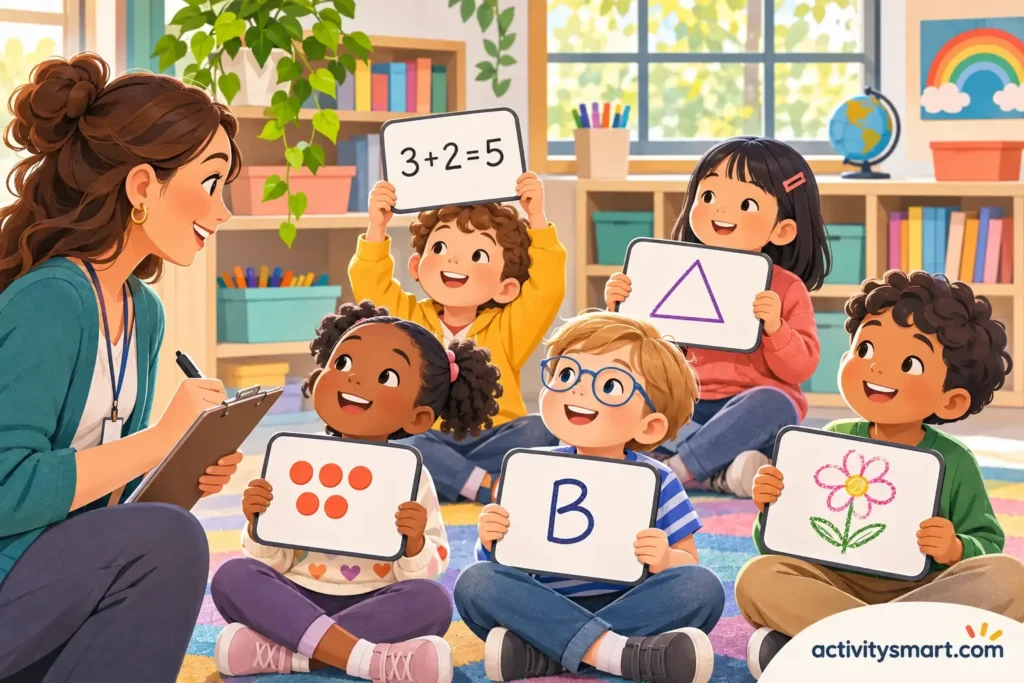
Ask one diagnostic question, pause for every child to work, then say “show.” For math, write 8 as two addends in different ways. For phonics, write the grapheme that matches the spoken sound when appropriate to the taught pattern. Scan all boards rather than selecting only the quickest volunteers.
What to do with the evidence: Notice patterns of errors, not just the percentage correct. If many students write 8 = 8 + 1, revisit what an equal sign communicates. If several boards are unreadable, ask one student to explain before concluding that the idea is missing.
Picture exit ticket
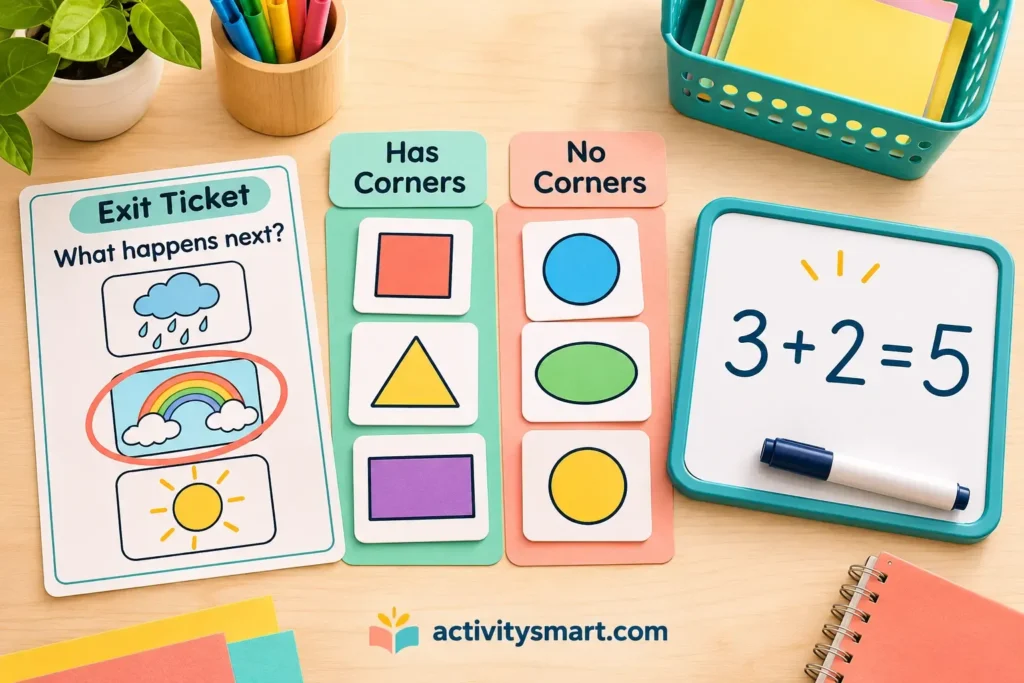
At the end of a story lesson, invite children to circle the picture that represents the main event and give one reason. In math, draw four dots and ask students to cross out one fewer. Keep the prompt short, directly related to the taught skill, and answerable in two or three minutes.
What to do with the evidence: Sort responses into secure understanding, developing understanding, and unclear evidence. The last pile might reflect a confusing picture, fatigue, or an inaccessible direction rather than a learning gap. Choose a brief follow-up before assigning more practice.
Explain to a partner, then sample
Give a prompt with a clear expected concept: “How do you know these two shapes are both triangles?” Allow quiet thinking time, brief partner talk, and then sample several students, including those whose thinking differs from the first answer. Listening reveals vocabulary, reasoning, and whether examples transfer.
What to do with the evidence: Use a simple note grid with a few target behaviors rather than attempting to transcribe every conversation. Partner agreement is not proof that both partners understand; invite individuals to demonstrate separately when needed.
Choose the misconception
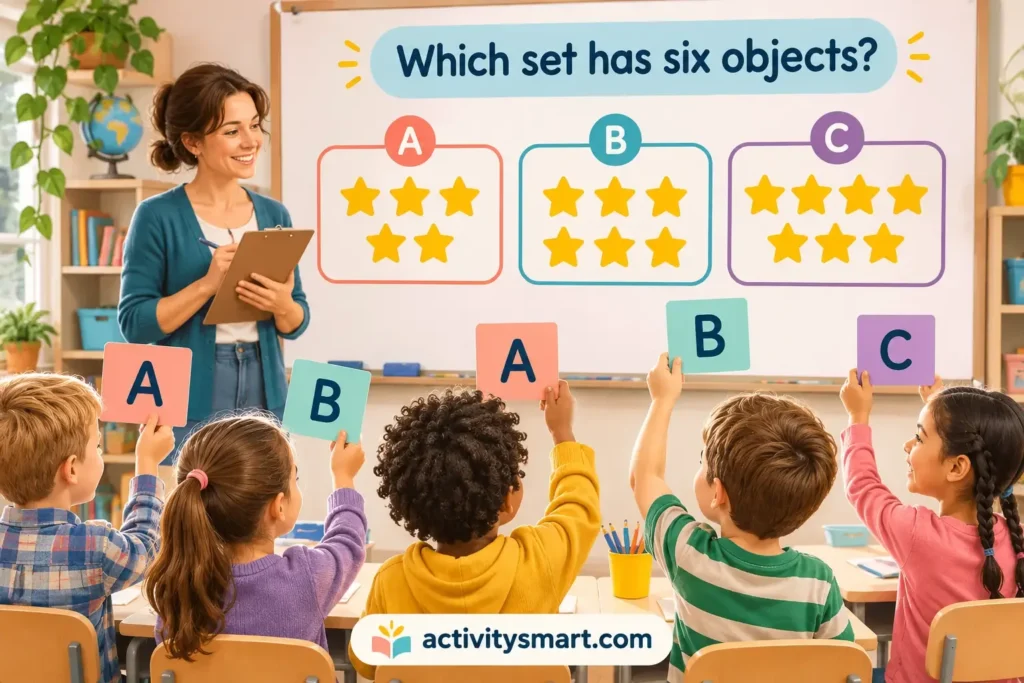
Show three possible answers to a carefully written question. For example: “Which set has six objects?” Include sets with five, six, and seven, arranged so spacing does not give away the answer. Children hold up an answer card or point privately to a labeled option.
What to do with the evidence: Design distractors based on misunderstandings you have actually observed, not tricks. Ask one child from each option to explain. A correct selection could be a guess, so the explanation makes the result more useful.
Sort and justify
Provide a handful of large paper cards with simple words, shapes, or pictures. Children make two groups and tell the rule they used. For geometry, group by whether a shape has four straight sides; for word study, group by a taught vowel spelling.
What to do with the evidence: An unexpected but consistent sorting rule may show strong thinking about a different feature. Ask “What rule did you use?” before correcting. To assess a specific target, clearly communicate the sorting criterion or follow with a targeted question.
Observe a hands-on demonstration
During counters, letter tiles, or manipulatives, watch a child perform a familiar task and record one objective behavior. For example, does each counted object get moved exactly once? Does the student combine and recount rather than guess? A brief demonstration can show processes invisible in a final written answer.
What to do with the evidence: Keep anecdotal records factual: “matched seven counters to number words independently,” rather than “weak at math.” Observations are snapshots; repeat in a different task before making a lasting decision.
Finish the teacher’s example
Display a partially solved problem or incomplete sentence at the exact point where students must make a meaningful choice. “I had five cubes and added two. I know the total is ___ because ___.” Learners can fill the blank, model with objects, or speak the explanation.
What to do with the evidence: Look for whether students understand the reasoning, not merely the final numeral. If the scaffold does too much of the work, remove one support at a time and see what they can do independently.
One-minute student reflection
At a natural transition, ask children to finish “I can now…” or “I still wonder…” with a word, picture, or oral response. A simple three-choice self-rating may help students communicate their experience, especially after a challenging lesson.
What to do with the evidence: Reflection is valuable for planning and building awareness, but confidence is not equivalent to competence. Pair it with a direct performance check so quiet, confident, or uncertain students are not misclassified.
Practical examples across reading, writing, and mathematics
Early reading: check more than confident participation
After a shared picture book, ask students to sequence two or three illustrated events, then explain what changed. This reveals comprehension more directly than asking whether they liked the story. A child might recall a vivid illustration but miss the event sequence; reread the turning point and model how readers connect events. Our picture-book comprehension teaching guide offers related discussion prompts.
For foundational reading, keep the check narrow. If the lesson targets a known letter-sound correspondence, say the sound and have students select or write the letter. Do not call this a comprehension check. If a child can identify a sound only in chorus, give a quiet individual opportunity before deciding that the correspondence is secure.
Writing: separate the idea from handwriting demands
Ask children to orally rehearse a sentence about a picture, then write or dictate it according to the objective and their access needs. If the target is expressing an idea with a clear subject and action, listen to the sentence itself. If the objective is punctuation, inspect the written punctuation. Do not infer weak storytelling solely from slow letter formation.
During independent writing, a brief conference can reveal the strategy behind a spelling attempt: “Tell me how you chose those letters.” Record what the child used successfully and choose one next step rather than correcting every feature. The National Council of Teachers of English position statement on formative assessment stresses observation, interaction, and student perspectives as sources of evidence.
Early mathematics: uncover strategies and misconceptions
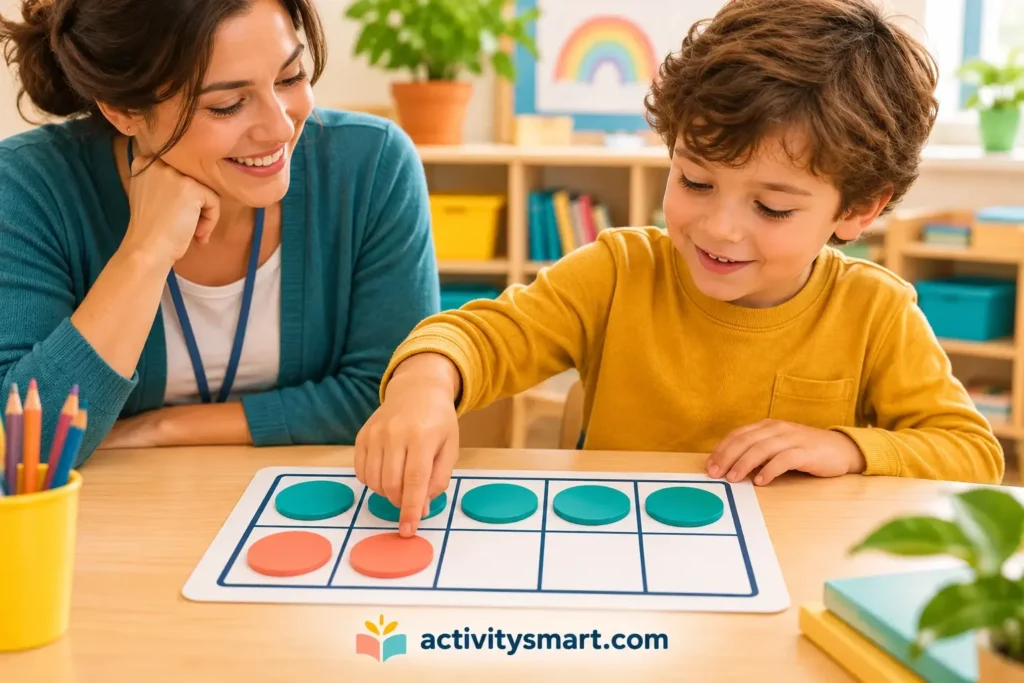
Ask students to show seven using counters, fingers, drawings, or a ten-frame. Then ask “How do you know it is seven?” A child who recounts accurately may have a different level of flexibility from a child who sees five and two more. These are useful descriptions of strategies, not fixed labels of ability.
For counting difficulties, connect the observation to one-to-one correspondence practice. To develop flexible quantities later, use ideas from teaching number sense before written addition. A strong check helps distinguish the next concept to teach from a general request to “practice more math.”
How to turn an answer into the next teaching move
Use a simple three-way response plan
After collecting one task, organize responses into three practical groups: evidence of the objective, evidence of a specific gap, and evidence that is inconclusive. These are temporary planning categories, not grades or identities. Note how many children fall into each group, but focus most on what their actual errors mean.
- Most students show understanding: move forward, while revisiting the skill later to see whether it transfers.
- A shared misconception appears: give the whole class a short contrasting example, then check again with a new prompt.
- A small group needs a particular scaffold: reteach with a model or manipulative while classmates practice or extend.
- The evidence is mixed or confusing: rewrite the question and collect a clearer demonstration before drawing conclusions.
For an example, suppose several children call every long four-sided shape a rectangle but reject a square. The next move is not ten more random shape worksheets. Display a rotated square and a non-square rectangle, compare the properties, and ask for another classification with a reason. The second check tells you whether the new explanation helped.
Make feedback actionable and age-appropriate
Feedback works best when it tells the learner what was achieved and what to do next. Rather than “Great job,” say, “You counted each cube once; now try starting at a different cube and check whether the total stays seven.” Rather than “Wrong,” say, “Your retelling includes the ending; let’s find the page showing what happened first.” See examples of task-focused feedback for more teacher language.
Do not confuse immediate correction with meaningful feedback. Sometimes a child needs a short example and another independent attempt; sometimes a question that invites explanation is enough. The response should fit the target and the student’s current understanding, not a universal script.
Compare common classroom check formats
| Method | Main advantage | Important limitation | Best use |
|---|---|---|---|
| Mini-whiteboards | Everyone can respond at once | Scanning may miss reasoning | Short constructed answers |
| Exit tickets | Easy to sort after a lesson | Can reveal learning too late for immediate repair | Planning tomorrow’s instruction |
| Oral conferences | Can explore why an answer was chosen | Take time and sample fewer learners | Digging into a misconception |
| Hands-on observation | Shows processes and strategies | Requires clear recording criteria | Early math and practical skills |
| Confidence signals | Simple way to invite help requests | Do not prove mastery | Student self-reflection |
No format is inherently “best” for all topics. Whiteboards can be preferable to hand-raising when you need a class-wide snapshot; a short interview is better when the reasoning behind an unusual answer matters. The method is only as strong as the prompt, interpretation, and subsequent response.
Make assessment fair, accessible, and emotionally safe
Offer several ways to show the same thinking
Children differ in expressive language, motor control, attention, literacy exposure, disability-related access needs, and familiarity with school routines. When the objective allows, accept a spoken answer, a drawn model, a gesture, a communication aid, or manipulatives. Keep the target concept consistent; change the response channel, not the standard invisibly.
For multilingual learners, confirm that unfamiliar vocabulary is not masking the concept being checked. A child may understand a quantity while not yet knowing the English phrasing of a word problem. Images or objects can reduce unnecessary language load. When language itself is the objective, however, assess that language explicitly and fairly.
Keep responses private when mistakes feel risky
Never use a red card, public ability ranking, or named error display to embarrass a child. Public response systems can be designed to reveal class patterns while protecting individuals: have students hold boards toward the teacher or place response slips face down. Normalize revisions by modeling a mistake and changing the approach openly.
Assessment checks should not be used to diagnose learning disorders or to label children after one difficult day. If a pattern persists, review multiple kinds of classroom evidence and work with the school’s support team and the family through appropriate procedures. For ideas on keeping classroom participation predictable, visit classroom transition routines.
Common mistakes that make quick checks less useful
- Only calling on volunteers: confident hands reveal little about students who stay quiet. Invite a response from everyone when feasible.
- Asking “Does everyone understand?”: agreement may reflect politeness or uncertainty. Request a demonstration instead.
- Overloading the prompt: a long direction tests memory and reading alongside the intended skill. Use clear directions and listening routines when directions themselves need support.
- Marking everything: exhaustive scoring is unnecessary for a quick instructional decision. Capture only the information you will use.
- Mixing confidence with competence: self-assessment tells you how a child feels, not necessarily what they can do.
- Following a rigid pacing plan: when evidence exposes a shared misconception, plan a responsive adjustment rather than ignoring it.
Another trap is turning each check into a miniature graded exam. Children may focus on getting a mark instead of explaining a method. Low-stakes checks are most useful when students can revise, receive a next step, and demonstrate growth. For students working at different levels, adapting one activity for different learners can help without creating separate lessons for everyone.
A five-day starter routine with almost no extra materials
Monday: choose one lesson objective and build a single multiple-choice misconception question. Note the most common wrong choice and prepare a contrasting example. Tuesday: use mini-whiteboards to see whether that contrast made sense. Record only the children who need a closer look and what they demonstrated.
Wednesday: watch a hands-on task or listen to pairs while teaching; make two or three brief observation notes. Thursday: offer a picture or drawing exit ticket tied to the week’s goal, allowing oral responses when suitable. Friday: revisit an earlier item in a different format to check whether understanding carries over.
After the first week, keep only the checks that earned their time. A one-page planning log can have four columns: objective, student evidence, likely explanation, next teaching move. Avoid writing permanent judgments about children. The value comes from responsive instruction, not a large archive of colorful slips.
Frequently asked questions
What is formative assessment in an early elementary classroom?
Formative assessment is the process of gathering evidence of children’s learning and using it to adjust teaching while learning is still underway. It can happen through questions, observation, drawings, short tasks, or conversation rather than a formal test.
What is the easiest formative assessment for kindergarten?
A single show-me task with objects, pictures, or a mini-whiteboard is often an easy kindergarten starting point. Ask one specific question, give everyone thinking time, and use the results to choose the next model or practice activity.
Are exit tickets appropriate for children who cannot write fluently?
Yes, exit tickets can work for emerging writers when students can circle, draw, point, use counters, or answer orally. The response format should not demand more writing than the learning objective requires.
How often should teachers use formative assessment?
Teachers can gather small pieces of formative evidence during ordinary lessons whenever a decision about instruction is needed. There is no universal number of checks per day; a few purposeful checks are better than frequent tasks that never affect teaching.
Do formative assessments need grades?
No, formative assessments do not require grades to guide instruction. Descriptive notes and brief feedback often provide more useful information about a learner’s next step than a score alone.
How can I check every child without using much time?
Use a simultaneous response such as mini-whiteboards, answer cards, or a hands-on demonstration with a clear prompt. Scan patterns first, then follow up individually where the evidence is unclear.
What should I do when most students get an answer wrong?
Reteach the specific misconception with a clearer example and check again using a different question. First rule out an ambiguous prompt or unfamiliar language before assuming the entire concept was not learned.
Can students assess their own learning in grades K–3?
Yes, young students can reflect on what they tried, what feels difficult, and which help they need with age-appropriate prompts. Combine their reflections with direct evidence of performance rather than treating confidence as proof of mastery.
How do I assess multilingual learners fairly?
Use accessible directions and allow pictures, objects, gestures, or oral responses when English proficiency is not the target skill. If language is the target, assess it explicitly and consider the supports and instruction the learner has received.
Is a formative check the same as a summative test?
No, a formative check is used to improve ongoing learning, while a summative assessment primarily summarizes achievement at a point in time. The same kind of question may serve either purpose depending on how its results are used.
Final takeaway: one question, one decision, one next step
Effective early-grade assessment does not require special software, lengthy quizzes, or piles of marking. Start with the learning goal, create a response every child can reasonably provide, look for the underlying strategy, and adapt instruction. Repeat with a fresh example to see whether the support worked. When the response changes what happens next, even a thirty-second check becomes useful teaching evidence.
If children need more practice explaining a strategy, try pattern-recognition activities as a context for sorting and reasoning discussions. Keep the emphasis on what students can show you today and what you can help them learn next.