Quick Answer
Following directions activities work best when children can hear a short instruction, see an optional demonstration, act on it, and receive supportive feedback. Start with one familiar action, then introduce two-step sequences and playful rule changes as the child is ready. Use movement games, pretend play, picture cues, and everyday routines—not repeated testing.
Listening and following directions are connected but not identical. A child may hear an adult clearly yet miss the meaning of a word, forget the second step, feel overwhelmed by noise, or need time to shift attention. It is helping children understand meaningful instructions, respond safely, and gradually become more independent.
This guide gives parents and educators specific language to use, games that require minimal supplies, ways to adapt activities from ages three to ten, and signs that suggest seeking professional guidance. For related practice, see our short working-memory games for kids.
What Does Following Directions Actually Involve?
Following a spoken direction draws on several skills at once. Children notice that someone is speaking, recognize words, interpret the request, hold enough information in mind to begin, and decide what action fits. If there are several steps, they must remember the order while doing the task. A child can be strong in one part of this process and still need support in another.
Listening is more than staying quiet
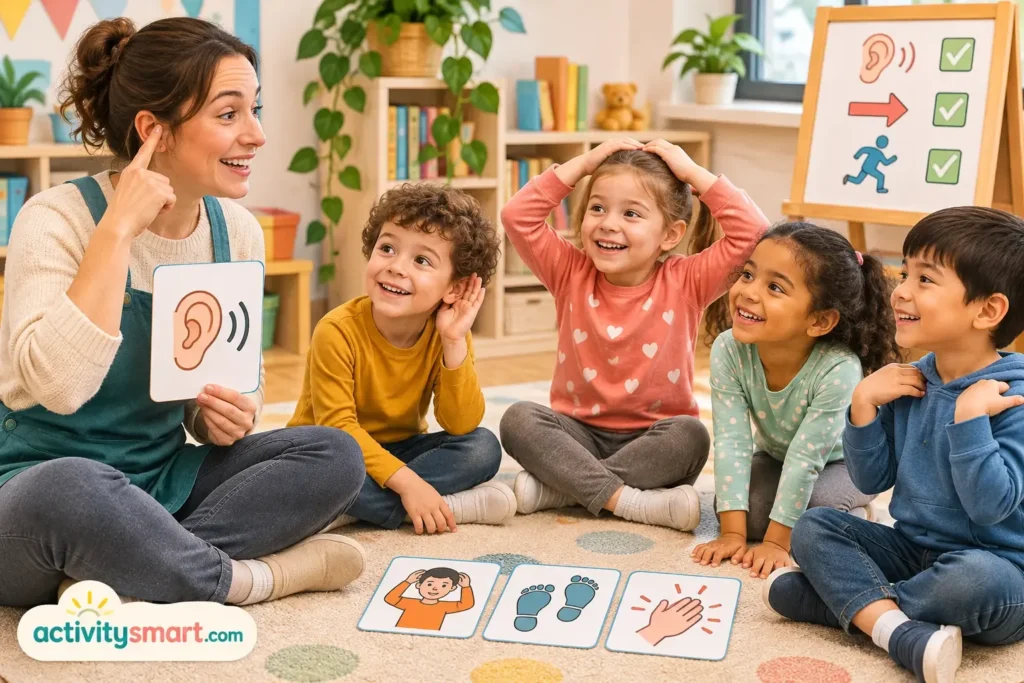
Quiet bodies do not automatically mean understanding. Some children listen while moving their hands; others need to face the speaker or reduce background sound. Instead of insisting on prolonged eye contact, check whether the message was understood. Invite the child to point to the object, show the first action, or explain the task in their own way.
Why short directions work better as a starting point
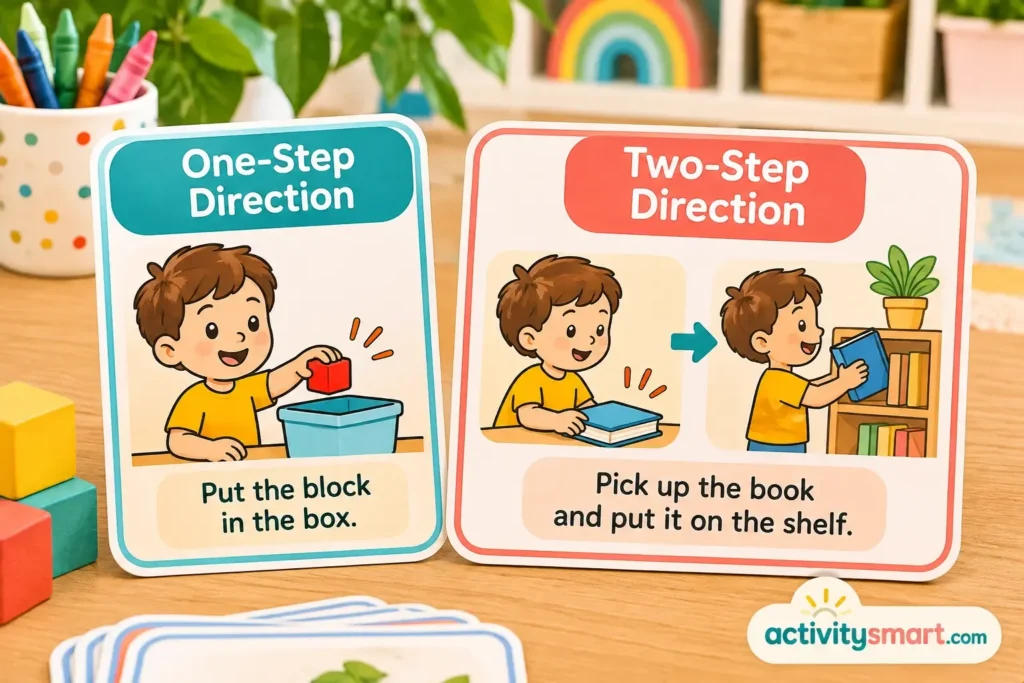
Compare “Put the pencils in the blue cup” with “Finish the drawing, clear the table, line up, and remember your jacket.” The second request adds vocabulary, sequencing, transitions, and competing priorities. Breaking it into smaller pieces reduces the amount that must be managed at once. The CDC’s guidance on giving directions recommends clear, concrete, age-appropriate directions and telling children what to do rather than only what to stop doing.
Start With the Right Level of Challenge
There is no universal age when every child should consistently follow a particular number of steps. Language experience, attention, familiarity, hearing, fatigue, emotional state, and disability can all affect performance. Think of the age bands below as planning ideas, not milestones or diagnostic cutoffs. When uncertain, begin with the easier version and increase complexity based on the child’s response.
| Starting point | Example direction | Support or extension |
|---|---|---|
| Preschool, roughly 3–4 | “Touch your knees.” | Model the action and use one familiar verb. |
| Preschool to kindergarten, roughly 4–6 | “Pick up the ball, then put it in the basket.” | Show two pictures; add the sequence only after single steps are comfortable. |
| Early elementary, roughly 6–8 | “Choose a card, draw its shape, then tell a partner.” | Offer a visual checklist; invite children to restate the plan. |
| Older elementary, roughly 8–10 | “Read the clues, gather two materials, and explain your choice.” | Add planning or peer collaboration rather than simply making commands longer. |
Observe the task itself: does the child understand the vocabulary, begin after a prompt, remember the order, and notice when clarification is needed? This is more useful than labeling a child a “good” or “bad” listener. The CDC developmental milestone resources provides broader developmental context, but its checklists should not be used as a scorecard for these games.
Following Directions Activities: Games Children Can Actually Play
Choose two or three games, repeat them across several days, and change just one element at a time. You can use the same game at home, in a small group, or as a classroom warm-up. Adapt movement to a child’s mobility, sensory needs, communication mode, and comfort.
1. Simon Says, with a kinder starting rule
Begin by saying “Simon says touch your head,” while demonstrating the motion. Use familiar actions such as clap, turn, stretch, or point. At first, omit the trick directions entirely so the child learns the game. Later, mix in an occasional instruction without “Simon says” and let everyone reset without being eliminated. This variation practices noticing a cue and holding back a response rather than punishing impulsive moves.
Make it easier: slow the pace and show the cue. Make it harder: invite children to take turns leading or add a safe two-action phrase. Keep the activity cooperative, especially with younger or anxious children.
2. The two-step treasure helper
Place a few large, safe objects on a low table: a scarf, a soft ball, a book, and a basket. Ask, “Find the scarf and put it beside the basket.” When this works comfortably, try “First put the ball in the basket; then bring me the book.” The child practices identifying an object, understanding a location word, and keeping a sequence in mind.
Do not hide materials in unsafe places or send children searching where adults cannot supervise. For a child who needs more support, speak one step at a time and gesture toward the correct area. For a challenge, add location words such as behind, next to, or between after teaching what they mean.
3. Freeze dance with a listening twist
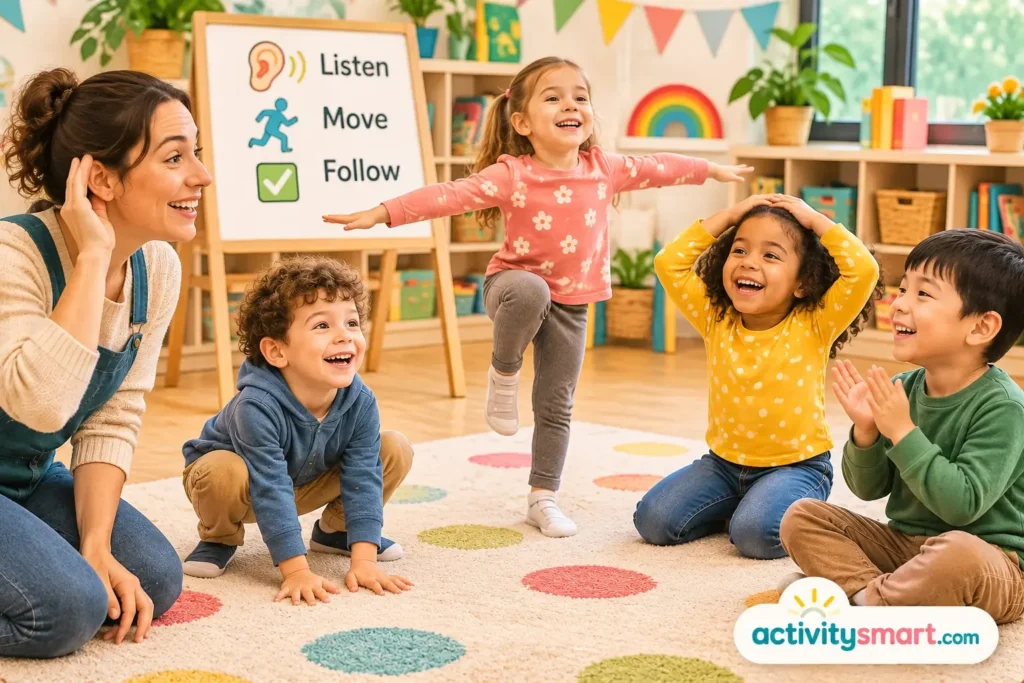
Play music at a comfortable volume, then pause it and say one direction: “Freeze like a tree” or “Put one hand on your shoulder.” Begin with the pause alone before combining movement and words. Once children understand the pattern, alternate two safe actions such as “freeze” and “wave.” Avoid sudden loud sounds, crowded spaces, or activities that depend on hearing a sound if a child needs visual cues.
For a seated version, children can freeze their hands, stop tapping a soft drum, or change facial expressions. The rule is the same: listen or notice the agreed signal, pause, and respond. Harvard’s play-based executive-function activity suggestions describes playful activities that offer opportunities to practice attention, working memory, and self-control.
4. Build-a-story directions
Set out large picture cards showing a person, a place, and an action. Ask, “Choose an animal, then put it next to the house.” After the child completes the direction, invite a short story about what the animal does there. The listening portion stays brief, while the storytelling makes the instruction meaningful. A teacher can let children use pointing, speech, sign, or an accessible communication system to share the story.
5. Robot directions with partners
One child is the “robot”; another gives a short instruction: “Take one step forward” or “Wave your left hand.” Before beginning, agree that everyone may say “pause” or “repeat” at any moment. Older children can work with a two-step code, while younger children can use picture cards. The partners switch roles after a few turns so everyone practices both giving and receiving clear directions.
Keep pathways clear and avoid blindfolds, rapid running, or commands that could lead to falls. The strongest learning conversation often comes after a confusing instruction: “What would make that message clearer?” This teaches children that effective communication is shared work, not simply a matter of following orders.
6. Copy my pattern, then change it
Clap, pat, clap; ask the child to repeat the pattern. Start with two actions, then try three if the sequence is manageable. Older children can create patterns using large colored squares, gestures, or musical instruments. Show the pattern visually when helpful, then gradually remove the model if the child wants the challenge.
Separately, simple pattern-recognition play shows ways to explore repeated patterns with objects. In this version, the child follows an action sequence. Those are related opportunities, but success at copying a clapping pattern does not prove an improvement in general listening or language comprehension.
7. Pretend café or grocery helper
Use toy food, paper menus, and reusable containers. One person takes an order: “Please bring a banana and put it on the plate.” Switch roles, and encourage children to ask “Which plate?” when information is missing. A classroom group might run a pretend café with clearly defined roles such as server, customer, and organizer.
8. Art-table missions
Give a specific, manageable instruction: “Choose a green crayon and draw a circle.” Later try “Draw a circle, then add two lines.” Let children choose their colors or subject whenever the objective allows it. The adult is checking whether the message is clear, not grading artistic quality, neatness, or fine motor control.
Use large paper and age-appropriate materials. Adapt by allowing a stamp, sticker sheet with appropriately sized pieces, verbal selection, or pointing if drawing is physically difficult. For related motor planning in play, see two-hand coordination activities with everyday materials. Never interpret an awkward pencil grip as a listening problem.
Turn Everyday Routines Into Listening Practice
Not every activity needs a special game. Real routines let children practice instructions with an immediate purpose. The difference is to design the request for success rather than issuing a string of orders from across the room. Get close enough to communicate, reduce competing noise where possible, use familiar words, and give the child a moment to respond.
Getting dressed and packing up
At home, use one concrete step: “Put your socks in the drawer.” Later, “Put your book in the bag, then zip it.” Keep a picture checklist on a reachable wall and point to each picture when it is complete. As the routine becomes familiar, invite the child to check the next picture independently. This approach connects with school-readiness routines through play through predictable transitions and child participation.
Clean-up and classroom transitions
During clean-up, tell the group exactly what happens first: “Put the blocks in their bin.” If a child finishes, offer a second job such as stacking the mats. A visual reminder can remain visible while the teacher supports other children. Our classroom transition routines offers additional strategies for making movement between classroom activities less dependent on repeated verbal reminders.
Consistent phrases help: “First put away the crayons; then choose a book.” If a classroom is loud, pair instructions with a gesture and allow extra processing time. Direction-following should serve a predictable routine, not become a contest for the fastest child.
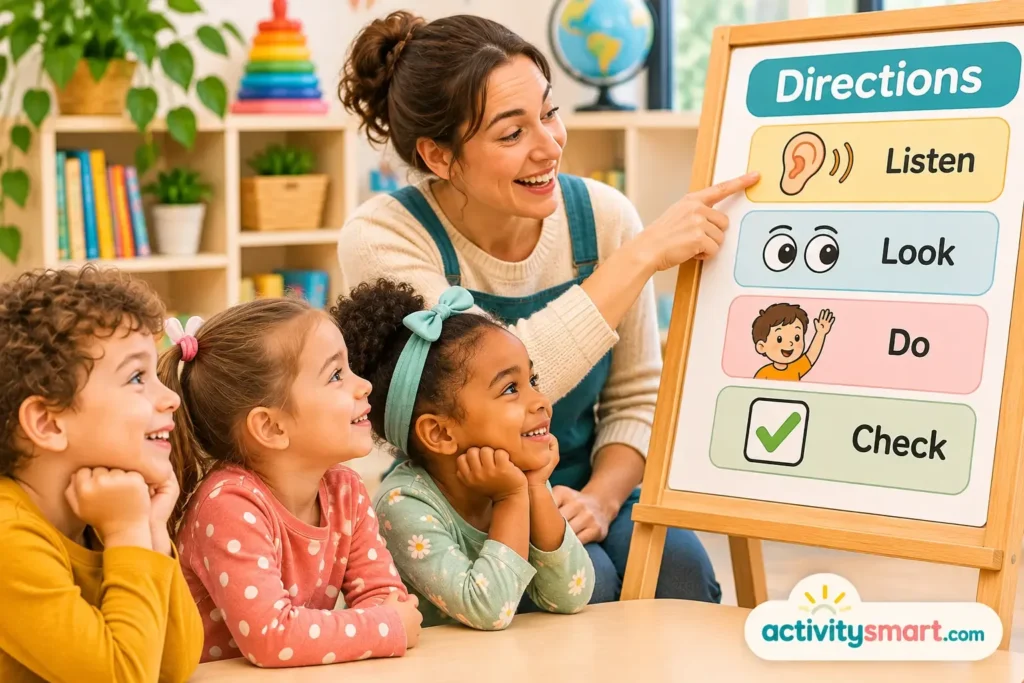
Use a Simple Teaching Sequence: Say, Show, Try, Reflect
Begin with a connection: name the child or use an agreed attention signal. Then give a short direction describing the action you want to see. If needed, demonstrate or point to a picture. Allow adequate processing time before repeating it. After the child tries, acknowledge what worked and clarify the next step in ordinary language.
Say what to do, rather than what not to do
“Walk next to me” describes a workable action. “Stop being wild” leaves the child guessing. “Put the cards on the tray” is clearer than “Be responsible.” The CDC’s recommendations support specific and developmentally appropriate directions, positive phrasing, and consistent follow-through. The details should remain respectful: a direction is not permission to ignore a child’s distress or communication needs.
Show the instruction without replacing language entirely
Gesture toward a shelf, show a picture sequence, or model one motion. Supports are tools, not shortcuts that children must “earn” by failing first. Some children understand more reliably through combined visual and spoken input. Keep the visual simple: a crowded poster can be harder to use than two clear images at eye level.
Try and reflect without a public score
If the child starts correctly but forgets step two, say, “You found the brush. What came after that?” If they do not know, repeat or show the second step. Specific responses such as “You put the cup on the tray when I asked” describe success more clearly than vague praise. For other examples, visit specific feedback for young learners. Avoid repeated correction in front of classmates.
Adapt Directions for Different Learners
Children of the same age may need different amounts of support. Treat accessibility as part of the activity design, not as an exception after a child struggles. A child may understand the concept yet be unable to perform the selected movement, speak the response, or tolerate the sensory environment. Offer multiple response options while keeping the learning goal clear.
For children learning English or another classroom language
Teach key action words with real objects and gestures before using them in long sentences. Show “under,” “beside,” or “behind” using a book and a box. When possible, welcome familiar home-language vocabulary; knowledge of a concept in one language is meaningful. Do not assume that a child who cannot yet respond in English cannot understand a direction in their stronger language.
For children with attention or working-memory needs
Reduce the number of steps, display a visual sequence, provide a quiet starting area, and let children complete one part before hearing the next. Movement and short breaks may be supportive. Ask, “What is the first thing?” rather than “Were you listening?” If the child is flooded with information, repeating the entire long instruction more loudly usually does not solve that problem.
For children using assistive communication or with sensory needs
Accept pointing, signing, choosing a picture, or using an augmentative and alternative communication system as ways to demonstrate understanding. For a child with hearing differences, ensure visual access to the speaker and follow any individualized support plan. Change the rules of sound-cue games so they also have an accessible visual cue. For children with limited mobility, let actions involve tabletop objects instead of whole-body movements.
Teachers designing one shared lesson can use differentiating activities for preschool and kindergarten to vary the response format and number of steps while preserving a common purpose. Adaptations should be reviewed with the family and relevant specialists when a learner has an established support plan.
How to Tell Whether a Game Is Helping
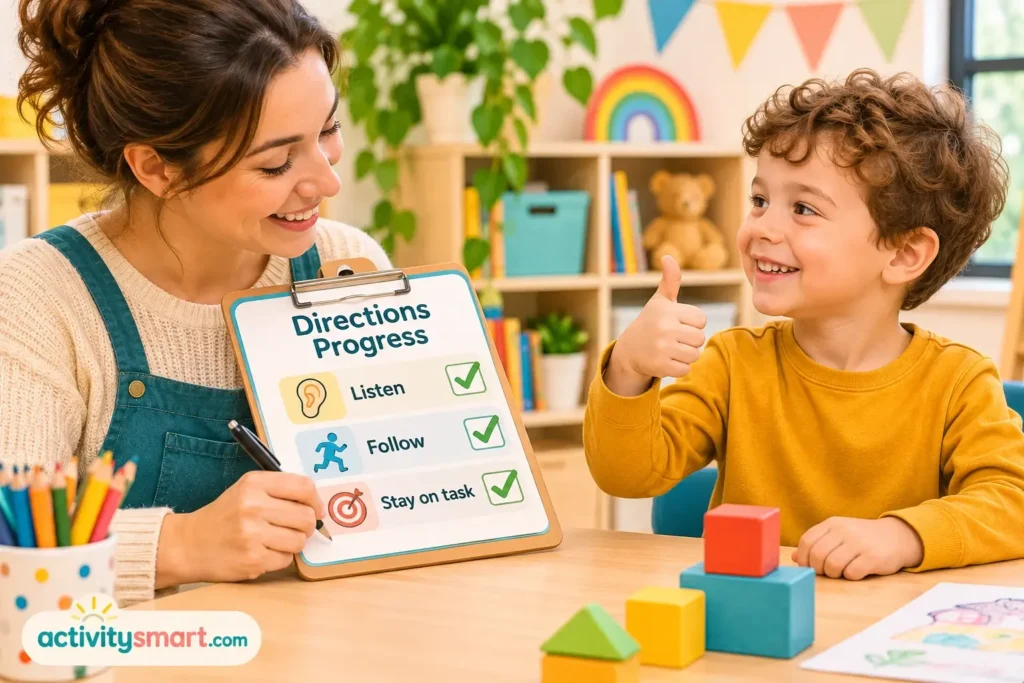
Look for practical changes within the same or similar tasks: does the child start with fewer reminders, understand familiar action words, use a picture sequence independently, or ask for clarification when uncertain? These observations can guide your next teaching choice, but they are not standardized assessment results and cannot establish a broad change in cognitive ability.
Keep notes brief and contextual. For example: “During tidy-up, followed ‘put three books on the shelf’ with a picture cue; needed the instruction broken into two parts when background music played.” Such notes are more useful than a score like “listening: 2/5,” because they show the condition under which the child succeeded.
Common Mistakes That Make Directions Harder
- Giving too many steps at once: separate a long request into actions children can manage, then reconnect them.
- Assuming refusal: first check whether the words, sequence, sensory setting, or task expectation are clear.
- Repeating louder: move closer, simplify the language, or change the setting rather than increasing volume.
- Making every game competitive: eliminating children quickly reduces opportunities to participate and try again.
- Using new vocabulary without teaching it: demonstrate location words and action verbs with objects first.
- Correcting without explanation: show which step was missed and offer a fresh chance without embarrassment.
- Measuring only speed: allow time to process; careful responding can be more valuable than racing.
When frustration grows, stop and reconnect. Our support for big feelings during learning explains approaches for supporting children through big feelings during learning, including adjusting task demands before expecting another attempt.
Safety and When to Seek Additional Support
Choose movements that suit each child’s physical abilities, clear the floor of trip hazards, and supervise games involving objects. Avoid blindfolds, sharp tools, small items that could be swallowed, and directions that send children into unsupervised areas. Never use listening games to practice unsafe obedience to unfamiliar adults; children should know they may say no, seek help, and question an instruction that feels unsafe.
Occasional difficulty with a multistep direction is not a diagnosis. If a child frequently struggles to understand familiar instructions across settings, seems not to hear speech, loses skills previously used, or is distressed by everyday communication, discuss observations with a pediatrician, audiologist, or speech-language pathologist as appropriate. ASHA’s preschool communication activity guidance identifies following directions as one possible area of difficulty in receptive language, but only a qualified professional can evaluate the cause.
A Flexible One-Week Practice Plan
This optional plan is a way to organize play, not a prescribed dosage or promise of measurable gains. Three to ten minutes can be enough for an enjoyable activity, depending on age and interest; stop sooner if the child is tired or upset. Repeat favorite games freely instead of insisting on a new task each day.
| Day | Activity | What to notice |
|---|---|---|
| Monday | One-action Simon Says | Does a gesture help the child understand the verb? |
| Tuesday | Treasure helper with two objects | Which location words are familiar? |
| Wednesday | Freeze dance | Can the child respond to an accessible pause signal? |
| Thursday | Pretend café | Does the child ask for clarification? |
| Friday | Picture-based clean-up | Can the child use visual support independently? |
| Weekend | Child chooses a favorite game | What feels enjoyable and manageable? |
If every instruction is easy, add one manageable change. If several feel hard, return to a familiar task and improve the cue. Children benefit when they can select games and take leadership roles; encouraging independent play without more toys has more ideas for creating space for child-directed play.
Connect listening with picture-book discussions.
Final Takeaway: Clarity Before Complexity
Start with a meaningful one-step action, give the child a chance to respond, and support understanding through demonstrations or pictures. Build toward sequences, partner instructions, and flexible game rules only when those changes remain enjoyable. Listening is not a competition, and the ability to complete a classroom command is not a measure of a child’s worth.
Those are useful communication strategies in the real world. Use short activities as invitations to practice, keep routines predictable, and seek professional input when persistent difficulties affect everyday participation.
Frequently Asked Questions
What are the best following directions activities for preschoolers?
Start with one-action Simon Says, picture-supported object hunts, and gentle freeze games. Use familiar verbs, model the action, and keep each round short enough for the child to succeed before adding another step.
How can I teach a child to follow two-step directions?
Teach two-step directions by connecting two familiar actions, such as “Pick up the book, then place it on the shelf.” Show two pictures if needed, pause for processing, and practice the sequence without rushing.
Why does my child follow directions at home but not at school?
Different noise levels, routines, language demands, and group expectations can make classroom directions harder than home directions. Compare the exact tasks and supports in each setting before assuming the child is choosing not to listen.
Does Simon Says improve listening skills?
Simon Says gives children opportunities to practice noticing spoken cues, remembering a rule, and controlling an immediate response. It should be viewed as guided practice, not a guaranteed intervention that improves every aspect of listening.
Should I ask a child to repeat directions back?
Asking a child to explain or show the first step can be useful when it feels supportive rather than like a test. Accept pointing or a picture response, and repeat or simplify the request if the child is unsure.
How long should listening games last for young children?
Keep listening games brief enough to remain enjoyable, often a few minutes at first. Follow the child’s engagement and sensory needs rather than a fixed timer, and offer breaks or a different activity when attention fades.
What if my child does not follow directions even when I repeat them?
Simplify the wording, reduce background distractions, give processing time, and add a gesture or picture cue before repeating again. If difficulties persist across familiar settings, seek guidance from an appropriate professional.
Can visual cues help children understand spoken directions?
Yes, pictures and gestures can clarify the objects, actions, or order in a direction for many children. Keep cues simple, use them consistently, and allow the child to continue using supports that improve participation.
Are following directions games appropriate for children with disabilities?
Yes, many following directions games can be adapted with accessible signals, communication methods, materials, and movement choices. Match the game to the child’s needs and any individualized support plan instead of requiring one standard response.
When should I ask about a possible hearing or language concern?
Ask a pediatrician or an appropriate hearing or speech-language professional when a child repeatedly struggles with familiar spoken instructions, appears not to hear speech, or loses previously used abilities. A play activity alone cannot identify the cause.
Sources and Further Reading
- CDC: Tips for Giving Directions — clear, positive instructions and preschool parenting examples.
- ASHA: Speech and Language Skills to Practice With Your Preschooler — everyday directions and picture routines.
- Harvard Center on the Developing Child: Brain-Building Through Play — age-sensitive play ideas and executive function.
- Harvard: Enhancing and Practicing Executive Function Skills — activities by developmental stage.
- CDC: Developmental Milestones — broad developmental context, not an activity scoring guide.