Quick Answer
Working memory games for kids are short, playful challenges in which children hold information in mind while using it: repeat a rhythm, follow two directions, remember what moved, or retell a tiny sequence. Start with one easy rule, model a round, and increase the challenge only when the child is comfortable. These games provide practice, not a guaranteed academic boost.
Working memory games for kids need not involve apps, expensive kits, or long lessons. A few everyday objects, clear spoken directions, and three to eight relaxed minutes can make an engaging activity for a child aged roughly three to ten. The best starting point is something the child can succeed at, followed by one small change.
Below are ready-to-say instructions, age-sensitive variations, a comparison table, a simple activity routine, and ways to respond when a child loses track. These are examples for ordinary play and teaching, not tests of intelligence or substitutes for professional assessment.

What working memory is—and what a game can actually do
Working memory is the limited ability to keep information available for a short time while acting on it. A child may hold “take the blue block, then place it behind the cup” in mind while locating the objects and completing the steps. That differs from remembering a birthday from last year. Attention, language understanding, inhibition, and familiarity with a task also influence performance.
Harvard’s Center on the Developing Child describes playful interactions as opportunities to practice executive function skills, including attention and working memory. Its age-organized brain-building play ideas place the emphasis on interaction and suitable challenge, not scoring children against a single standard.
Importantly, improvement at a practiced game does not establish broad gains in reading, mathematics, or intelligence. A systematic review of everyday working-memory interventions found some gains on memory tasks and mixed evidence of transfer. A separate meta-analysis of working-memory training reported little evidence for broader academic effects. Enjoy the games for what they are: structured play that exercises listening, noticing, remembering, and adapting.
For related observation-and-matching play, see ActivitySmart’s visual discrimination activities. The ability to spot details complements memory tasks, but the two are not interchangeable.
How to choose working memory games for kids
Select one brief activity according to what the child already understands, rather than treating age as an exact performance rule. A child who is learning the language of instruction may need a demonstration even when they can remember a complicated visual pattern. A child with a strong vocabulary may still prefer movement to seated games.
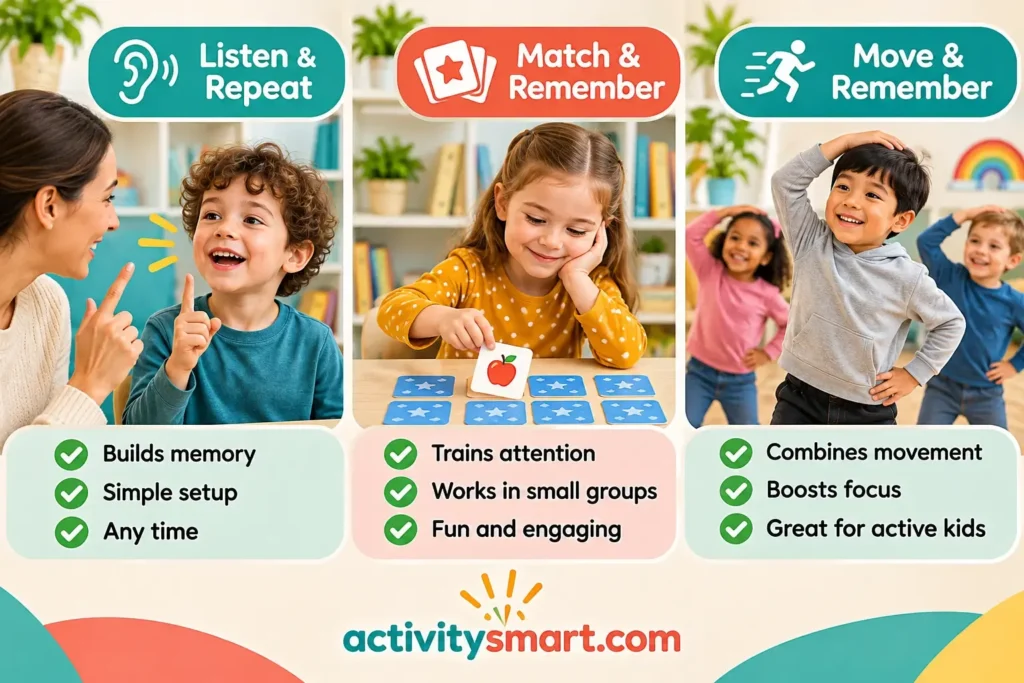
Three quick picks to start today
- For a preschool beginner: “What Went Missing?” with three large, familiar items and a five-second look.
- For children who like to move: “Action Echo” with two movements, such as clap then touch shoulders.
- For an older child seeking a puzzle: “Backward Beat,” repeating two to four distinct sounds in reverse order.
Say the entire rule in one calm sentence, show one example, and take a practice turn together. If the child struggles twice, simplify the information to remember; do not demand faster performance. The Harvard executive-function activities guide recommends matching playful challenges to children’s developing abilities and adjusting the adult role as children gain confidence.
At-a-glance comparison: six short memory challenges
The table compares what children do, not measured brain-training outcomes. Suggested ages are flexible entry points rather than milestones, and times are practical activity lengths rather than clinically established doses.
| Game | Starter challenge | What must be held in mind | Approximate time |
|---|---|---|---|
| What Went Missing? | Recall one hidden object | Visual set of familiar items | 3–5 minutes |
| Action Echo | Repeat two movements | Movement order | 3–5 minutes |
| Little Errand | Complete two pretend tasks | Spoken instructions | 4–6 minutes |
| Story Chain | Recall two story details | Meaningful verbal sequence | 5–8 minutes |
| Pattern Peek | Rebuild a three-object layout | Locations and arrangement | 4–6 minutes |
| Backward Beat | Reverse two sounds | Order plus mental manipulation | 3–5 minutes |
Game 1: What Went Missing?—a visual memory warm-up
Materials: three to five safe, large, familiar objects, such as a spoon, washable block, and soft toy, plus a cloth. Avoid small detachable pieces with children who may put objects in their mouths.
- Put three objects on a table. Say: “Look carefully. We will remember what is here.”
- Give a short, unhurried look. Cover the objects and quietly remove one while the child looks away.
- Reveal the remaining items and ask: “Which one is missing?”
- Let the child point, speak, or choose from picture options. Reveal and celebrate their strategy, not just correctness.
Make it easier: use two objects or name each one together. Make it harder: use four objects or switch positions instead of removing one. Those changes affect different demands: removal asks about item identity, while switching asks about location.
If the child names a plausible but absent object, respond, “You remembered the spoon; shall we look together at what changed?” That keeps the activity cooperative. For a child who enjoys finding patterns rather than missing objects, try simple pattern recognition play as a follow-on rather than turning every round into a test.
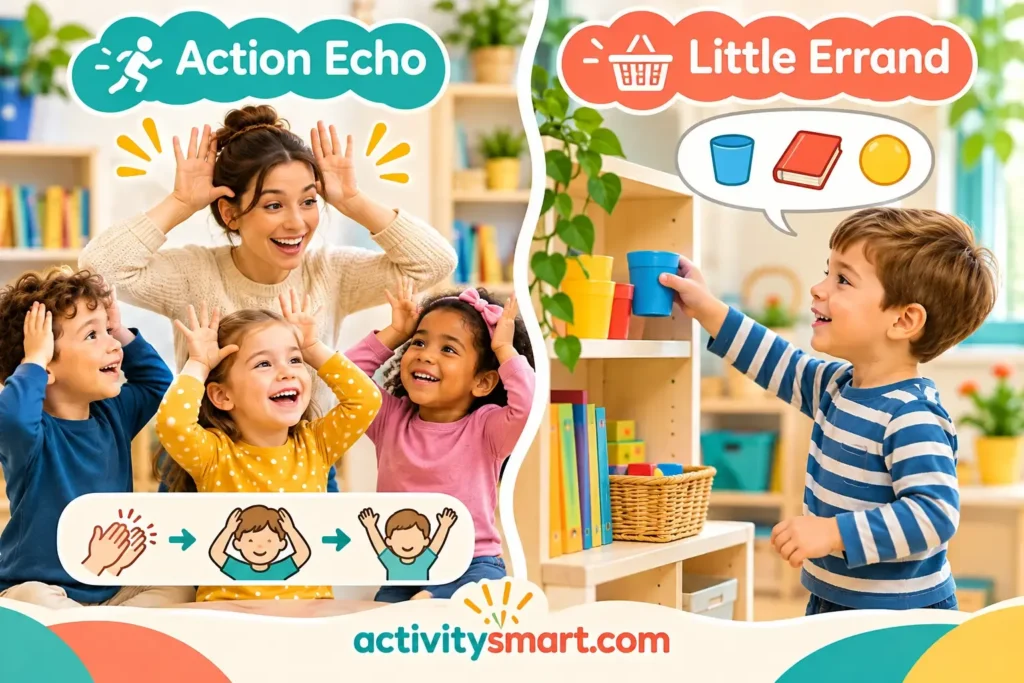
Game 2: Action Echo—remember a movement sequence
Materials: none. Choose movements that work seated or standing: clap, tap knees, raise hands, touch shoulders. Avoid fast spinning, jumping from furniture, or movements that cause discomfort.
- Say: “Watch me, then do these moves in the same order.”
- Perform “clap, tap knees” at a steady pace.
- Pause briefly; invite the child to copy the whole sequence.
- Repeat once if requested, then ask whether they want another round or a new leader.
Make it easier: do one move at a time and build up to two. Make it harder: add a third movement only after the child understands the rule. With a group, the leader can intentionally pause so everyone has time to think. Children who cannot make a particular movement can choose gestures of their own or use picture cards.
Movement sequences blend memory with coordination, but copying accurately depends on physical abilities as well. The companion bilateral coordination activities offers other ways to explore two-sided body movements without suggesting they measure memory capacity.
Game 3: Little Errand—practice holding spoken directions
Materials: a toy, a box, and a pretend delivery destination. Explain the vocabulary first: show what “inside,” “beside,” and “behind” mean before asking children to remember them.
- Say: “Here is your mission: put the bear in the box, then bring me the cup.”
- Ask the child to tell or show you the plan before starting if they wish.
- Watch without interrupting. After the turn, check the steps together in a friendly tone.
- Offer a new mission by swapping familiar objects or reversing the order.
For a younger child, offer one step and visually point to the destination. For a child ready for more, use two steps with a short delay before acting. Three steps are not automatically better; language comprehension can become the main obstacle. When teaching a new routine, a visual cue is useful support, not cheating.
Everyday routines have different stakes from games. For real classroom arrivals, keep reliable visual reminders in place; classroom transition routines can help reduce waiting and confusion. A child should not have to remember several unfamiliar directions under pressure just because they succeeded in a pretend errand.
Game 4: Story Chain—hold details while making meaning
Materials: none, or one picture card. Tell a two-sentence story: “A rabbit found a red hat. The rabbit put it on a bench.” Ask, “What did the rabbit find?” and “Where did it go?” Keep the questions literal before adding imaginative changes.
- Read or say the mini-story slowly once.
- Invite a retelling with words, gestures, pictures, or a mix.
- Ask one detail question. Reread without penalty if needed.
- Invite the child to add a new detail that the next player remembers.
Make it easier: display a picture and ask about one event. Make it harder: add a third event or ask for the events in order. Do not confuse expressive language difficulty with lack of understanding: a child may recognize the right picture without being ready to narrate it orally.
A remembered detail is not the same as comprehension. Asking why a character acted, making a prediction, or connecting events involves additional language and reasoning. ActivitySmart’s picture book comprehension strategies provides a better next step when the aim shifts from simple recall to understanding a story.
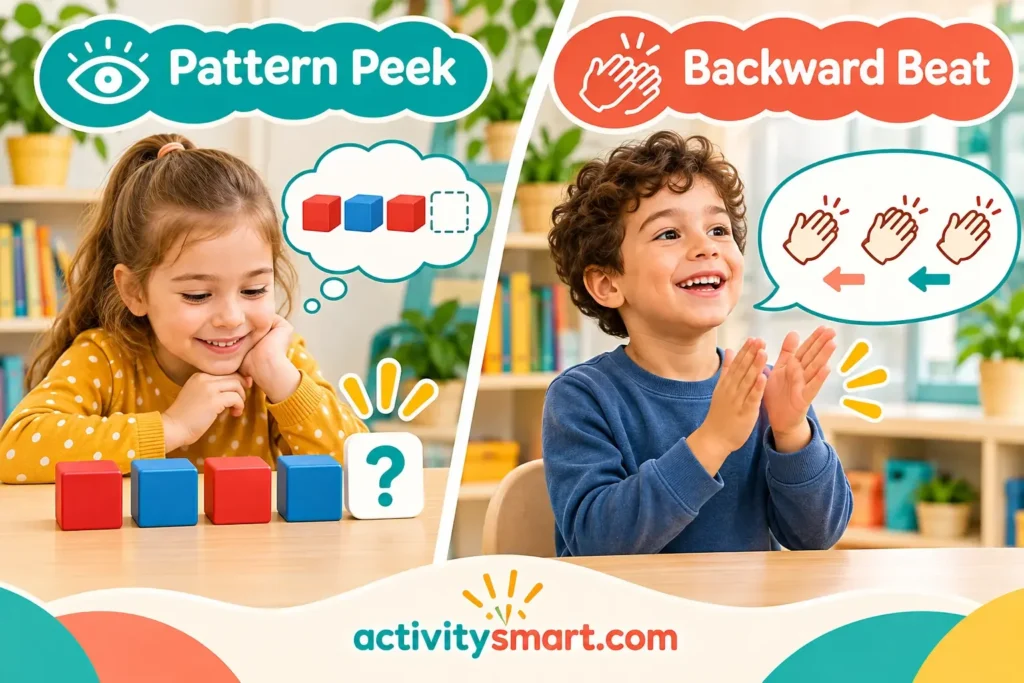
Game 5: Pattern Peek—rebuild what you saw
Materials: three large blocks or colored cards and a cloth or screen. Start with a simple left-to-right layout such as blue, yellow, red. The child may arrange their own objects, point to options, or dictate the order to an adult.
- Arrange the pieces, then say: “Look at the order. We will hide it and make the same pattern.”
- Give a short viewing period without rushing.
- Cover the model. Invite the child to recreate the arrangement using a matching set.
- Reveal the original and compare the two side by side.
If color recognition is uncertain, use distinct shapes or familiar picture cards. Increase difficulty by adding one piece, not by suddenly shortening the viewing period. A child may remember “first, middle, last” more easily when you model the positional words. Let them describe the pattern in their own terms.
Observe whether the child notices the pieces, remembers their order, or simply needs help aligning the copy. These are different sources of difficulty. For additional matching and sorting ideas, spotting visual differences is a useful complementary activity.
Game 6: Backward Beat—remember and reverse
Materials: hands, a tabletop, or two distinct gentle sound-makers. Say, “I make two sounds. You make them backward.” Demonstrate with clap–tap, then model tap–clap so the reversal rule is clear.
- Give two sounds with an obvious difference, such as clap then tap.
- Pause and invite the reversed order.
- If the child repeats the original order, show both versions side by side.
- Try one more pair and end while the game is still enjoyable.
This is more demanding than exact copying because the sequence must be held and rearranged. Begin only when the child enjoys simple echo games. For ages where reversal remains confusing, stick to forward sequences; successful participation matters more than pushing difficulty. Avoid loud percussion or startling noises, especially for sound-sensitive children.
An older child can try three quiet sounds, but there is no need to build a competition around sequence length. You can also reverse two picture cards instead of sounds for someone who benefits from visual input.
Other short variations for home and classroom
Remember the changes
Show a simple drawing with a sun, house, and tree. Hide it and change one feature on a second drawing. Ask the child to identify what changed. Create obvious differences at first, such as removing the tree, before trying a smaller alteration. Children with visual access needs can work with textured objects or spoken stories instead.
Shopping basket recall
Say, “We need apples and bread.” The child places pretend items in a basket without seeing a written list. Begin with two familiar foods and let the child repeat the list before collecting. You may intentionally add a distractor item for an older child, but make the rule clear: the job is to collect only the items named.
Pass the rhythm
In a circle, one player taps a short pattern on knees or palms, and the next echoes it. For mixed ages, use a consistent two-beat pattern and invite voluntary leadership. This adapts to seated participation and avoids eliminating children who make mistakes.
Hidden picture route
Show a drawn route from a house to a park with a stop at a bridge. Hide it and ask the child to place large landmark cards in the same order. If the geography words are new, teach the landmarks first. A child who knows the route may benefit from a new arrangement later.
A simple five-minute facilitation routine
Minute one: introduce just one rule and model an entire round. Say what will happen before hiding objects or giving a sequence. Minutes two and three: play two or three turns without counting errors aloud. Watch for comprehension of the rule as well as memory demands.
Minute four: offer one choice: “Would you like an easier round, a different object, or a challenge?” A meaningful choice gives the child some control. Minute five: close positively by naming a strategy the child used: “You said the steps softly before starting.” Do not tell a child their brain has become stronger after one game; that is not an outcome you measured.
Keep the structure flexible. Some preschoolers will be finished after two minutes; others may want ten minutes. Stop or switch when frustration, fatigue, or sensory overload begins. When transitions are difficult, let the child know the game has one round left instead of ending without warning.
In a classroom, demonstrate once with a volunteer and give the rest of the group a chance to rehearse quietly. Avoid having each child wait through a long series of public turns. For home play, a sibling can be the game leader provided rules stay fair and there is no pressure to outperform anyone.
How to adapt by age and individual needs
Roughly ages three to four: familiarity and short turns
Begin with two or three familiar objects, one direction at a time, and concrete demonstrations. Use large safe materials, gestures, and frequent opportunities to switch roles. A child may need to watch several rounds before joining. Do not treat disinterest as evidence of a memory problem; the activity may not match the child’s language, mood, or interests.
Roughly ages five to seven: simple rules and playful shifts
Try two-part directions, three-item displays, and a repeating rhythm. Once the basic game is known, change one feature: which object disappears, who is the leader, or which movement goes first. Harvard’s age-based activities resources explicitly include card games, movement games, and rules that children can gradually manage with less adult intervention.
Roughly ages eight to ten: meaningful mental manipulation
Invite the child to reverse a short sequence, explain a strategy, or make a memory challenge for a partner. Avoid automatically making everything faster. Letting a child create fair rules may be more motivating than increasing the number of items. Older children differ considerably in attention, vocabulary, and game preferences.
Speech, attention, motor, and sensory adaptations
Offer a pointing response, pictures, tactile items, or a seated alternative as appropriate. Give extra processing time and reduce background noise. For a child learning English, use familiar vocabulary or the home language when possible. If a child needs a visual reminder to participate, use it; the goal is successful engagement, not withholding accessibility supports.
If a child’s difficulties extend beyond games into daily activities, discuss observations with their teacher or a qualified pediatric or developmental professional. No single game, and no arbitrary item-count cutoff, diagnoses a condition.
Responding to mistakes without turning play into a test
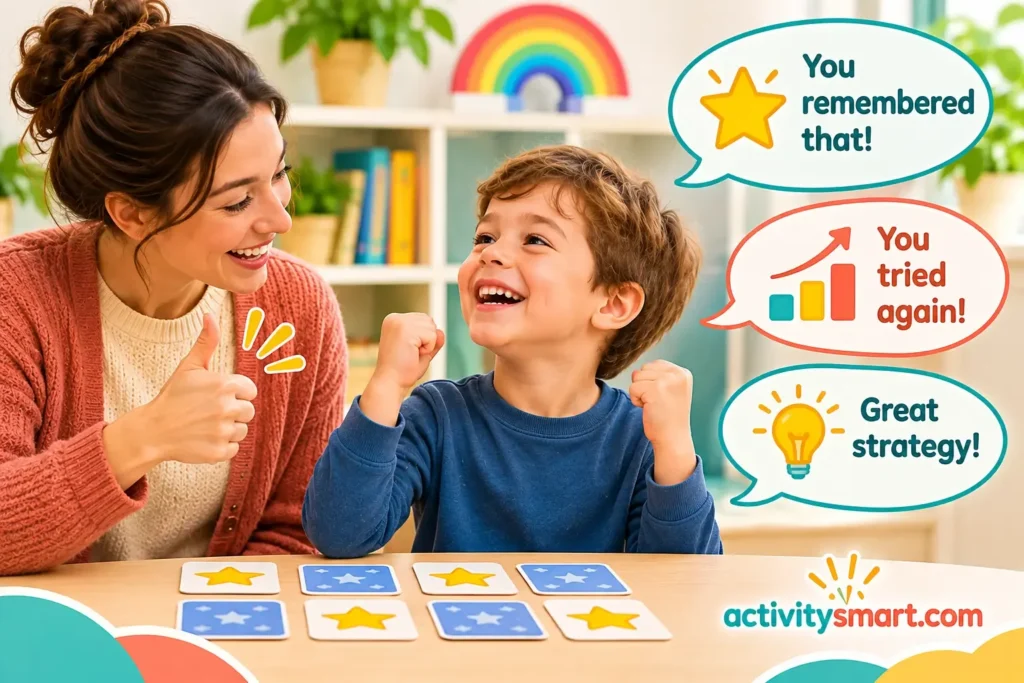
A missed item can mean many things: the child did not hear it, did not know the vocabulary, was distracted, or was asked to remember too much at once. Start by checking the instruction itself. Ask, “Did I explain the rule clearly?” before judging the child’s performance.
Use neutral feedback such as “We found two; let’s look again” or “You remembered the clap first.” Offering a fresh example is often more useful than asking “Why did you forget?” The companion article on specific feedback for young learners gives more language for acknowledging effort and useful strategies without empty praise.
If a child becomes upset, stop the memory challenge and reconnect through ordinary play. You can revisit it another day with fewer steps. For approaches that make learning emotions easier to handle, read supporting big feelings during learning. The aim is a safe relationship and an engaging game, not a performance chart.
Common mistakes and safer alternatives
- Stacking instructions before modeling: demonstrate the game first, then give one clear rule.
- Making each round longer: vary the objects or theme; longer sequences are not always more useful.
- Correcting in front of peers: make mistakes normal and avoid public ranking or elimination.
- Assuming a slow response means poor memory: check hearing, language familiarity, attention, access needs, and comfort.
- Using tiny game pieces: choose age-appropriate materials and supervise younger children; do not use choking hazards.
- Replacing teaching with brain-training claims: practice real reading, number, and classroom tasks directly instead of assuming game gains will transfer.
Short games can fit a school-readiness routine, but readiness includes communication, play, relationships, and routines too. ActivitySmart’s school readiness through everyday play offers a broader view. Memory play should be one enjoyable part of a balanced day, not an obligation that displaces free play, conversation, movement, or rest.
What the research says—and what it does not
Executive function includes related skills such as attention control, working memory, and flexible thinking. The Harvard activities guide presents age-appropriate games as ways to practice these skills through relationships and play. It does not establish that any one game will raise classroom grades or produce a particular developmental outcome.
In a 2019 review of non-computerized interventions for children aged four to eleven, the researchers reported improvements on some practiced memory tasks, with limitations in study methods, long-term follow-up, and evidence that improvements generalize. A 2020 meta-analysis of typically developing children found stronger effects on similar memory measures than on academic outcomes. That contrast matters: the ability to recall a longer beat sequence after practice should not be presented as proof of better mathematics performance.
Adults can still value games for collaboration, turn-taking, enjoyment, noticing strategies, and practicing manageable challenges. If your immediate goal is to teach a classroom procedure or support comprehension, instruction targeted to that actual task and useful environmental supports are more directly relevant than trying to boost a general memory score.
Final verdict: start small and let the child lead
The most useful working memory activity is the one the child understands, wants to try, and can adjust with a little support. Start with What Went Missing? for visual play, Action Echo for movement, or Little Errand for purposeful listening. Model once, keep the first challenge easy, and change one element at a time.
Look for enjoyment, attempts to describe a strategy, and willingness to try again rather than a score. These games create moments to practice holding and using information; they cannot promise broad academic improvements. After a short round, leave time for open-ended play, conversation, and ordinary learning experiences.
Frequently asked questions
What are working memory games for kids?
Working memory games for kids are playful tasks that ask children to keep information in mind briefly while using it. Remembering an object that disappeared or copying a sequence are simple examples.
What is the easiest working memory game for a three-year-old?
What Went Missing? with two or three familiar, safely sized objects is a simple starting option. Demonstrate first, allow pointing instead of speaking, and shorten the round if needed.
How long should a memory game last?
A few relaxed minutes is enough for a short play session. There is no proven universal game duration; stop when the child is tired or no longer interested.
Do memory games improve reading or math grades?
Memory games have not been shown to reliably improve reading or mathematics grades through broad transfer. Research more consistently finds gains in tasks resembling those practiced, so teach academic skills directly too.
Can I play these games without cards or printed worksheets?
Yes, claps, taps, simple stories, and two-step pretend errands work without printed materials. Pick a game whose instructions and sensory demands fit the child.
What if my child cannot remember two instructions?
Reduce the task to one familiar step, demonstrate it, and check that the child understands the words. If difficulties persist across everyday situations, seek guidance from a qualified professional rather than using a game as a diagnosis.
Should I time children or keep scores?
No, timing and scores are optional and usually unnecessary for relaxed practice. Emphasize clear rules, participation, and strategies instead of comparing children.
Are visual games better than listening games?
Neither format is universally better; they involve different sensory, language, and memory demands. Choose a format the child can access, then try another if the child enjoys variety.
How do I make a game more challenging without frustration?
Change just one feature, such as adding one item or reversing a short pattern. If the child gets frustrated, return to the simpler version or switch to cooperative play.
Sources and further reading
- Harvard Center on the Developing Child: Brain-Building Through Play (2022) — age-organized play suggestions and executive function overview.
- Harvard Center on the Developing Child: Executive Function Activities Guide (2014) — developmentally flexible activity examples.
- 2019 systematic review of non-computerized working-memory interventions — evidence and methodological limitations.
- 2020 meta-analysis of working-memory training in children — distinction between practiced-task gains and academic transfer.