Quick Answer
Effective classroom transitions for young children begin before anyone moves: prepare the next activity, show or say what happens next, send children in manageable groups, and give purposeful choices to those who remain. Reduce unnecessary lines and teach the routine through modeling and practice. Adjust cues and pacing for children who need extra support.
Moving from blocks to snack, from reading to recess, or from outdoor play to a lesson can take more energy than the lesson itself. The goal is not perfectly silent children. It is a predictable path in which children know what to do, have enough time to do it, and spend as little time as practical waiting for adults or shared supplies.
Why transitions become difficult
A transition combines several demands: stopping an enjoyable activity, processing a new instruction, finding belongings, moving safely, and adapting to another setting. Some children can handle that sequence with one spoken cue. Others need a picture, a demonstration, more processing time, or a familiar adult nearby. Neither response tells you everything about a child’s motivation or ability.
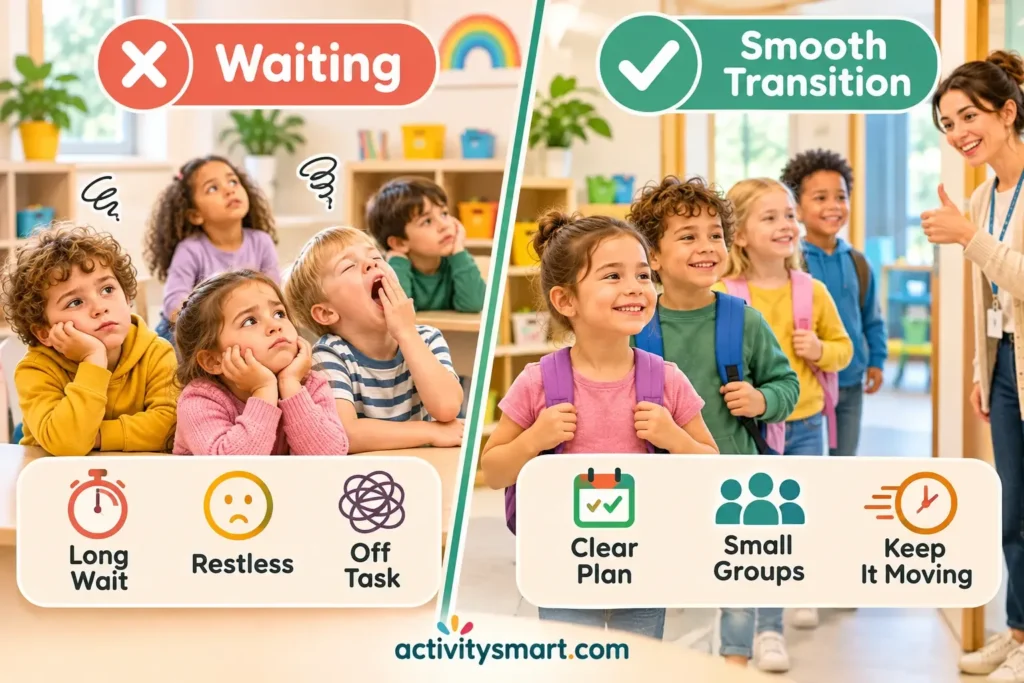
Much classroom waiting is a design problem rather than a patience problem. One sink cannot serve an entire group simultaneously. A teacher who is still distributing paint while everyone sits at empty tables has unintentionally created idle time. The IRIS Center guidance on temporal environments recommends limiting waiting and unnecessary transitions while preparing the next activity before children arrive.
A well-designed schedule is predictable but flexible. Preschoolers still need time for play, conversation, movement and individualized support. The Head Start teaching and learning environment requirements explicitly treats daily routines and transitions as opportunities for learning and development, not merely breaks between “real” lessons. That does not mean every queue must become an academic game; sometimes a shorter queue is the better solution.
A practical routine for classroom transitions for young children
Prepare the destination before giving the signal
Before saying “Come to the table,” check that seats, materials and adult coverage are ready. Place paper where children can reach it; open containers that require adult assistance; identify where finished work belongs. For outdoor time, plan access to coats and the doorway. The first transition improvement may be moving preparation earlier rather than buying a timer.
If another adult is available, agree who supervises the current activity and who gets the next area ready. If you teach alone, keep children engaged in a safe activity while preparing only the essentials. Avoid asking children to line up for a destination that cannot yet receive them.
Give a warning with a useful next step
Warnings work best when they describe what will change. Instead of repeating “Hurry, hurry,” try, “After this turn, blocks go in the basket. Then we wash hands.” For children who understand time, a short countdown may help; for others, a picture card or a concrete event such as finishing a song is clearer than an abstract number of minutes.
Do not rely on one auditory signal for everyone. A child who cannot hear the bell, is learning English, or is deeply engaged may need a visual or personal cue. Approach, gain attention respectfully, show the next step and allow a moment to respond. Avoid startling noises and repeated flashing lights, especially where sensory sensitivities are known.
Model, practice, and acknowledge the specific action
Teach transitions when children are calm, not only at the hardest moment. Demonstrate how to put a material away, walk to the next area, and begin the arriving activity. Invite children to rehearse the sequence in a playful, low-pressure way. Keep expectations observable: “Place the book on the shelf” is easier to act on than “Be responsible.”
When a child completes a step, describe what helped: “You put the markers away, and now the table is ready for the next group.” Specific, respectful feedback communicates the routine without labeling a child good or bad. The What Works Clearinghouse classroom behavior practice guide includes explicit teaching and reinforcement of appropriate skills among its evidence-informed classroom recommendations for elementary settings.
Make visual schedules actually useful
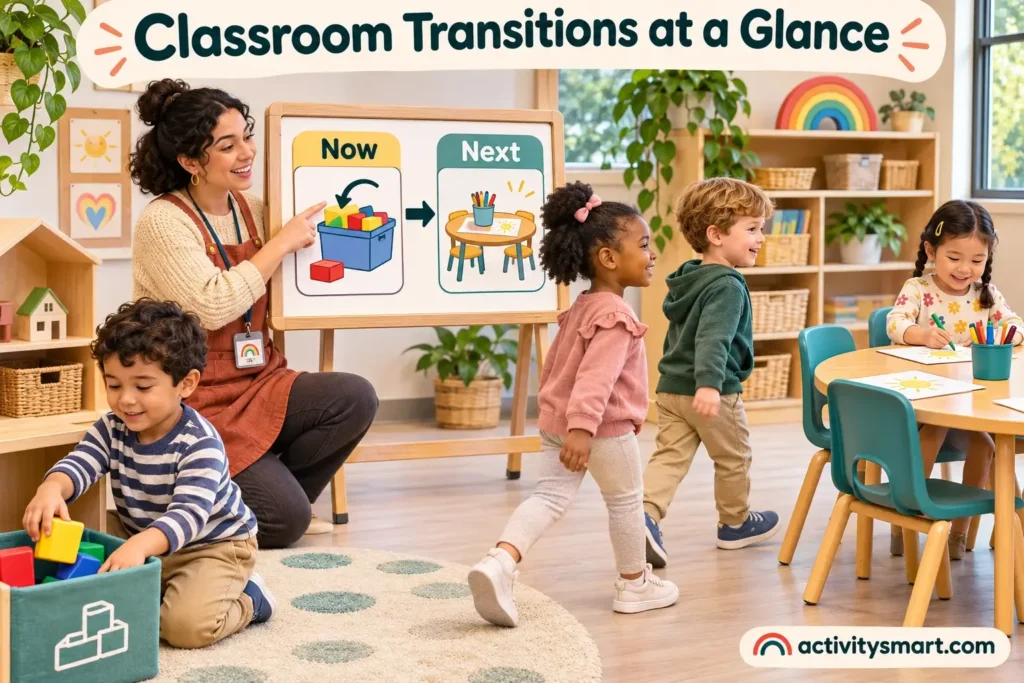
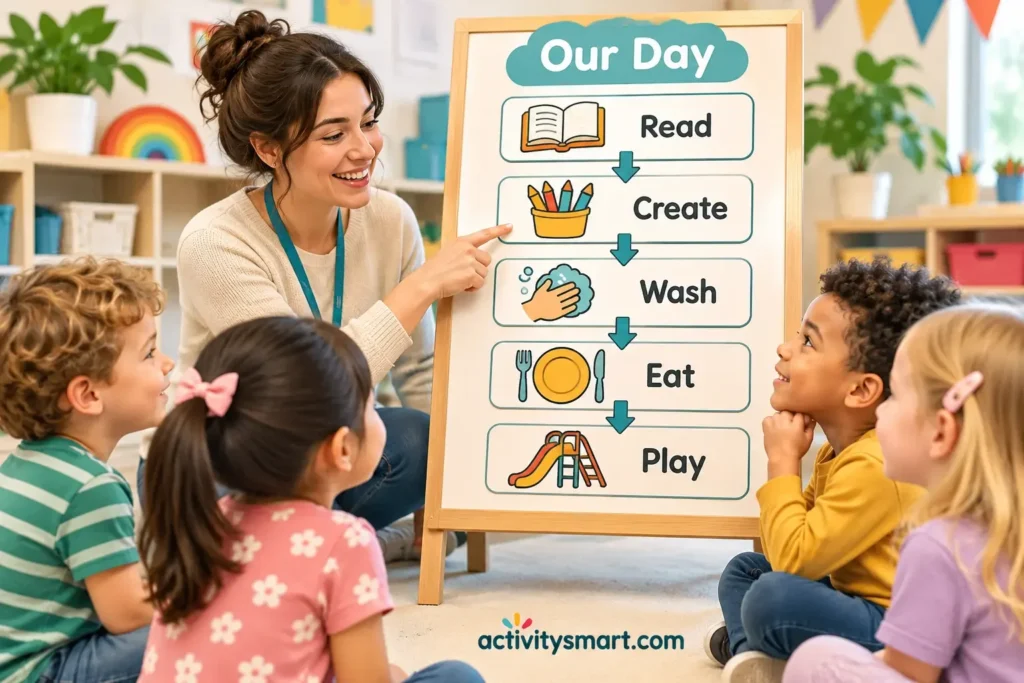
A visual schedule should answer “What now?” and “What next?” in seconds. Use real photographs, clear symbols or simple drawings that resemble the actual classroom activities. Position the pictures near the place where decisions happen rather than on a distant wall. A two-card sequence may be more useful than a large, crowded daily chart for a child who is learning the routine.
Point to the first image, briefly name the action, then point to the next. Let children remove, flip or move a finished card if they find that action helpful. Review changes openly: “The playground is wet, so we will read inside first.” Visuals are supports for communication, not an inflexible contract that the day can never change.
A schedule should not replace individualized communication or relationships. Some learners benefit from a personal version, objects that represent activities, a written checklist or a simple gesture. The NAEYC article on individualizing preschool routines emphasizes adapting routines and transitions to children’s different strengths and support needs.
Reduce bottlenecks instead of entertaining long lines
Stagger movement to shared spaces
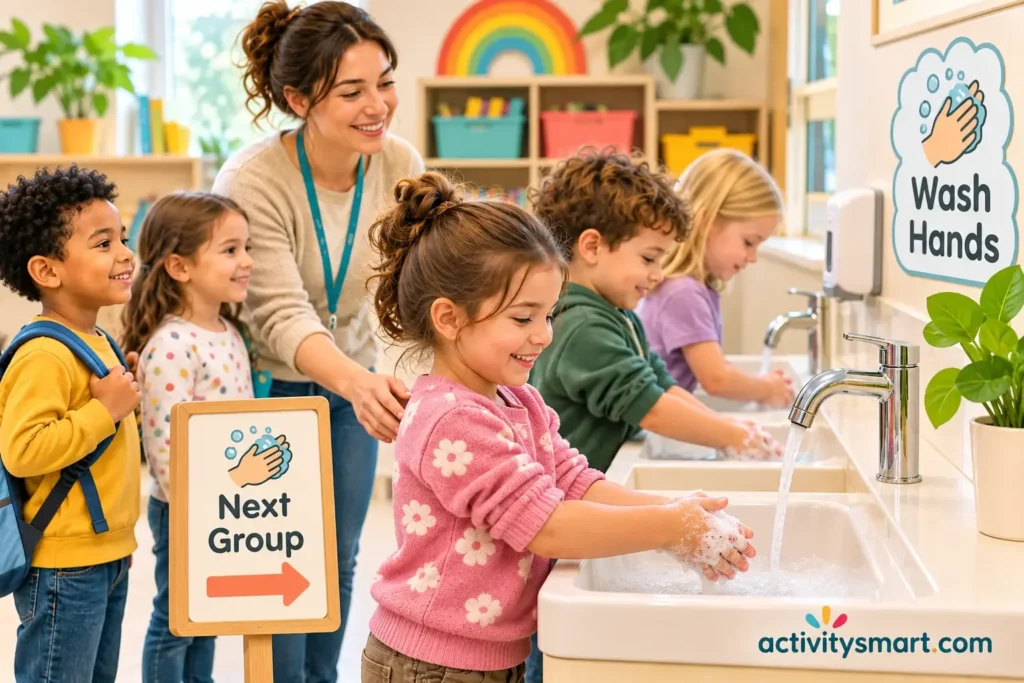
When one area has limited capacity, send a small group while others remain engaged at a supervised station. Handwashing, coats, drinking water, toilets and narrow doorways are common pinch points. The number of children per group depends on available space, safe supervision, staffing and the particular task; it is not a universal magic number.
For example, while one group washes hands, classmates might look at board books or work on a quiet, familiar tabletop activity. As soon as the sink is free, call the next group. Choose an activity children can stop without frustration. Do not make a child delay an urgent toilet need to preserve a rotation.
Give waiting children a real job or choice
A short wait sometimes cannot be removed. Offer a choice between looking at a familiar book, matching two picture cards, humming a quiet song or talking with a partner. Avoid activities that require lengthy setup or make children more excited than the destination can accommodate. A choice is useful only if there are enough materials and the activity is accessible.
Keep any movement games away from stairs, doorways, shelves and crowded lines. Children should not carry heavy or sharp supplies as a supposed “helper job.” Purposeful participation matters more than assigning every child a role. If children consistently wait longer than the task itself, revisit the schedule and space instead of adding another waiting game.
Choose a transition strategy that fits the problem
The following options are practical design choices, not a ranking from a controlled head-to-head trial. Observe your group and adjust what you use. The same room may need visual cues for cleanup and staggered arrivals for lunch.
| Transition problem | Useful strategy | Watch for |
|---|---|---|
| Children are surprised when play ends | Advance warning plus a now-next cue | Warnings so early they lose meaning |
| Everyone crowds one sink | Supervised small-group rotation | Unsupervised children at the waiting station |
| Children arrive before materials are ready | Prepare the destination first | Adults setting up while children idle |
| Directions are forgotten | One observable instruction, then the next | Long multi-step verbal commands |
| A learner finds changes distressing | Personal preview and flexible support | Assuming one visual works for everyone |
Do not select strategies solely by the fastest average time. A two-minute transition that leaves a child overwhelmed, creates unsafe rushing or prevents access is not automatically better than a calmer four-minute one. Consider clarity, participation, safety and the quality of the next activity alongside time.
Ready-to-use scripts for everyday transitions
From centers to cleanup
Start by naming the end of the current activity: “One more turn with the blocks. Then the blocks go on the shelf.” Point to the shelf label. When it is time, assign a small, manageable step: “Put the long blocks in this basket.” Finish by showing the next activity: “Your table has paper ready.” A child who is building something elaborate may benefit from photographing the project or setting it aside when space permits.
Avoid turning cleanup into a race that makes children throw materials or compete over who is fastest. If the routine is new, model with two or three objects before expecting independent sorting. Children practicing hands-on fine motor activities can also build manipulation and organizing habits during ordinary cleanup, without turning the transition into a formal motor assessment.
From story time to table work
Close the story with a recognizable ending: “We have finished the last page. First stand and stretch, then go to your colored table.” Release tables in small groups if chairs or walking routes are narrow. At each table, have an inviting first action ready, such as finding a pencil or looking at the cover of the next book.
When shared reading sparks a lively question, preserve it for later: “I heard you wonder why the character hid. We can talk about that at our next reading time.” See shared picture-book discussion for ways to make that conversation more meaningful without creating an extended holding period between activities.
From outdoor play to indoors
Give a brief signal where children can see or hear it, then guide movement to a consistent gathering point away from gates or vehicle areas. Check attendance using the site’s established procedure before and after movement as required. Allow extra time for clothing, mobility supports and weather conditions; never replace safety checks with a speed goal.
Have an indoor arrival choice ready: hang the coat, wash hands when directed, then choose a picture book or another quiet activity. Some children need to move and regulate after active outdoor play rather than immediately sit through a long discussion. For routines beginning at home, a predictable morning routine provides a related example of making the first steps of the day predictable.
From snack to a learning center
Before children finish, ensure cleanup supplies and the next learning station are available. Invite each child to clear their own place if appropriate, follow hygiene guidance, and then move to an already supervised activity. Avoid insisting that children finish eating quickly to meet an arbitrary transition target.
A simple post-snack station might offer familiar counting objects, but use age-appropriate materials and supervise anything that could be mouthed or swallowed. If you want an instructional extension later, counting with one-to-one correspondence explains how counting objects can support one-to-one correspondence. Keep the snack transition itself clear and low-pressure.
Teach flexible routines for different ages and needs
Preschool: fewer steps, visible destinations
For many three- to five-year-olds, concrete cues and short directions are easier to follow than a string of requests. Show the storage basket and ask for one action, then gesture toward the next place. Repeat familiar procedures but leave room for differences in language, attention and development. Chronological age alone does not tell you what level of cue a child needs.
If a child has difficulty stopping preferred play, consider a preview, a transition object when appropriate, or a predictable final turn. Offer a meaningful choice within the boundary: “Would you like to put away the cars or the ramps first?” Avoid presenting a nonnegotiable safety action as an optional choice.
Kindergarten and early elementary: increasing independence
As children become familiar with the process, gradually replace adult reminders with accessible displays and simple self-checks. A three-step card might read “Put away, move, begin.” Invite students to describe what helps their class move safely; their observations may identify problems adults overlook. Continue to model changes when room layouts or timetables shift.
Children who are ready for more independence can manage materials or use a personal checklist, but do not turn quick transitions into a test of reading ability. Learners developing literacy can still use symbols. Resources on playful letter-sound instruction may help with language-rich instruction during lessons; transition directions should remain understandable even without decoding print.
Accessibility and individual accommodations
A child using mobility equipment may need a wider route and additional time. A child with hearing differences may need a visual signal; one with vision differences may need a tactile or spoken cue. Multilingual learners may benefit from gestures, familiar images and consistent plain-language phrasing. Ask families and relevant school specialists what supports are effective rather than making assumptions about diagnoses.
For children with individualized education plans or other agreed accommodations, follow the plan and coordinate with the responsible team. If transition distress is frequent, observe what happens before and after rather than guessing at the cause. When developmental or health concerns arise, discuss them with appropriate qualified professionals; a classroom routine article cannot diagnose their source.
Common mistakes that increase waiting or stress
- Calling children before the next area is ready. Check the destination first; otherwise enthusiasm turns into an avoidable line.
- Giving four directions in one breath. Start with the first visible action, then provide the next instruction.
- Using a timer as a threat. A timer can mark a predictable change, but should not become pressure to rush, especially for children needing additional time.
- Expecting one strategy to fit everyone. Offer individual cues or altered routes when appropriate.
- Making children wait to earn basic access. Toileting, drinking water and necessary support should not be withheld as behavior management.
- Confusing a quiet line with a successful transition. Check whether children understand the process, feel safe and reach an activity that is ready.
Avoid publicly shaming a child who is last, using physical force to hurry someone along, or withholding play and meals because a transition takes longer. A child may be processing a change, searching for an item, experiencing sensory overload or simply following unclear directions. Modify the adult plan before attributing the difficulty to a character flaw.
Plan a one-week classroom improvement cycle
Observe one repeated transition rather than the entire day
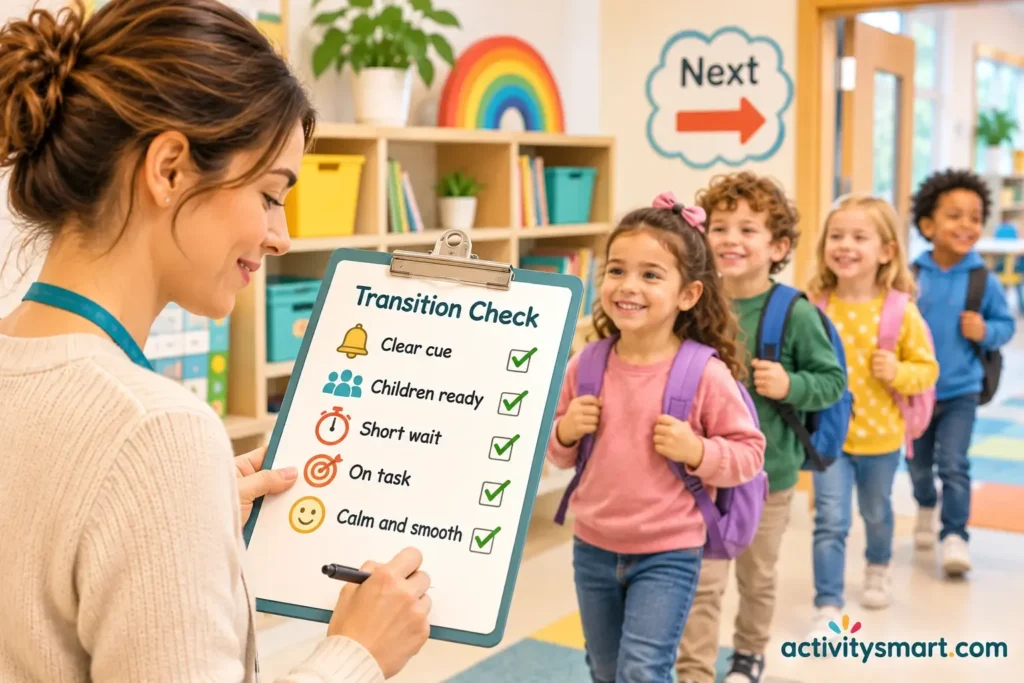
Pick one transition that regularly produces a line, confusion or conflict. Note when the cue begins, when the destination is ready, and roughly how long children wait without a meaningful activity. Observe where adults stand, which instruction children miss, and whether some learners consistently need help. Use anonymous group notes rather than publicly ranking children by speed.
Separate observed facts from interpretations. “Six children reached the sink while it was occupied” is an observation; “They were impatient” is a guess. Record whether the delay comes from one shared facility, late setup, uncertain expectations or an inaccessible route. Ask children simple questions: “What tells you it is time to move?” and “Where do you go next?”
Change one thing and check whether it helps
On the next day, prepare the destination earlier or divide movement into two supervised groups. Teach the new routine explicitly. Over several comparable days, look for shorter idle periods, clearer participation and fewer safety concerns. Weather, attendance, staffing and special events can change transition demands; do not present a single successful morning as proof of a universal outcome.
If the change fails, ask why. Perhaps children cannot see the cue, adults cannot supervise both spaces, or the supposedly independent holding activity needs constant assistance. Restore a safe arrangement and revise. Improvement should reduce burden on children and teachers, not create an elaborate chart that takes more time to maintain than it saves.
Keep the day connected to learning and play
Transitions are part of the learning environment, but they should not consume the learning day. A useful routine creates more room for sustained play, conversation, storytelling and hands-on work. When planning blocks of instruction, protect enough time for children to finish an idea rather than constantly moving them to the next center. For a broader view of learning beyond academic checklists, explore school readiness beyond letters and numbers.
Use a transition-related song when it truly helps children anticipate a change; do not make every move a performance. Likewise, brief picture-book browsing or sorting objects can serve as a respectful waiting choice, but should not substitute for resolving an obvious scheduling problem. If children are getting restless while waiting for an art task, consider whether supported preschool scissor practice can be scheduled in a small supervised group after materials are ready.
Safety and supervision during movement
Maintain required adult-to-child supervision and follow your program’s policies for headcounts, toileting, allergies, handwashing, evacuation routes and collection by authorized adults. Never send a group out of sight simply to shorten a queue. Arrange furniture to keep paths clear, use walking directions suited to the space, and avoid games that encourage running near doors or wet floors.
A calm transition may take longer when someone requires a mobility aid, translation, health support or reassurance. Make that support part of the plan rather than treating it as an interruption. Give children privacy and dignity during personal-care routines. The goal is safe, predictable participation—not uniform movement at identical speed.
Final recommendation: change the system before adding more reminders
Start with the easiest structural improvement: get the next activity ready before signaling, then eliminate an unnecessary whole-class queue. Add one shared cue, model the action and provide an accessible option for children who remain. Observe the result for several days, adjust for individual needs, and keep transitions purposeful rather than frantic. The strongest classroom routine is one children can understand and adults can sustain.
Sources and further reading
For preventive cues, classroom timing, access and environment design, consult NAEYC guidance on reducing transition difficulties. Additional references cited above include the IRIS Center, What Works Clearinghouse, Head Start and NAEYC guidance on individualization. These sources support general principles; the scripts and observation cycle above are practical adaptations, not claims of a tested standalone intervention.
Frequently asked questions
What is a classroom transition for young children?
A classroom transition is the move from one activity, place or routine to another, such as cleanup before snack. It includes preparing, moving and settling into the next experience.
How can I reduce waiting during preschool transitions?
Reduce waiting by preparing the destination first and rotating children through shared spaces in supervised small groups. If a delay remains, offer a simple accessible activity while you correct the underlying bottleneck.
Do visual schedules help with classroom transitions?
Visual schedules can help children understand what happens now and next, especially when paired with clear teaching and consistent use. Choose accessible pictures or other cues suited to each learner rather than assuming one format works for all.
How much warning should I give before cleanup?
Give a brief, understandable warning before cleanup, then a clear signal when it begins. A useful interval depends on the child and activity; concrete steps or a picture may work better than minutes for younger learners.
Should every child line up at the same time?
No, whole-class lining up is not always necessary or efficient. Where staffing and supervision allow, small groups can move to sinks or materials while others remain safely engaged.
What if a child becomes upset when play ends?
Respond calmly, acknowledge the difficulty and offer a predictable next step without removing necessary boundaries. Look for triggers such as abrupt endings or confusing directions, and collaborate with family or specialists if support needs persist.
Are transition songs better than timers?
Neither songs nor timers are universally better; use the cue children can perceive and understand. A familiar song may communicate the sequence, while a timer may help some children anticipate its timing.
How do I support multilingual learners during transitions?
Support multilingual learners with consistent short phrases, gestures, demonstrations and clear pictures. Verify understanding through participation rather than expecting immediate mastery of spoken classroom vocabulary.
What should I measure when improving a transition routine?
Measure observable features such as idle waiting, readiness of materials, clarity of directions, safe movement and children’s participation. Compare several typical days and avoid interpreting speed alone as success.