
Quick Answer
A calm morning routine for kids starts with enough sleep, a few preparations the evening before, and a short, predictable sequence before school. Work backward from your departure time, show children what comes next, and offer the help they need. Keep breakfast, essential care, and safe travel ahead of optional chores.
You do not need a minute-by-minute performance or a child who never complains. You need a plan that still works when someone spills milk, cannot find a sock, or needs extra reassurance. This guide helps families of children roughly ages three to ten design that plan around real constraints.
The examples below are practical planning suggestions, not tested schedules or age-based independence requirements. Choose the parts that solve your household’s actual problems. A preschooler attending nursery, an elementary student taking a bus, and siblings sharing one bathroom will need different arrangements.

Choose a morning routine for kids that fits your household
Start with the moment you must leave home, rather than the time school begins. Include the walk to the bus stop, parking, or the journey to the classroom. Then list what genuinely needs to happen beforehand. A useful first draft is wake, toilet, dress, breakfast, personal care, shoes, bag, and goodbye.
Separate adult responsibilities from child practice. A child can check whether a lunch box is in a bag; an adult still checks that necessary food, medication arrangements, and transport are covered. Independence grows through supported participation, not through being made responsible for consequences they cannot manage.
Quick picks for your biggest pressure point
- Always searching for belongings: choose one reachable place for school bags and shoes.
- Repeated reminders: display a short sequence with familiar pictures or words.
- Clothing battles: prepare two suitable options before bedtime.
- Children waiting for help: assign adult help to specific tasks and stagger bathroom turns.
- Everyone running late: remove optional tasks before moving the alarm earlier.
Pick one starting change. Installing a new chart, a new breakfast menu, and a new reward system together makes it harder to tell which adjustment helped. Keep the first version small enough that another caregiver could understand it without a lengthy explanation.
Understand the bottleneck before changing the child
For a few ordinary mornings, note where the routine stops. Write observations such as “shirt seam uncomfortable” or “adult packing lunch while child waits for toothpaste,” rather than judgments such as “lazy.” Record what help was available and whether the child knew the next step.
Distinguish a missing skill from a missing cue. A child who cannot manage a fastening needs teaching or different clothing. A child who can do it but forgets which item comes next might need a reminder. A child who becomes distressed specifically before school needs a conversation about school, not simply a larger checklist.
Keep your notes brief and private. You are identifying a pattern, not collecting evidence against your child. One difficult morning after a disrupted night does not establish a persistent problem. Look for repeated obstacles that suggest a practical change you can actually make.
Protect sleep and prepare without creating another evening battle
Check sleep before adding an earlier wake-up. The CDC’s sleep recommendations are 10–13 hours per 24 hours for ages three to five, including naps, and 9–12 hours for ages six to twelve. These are recommended ranges, not a prescription for one particular bedtime. Sleep quality matters too.
Repeated difficulty waking deserves attention even if a child appears to spend enough time in bed. Discuss persistent sleep concerns with their healthcare professional. A checklist cannot correct a sleep problem, and reducing sleep to fit more tasks into the morning is a poor trade.
Make tomorrow’s essentials easy to find
Choose one brief evening reset: check school messages, identify any special equipment, place suitable clothes together, and return bags to their usual spot. Keep perishable lunch items refrigerated until needed. A note or picture on the bag can remind the adult to add them in the morning.
Put “library book” or “sports clothes” on the relevant day’s reminder rather than making children recheck every possible item daily. Check an actual school message when unsure. This avoids packing unnecessary belongings and makes the final check shorter.
Do not turn preparation into a second exhausting routine. If evenings are crowded, prioritize the thing that most often causes delay. Matching socks can wait; locating required footwear may be the useful task. Where possible, prepare adult keys, work items, and travel information too.

Build a realistic schedule by working backward
Estimate how long tasks take on a normal day, including adult assistance. Then leave some unassigned time for ordinary interruptions. The example below assumes a 7:50 departure and roughly an hour available; it is a planning illustration, not a recommended duration for every family.
| Time | Child’s next step | Adult’s role |
|---|---|---|
| 6:50 | Wake, connect, use toilet | Offer a gentle greeting and needed help |
| 7:00 | Get dressed | Support difficult clothing steps |
| 7:10 | Eat breakfast | Provide food and supervise as needed |
| 7:30 | Finish personal care | Help with toothbrushing and other care |
| 7:40 | Shoes, outerwear, bag check | Add refrigerated items and check essentials |
| 7:50 | Leave with agreed caregiver | Manage safe departure and travel |
If breakfast regularly needs longer, change the schedule rather than telling a child to chew faster. If dressing before breakfast creates frequent spills, reverse those steps. Keep a stable sequence once you find an arrangement that works, while explaining occasional changes in advance.
Plan for the caregiver’s workload
Two tasks cannot both receive your full help at once. Put your own essential preparation on the schedule and identify collisions. You might prepare breakfast before waking children, or help one child dress while another completes a familiar task nearby.
For households with two caregivers, use clear ownership: one handles breakfast and food packing; the other handles dressing and bags. If only one adult is available, simplify the plan to fit that reality. A system requiring an extra pair of hands is not a realistic solution.
Use a visual checklist as a cue, not a test
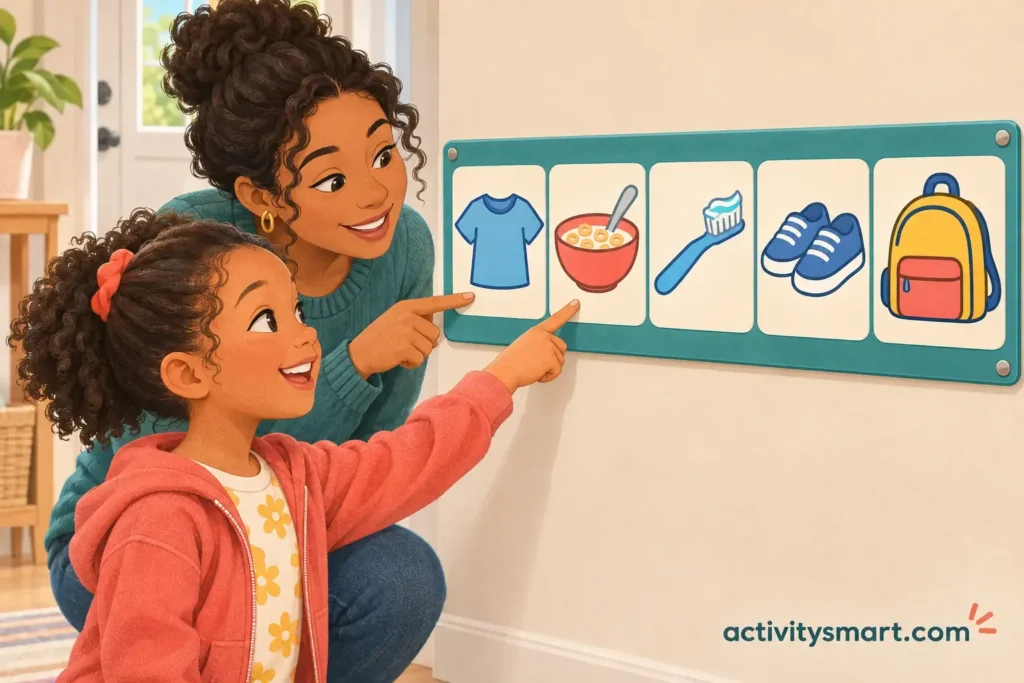
Make a chart your child can understand at a glance. For a beginning reader, draw familiar objects such as a shirt, bowl, toothbrush, shoes, and bag. For a confident reader, use short action phrases. A handwritten strip is sufficient; attractive design is optional.
Show how to use the chart during a calm practice. Walk through the actual rooms and point to the next picture. Decide together how to mark a completed step: a pencil tick, a large flap, or simply moving a finger along the sequence. Avoid small detachable pieces where younger siblings could reach them.
The CDC’s guidance on routines and rules emphasizes predictability and matching tasks to a young child’s abilities. Apply that principle by removing steps your child cannot understand and keeping adult-only responsibilities off the child’s checklist.
If children want to decorate their own chart, do it away from the school deadline. ActivitySmart’s guide to teaching children to write their name can support an optional name label. Writing neatly is not a condition for using the routine.
Choose the amount of help by task
| Starting point | Useful support | Possible next practice |
|---|---|---|
| Needs hands-on help | Adult assists while naming one step | Child completes one manageable part |
| Can act with a cue | Point to a picture or give one direction | Child checks the next step |
| Usually manages independently | Agree a check-in point | Child notices a missing item and asks for help |
A younger child may need you beside them through most steps. An older child may manage a written sequence but still need help with planning, sensory discomfort, or time. The same child may need different support for different tasks or on different days.
Practice tricky hand tasks outside the rush. ActivitySmart’s fine motor activities offer ideas for separate play sessions; they are not a substitute for assessment if daily tasks are persistently difficult. Choose easier fastenings for school mornings while a skill is being learned.
Give directions that point to the next action
Replace “Get ready!” with something you can both recognize as complete: “Put your socks on.” Come close enough to be heard, reduce competing noise, and check understanding without demanding eye contact. For a child using pictures, gestures, or another communication system, use their familiar supports.
For toddlers and preschoolers, the CDC recommends clear, age-appropriate directions, one at a time, with a calm tone and limited choices. That is useful guidance for young children; it does not mean every older child needs every task broken down in the same way.
Offer choices inside a workable boundary: “The green jumper or the blue jumper?” is manageable when both suit the weather and school rules. “What do you want to wear?” may open a much larger decision than anyone has time for. Avoid choices you cannot honor.
Notice effort without turning everything into a reward
Use specific observations: “You checked for your water bottle before I reminded you.” This tells a child which action helped. A brief shared story or conversation after getting ready can be pleasant, but care, breakfast, comfort, and affection should not depend on earning points.
If you choose a reward, keep the target small and achievable with appropriate support. Review whether the child understands it and can actually do the task. A chart that repeatedly records failure is a reason to change the target or assistance, not to increase the stakes.
Make breakfast and waiting time easier to manage
Decide on a small selection of familiar breakfasts that fit dietary needs, allergies, available time, and school arrangements. Offer food without making the morning a negotiation over every bite. If school breakfast is part of your plan, confirm serving times and access rather than assuming it will be available after a late arrival.
Keep eating seated and supervised as appropriate. Avoid solving lateness by asking children to rush food or eat while walking. If eating, swallowing, or restricted intake is a persistent concern, seek individual advice from a qualified healthcare professional rather than relying on a routine article.
For children ready early, prepare one easy-to-stop activity in a defined place. A short book, a conversation, or a few crayons may work better than beginning a complicated project. Keep the bag and shoes ready so the spare time does not become another search.
You could save ActivitySmart’s unicorn above a rainbow coloring page for that optional pause. If writing or tracing suits your child, explore the tracing lines collection at another convenient time. Neither activity belongs on the essential morning checklist.
Set a clear plan for entertainment screens
If videos or games regularly make departure harder, try leaving entertainment screens off until after school and tell children the plan beforehand. Keep communication devices, assistive technology, or a necessary visual schedule available. Removing a support is different from removing a distracting show.
Families considering digital coloring can consult ActivitySmart’s discussion of online coloring for kids separately. For the morning, the useful question is simple: can this particular child stop this particular activity when it is time to leave?
Respond to distress and sibling conflict without losing the essentials
When a child is upset, pause the stream of instructions. Use a brief acknowledgment and one manageable next step: “Those socks feel uncomfortable. Let’s try the other pair.” You do not need to decide whether every complaint is justified before offering practical help.
For siblings, identify shared resources instead of comparing speed. Give each child a place for belongings and decide who uses the bathroom first. If one child needs close support, let the other begin a task they already know. Do not assign a young sibling responsibility for managing another child’s distress.

Adjust for sensory and communication needs
Ask what is difficult: bright lighting, a noisy appliance, toothpaste flavor, clothing seams, or an unexpected change. Try one reasonable adjustment and observe the result. Provide advance notice of changes and keep familiar cues available. These are accommodations to explore, not a diagnosis or a treatment plan.
Coordinate with professionals already supporting your child when relevant. A child who needs assistance is not failing at independence. The right goal may be a supported departure with less distress, rather than completing every step alone.
Have a short plan for the morning that goes wrong
Agree beforehand which optional tasks can disappear: bed-making, extra practice, decorative hairstyles, or a waiting activity. Preserve necessary care, appropriate food arrangements, essential belongings, and safe travel. Contact school if needed and follow attendance procedures; do not compensate for lost time by rushing road crossings or unsafe driving.
If you shouted, repair briefly: “I raised my voice. That was not helpful. I will speak more calmly. Next we need shoes.” Discuss the problem properly later. The doorway is rarely the place for a long lesson about responsibility.
Review the routine and know when more support is needed
After several school mornings, ask one useful question: “Which part still needs help?” Compare practical outcomes such as fewer searches, clearer handovers, or leaving closer to the planned time. These observations tell you whether the arrangement fits; they do not prove a developmental improvement or a guaranteed effect on learning.
Keep the parts that help and change one obstacle at a time. If the chart is ignored, try fewer steps or a better location. If a timer creates panic, use a quiet adult reminder instead. If the evening reset never happens, reduce it to the single most important preparation.
Seek support when distress repeatedly disrupts attendance or family functioning, when your child reports bullying or another school concern, or when sleep or daily-care difficulties persist. Start with the teacher, school support team, or child’s healthcare professional as appropriate. The Child Mind Institute’s school-morning guidance also discusses professional help when difficulties are substantial.
Common mistakes to avoid
- Adding too many jobs: build a workable departure before adding chores.
- Using a chart as proof of defiance: check understanding, ability, comfort, and support first.
- Racing siblings: compare the routine with your own needs, not another child’s speed.
- Changing everything after one bad day: look for patterns before redesigning the plan.
- Making adults invisible: include their preparation, workload, and handovers.
Final verdict: make the next step easier
A useful morning routine is clear enough to follow and flexible enough to survive ordinary life. Its advantages are fewer decisions and more visible responsibilities; its limitation is that no schedule removes illness, worry, disability, or external pressures. Start with one bottleneck, keep support available, and protect the relationship while you improve the logistics.

Frequently asked questions
How long should a school morning routine take?
There is no single correct length; allow enough time for your child’s essential tasks and the help available. Measure a few ordinary mornings, work backward from departure, and leave room for interruptions. The example schedule is a starting illustration, not a target to beat.
What should a morning routine include?
Include waking, toileting, dressing, breakfast arrangements, personal care, essential belongings, and safe departure. Adapt the order to your home and your child’s needs. Optional chores and learning activities can wait if they compete with those essentials.
How do I make a checklist for a child who cannot read?
Use recognizable pictures or drawings showing the actions in your actual routine. Demonstrate the sequence together and point to one step at a time. Keep the chart short and accessible; a picture chart still needs adult explanation and support.
Should I wake my child earlier to stop being late?
Wake your child earlier only if the revised schedule still allows adequate sleep and addresses a real timing problem. First remove unnecessary tasks and prepare essentials ahead. Persistent difficulty waking is worth discussing with a healthcare professional rather than repeatedly shortening sleep.
What if my child refuses to get dressed?
Check what makes dressing difficult before treating the refusal as a behavior problem. Offer suitable clothing choices, help with fastenings, and address discomfort where possible. Discuss persistent distress or difficulty with an appropriate professional, especially if other daily tasks are also affected.
Can a timer help with getting ready?
A timer may help a child who finds a visible or audible cue useful, but it is optional. Introduce it calmly and avoid racing through eating or personal care. Stop using it if it increases distress or distracts from the task.
Should children watch television before school?
You can leave television off before school if stopping it makes departure harder. Explain that boundary ahead of time and offer a simple waiting activity instead. Keep necessary communication or assistive devices available; those serve a different purpose from entertainment.
How can one parent manage siblings with different needs?
One parent can simplify shared tasks, stagger turns, and reserve direct help for the steps each child needs support with. Use separate places for belongings and avoid expecting siblings to manage each other. Revise any schedule that requires simultaneous hands-on help.
When should I ask for help with morning distress?
Ask for help when distress repeatedly affects attendance, daily care, sleep, or family functioning, or when your child reports a school safety concern. Contact the teacher or school support team for school-related issues and a healthcare professional for health or developmental concerns. A routine cannot resolve every underlying difficulty.
Sources and further reading
These resources provide professional guidance and background, rather than evidence that one exact schedule will work for every family. For another family-planning example, see Raising Children Network’s approach to separating evening preparation from morning tasks.