To teach letter sounds, show a printed letter, model a common sound clearly, connect it to a familiar spoken word, and give the child a short turn to practice. Return to previously learned sounds, then use a few known letters to build and read simple words. Keep the task small enough that the child understands what to do.
This guide is for parents and teachers working with preschool and kindergarten children, roughly ages 3–6. Younger preschoolers may enjoy listening and matching; children ready for more can blend sounds and spell short words. These are flexible educational suggestions, not developmental deadlines, a screening tool, or a replacement for a school’s reading program.
Understand what you are teaching
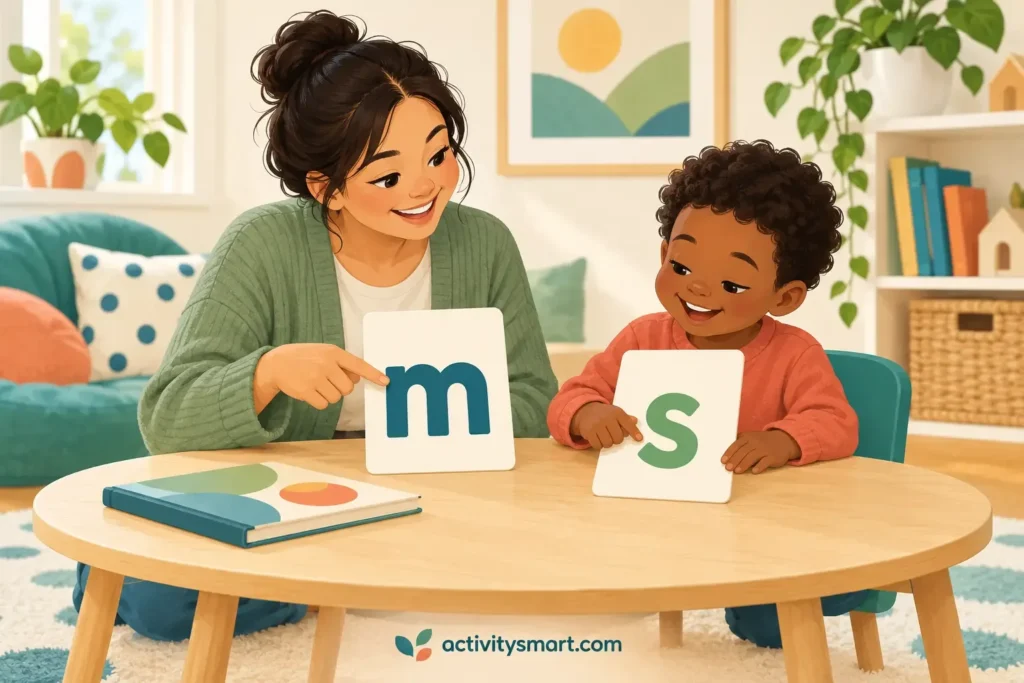
A letter has a name and can represent a sound. The name of m is “em”; its common sound is /m/, heard at the beginning of moon. Slashes in this guide indicate spoken sounds, not letter names. You do not need to teach children this notation.
Phonemic awareness involves noticing and working with individual sounds in spoken words. Phonics connects sounds to print. Saying the first sound in sun without looking at writing is a listening task; pointing to s and saying /s/ adds a print connection. Neither requires a child to explain the technical vocabulary.
The IES foundational reading practice guide recommends linking speech sounds to letters and teaching decoding and writing. Its recommendations concern kindergarten through third grade. For preschoolers, use brief, inviting introductions rather than importing an elementary lesson unchanged.
A child can sing the alphabet without knowing individual sound connections. Another child may recognize a letter in their name but overlook it on a food label. Treat these as clues about the next teaching opportunity, rather than evidence that the child has failed.
Start with a small, purposeful selection
Find an entry point without a long test
Place three or four familiar letters on the table. Ask, “Do you know any of these?” If the child supplies a name, acknowledge it and model the sound too. If they shrug, demonstrate one connection and invite them to join. Avoid repeatedly asking questions whose answers you have not taught.
Try a spoken comparison as well: “Listen: moon, milk. They start with /m/.” Next offer moon and sock and ask which starts like milk. Say the picture names yourself so unfamiliar vocabulary does not obscure the listening task. One calm exchange gives you more useful information than a timed alphabet recital.
Choose letters that will work together
Follow the school’s phonics sequence when one exists. At home without a sequence, an illustrative starting collection is m, s, a, t, followed gradually by p and i. Teach short a as in map and short i as in sit. This collection offers opportunities for words such as mat, sat, map, and sit as the relevant connections become familiar.
This is a planning example, not a universally preferred order. Introduce one new connection at a time when helpful, while reviewing old ones. Do not present the whole collection as a memorization assignment. A meaningful name letter can be included, but explain its sound in that particular name; names do not always follow the simplest spelling patterns.
Start with lowercase forms used in ordinary words and show their uppercase partners in context. There is no need to teach only capitals because their shapes seem simpler. Keep early cards visually plain so a decorative font does not become an extra puzzle.
Gather a simple teaching kit
- Several large handwritten lowercase letter cards or sturdy letter tiles.
- A few familiar objects or clear pictures, such as a sock, mug, map, and sun.
- Paper and a thick crayon or marker for optional writing.
- Three large counters or paper circles for sound work.
- A favorite picture book and a small space without competing audio.
Use age-appropriate materials and supervise handling; small loose pieces are unsuitable for children who might mouth them. Homemade paper cards are enough. Avoid buying a large kit before you know whether the child needs help hearing sounds, remembering symbols, or blending them.
Arrange only the materials for the current turn. A table covered with twenty objects can turn a simple sound choice into a visual search. Keep pictures separate from plain letter cards so you can later check whether the child recognizes the letter without the picture cue.
Model one connection clearly
Show, say, connect, and invite
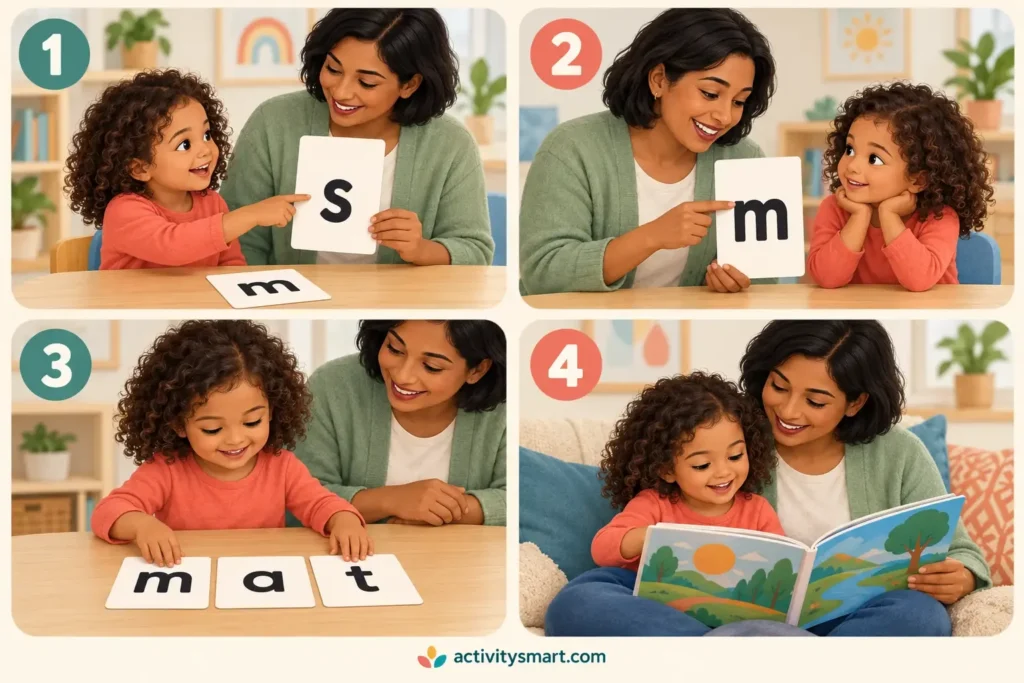
- Show m and point to its shape: “This is m.”
- Say its sound: “It represents /m/. Listen: /mmm/.”
- Connect a familiar word: “Moon starts with /m/.”
- Invite participation: “Let’s say /m/ together.”
- Offer a choice: “Which letter represents /m/?” Present m beside one known, different letter.
These are suggested teaching lines, not quotations from a study. Speak naturally and leave room for a response. A child can first point instead of speaking. After a supported turn, offer another chance with less help; remove the picture before assuming the printed connection is secure.
Keep sounds clear and brief
For a stretchable sound such as /m/ or /s/, sustain the sound without adding a separate vowel. For a stop sound such as /t/ or /p/, make a short release rather than saying “tuh” or “puh.” An added vowel can make it harder to hear the intended word when blending.
Do not stretch a stop consonant into repeated syllables. If pronunciation feels awkward, ask the child’s teacher to demonstrate the program’s sounds. Keep your own accent; use familiar example words and acknowledge ordinary pronunciation differences instead of correcting a family accent as though it were a learning error.
For vowels, pair the sound with an anchor word: a as in apple, i as in insect. Say the word normally before emphasizing its beginning. Avoid choosing ambiguous pictures, such as an image that could be called either a sofa or a couch, unless you first agree on its name.
Practice through games with a clear learning purpose
1. Two-letter sound delivery
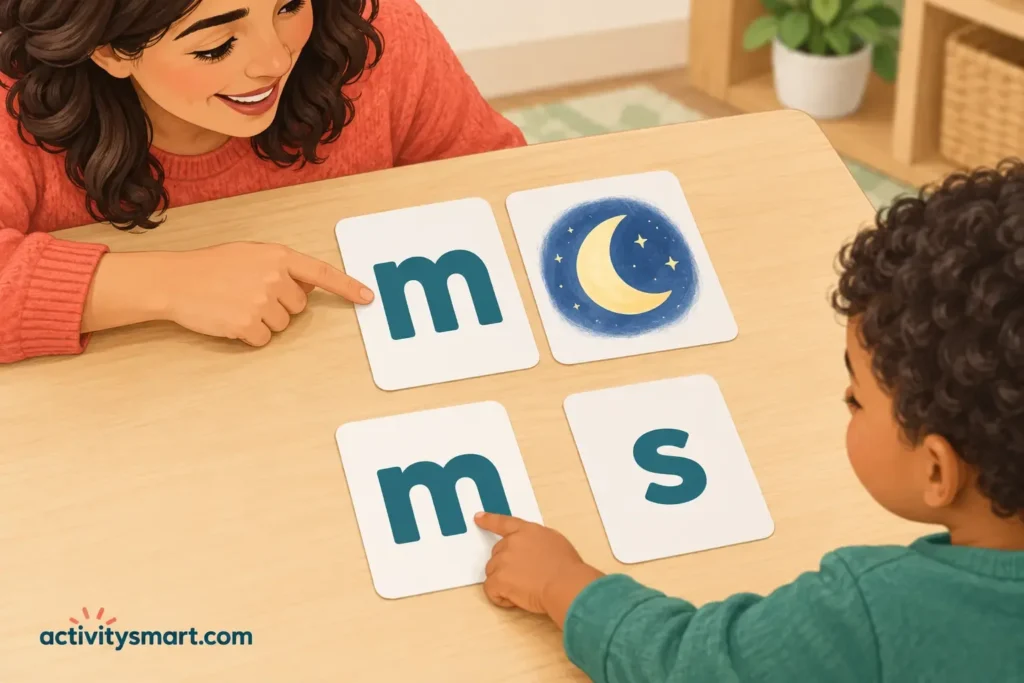
Put m and s on opposite sides of the table. Say /m/ and ask the child to deliver a large paper circle to the matching letter. Change card positions after several turns. Otherwise a child might remember “left” instead of recognizing m.
Make it easier by modeling immediately before the choice. Make it harder by adding one previously taught letter or asking the child to say the sound after delivering the circle. Keep the challenge about sounds and print, rather than making the delivery route physically difficult.
2. Beginning-sound sorting
Place m and s cards above two spaces. Name a moon picture, a sock, a sun picture, and a mug. Model sorting mug under m: “Mug begins with /m/.” Let the child sort another item, saying its name with you.
For an easier version, offer one target sound and ask whether each word starts with it. For a harder version, have the child suggest a new word without a picture. Acknowledge sensible vocabulary choices, then return attention to the first sound.
Watch the difference between letters and sounds: shoe starts with /sh/, not /s/, despite beginning with the letter s in print. Save it for a later lesson on sh rather than placing it in the /s/ group. Choose clean examples while a connection is new.
3. Letter hunt with a book
After enjoying a story, choose one page and look for a taught letter. Point to s in a word, say its sound in that word, and let the child find another occurrence. If the letter represents a different sound, explain briefly or choose a clearer example.
Keep the hunt separate from the main read-aloud so the story remains enjoyable. The NAEYC family literacy guidance places alphabet exploration alongside conversation, books, and meaningful writing. Letter practice should fit within that broader experience.
4. Make a letter, then retrieve its sound
Write a large m and invite the child to trace it with a finger while saying /m/. Then cover the model, reveal a plain m card, and ask for the sound. The second step matters: producing a shape and remembering its sound are related tasks, but one does not prove the other.
If the child enjoys paper practice, choose a small section from the alphabet worksheets for a sound conversation. You can do the sound work orally while the adult handles writing. Do not make pencil control a condition for joining a phonics activity.

Move from separate sounds to simple words
Once a child knows a few useful sound connections, show how they work together. You do not need to wait for every alphabet letter. Select words composed entirely of taught connections, and introduce blending through a demonstration rather than another unexplained question.
Blend to read
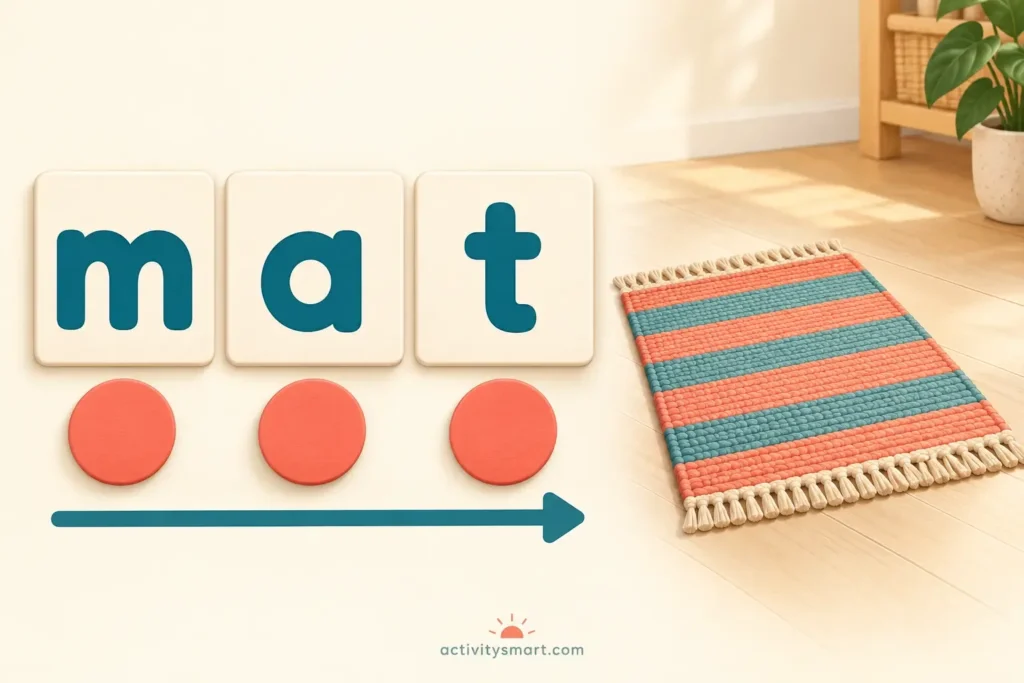
Arrange m, a, and t from left to right. Point beneath each letter, say its sound, then move smoothly through the sequence and say mat. Invite the child to try with you. Keep the short a consistent with the vowel in mat.
If the child gives three separate sounds but cannot hear mat, model the blending again with shorter gaps. You can begin by blending the two sounds in am, then return to a familiar three-sound word such as mat. Choose vocabulary the child understands so the task stays focused on joining sounds rather than learning an unfamiliar word.
When a word is read, ask what it means or use it in a short sentence. Pictures can help discuss meaning after decoding; they should not supply the answer before the child attends to print. If you offer a picture match, have the child read the printed word first.
Segment to spell
Say sat normally, then slowly separate /s/, /a/, /t/. Move one large counter for each sound. Replace the counters with the corresponding letter cards. Read the completed word together. Here the child is moving from spoken language toward spelling, rather than recalling a visual arrangement.
Change sat to mat by replacing the first letter. Ask what changed in the sound and print. Keep the middle and final letters stable so the comparison is manageable. If this is difficult, return to building sat together and try the change another day.
For children ready to practice taught three-sound patterns on paper, use selected CVC word worksheets. Check each word against the connections already taught. A page’s overall label does not guarantee that every item fits the current lesson.
Choose the next step from what you observe
| What you notice | Try next | Add challenge when ready |
|---|---|---|
| Recognizes a picture but not its letter | Pair one plain letter with its sound and anchor word. | Remove the picture and change the card position. |
| Knows letter names only | Acknowledge the name and explicitly model the sound. | Alternate name questions and sound questions clearly. |
| Knows sounds but pauses between them | Model blending a short word with smaller gaps. | Offer another word using the same connections. |
| Reads a familiar card from memory | Build a different word with known letters. | Change one letter and compare the words. |
| Finds handwriting tiring | Use pointing or large movable letters. | Add optional writing separately. |
These observations guide teaching; they do not establish a diagnosis. Avoid labeling a child by one response. Fatigue, vocabulary, noise, and unfamiliar directions can all affect a particular turn.
Use a short routine you can repeat
Try the following five-to-eight-minute routine as a practical starting point, shortening it whenever attention or comfort fades. The timing is an organizational suggestion, not a prescribed dose. A preschooler might do only the first two parts; a kindergarten learner may be ready for all four.
- Reconnect: review two or three familiar cards in mixed order.
- Model: introduce one connection, or reteach a tricky one with a clear example.
- Use: play a matching game or build one word with known letters.
- Finish: revisit one successful response and choose a book or ordinary play activity.
Before the session, ask yourself: Are my example words familiar? Have I chosen only taught connections for the reading task? Can the child respond without writing? Afterward, note one independent success and one useful next step. “Said /m/ without moon picture” is more actionable than “good at phonics.”
Across several sessions, keep the structure stable while changing the examples. Revisit an old sound before adding a new one. If yesterday’s connection has disappeared, model it again and reduce the number of choices. A missed response is information about practice, not a reason to extend the session until the child performs.
Adapt for classrooms, home languages, and different needs
In a small group, give every child a pair of cards to point to, rather than relying on the loudest volunteer. After a group response, quietly check individual understanding. Build groups around the immediate task, such as matching /m/ to m, and change them as needs change.
At home, ask the teacher which connections and example words are being introduced. Use the same sound models where possible. A short note about what was easy or confusing helps adults coordinate without turning family time into a second full school lesson.
For multilingual children, establish the English picture name before asking about its beginning sound. A child may know the object well under a different word. Welcome that word and explain which language the current sound task uses. Keep conversation and stories in the family’s languages; English practice does not require replacing them.
Children who communicate through pointing or an established communication system can choose letters without producing every sound aloud. Keep cards large, well spaced, and easy to reach. Ask the child’s teaching or support team how to adapt access when vision, hearing, movement, or speech differences affect participation.
A name can provide a meaningful connection to print. The guide to teaching a child to write their name supports the writing side of that activity. Explain name-specific spellings accurately instead of forcing every name into a simple one-letter, one-sound pattern.
Common mistakes and helpful corrections
- Introducing too much: reduce the set and review a few known connections.
- Keeping cards in alphabet order: mix their positions so recall does not depend on a sequence.
- Testing before modeling: demonstrate the exact response you want, then invite a turn.
- Using pictures as reading shortcuts: teach attention to the letters; use pictures to discuss meaning.
- Correcting with repeated “try again” prompts: supply the sound, say it together, and return to it later.
- Making practice a race: prioritize accurate, comfortable responses before increasing pace.
English spelling includes alternatives: c can represent /k/ in cat and /s/ in city, and sh represents one sound using two letters. Start with a manageable connection while saying “in this word” or “a common sound.” Avoid teaching an absolute rule that must immediately be undone.
The EEF phonics evidence summary supports explicit, systematic instruction matched to current knowledge. It also emphasizes that reading development needs more than phonics, including vocabulary and comprehension. Keep rich conversation and meaningful reading alongside this focused practice.
When to ask for additional help
Children develop at different rates, and a single forgotten sound is not a diagnosis. If difficulty remembering taught connections persists despite clear instruction and repeated supported opportunities, discuss specific observations with the classroom teacher or a qualified reading specialist. Ask which skill needs attention and how progress will be reviewed.
Concerns about hearing, speech, or broader development belong with appropriate qualified professionals, such as the child’s pediatrician, audiologist, or speech-language pathologist. Continue accessible, enjoyable participation while seeking guidance. Home games can support learning, but they should not be presented as treatment for a suspected condition.
Frequently asked questions
Should I teach letter names or sounds first?
Teach the difference explicitly and connect both to print. You can introduce a letter name and a common sound together; children do not need to memorize every name before exploring sounds. Make each question clear: ask for the name or ask for the sound.
How many letter sounds should we practice at once?
Begin with a small selection that the child can manage, reviewing familiar connections alongside a new one. There is no single correct number for every learner. Reduce the choices if the child is guessing, and add connections as responses become more independent.
Does my child need to know the whole alphabet before blending?
No. You can demonstrate blending with a few known connections. Choose a short word made entirely from those connections, model how the sounds join, and explain its meaning. Continue teaching additional letters while practicing the ones already introduced.
What if my child says the letter name instead of its sound?
Acknowledge the correct name, then model the requested sound: “Yes, that is m. Its sound here is /m/.” Say it together and offer another supported turn. Do not treat a correct letter name as meaningless; clarify which response the task requires.
Can worksheets help children learn letter sounds?
A carefully selected worksheet can provide a place to point, match, or talk about letters. Use only items that fit the current teaching goal and say the sounds aloud together. Paper practice should complement clear instruction, conversation, play, and books, rather than replace them.
When should I ask the teacher about continuing difficulties?
Raise concerns when remembering taught connections or using them in words remains difficult across repeated supported opportunities. Share concrete examples and ask about the next instructional step. For hearing, speech, or developmental concerns, seek guidance from an appropriate qualified professional; this guide cannot diagnose the cause.