Quick Answer
Sorting skills activities help children notice an attribute, group objects by a shared rule, explain their choices, and eventually switch rules or create categories. Start with a small set of large, safe objects sorted by one obvious feature such as color. Progress toward shape, size, two-step rules, and flexible categories when children can explain their groupings.
Quick Picks
- Starting out: sort six large blocks into two color groups.
- Ready for a change: re-sort the same blocks by shape.
- Ready to explain: invent a category and justify each item.
- At home: group clean socks or large kitchen utensils.
- In a classroom: let partners compare two valid sorting rules.
Sorting is more than putting matching colors together. When a child groups objects, they attend to a feature, compare examples, and decide what belongs. An adult can make that thinking visible by asking, “What is the rule for this group?” Start with a manageable collection, allow more than one defensible answer, and raise the challenge slowly rather than treating speed as success.
This guide moves from color to categories with activities for preschool and early elementary children. It separates observing a sorting strategy from claiming measurable academic improvement. Related practice in visual discrimination games helps children notice details before they choose a grouping rule.
What children learn when they sort
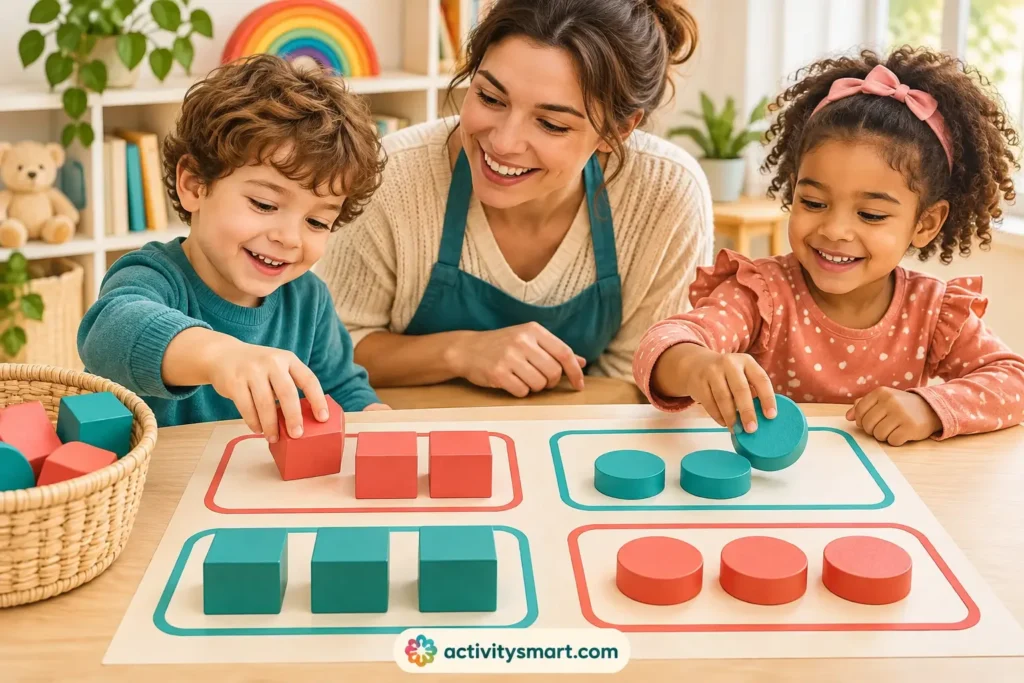
A sort places objects into groups using a rule, usually a feature called an attribute. Color, size, shape, texture, use, and material can be attributes. A category is a group defined by shared membership, such as things used for writing. A set is a collection considered together. These ideas overlap, but they are not interchangeable: a red pencil can belong to the red set, the pencil set, and the writing-tools category.
Sorting supports mathematical conversations about same and different, more and fewer, and whether an item fits a stated condition. It also gives adults a window into a child’s reasoning. A child who says “These all have corners” has described a more precise rule than one who silently puts three objects together. That explanation matters even when the piles look identical.
Why explanation matters more than a perfect pile
Two children might place the same toy car with different objects: one groups it with red toys; the other groups it with vehicles. Both can be correct if the rule is consistent. Ask children to show an example that belongs and one that does not. This reduces guessing about what an adult wants and leaves room for ideas that an observer did not anticipate.
The NAEYC preschool sorting and sets resource describes sorting familiar items, discussing their similarities and differences, and revisiting the same collection with a different rule. This is a practical teaching model, not proof that any particular sorting game produces a guaranteed test-score gain.
Sorting skills activities: a progression from color to categories
A useful progression increases the thinking demand one step at a time. The following sequence is not a fixed age ladder. A child may sort familiar socks by type but struggle to sort unfamiliar geometric pieces, or understand the rule before being able to explain it aloud. Demonstrate with one example, then watch what the child can do independently.
| Stage | Child’s task | Adult prompt | Sign of readiness |
|---|---|---|---|
| Match | Find two alike items | “Find another like this.” | Matches without frequent pointing |
| One rule | Sort into two color or shape groups | “Where do the blue ones go?” | Uses the rule across several items |
| Re-sort | Change from color to shape | “Can we make new groups?” | Changes the rule with support |
| Complex rule | Use two properties or make subgroups | “Which are red and round?” | Checks both conditions |
| Explain category | Make a meaningful category | “What belongs, and why?” | Explains inclusion and exceptions |
Use the table to decide what to try next, not to label children as ahead or behind. EEF comparisons and connections evidence summary describes scaffolding from what children know, using materials they can handle, and making comparisons across examples; it also notes limitations in the research base. This supports a responsive approach rather than rigid age cutoffs.
Start with color: the two-basket sort
Set up a small, clear choice
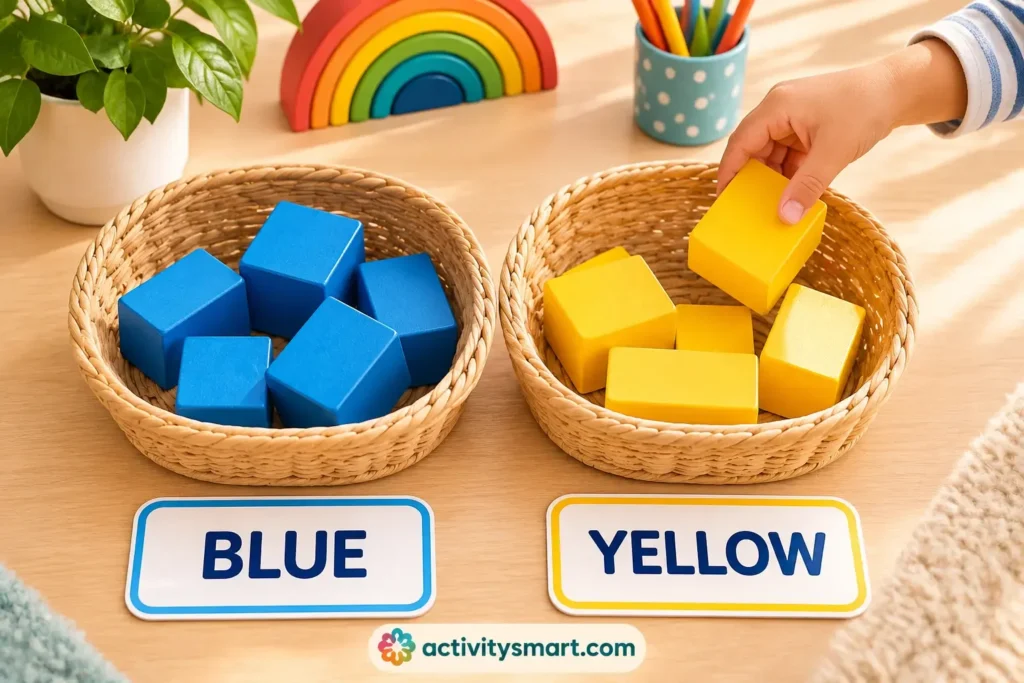
Place two shallow containers on a table and gather six to ten large blocks in two colors. Put one example in each container. Invite the child to place the remaining pieces. Say, “These are the blue blocks; those are the yellow blocks.” If a child hesitates, hold up one piece and ask them to compare it with the two examples. Avoid correcting several mistakes at once.
When the two groups are complete, mix the blocks and invite another attempt. Then change the location of the baskets to check whether the child is following color rather than always choosing the left or right side. If they are ready, remove the examples and ask the child to explain the rule before starting.
Make it easier or harder without changing materials
To simplify, use just four highly contrasting pieces and model the first choice. To extend, add a third color, introduce a piece that does not belong in either group, or ask children to create labels using colored paper. An outlier is not a trick: explicitly allow a “not in these groups” area so children can reason without being forced into a false choice.
For children who do not consistently name colors, focus on matching first. Speaking a color word and recognizing a matching feature are related but different tasks. Offer pointing, placing, or selecting as valid ways to respond.
Move from color to shape and size
Keep the objects; change only the rule
Choose pieces that vary on two dimensions: red circles, blue circles, red squares, and blue squares. First sort them by color. Then mix the whole collection and ask, “Could the circles live together instead?” Make the change explicit. The point is not to remember two rules at once but to understand that the same collection can be organized in more than one way.
If children consistently group by color, start with only circles and squares in one color. Once shapes become salient, restore the other color. This is an example of adjusting task difficulty, not a sign that the child lacks understanding. Pair the activity with teaching shapes with everyday objects to explore shape attributes in other contexts.
Size sorting needs careful comparisons
Gather three or four versions of the same object with clear size differences. Ask children to make a small pile and a large pile. For an extension, arrange them from shortest to tallest or smallest to largest. Ordering objects along a dimension is called seriation, which is related to sorting but requires attention to sequence as well as categories.
Keep one dimension as consistent as possible. A tall narrow cup and a short wide cup make “bigger” ambiguous. Ask whether the child means height, width, or how much something holds. The distinction is useful mathematical language, not a reason to turn a playful activity into a quiz.
Try category sorting with familiar objects
Sort by purpose, not appearance
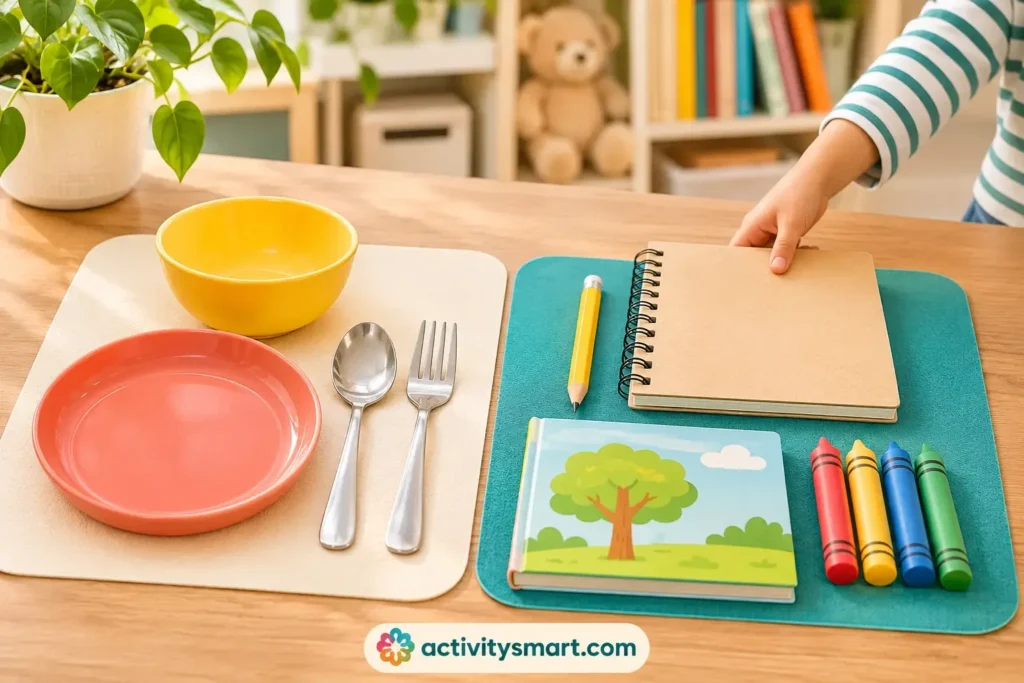
Set out safe, familiar items: a spoon, fork, washcloth, pencil, notebook, toy dish, and small book. Invite the child to organize items that “go together.” They might make a writing group and an eating group. Ask why a particular object belongs. Accept an unexpected group if the child can state a meaningful rule; then introduce a second perspective gently.
Next, use picture cards for animals, food, transport, and clothing. Ask children which items belong together and whether any card could belong to two groups. A picture of a raincoat, for example, can be clothing and something used on rainy days. This begins to reveal how categories can overlap, although physically putting one card into two piles at once may require a copied card or a drawn overlapping-circle diagram.
Broaden the idea to living and nonliving
Category work connects naturally to words and concepts, but the aim here remains identifying a rule. The IES What Works Clearinghouse early mathematics guide recommends integrating mathematics throughout the day and building learning through a developmental progression; it does not require a separate worksheet for every group children make.
Five ready-to-use sorting games for home or school
Laundry detectives
Put a small selection of clean adult-sized socks, washcloths, and hand towels on a mat. Invite children to sort by type; later sort by color, then by intended use. Ask which rule was easiest to see and why. This works naturally during a household routine and uses materials that are already available. Keep sorting separate from any unsafe appliance or cleaning products.
Nature tray investigations
Offer large, clean leaves or photographs of leaves and stones. Children can group by shape, edge, pattern, or color. Ask, “Would this leaf fit your group if it changed color?” The question highlights how the defining rule matters. For younger learners, photographs are often safer and easier than collecting unknown plants or objects outdoors.
Picture-card shop
Create a pretend shop with pictures of groceries, school supplies, and clothes. Children decide which shelf each item belongs on. Once the first arrangement works, ask them to redesign the shop for a customer looking for items used outside. It is fine for categories to change when the purpose of the shop changes.
Shape rescue
Scatter large paper circles, squares, triangles, and rectangles on the floor. Invite children to rescue all pieces that match one clue, such as “has three straight sides.” Then invite them to give a clue. Distinguish the formal geometric definition from everyday appearance; rotated squares are still squares. Add hands-on number sense when comparing how grouping and quantity connect.
Guess my rule
An adult silently places three objects together and leaves one aside. The child guesses the rule, then tests it with another object. Reverse roles so the child invents a group. More than one answer may fit the examples; ask for a counterexample or one additional object to narrow the possibilities. This game is especially useful for developing explanations.
Turn sorting into early data and number talk
Once the groups have a clear rule, count the items in each. Ask which set has more, which has fewer, and how many altogether. A group of five red blocks and three blue blocks can be shown with two rows of marks. The recording should reflect the actual collection, not an invented numerical target. Compare the rows visually, then count to verify.
For a small group or class, invite every child to choose a favorite fruit picture and place it in the appropriate column of a large graph. Discuss whether each person contributed exactly one picture and what the columns show. If the question changes—favorite fruit versus fruit eaten yesterday—the meaning of the resulting graph changes too.
Sorting prepares the organization; counting and representing quantities add different mathematical demands. For a child working on touching or moving one object per number word, use counting with one-to-one correspondence before increasing the number of items. Do not assume a neat graph means the child understands cardinality; ask them to explain what a column’s total represents.
The IES practice guide describes counting and sorting familiar items as ways to organize information. These examples are small opportunities for mathematical conversation, not substitutes for systematic teaching of counting or number relationships.
How to move to two attributes and overlapping groups
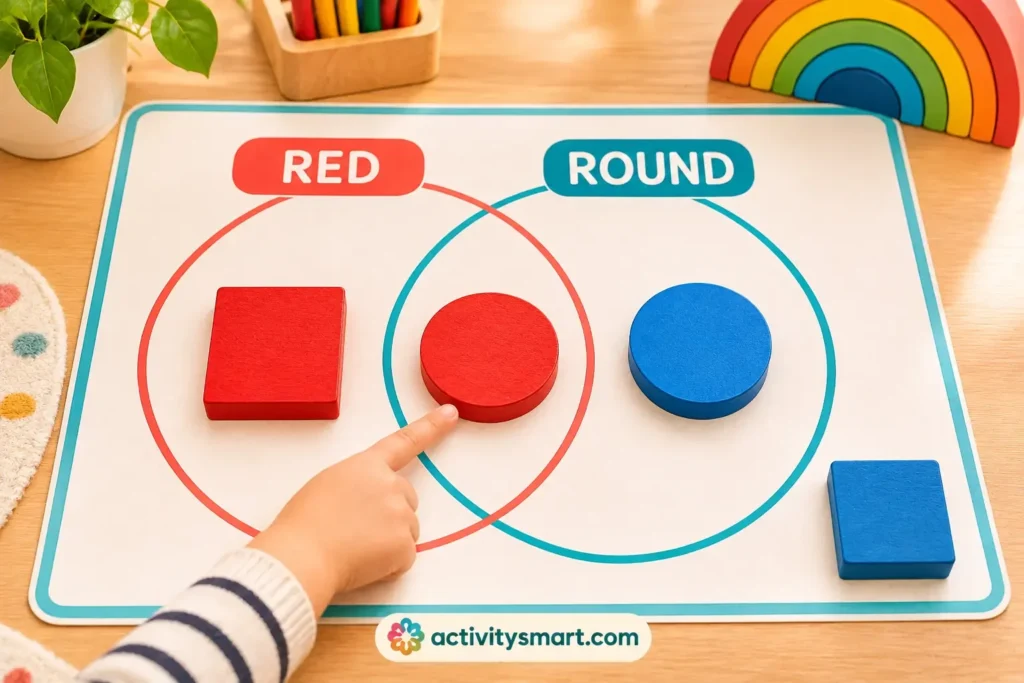
Once a child can sort by color or shape separately, ask them to find pieces that are both red and round. Use a small four-combination set: red circles, blue circles, red squares, and blue squares. Begin with a visible model. Put a red circle in a special area and ask which other pieces meet both conditions. Have children check each condition aloud or by pointing.
Next, draw two overlapping circles on a large sheet of paper. Label one “red” and the other “round,” using pictures if preferred. Explain that the middle is for items that match both rules. Red squares belong in the red-only region, blue circles in round-only, and blue squares outside both. Do not present this as a required preschool benchmark; it is an optional extension for children ready to coordinate rules.
How to know whether to advance the challenge
Observe the strategy rather than timing the activity. Can the child identify a shared feature? Can they apply the rule to a new item? Can they tell you why an item belongs or point to the evidence? Can they switch to a new rule when you model it? A confident answer to one question is useful information; a single mistake is not a developmental assessment.
Try a simple observation record with three headings: rule used, explanation given, and support needed. Write a concrete note such as “sorted seven of eight large shapes by type after one model.” Avoid labels such as “bad at math” or “advanced” based on a short game. Revisit a comparable task on another day before drawing instructional conclusions.
If a child can sort by color independently but needs help to re-sort by shape, provide a shape-only warm-up and try again. If they invent categories spontaneously, ask for a second way to group the same materials. For mixed-age groups, see adapting one activity for different learners; everyone can use the same set while receiving a different prompt.
Language, attention, familiarity, vision, motor access, and the clarity of the materials can affect performance. Offer accessible responses, such as pointing or using large picture cards. If concerns persist across settings and tasks, discuss them with the child’s teacher or an appropriately qualified professional rather than using a home sorting game to diagnose anything.
Make sorting inclusive, calm, and collaborative
Separate explaining from speaking fluently
Children learning English or developing expressive language may demonstrate a sorting rule without using its English name. Invite them to place objects, point to examples, or use their home language. Model concise words such as same, different, group, shape, and because without interrupting their thinking after every choice.
For children with low vision or color-vision differences, offer tactile or shape-based sorting rather than relying solely on subtle colors. For children with motor difficulties, use larger lightweight objects, a wide mat, and a partner who moves items according to the child’s decisions. The goal is mathematical reasoning, not testing dexterity.
Use disagreement as a question
If one child calls a wooden spoon a kitchen tool and another calls it a wooden object, ask each to explain their rule. They may both be correct. Invite the group to choose a rule for the current round, then try the alternative. Encourage descriptive specific feedback for young learners such as “You checked whether each object had corners” rather than praise based only on speed or neatness.
Safety and common mistakes to avoid
Choose materials based on each child’s age, abilities, and the setting. Small buttons, beads, coins, magnets, loose batteries, and other tiny parts can be choking or ingestion hazards, especially where younger siblings are present. Use large blocks, sturdy picture cards, or adult-sized fabric items instead. Adults should supervise, check for sharp edges, and keep outdoor collections free from unknown plants, chemicals, and animal waste.
- Too many competing features: begin with clear color or shape differences before introducing mixed attributes.
- Only one “correct” pile: ask for the rule before deciding whether a child’s arrangement makes sense.
- Changing the task silently: announce when a color sort becomes a shape sort.
- Turning every response into a quiz: allow exploration and model useful vocabulary.
- Equating fast sorting with deep understanding: ask children to explain an example and a nonexample.
- Making fine-motor demands the obstacle: use larger items or pictures, with ideas from fine motor play ideas.
Be particularly cautious about recommendations that show small loose counters in a photograph: an attractive image does not establish suitability for a particular child. Do not use sensory bins of tiny parts with children who may mouth objects. Adapt or omit the materials rather than relying on a warning alone.
A practical week of short sorting invitations
Day one: invite a two-color block sort and ask children to name or indicate the shared feature. Day two: use the same blocks with two shape groups. Day three: sort three sizes of a familiar object, then discuss whether “large” is a comparison or a fixed label.
Day four: organize picture cards into familiar-use categories, allowing children to propose their own labels. Day five: revisit a favorite collection and ask for two different arrangements. Offer “show me another way” only when the first rule is understood. Families can spread these invitations over more than a week; the sequence is a planning example, not an evidence-based dosage.
In a classroom, use the activities at a small-group table or as a transition station with large materials. At home, fold them into laundry, toy cleanup, or picture-book discussions. The EEF guidance on maths in everyday routines highlights everyday routines as opportunities for maths, while the EEF comparisons and connections evidence summary emphasizes connecting examples and providing support based on children’s understanding.
What sorting can and cannot tell you about math readiness
Sorting offers evidence that a child can notice attributes, maintain a rule, and discuss relationships. It does not by itself demonstrate mastery of number facts, measurement, geometry, or later school mathematics. A child may make thoughtful groups yet still need explicit instruction in counting, quantity, or the properties of shapes. Similarly, one unsuccessful attempt may reflect confusing instructions or unfamiliar materials.
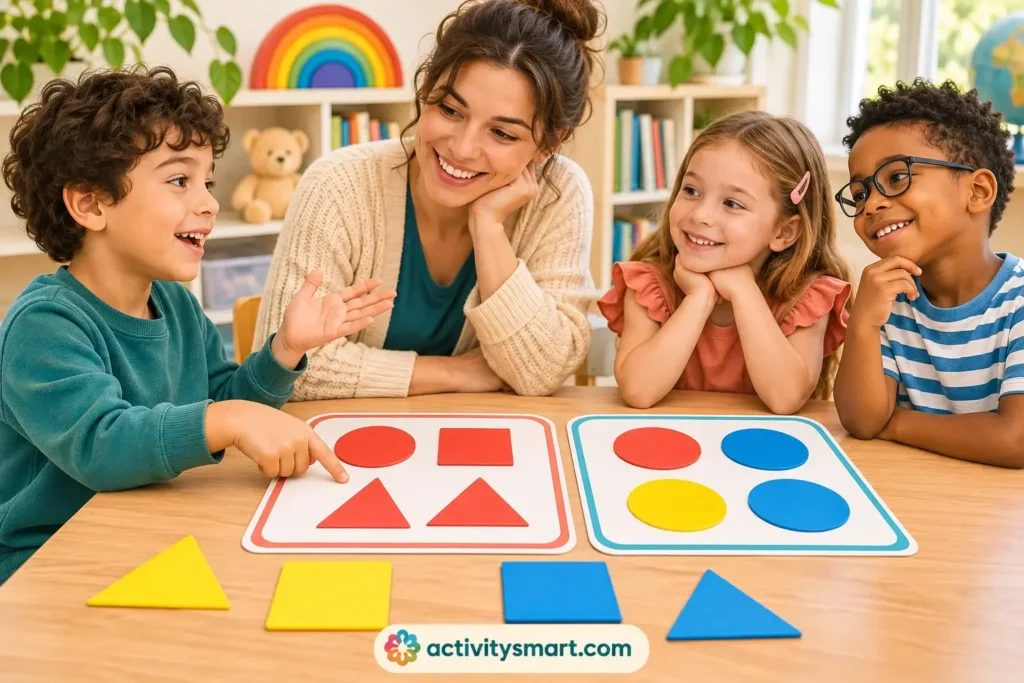
Use sorting as one component of a varied early mathematics experience: comparing quantities, talking about shapes, making patterns, measuring informally, and playing number games. simple pattern recognition activities offers a complementary next step when children are ready to notice repeated sequences rather than shared group membership.
Final takeaway
Start with a few safe, familiar objects and one visible rule. When that makes sense, re-sort the same collection by another attribute, introduce categories based on use, and invite children to justify their decisions. The most informative question is often not “Did you get it right?” but “How did you decide?” Keep the progression flexible and combine it with other early math experiences.
Frequently asked questions
What are sorting skills activities for preschoolers?
Sorting skills activities for preschoolers are hands-on games in which children group objects by a shared feature such as color, shape, or use. Begin with a few large, familiar items and one clear rule.
Should children learn color sorting before shape sorting?
Color sorting does not have to come before shape sorting for every child. Start with whichever feature is most recognizable in the available materials, then introduce another feature and invite a re-sort.
At what age should a child sort by two attributes?
There is no single age at which every child should sort by two attributes. Offer it as an extension after the child can apply and explain one rule, using models and simple examples.
What is the difference between sorting and classifying?
Sorting is the act of arranging items into groups using a rule; classifying emphasizes defining or recognizing the categories those groups represent. In early learning, the terms often overlap.
How can I make sorting harder without buying supplies?
You can make sorting harder by changing the rule, asking for two valid groupings, adding a clearly explained exception, or combining two attributes. Reuse the same safe blocks or picture cards.
What if my child sorts items in an unexpected way?
Ask your child to explain the rule before correcting the group. An unexpected arrangement may be logical, such as grouping objects by use rather than color, even when it differs from your plan.
Are worksheets necessary for learning to sort?
Worksheets are not necessary for learning to sort. Children can use safe everyday objects and pictures, then record groups on paper when that adds a useful challenge.
Can sorting help children learn counting?
Sorting can create meaningful sets for counting and comparison, but it does not replace explicit counting practice. Once groups are clear, count each set and discuss more, fewer, and equal.
What materials should I avoid for young children?
Avoid small loose items that could be swallowed, including beads, buttons, magnets, batteries, and coins, particularly when a child mouths objects. Choose large, clean, age-appropriate materials and supervise.
Sources and further reading
These resources inform the teaching approach and discussion of its limits; they do not establish that every activity in this guide has been individually tested.