Quick Answer
To learn how to teach shapes, start with familiar objects, let children move and build shapes, and then invite them to draw and explain what they notice. Introduce circles, triangles, squares, and rectangles in varied sizes and orientations. Ask about sides and corners rather than relying on memorized labels, and revisit the ideas through short games.
Quick Picks
- For a first lesson: match large cutout shapes to familiar objects.
- For active learners: walk around a floor outline and describe turns and sides.
- For children ready to extend: rotate unusual triangles and compose new pictures from shapes.
- For a quick check: ask “How do you know?” instead of “What is this called?”
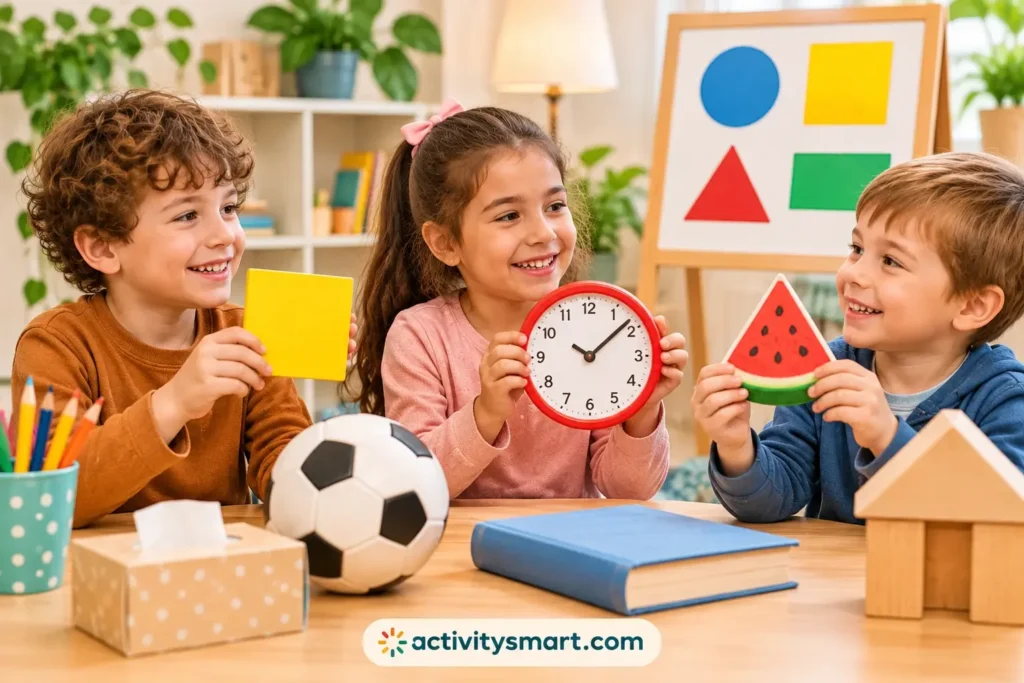
Shapes become easier to understand when a child can see them in different places, feel their boundaries, move them, and explain their features. A round plate, a rectangular book, and a cardboard triangle provide more useful starting points than a page of identical outlines alone. Children can learn names while also building the more durable habit of looking closely at properties.
This guide offers a practical sequence for home or classroom use with children roughly ages three to ten. The easiest tasks suit many preschoolers, while comparisons, rotations, and shape compositions extend into early elementary learning. Select the next task from what a particular child can do rather than treating age labels as deadlines. For a broader foundation, connect shape talk to playful school readiness skills.

Why objects, movement, and drawing belong together
Recognizing a shape on a flashcard is not the same as recognizing it after it has been turned, stretched in size, or placed within an everyday object. Object play gives children examples to inspect. Movement makes boundaries and direction noticeable. Drawing or building requires children to choose and arrange features themselves. None of these channels needs to be the only “right” way to learn.
The IES What Works Clearinghouse early mathematics practice guide recommends developing geometry and related concepts through an appropriate progression and integrating mathematical discussion into regular activities. Its evidence ratings differ among recommendations; it does not establish a particular movement game as a guaranteed method. The EEF guidance on mathematics in everyday routines also emphasizes varied shapes, hands-on materials, and conversational teaching. These recommendations support a thoughtful mix of experiences, not a rigid script.
Notice what a child attends to. A child who says “That triangle is wrong because it points down” needs more rotated examples; a child who calls every four-sided shape a square needs comparison of side lengths and angles. A child who can name a circle but cannot find one in the room may benefit from real-object sorting before drawing more circles.
How to teach shapes with a simple learning progression
Start with noticing and matching
Place a circle, a triangle, and a square cut from sturdy paper beside several everyday objects or pictures. Choose items whose relevant flat face is easy to see: a coaster, a triangular sign picture, and a square tile. Show one shape and ask the child to find a matching face. Say “This face is circular” rather than claiming the entire three-dimensional object is a two-dimensional circle.
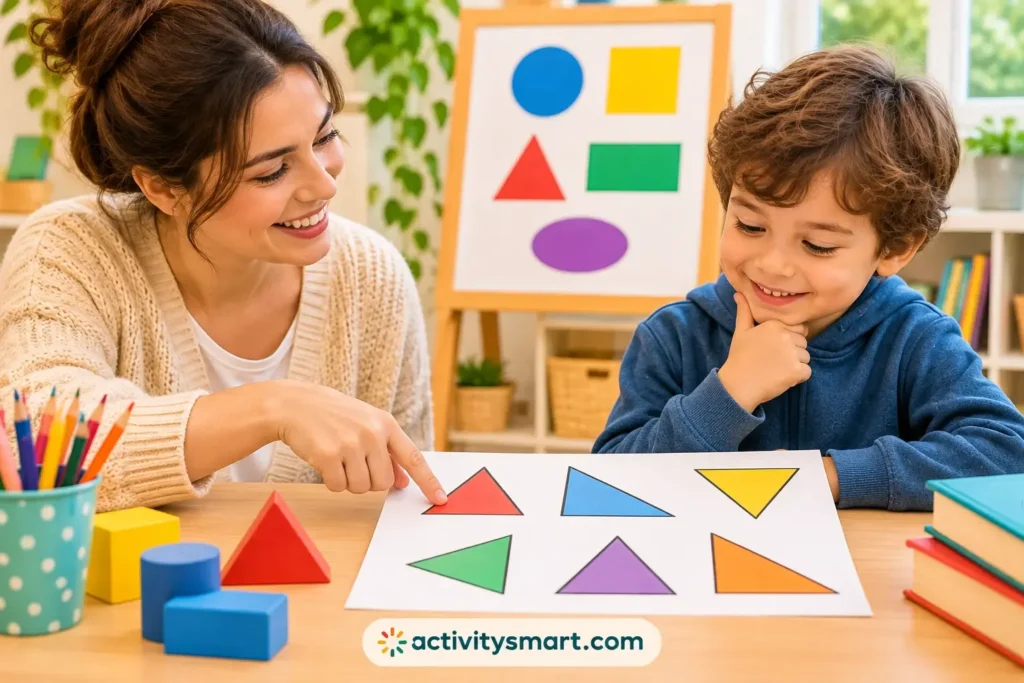
Keep the first set small. When matching is comfortable, add rectangles and examples that differ in color, size, and position. Invite the child to turn a card and decide whether its shape changed. A triangle remains a triangle when its point faces down. If the first attempts are difficult, model one comparison and then let the child choose the next match.
Move from names to attributes
Ask children to trace the boundary of a flat shape with a finger. For polygons, count straight sides and corners together. A triangle has three straight sides and three corners. A square has four equal sides and four right angles; a rectangle has four right angles, and a square is a special rectangle. A circle has a continuous curved boundary and no straight sides or corners. These descriptions matter more than whether the first drawing looks perfect.
Use accessible language first—“corner” and “turn”—and introduce “vertex” or “right angle” when it helps an interested child explain a distinction. Avoid defining rectangles as merely “long shapes”; rectangles can be tall, wide, nearly square, or exactly square. The NAEYC preschool shapes and space article illustrates how comparing and rotating examples strengthens classroom shape discussions.
Make, move, and explain
Next, offer large craft sticks, magnetic tiles, paper strips, or blocks appropriate to the child’s age. Ask for a triangle with a point to the side, or two different rectangles. Have the child turn a completed shape without taking it apart and describe what remained the same. Finish with a sketch, tracing, or picture made of the shapes. A child who is not ready to draw independently can place paper pieces on a page and dictate the explanation.
This sequence is flexible. Some children understand a shape while building long before they can name it accurately; others know labels but struggle to produce the form. Treat these as information for the next lesson, not a diagnosis. If drawing control is a barrier, explore play-based pre-writing activities separately so that pencil difficulty does not obscure geometric understanding.
Teach shape recognition with real objects
Run a purposeful shape hunt
Choose one shape to investigate and walk around a safe room together. Ask for two examples and one almost-match. A window may show a rectangular face; a clock may show a circular face; a square napkin can be folded into a triangle. Ask “What part are you looking at?” because a ball is a sphere, while its image or silhouette may look circular.
For a classroom, photograph or sketch examples on a shared chart. Record a child’s exact observation—“The book cover has four corners”—then refine it together. For home, make a tiny collection of drawn examples without turning the walk into a long quiz. The NAEYC everyday shapes guidance similarly suggests spotting and comparing shapes during ordinary routines.
Sort by features instead of decoration
Lay out shapes in two colors and several sizes. Ask children to make a triangle group and explain why each piece belongs. Then deliberately include a large upside-down triangle and a small square in the same color. This reveals whether the child is using geometry or a distracting feature such as color. Invite a new rule: straight sides versus curved edges, three corners versus four, or shapes that can roll as solid objects.
Let children sort one set in two different ways and defend both rules. A rectangle might belong with “four corners” and later with “has right angles.” This connects naturally to visual discrimination activities, which can help children attend to relevant visual differences without assuming that sorting alone measures intelligence or future school success.
Use movement to make geometry physical
Walk large shape outlines
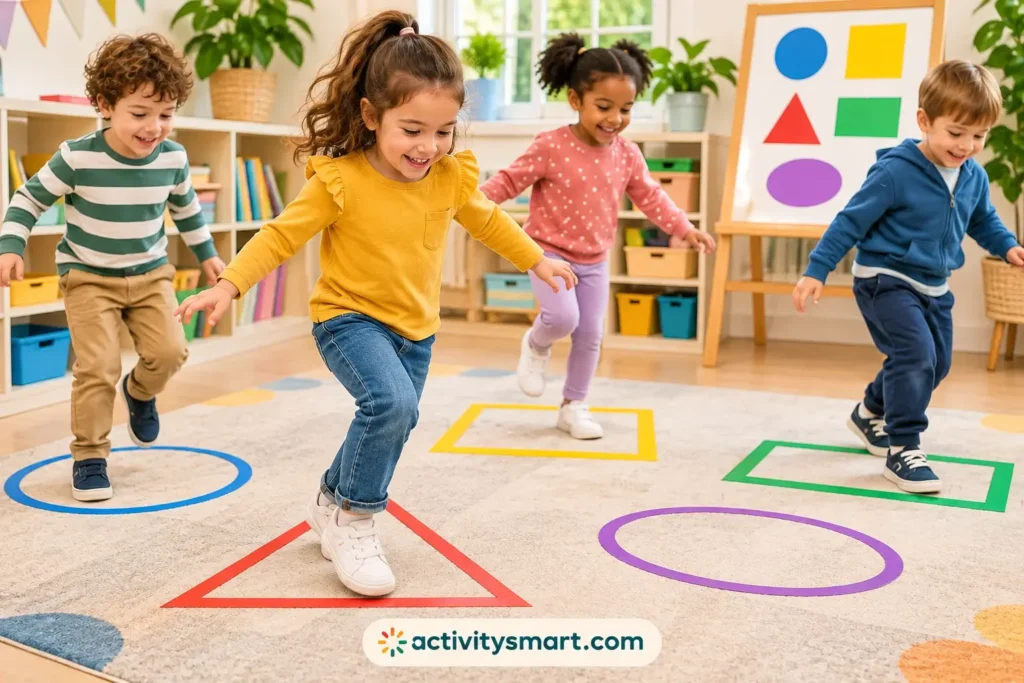
Mark a large triangle and rectangle on the floor using removable tape approved for that surface, or use flat rope under close adult supervision. Children can walk slowly along an edge, stop at a corner, and turn before continuing. Ask how many straight journeys and turns they made. A circular path feels different because the direction changes continuously instead of at a few corners.
Make movement optional and accessible: a child may trace the path with a toy vehicle, a pointer, or a finger on a large board. Keep floor routes clear of clutter, avoid slippery or raised tape edges, and never require jumping or balancing to demonstrate understanding. The purpose is to reason about paths, not to test coordination or endurance.
Turn, flip, and slide without renaming
Give each child an oversized paper triangle and ask them to rotate it a quarter turn. Does it still have three sides? Now slide it across the table and flip it over. Explain these motions as turning, sliding, and flipping; older learners can connect them with rotation, translation, and reflection. Compare what changes—position or orientation—with what stays the same, such as side count.
Try a partner game: one child describes a move and another moves a shape. Use the language “above,” “below,” “beside,” “between,” and “turn clockwise” when appropriate. Start with one instruction, then gradually combine two. If a child has difficulty remembering multiple directions, simplify the instruction instead of concluding that they do not understand the shape.
Build human shapes cooperatively
In a spacious supervised area, four children can stand at the corners of an imagined rectangle while others describe the edges between them. Use a floor diagram as a guide; children need not hold ropes or link bodies. For small groups, assign one child to move a large triangle card into different orientations while others check whether its properties changed.
Move from constructing shapes to drawing them
Build first, then trace the idea
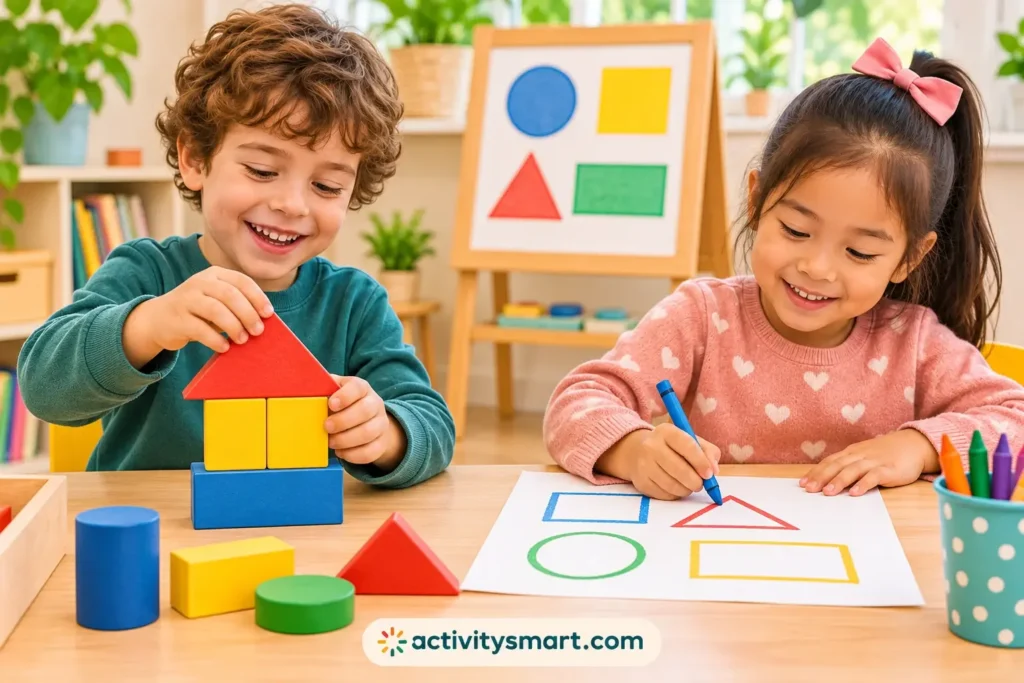
Arrange four large sticks into a rectangle and ask what keeps it rectangular as the sticks are repositioned. Then place a rectangular frame on paper and draw around its inner edge. The child can compare the drawing with the construction, find four corners, and discuss which lines should meet. Avoid making neatness the primary assessment: a wobbly drawing can still communicate geometric knowledge.
Offer chunky crayons, a board, or an easel as alternatives to a standard pencil. Some children prefer drawing on a vertical surface, and others prefer arranging shapes before marking paper. The goal is to connect a mental model with a visible representation. For grip and control ideas, see fine motor skill activities.
Draw what you notice, not just a memorized icon
Show three triangles: a wide low triangle, a tall narrow triangle, and a right triangle. Invite children to draw one that looks different from the others while retaining exactly three straight sides. Then rotate their drawings. This prevents the familiar roof-shaped triangle from becoming the child’s only accepted example.
Ask older students to draw a rectangle that is not a square, then a square, and explain how both meet the rectangle definition. A useful extension is to sketch a shape that almost qualifies and change one attribute to make it fit. For example, a three-sided figure with one curved edge is not a triangle in elementary geometry because its sides are not all straight.
Compose pictures without losing the mathematics
Build a house from a rectangle and triangle, a vehicle from circles and rectangles, or an abstract animal from cutouts. Ask children to name a shape that forms a part, then count its sides or explain how it was rotated. Encourage redesign: Can two triangles make a different larger figure? Does flipping one piece help it fit the picture?
Which teaching method fits the learning goal?
Objects, movement, drawing, and worksheets serve different purposes. This comparison is a planning aid, not a claim that one activity has been experimentally proven superior in every context. Combine methods according to the child’s prior understanding and the feature you want them to notice.
| Method | Best immediate goal | Adult prompt | Potential limitation |
|---|---|---|---|
| Everyday objects | Recognize shapes in new contexts | “Which face looks rectangular?” | Solid objects may confuse flat and 3D forms. |
| Floor or tabletop movement | Notice boundaries and transformations | “Did turning change its sides?” | Movement can distract without discussion. |
| Construction materials | Identify defining attributes | “What must stay true of this triangle?” | Materials may constrain possible shapes. |
| Drawing and composing | Represent and combine shapes | “Show another kind of triangle.” | Motor demands can hide conceptual knowledge. |
| Paper matching exercises | Practice and independently check recognition | “Explain why these match.” | Repeated identical icons encourage guessing. |
Use paper exercises as one option after children have seen a range of examples. A short matching sheet can be efficient, but it should not replace opportunities to manipulate shapes. You can adapt the same core task across ages using ways to adapt one activity for mixed ages rather than creating a completely different lesson for every child.
Plan a practical 20-minute shape lesson
Before the lesson: choose one observable aim
Decide whether children should match triangles in several orientations, distinguish squares from other rectangles, or combine shapes into a picture. Gather a few large cutouts, familiar objects, washable drawing tools, and a clean work surface. Avoid introducing six new shape names at once when the group is still identifying circles and triangles.
Minutes 1–5: notice and describe
Show a familiar object and a flat shape card. Ask what looks alike and what differs. Model a single sentence, such as “I can see three straight sides.” Invite children to explain with a point or gesture when words are hard to find. Record the vocabulary that arises naturally and correct misconceptions gently.
Minutes 6–12: move and compare
Children turn or slide large cards and search for matches among varied examples. Ask one reasoning question after each change: “What stayed the same?” Invite a peer to choose a surprising example, such as a sideways triangle or a small square. For groups, use stations so no child waits too long for a turn.
Minutes 13–18: build or draw
Ask children to construct a shape or design with a clear rule: include two different triangles, or build one rectangle and identify its four corners. Allow tracing, drawing, or placing paper cutouts. For children who finish early, challenge them to rotate one piece or build a shape in an unfamiliar size.
Minutes 19–20: assess without a test atmosphere
Hold up two contrasting examples and ask children to point to a triangle and explain how they know. One sentence, gesture, or demonstration is enough. Note who identifies by name, who describes sides, and who recognizes a rotated example. Use the observation to choose tomorrow’s task; the two-minute check is not a standardized measure.
Adapt shape activities for different learners
Beginning learners: offer two highly contrasting cards, model one match, and use familiar language with gestures. Start with a circle and triangle before adding related quadrilaterals. Keep tasks short enough to end on a genuine opportunity to explain something.
Developing learners: mix size, orientation, and color. Ask for a reason when children sort, or challenge them to find a nonexample. Include shapes with the same number of sides so attention turns toward equal lengths and right angles rather than simply counting.
Experienced early-elementary learners: ask whether every square is a rectangle, compare rectangles and nonrectangular quadrilaterals, and explore how two triangles can be composed into a larger shape. Encourage precise descriptions while allowing informal vocabulary during first attempts.
Children with differing access needs: provide high-contrast large pieces, tactile outlines, verbal descriptions, or a quiet tabletop route. Offer ways to answer by pointing, moving, speaking, or selecting a card. A learner who finds drawing difficult can still demonstrate shape knowledge by composing pieces. Ask families and support staff about useful accommodations without assuming that a single adaptation fits everyone.
Use specific feedback for young learners that states the evidence of understanding: “You checked every side before choosing” is more informative than “You are a shape genius.” Praise attention and reasoning while remaining specific about what the child actually did.
Common misconceptions and teaching mistakes
Only showing one “standard” triangle
Children may learn that a triangle must be symmetric with a point on top. Prevent this by displaying tall, wide, right-angled, and rotated triangles from the beginning. Ask for the common property: three straight sides forming a closed shape. Never dismiss a correct triangle merely because it looks unfamiliar.
Confusing a flat shape with a solid
A coin or plate has thickness; it is not literally a two-dimensional circle. Say “the face looks circular” when describing a real object. Compare a ball with a paper circle, and a box with a rectangular card. Introduce sphere, cube, and cylinder as solid shapes when the child is ready, without demanding mastery of both categories in one sitting.
Relying on colors, speed, or drawing neatness
If every triangle is yellow and every circle blue, children can succeed by sorting color alone. Mix colors across categories. Timed races may reward quick guessing rather than thinking, and perfectly traced lines may say more about motor control than geometry. Ask for an explanation, vary the examples, and give time to inspect.
Correcting before listening to the reasoning
When a child calls a tilted square a diamond, ask what they notice. “Diamond” is often an informal visual label, whereas a square retains its geometric properties after rotation. Recognize the observation, turn the shape, and count features together. Similarly, when a child says a square cannot be a rectangle, compare right angles and explain the inclusive definition rather than treating the response as carelessness.
Safety and practical preparation
Choose large, age-appropriate materials. Small counters, beads, sharp sticks, pins, and magnets that can detach or be swallowed are unsuitable around children who may put items in their mouths. Supervise all materials according to individual abilities and follow product age labels. Use blunt approved tools for cutting and keep adult scissors away from unsupervised groups; safe scissor skill progression provides ideas for scaffolded cutting activities.
For tape-and-movement lessons, check floor grip, exits, and accessibility before starting. Paper strips or large cardboard outlines can replace floor tape. Use washable non-toxic drawing materials, protect tables, and check allergies or sensitivities when selecting dough or reused packaging. Never use movement, touch, or public performance as a requirement for participation.
Check understanding across different contexts
Keep informal notes with concrete observations: “Matched three rotated triangles without a model” or “Needs a prompt to distinguish circular faces from spheres.” These notes help plan instruction. They do not diagnose developmental conditions and should not be treated as standardized scores. For wider mathematics connections, see early number sense ideas.
If a child consistently struggles across multiple learning contexts, consider whether language, vision, access to materials, attention, or the task demands are contributing. Consult the child’s teacher or a qualified professional when a broader developmental concern persists, rather than inferring a disorder from shape naming alone.
Final teaching recommendation
Begin with one familiar shape and a real example, add a few noticeably different versions, then let children move, construct, and represent it. Use questions about sides, corners, curves, position, and orientation to expose the mathematical idea. Return to the same idea in fresh contexts rather than escalating to harder vocabulary on a fixed schedule.
Sources and further reading
- IES What Works Clearinghouse early mathematics practice guide
- IES early mathematics resources for families
- NAEYC everyday shapes guidance
- NAEYC preschool shapes and space article
- EEF guidance on mathematics in everyday routines
Frequently Asked Questions
What shapes should I teach first?
Start with circles, triangles, squares, and rectangles, using clear contrasting examples. Add less familiar polygons and solid shapes once the child is comfortable comparing sides, corners, and curved boundaries.
How do I explain a triangle to a preschooler?
A triangle is a closed flat shape with three straight sides and three corners. Show triangles of different sizes and orientations, then invite the child to trace and count each side.
Is a square also a rectangle?
Yes, a square is a special kind of rectangle because it has four right angles. A square also has four equal sides; use paper pieces to compare these attributes rather than treating the names as mutually exclusive.
How can I teach shapes without worksheets?
Use object hunts, large cutouts, block building, floor paths, and drawing conversations. Ask children to explain one defining feature after each activity so the play builds geometric understanding.
What if a child calls a rotated square a diamond?
A rotated square is still a square. Acknowledge the informal description, rotate the card back, and compare side lengths and corners to show that orientation did not change its geometry.
Should I teach 2D and 3D shapes together?
You can compare them briefly, but keep the distinction explicit: a paper circle is flat, while a ball is a three-dimensional sphere. Introduce solid-shape names gradually as children handle real objects.
How can I tell whether children truly recognize shapes?
Show unfamiliar examples in different colors, sizes, and orientations and ask children to explain their choice. Recheck in drawing, building, and everyday-object contexts rather than relying on one naming quiz.
Do movement games help children learn shape names?
Movement games can offer useful opportunities to notice sides, turns, and orientation, but movement alone does not guarantee learning. Pair paths or card turns with short mathematical questions and accessible participation options.
What if drawing shapes is frustrating for a child?
Let the child trace, arrange large paper pieces, use blocks, or answer verbally before expecting an independent drawing. Drawing difficulty alone does not establish a lack of shape understanding.
How long should a shape activity last?
A short, engaging activity is usually more useful than continuing after children disengage. A sample twenty-minute lesson can be shortened or divided into several sessions based on attention, access, and the learning goal.