Quick Answer
Start with one shared learning goal, then offer different ways to enter, practice, and explain the task. Differentiating activities for young learners means changing prompts, materials, supports, or challenge according to what each child demonstrates—not assigning a fixed preschool or kindergarten level. Observe responses, adjust during play, and keep the core concept accessible to everyone.
Quick Picks
- Fastest adjustment: replace an open-ended instruction with a model and one clear choice.
- For children ready to extend: ask them to explain or change the sorting rule.
- For mixed-age groups: keep the same materials and vary the question.
- For access needs: change how children see, touch, move, or communicate before changing the goal.
Preschool and kindergarten children can explore the same activity while needing very different kinds of support. A child may recognize colors confidently yet struggle to explain a rule; another may tell a sophisticated story but find small manipulatives tiring. The useful question is not “Which worksheet belongs to this age?” but “What does this learner understand, and what invitation will move the thinking forward?”
This guide uses one repeated example—a hands-on sorting and pattern investigation—to show how to plan, teach, observe, and adapt within a real classroom. The same decisions work for read-alouds, counting games, art, and inquiry centers. There is no single developmental timetable that can accurately place every child.
What differentiating activities for young learners actually means
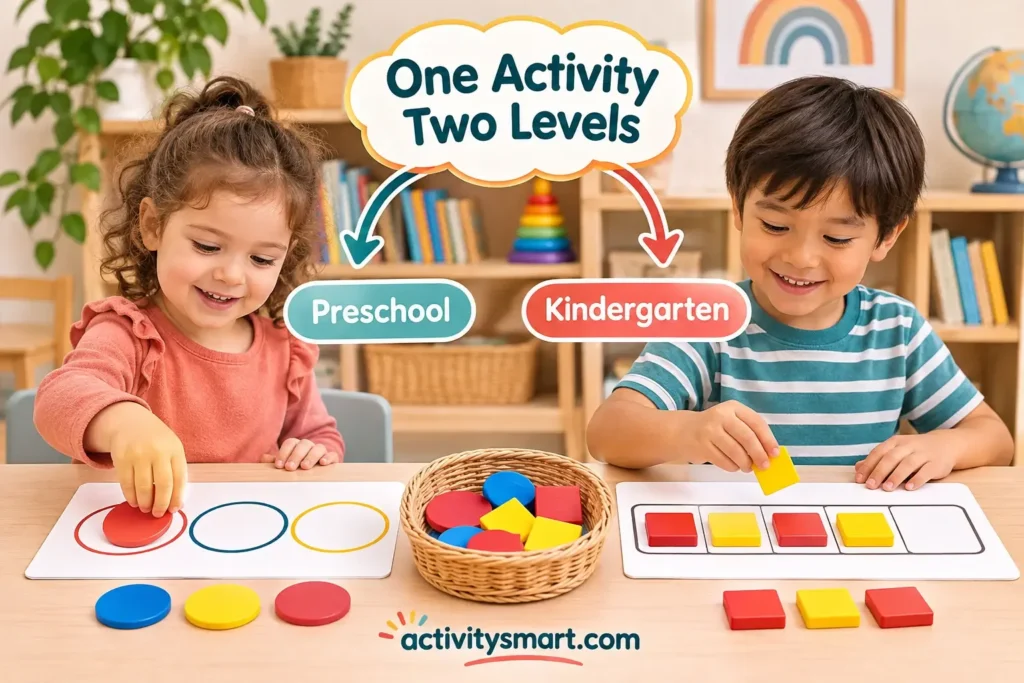
Differentiation is an intentional adjustment to the route toward a shared purpose. The learning goal stays visible, while the amount of guidance, the format of the task, or the depth of the response can change. One group might sort familiar objects by color; another might invent a rule, test it, and explain why a tricky object fits.
The National Association for the Education of Young Children emphasizes common developmental patterns, each child’s individuality, and the social and cultural context of learning. These are useful planning considerations, not a formula that equates age with ability. See NAEYC’s core considerations for developmentally appropriate practice.
Differentiation is not a promise that every child will learn faster. It is a practical way to notice barriers and respond. A child who is quiet during whole-group talk may demonstrate strong reasoning through pointing, arranging objects, signing, or speaking with a familiar partner.
Keep three decisions separate
- Goal: What idea should every child encounter? For sorting, it may be “Objects can be grouped according to an observable attribute.”
- Access: What will help a child participate? Consider large objects, picture cues, a familiar word, a peer partner, or extra processing time.
- Extension: What deeper reasoning is possible? Ask a child to compare rules, defend a choice, identify an exception, or create an example.
Start with a shared goal, not two separate lesson plans
Imagine a center with baskets of large washable shapes. Everyone is invited to notice what is alike and different. The educator names a simple purpose: “We are finding ways things belong together.” No child must produce identical work; no group is announced as the “easy” or “smart” table.
Before children arrive, prepare a compact tray of red and blue circles, squares, and triangles. Choose shapes large enough for safe handling and provide a clear mat or two broad sorting areas. A picture of a circle and square can cue possibilities without supplying every answer. For related classroom extensions, the ActivitySmart guide to visual discrimination activities offers ideas for comparing visible features.
A practical three-pathway design
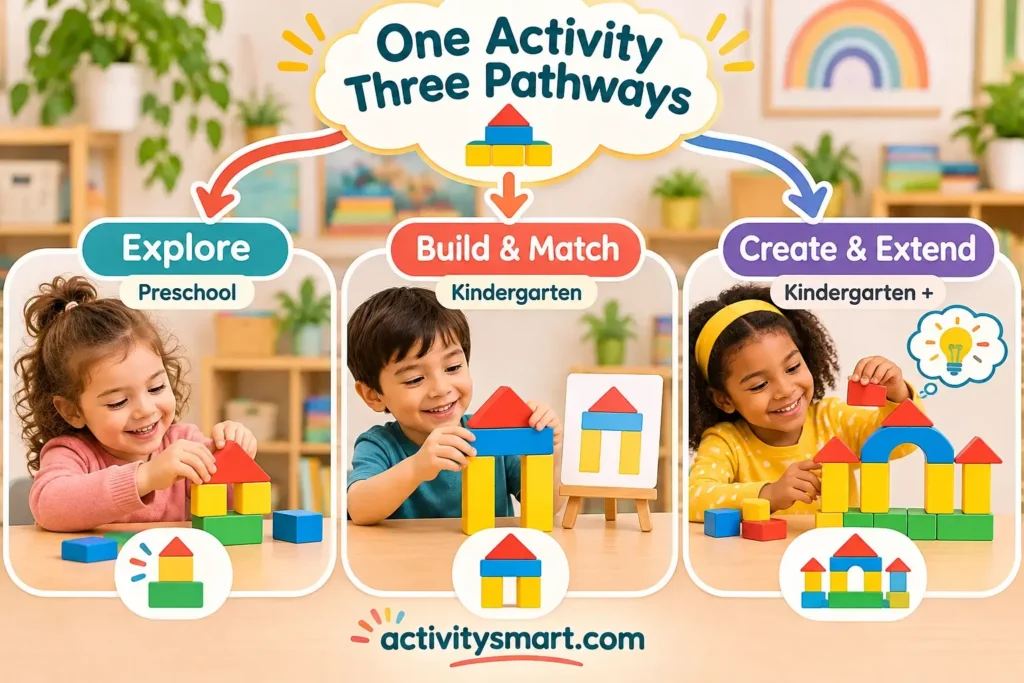
- Entry pathway: present two contrasting objects, model noticing one attribute, and invite a child to match another. Accept pointing or placing as a valid response.
- Core pathway: invite a child to make two or more groups, identify the chosen rule, then try one unfamiliar example.
- Extension pathway: ask for a different valid rule using the same set, or present an object that could fit several groups and discuss the decision.
Preschool and kindergarten: useful differences without rigid assumptions
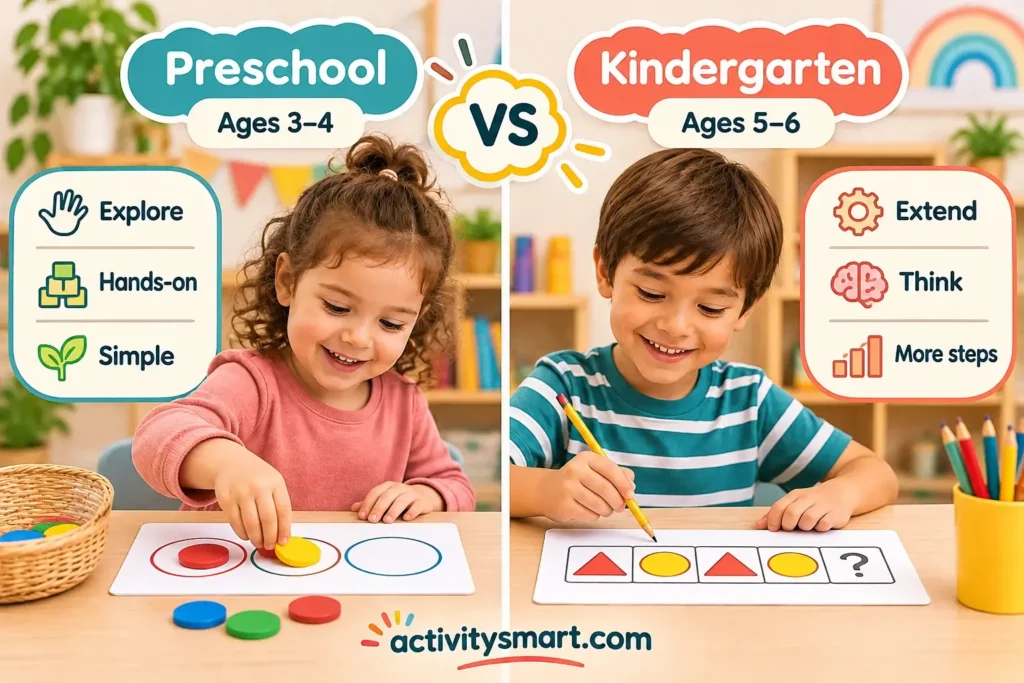
Preschool and kindergarten labels describe settings, not fixed developmental ceilings. Many preschoolers enjoy explaining their thinking, and many kindergarteners need concrete demonstrations. The table below compares reasonable starting invitations, not age-based requirements or a standardized assessment.
| Teaching decision | Possible preschool starting point | Possible kindergarten starting point | What to observe |
|---|---|---|---|
| Invitation | Notice and match two familiar pieces | Choose and explain a grouping rule | Does the child understand the task? |
| Language support | Model “same,” “different,” and gesture | Invite comparison using “because” | Does language hide or reveal reasoning? |
| Materials | Few large, high-contrast objects | More varied items with some overlaps | Is the quantity helping or overwhelming? |
| Adult role | Demonstrate one match, then fade help | Probe alternative rules and evidence | What can the child do independently? |
| Evidence of understanding | Point, place, select, or name | Arrange, draw, describe, or justify | Can the child show the same idea in another way? |
What if the older child needs the simpler prompt?
Offer the prompt privately and without apology. “Show me one shape that belongs with this one” is respectful at any age. Once the child is successful, ask what they noticed. If the child then offers an explanation, increase the reasoning demand rather than adding a harder-looking worksheet.
For younger children ready for more, introduce a second rule: “You sorted by color. Could you sort by shape instead?” Challenge should follow evidence of readiness, not a birthday. The ActivitySmart resource on recognizing patterns through play can provide another way to extend attention to attributes and relationships.
A five-step routine for planning and teaching the same activity
Before the lesson: write one observable goal
Use a sentence such as “Children will group objects using at least one feature and show or communicate the feature they used.” This is more workable than “Children will finish a sorting sheet.” The objective describes understanding, not a preferred format of output. Decide what counts as evidence: grouping, pointing, explaining, correcting a misplaced shape, or repeating the rule with new objects.
During the launch: model briefly, then release
Gather children for a short introduction. Place two red shapes together and say, “I put these together because both are red.” Then hold up a blue shape and ask, “Where might this go? Why?” Accept more than one response when the rule genuinely allows it. Invite learners to explore their own groupings, rather than insisting they copy the teacher’s exact arrangement.
While children work: observe before rescuing
Give a few seconds after a question, and look for a strategy. A child may be checking each item carefully rather than feeling stuck. Notice whether the child looks between examples, self-corrects, asks peers, uses a gesture, or chooses randomly. These details guide the next prompt better than speed or whether the tray is full.
Record one neutral note when useful: “Grouped six items by color after a visual example; identified the rule by pointing.” Avoid unsupported judgments such as “not ready for kindergarten.” Another day, test whether the skill appears with different colors or objects. Related ideas about precise, task-focused responses appear in feedback for young learners.
When there is a barrier: change the smallest useful thing
If the child cannot start, try demonstrating one example rather than giving the full answer. If the pieces are difficult to manipulate, offer larger shapes or a pointing response. If vocabulary is the obstacle, pair words with gestures and accept home-language explanations when a familiar adult or suitable support can interpret them. If the child is bored, ask for an exception, a new rule, or a way to teach a peer.
These adjustments resemble the options described by CAST’s Universal Design for Learning guidance on action and expression: learners benefit from different ways to interact, communicate, and demonstrate knowledge. The guidance is a planning framework; it does not prove that any single adaptation works for every learner.
At the close: compare strategies, not children
Invite two or three children to show different ways to group shapes. You might say, “These shapes were sorted by color, and this set was sorted by corners.” Ask the group what stayed the same: they looked closely and made a rule. Avoid publicly ranking methods as beginner or advanced. Close with a question children can revisit tomorrow: “Could one shape belong in more than one group?”
Four examples beyond sorting that use the same differentiation logic
Counting collections
Use small, safely sized collections and a shared goal: connect each item to one count word. Some children move three large counters into a row as they count; others count a scattered group, check by rearranging it, or explain why the final number tells how many. If accuracy breaks down, reduce clutter and model moving one object once. If the child is secure, vary arrangement while keeping quantity constant.
A higher count is not automatically a better challenge. Asking a child to explain how they checked a set can reveal more about the intended concept. The one-to-one correspondence counting guide addresses the count-word-to-object relationship, while hands-on number sense activities explores broader quantity ideas.
Picture-book conversation
Read one short, engaging story aloud. Invite some learners to point to a character or choose between two picture clues. Ask others to describe what happened and why; invite confident storytellers to compare a character’s possible choices using evidence from illustrations. Children may reply in speech, gesture, a drawing, or with a communication aid. Keep each question anchored in the same story.
Do not mistake willingness to speak in a large group for comprehension. Use partner talk, a small-group revisit, or picture sequence cards to learn what quieter children understand. See the related ActivitySmart ideas for school readiness through play when selecting broader participation skills to notice.
Letter and sound noticing
Use a familiar song, name card, or picture assortment. One learner can listen for the beginning sound in a spoken word while another compares two words with the same opening sound. A child already succeeding may offer a new example and explain the match. A visual letter card can be added when letter-symbol knowledge is the goal, but hearing a sound and naming a printed letter are not interchangeable tasks.
Avoid demanding written answers as proof of listening if handwriting is not the objective. Follow the ActivitySmart guide to teaching letter sounds for a more focused literacy sequence. In multilingual groups, choose words children know and recognize that sound contrasts may differ across the languages they use.
Collaborative building or art
Ask children to build a bridge that joins two blocks or make a picture showing a repeated design. An entry route may include large pieces and a photograph of a possible start. A core route invites a child to test and revise. An extension asks the child to explain what changed, document a trial, or represent the plan with a simple drawing. The goal is experimenting and communicating, not producing matching projects.
Scaffolding: when to model, prompt, extend, or step back
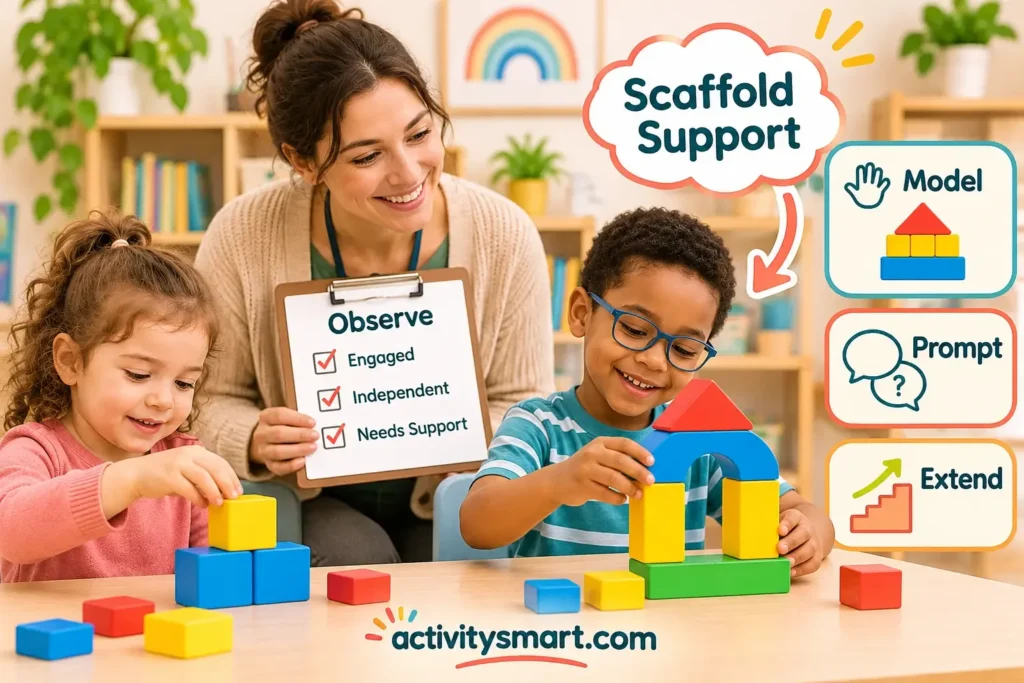
Scaffolding means offering temporary help that makes a meaningful task manageable, then reducing that help as the learner gains control. It should not become a script in which the adult supplies every decision. A practical sequence is: observe the attempt, name the relevant feature, model one step if necessary, invite the next step, and wait.
| You notice | Try this response | Then check |
|---|---|---|
| Child cannot begin | Offer two pieces and demonstrate one match | Can they place a new example? |
| Child starts but changes rules accidentally | Ask “What do these have in common?” and point to earlier choices | Can they restate or show the rule? |
| Child uses one rule reliably | Invite a second valid rule | Can they switch and explain? |
| Child has an access barrier | Offer larger items, visuals, or another response mode | Does the concept become visible? |
An adult may need to stay alongside a child longer because of communication, sensory, motor, or emotional needs. That is not a failure of independence. The goal is appropriate participation and growing competence, not withdrawing support according to a timer. Likewise, a quick correct answer may be memorized; ask for a fresh example before deciding to extend.
Assessment that changes the next lesson
The most useful assessment here is brief, low-pressure, and tied to the goal. Choose one behavior to notice: Does the child identify a feature? Maintain a rule across several examples? Revise a choice with a reason? Try a new sorting rule with no model? Document only what happened and what support was present. Children’s performance can change with familiarity, language, fatigue, and context.
A simple planning note has three columns: Observed, Support used, and Next invitation. For example, “Sorted four items by shape / adult gave first example / offer mixed colors and ask for rule.” This shows what to try without assigning the child a permanent level. Use the next activity to test the hypothesis rather than treating one observation as a verdict.
Watch for participation too. Did the child choose a material? Ask for help? Work with a peer? Return after difficulty? Not every observation demonstrates the same learning goal, but this information can guide engagement and access. For transitions that preserve teaching time, see classroom transition routines for young children.
How to tell whether differentiation helped
Look for clearer evidence of the same concept after a specific adjustment. If a child can sort accurately when objects are larger, the original format may have imposed an unnecessary motor barrier. If the child can explain a rule when speaking to a partner, public speaking may have masked the reasoning. Neither observation proves a diagnosis or long-term effect; it tells you what instructional choice to try again.
Inclusive access, emotional safety, and material safety
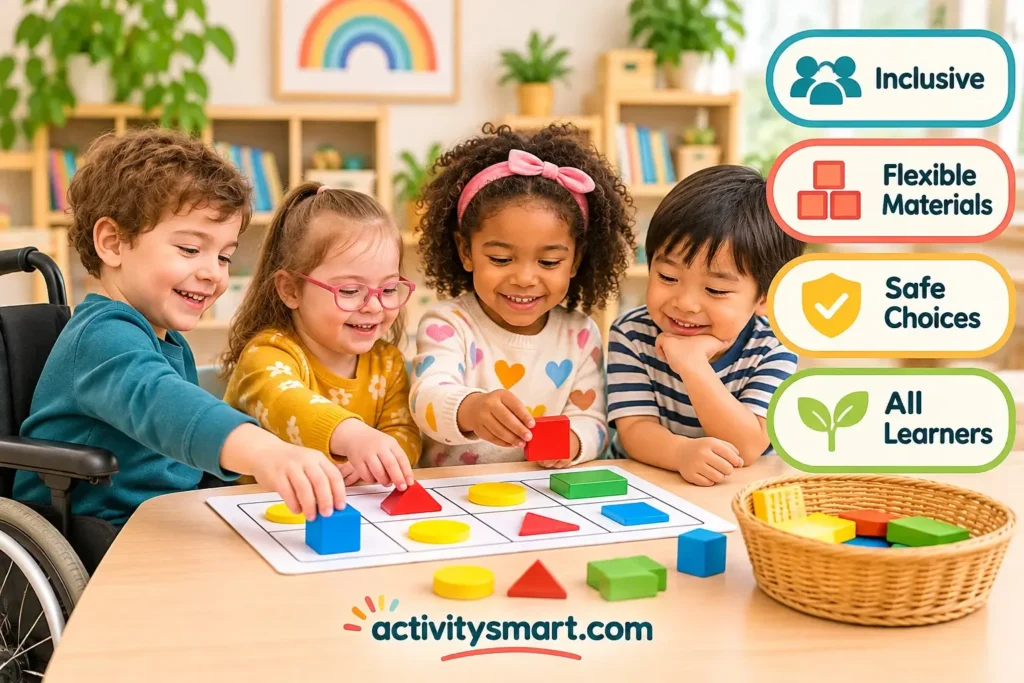
Accessible differentiation begins before children request help. Present information in more than one form, such as spoken instructions paired with a concrete demonstration and a simple picture cue. CAST’s guidance on representation identifies multiple ways of perceiving and understanding information as a design consideration. Offer equivalent ways of responding when handwriting, speech, or fine-motor demands are not the intended lesson.
Use respectful language: “You can show me with the pieces or tell me” rather than “You get the baby version.” Invite family knowledge and familiar objects into examples without assuming all children share a particular home language or experience. Check that classroom images portray a variety of people and roles. Children may also need a quieter spot, a predictable routine, or a break before returning to the task.
Choose materials that suit the youngest children present and follow product age guidance. Avoid loose small parts for children who mouth objects or whose supervision needs make choking a concern; substitute large, sturdy, washable items. Check for sharp edges, loose magnets, accessible button batteries, and food allergens when materials are repurposed. Supervise scissors, glue, and sensory materials according to the children’s abilities and site rules.
Do not use difficulty as a punishment or remove access when a learner is overwhelmed. A calm, supported reset can preserve dignity; ActivitySmart discusses additional options for supporting big feelings during learning. If a concern about communication, motor skills, or development persists across settings, discuss observations with the family and relevant qualified school or health professionals rather than diagnosing based on a classroom task.
Common mistakes that make differentiation harder
- Permanent age-based groups: these overlook individual strengths. Make pathways flexible and revisit placements as the task changes.
- More work as a reward: extra worksheets often increase workload without adding reasoning. Extend the concept with a better question.
- Unclear common goal: three different tasks cannot meaningfully be compared if they teach unrelated ideas. Name the shared concept first.
- Hidden barriers: small print, dense verbal directions, or tiny objects can prevent participation even when children understand the idea.
- Overprompting: giving every next move prevents you from seeing independent thinking. Model briefly, then pause.
- One response format only: a written answer may assess pencil control when you intended to assess classification. Offer other evidence.
A ready-to-use 20-minute mixed-age activity plan
Minutes 0–3: show a small shape collection, invite noticing, and state the goal in child-friendly language: “We can make groups and tell how they belong together.” Use one obvious model. If several languages are represented, pair the spoken words with gestures and the objects themselves.
Minutes 3–12: let children choose a sorting space. Circulate with two questions: “How did you decide?” and “Could there be another way?” Offer entry supports only where needed. One learner may sort by color; another may create a shape-based rule; a third may explore texture using tactile shapes. Keep observation notes short enough that children receive your attention.
Minutes 12–16: offer a fresh object or a new attribute as a transfer check. Ask a child who has finished early to design a grouping puzzle for a peer rather than requiring extra quantity. Encourage learners to explain disagreements by pointing to the rule, not by judging one another.
Minutes 16–20: invite examples from different approaches. Revisit the common idea and collect materials using a predictable routine. Note which children need another demonstration, a communication option, or a more demanding question next time. Twenty minutes is a sample planning structure, not a required duration: shorten or extend it according to attention, access, and school routines.
What the evidence supports—and what it does not
The recommendations here combine professional frameworks with practical lesson design. NAEYC provides a rationale for developmentally appropriate, individualized, context-aware practice; CAST offers options for engagement, representation, and action. Those resources support thoughtful flexibility, but they do not validate a universal “preschool level” or “kindergarten level” for every activity.
For further planning, compare CAST’s engagement guidelines with the two design questions in this guide: “Does the task feel relevant and welcoming?” and “Can children stay involved while receiving appropriate challenge?” Differentiation works best as a flexible professional judgment rather than a rigid ladder.
Final takeaway: same invitation, responsive pathways
For a mixed preschool and kindergarten group, keep the big idea shared and the routes flexible. Start with a clear learning goal, offer accessible materials, listen to children’s strategies, and choose the smallest next prompt that helps. Ask confident learners for deeper thinking rather than automatically giving more tasks. The decisive measure is what a child can show about the goal, with the supports they need made visible.
Frequently asked questions
What is the simplest way to differentiate one activity for two age groups?
Keep one learning goal and change the amount of modeling, the complexity of the prompt, or the response option. Begin with the same materials and adapt only after seeing how each child approaches the concept.
Do preschool and kindergarten children need separate materials?
No, separate materials are not automatically necessary. Shared large shapes, picture cards, or counting objects can support different prompts; provide alternate tools when access or safety makes them useful.
How do I challenge a kindergartener without assigning extra worksheets?
Ask for a new strategy, an explanation, or a comparison rather than more items. For sorting, a child might find a second rule or explain why an object can fit two groups.
What should I do when a preschooler finishes the extension task?
Offer the next meaningful question if the child demonstrates readiness, regardless of age. You can invite a different rule, an explanation, or a transfer example without assigning a permanent ability label.
How can I differentiate for children learning English?
Use concrete demonstrations, gestures, familiar vocabulary, and ways to respond without extended English speech. Encourage home-language contributions where support is available, while keeping the underlying concept and respectful challenge.
How do I know whether a child needs support or more challenge?
Observe what the child can do with the present prompt and one small change. Note whether an example, fewer objects, or a different response mode helps; extend only when the target concept is consistently visible.
Can differentiation work in a large mixed-age classroom?
Yes, it can be organized around a common task with a few reusable prompts and accessible options. Start with one small-group observation focus rather than trying to individualize every detail at once.
Does differentiating mean lowering expectations for some children?
No, appropriate differentiation retains a meaningful learning purpose while removing unnecessary barriers. Support and challenge can both change as children demonstrate understanding; expectations should not be fixed by labels.
What should I do if a child becomes frustrated by the activity?
Reduce the immediate barrier, acknowledge the feeling, and offer a supported way to rejoin or take a break. Revisit the learning goal when the child is ready; recurring concerns deserve collaborative discussion with family and appropriate professionals.
Sources and further reading
- NAEYC: Core Considerations to Inform Decision Making — individuality and context in early childhood practice.
- NAEYC: Defining Developmentally Appropriate Practice — strengths-based and play-based principles.
- CAST: Action and Expression — options for demonstrating knowledge.
- CAST: Representation — accessible ways to perceive and understand.
- CAST: Engagement — relevant choices, play, and appropriate challenge.