Quick Answer
Short vowel worksheets for kindergarten help children hear, identify, read, and spell the five short vowel sounds in simple CVC words such as cat, bed, pig, fox, and sun. The most effective practice moves from listening and picture sorting to word building, decoding, sentence reading, and a brief progress check.
Quick Picks
- Best first activity: picture sorting by middle sound
- Best decoding practice: CVC word families
- Best hands-on option: cut-and-build letter cards
- Best independent task: read, match, and color
- Best review: mixed short vowel mini-assessment
Short vowel worksheets for kindergarten work best when they support real phonics teaching rather than replace it. A child should first hear the sound, say it, connect it to a letter, and then read it inside a word. Worksheets become useful after that oral practice because they give children a clear place to sort, trace, build, read, and write.
This guide shows parents and teachers how to choose developmentally appropriate pages, introduce each vowel, prevent common confusions, and turn a printable packet into a simple learning sequence. For broader practice ideas, explore our kindergarten learning activities and combine phonics work with short, playful tasks.
What Are Short Vowel Worksheets for Kindergarten?
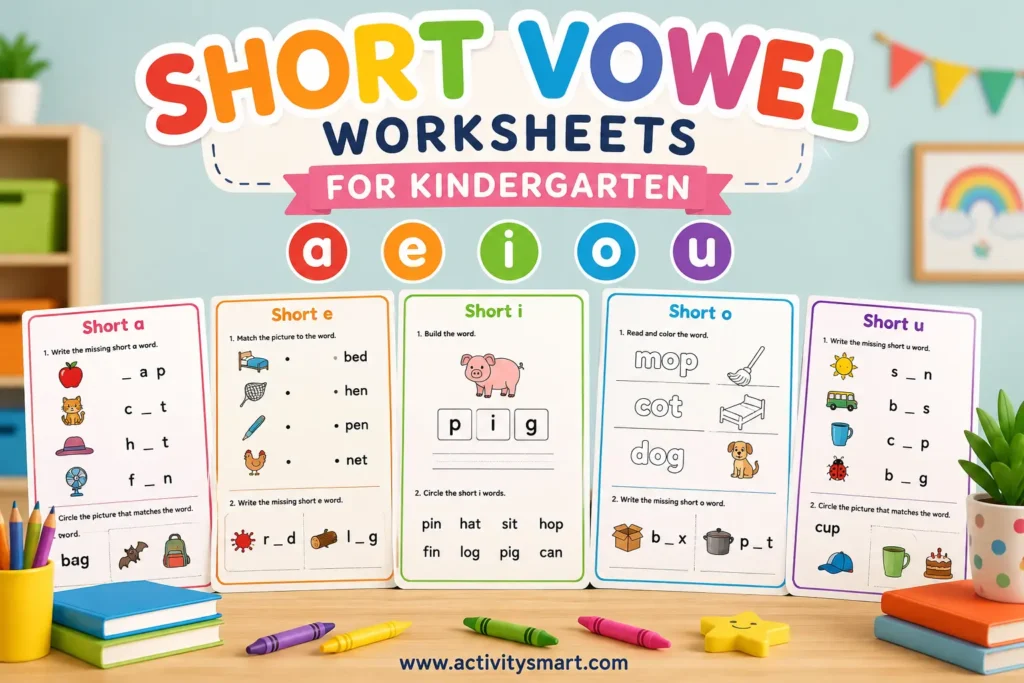
Short vowel worksheets focus on the common sounds of a, e, i, o, and u in closed syllables. In kindergarten, these sounds usually appear in consonant-vowel-consonant words, often called CVC words. Examples include map, hen, sit, log, and cup. The middle letter changes the vowel sound, so children learn to pay close attention to the center of the word.
The five short vowel sounds
- Short a: /ă/ as in apple, cat, and map
- Short e: /ĕ/ as in egg, bed, and ten
- Short i: /ĭ/ as in insect, pig, and fin
- Short o: /ŏ/ as in octopus, fox, and log
- Short u: /ŭ/ as in umbrella, sun, and bug
The symbols above are only labels for adults. Young learners do not need technical notation. They need clear mouth models, repeated examples, and chances to compare words. Saying “cat, cap, can” while stretching the middle sound is more useful than giving a long definition.
Why CVC words come first
CVC words are short enough for beginners to blend without holding too many sounds in memory. A child can point under each letter, say /m/ /ă/ /p/, and sweep a finger across the word to read “map.” Once that routine becomes automatic, children can tackle blends, digraphs, and longer words with more confidence.
What a strong worksheet should include
A useful page has one clear goal, readable print, familiar pictures, enough white space, and a manageable number of items. It should ask the child to do something meaningful with sound, not merely decorate a page. If the activity is visually crowded or requires several unrelated directions, the phonics target can disappear beneath the pencil work.
Why Short Vowel Practice Matters
Phonemic awareness supports decoding
Before children can read the letter in the middle, they must notice the sound in the middle. Ask learners to compare cat and cot, or pig and pug. They can tap three counters for the three sounds and slide the center counter upward when they hear the vowel. This makes an invisible sound feel more concrete.
Children who struggle to identify the middle sound often guess from the first letter or picture. Slow down and return to listening games. A worksheet should confirm the sound they can already hear, not become a test of a skill that has not yet been taught.
Automatic vowel recognition improves fluency
Early readers spend a great deal of mental energy decoding. When the five short vowels become familiar, children recognize word patterns faster and have more attention left for meaning. Repeated practice with word families such as -at, -en, -ig, -op, and -ug builds speed without requiring memorization of every word as a separate shape.
Spelling reveals what children understand
Reading a word and spelling it are related but different tasks. A child may read “bed” correctly and still write “bad” when hearing the word. Dictation, sound boxes, and missing-middle-letter pages reveal whether the child can map the heard vowel to the correct letter.
Build the foundation first: use letter tracing worksheets for letter formation and sound-symbol review before expecting long written answers.
Best Order for Teaching Short Vowels
Teach one sound clearly, then compare
There is no single mandatory order, but many teachers begin with short a because it appears in many familiar words. Short i often follows, then short o, short e, and short u. The exact sequence matters less than clarity. Introduce one sound with several examples, practice it, and then contrast it with a previously learned sound.
A simple five-step lesson routine
- Hear it: say three or four words and identify the shared middle sound.
- See it: show the vowel letter and a memorable keyword picture.
- Build it: use movable letters to create two or three CVC words.
- Read it: blend a short list of decodable words.
- Write it: complete one focused worksheet or quick dictation.
This routine can take ten to fifteen minutes. Young children usually learn more from a brief, consistent lesson than from a large packet completed in one sitting.
When to mix all five vowels
Mixed review should begin only after a child can recognize at least two or three vowels separately. Start by contrasting sounds that are easier to distinguish, such as short a and short o. Later compare closer sounds, especially short e and short i, which many learners confuse.
Types of Short Vowel Worksheets That Actually Teach
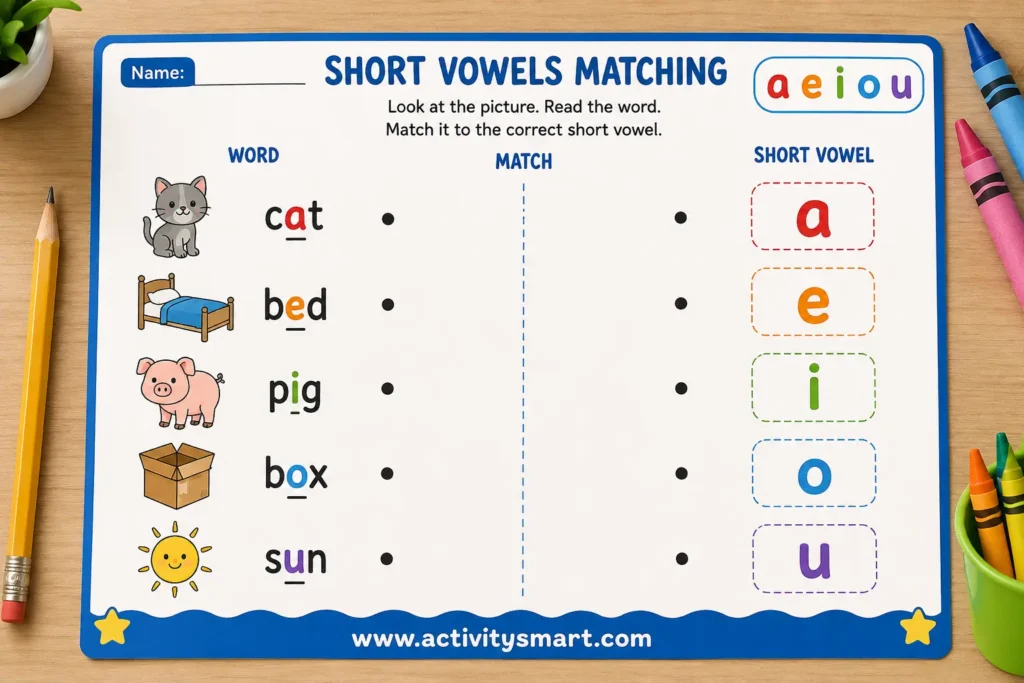
Picture sorting worksheets
Children name each picture and sort it under the correct vowel. This format checks listening before reading. Use pictures with unambiguous names; “rabbit” may be called “bunny,” and “cup” may be called “mug,” which changes the target sound. Say the expected picture names together before the child begins.
Missing vowel worksheets
A page might show c_t beside a picture of a cat. The child says the word slowly, identifies the middle sound, and writes the missing vowel. This is effective because it combines phonemic segmentation with spelling. Avoid presenting too many choices at first; two vowel options are enough for beginning comparison.
Word-family worksheets
Word families help children notice that changing the first sound creates a new word while the ending remains stable. A page may include cat, hat, mat, and sat. However, include occasional non-rhyming review words so children continue to inspect each letter instead of blindly repeating the pattern.
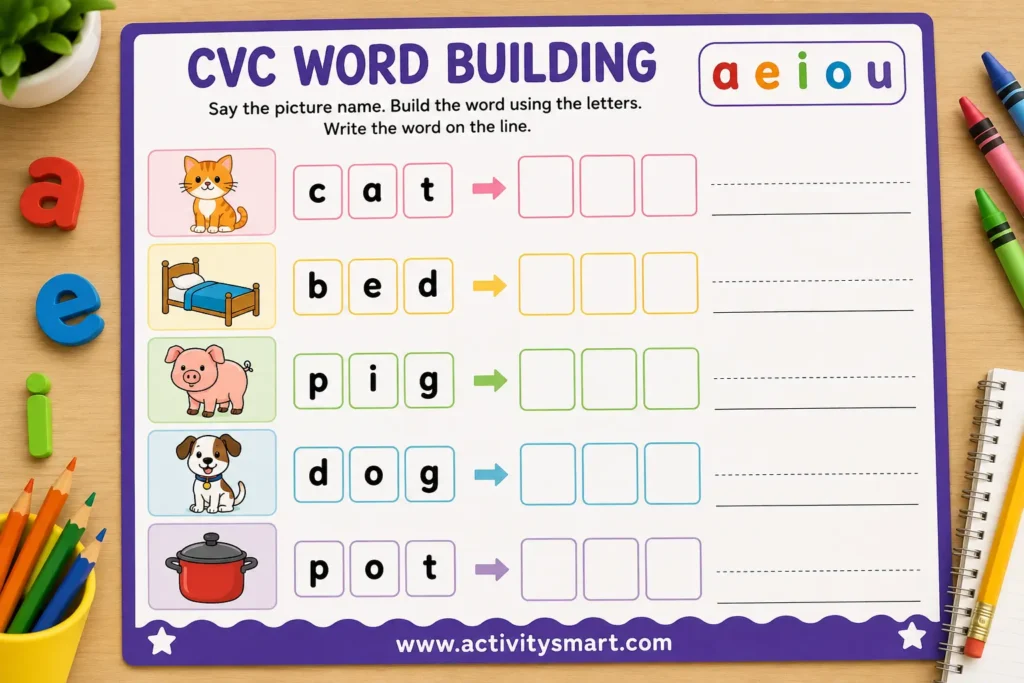
Cut-and-build activities
Movable letter cards add a tactile step. Children cut out letters, build a word, read it, and glue it beside the matching picture. This is helpful for learners who need more than pencil practice. Pair it with tracing lines worksheets when fine-motor control is still developing.
Read-and-match pages
The child reads a CVC word and draws a line to the matching image. This reduces the writing demand and keeps the focus on decoding. It is also easy to check because a wrong match shows exactly which word caused confusion.
Sentence reading worksheets
After children can decode several CVC words, use short decodable sentences such as “The cat can nap.” Keep sight words controlled and illustrations supportive but not so revealing that children can guess the sentence without reading.
Short Vowel Worksheet Comparison Table
| Worksheet type | Main skill | Best for | Difficulty | Adult support | Common risk |
|---|---|---|---|---|---|
| Picture sort | Hearing middle sounds | Beginners | Easy | Moderate | Unclear picture names |
| Missing vowel | Sound-letter mapping | Early spellers | Easy–medium | Low | Guessing from pictures |
| Word family | Blending patterns | Developing readers | Medium | Low | Pattern guessing |
| Cut and build | Segmenting and spelling | Hands-on learners | Medium | Moderate | Fine-motor fatigue |
| Sentence reading | Fluency and meaning | Advanced kindergarten | Medium–high | Low | Too many untaught words |
| Mixed assessment | Independent mastery | Review and progress checks | High | Minimal | Testing too soon |
How to Use Short Vowel Worksheets at Home
Keep sessions short
Five to ten focused minutes can be enough. Begin with oral sound play, complete part of a page, and stop while the child is still successful. A worksheet does not need to be finished in one sitting to be valuable.
Say the word before writing
Ask the child to name the picture, stretch the word, and tap each sound. Then write. This prevents the activity from turning into visual guessing. If the child says the wrong picture name, supply the intended word without treating it as a reading error.
Use simple praise
Praise the strategy: “You listened to the middle sound,” or “You checked every letter.” Strategy-based feedback teaches children what to repeat next time. Avoid turning every answer into a performance score.
Add playful review
After the worksheet, choose three words for a scavenger hunt, magnetic-letter challenge, or silly sentence. Printable practice pairs well with printable maze worksheets for kids or color by number worksheets when children need a lighter activity after concentrated phonics work.
How Teachers Can Use the Worksheets in Class
Whole-group modeling
Project or enlarge one item and think aloud: “I see a pig. I will say it slowly: /p/ /ĭ/ /g/. The middle sound is /ĭ/, so I write i.” Modeling makes the invisible decision process visible.
Small-group differentiation
One group may sort pictures by two vowels, another may fill missing vowels, and a more advanced group may read sentences. The topic stays consistent while the cognitive demand changes. This is more useful than giving every child the same page at the same time.
Independent centers
Use familiar formats at independent centers. A child should not have to decode complicated directions while practicing decoding. Add a completed example, limit the number of steps, and keep answer choices visually organized.
Progress monitoring
Save one brief mixed-vowel page for periodic checks. Record which errors occur: incorrect vowel, first-sound confusion, final-sound omission, or picture-name uncertainty. The pattern of errors tells you what to teach next.
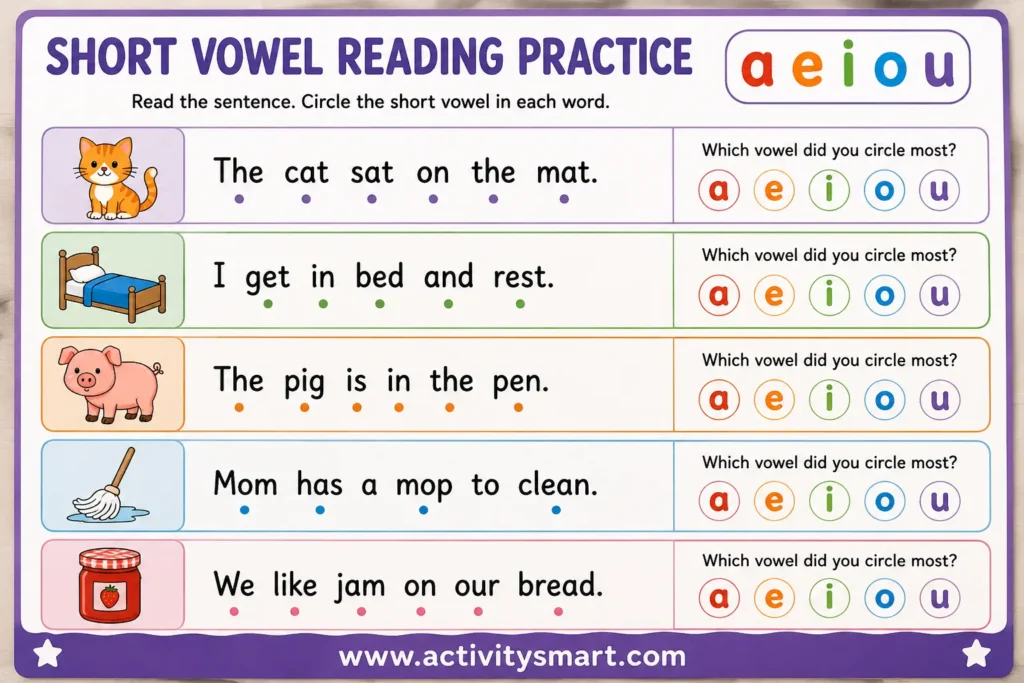
Best Short Vowel Activities for Beginners
Beginners need listening and matching more than long writing. Start with two contrasting vowels, five or six pictures, and large answer spaces. Let children use counters, letter tiles, or clothespins before they pick up a pencil.
- Sort picture cards under two vowel headers.
- Cover the correct vowel with a counter.
- Build one CVC word with magnetic letters.
- Trace the vowel while saying its sound.
- Read three words and celebrate accuracy, not speed.
Children who are still learning letter shapes can benefit from preschool worksheets before moving to denser kindergarten pages.
Best Short Vowel Activities for Advanced Learners
Advanced kindergarten readers need transfer, not endless repetition. Ask them to sort mixed words, identify real and nonsense CVC words, change one phoneme to create a new word, or write a decodable sentence using two target words.
- Change map to mop, then mop to pop.
- Read nonsense words such as zim or lat to test true decoding.
- Correct a deliberately misspelled word.
- Write a sentence and underline the short vowel words.
- Compare words with the same consonants but different vowels.
Common Mistakes to Avoid
Teaching every vowel at once
A five-column sort looks efficient, but it can overwhelm a beginner. Teach a smaller contrast first, then widen the choices as accuracy improves.
Using pictures with uncertain names
If a child sees a sofa but the answer expects “couch,” the worksheet is testing vocabulary rather than vowels. Choose familiar, culturally clear images and review their names aloud.
Relying on tracing alone
Tracing helps handwriting, but it does not prove that a child can hear or choose the vowel. Pair tracing with listening, matching, reading, or spelling.
Correcting too quickly
Give the child time to stretch the word and reconsider. A useful prompt is, “Say it slowly and listen to the middle.” This supports independence without revealing the answer.
Finishing too many pages
More paper does not automatically mean more learning. Stop when attention drops or errors increase. Revisit the skill later with a different format.
Do Not Use These Worksheet Designs
- Pages with tiny fonts or cramped answer boxes
- Activities containing many untaught blends or digraphs
- Pictures whose names do not clearly match the target word
- Long instructions that require an adult to reinterpret every item
- Decorative fonts that make a, g, or other letters hard to recognize
- Mixed academic tasks that hide the phonics objective
Safety and Printing Tips
Use child-safe scissors for cut-and-paste pages and supervise children who still mouth small paper pieces or counters. Print at actual size so letter boxes remain large enough. A dry-erase sleeve can make one page reusable, but avoid strong-smelling markers in poorly ventilated spaces.
For classrooms, write student names before laminating or use removable labels. Keep answer keys separate from the student packet. Black-and-white pages usually print clearly and allow children to color after the phonics task is complete.
Pros and Cons of Printable Short Vowel Practice
| Pros | Cons |
|---|---|
| Easy to prepare and repeat | Can become passive without oral practice |
| Shows individual error patterns | Picture vocabulary may confuse some learners |
| Supports home-school communication | Too much writing can tire young children |
| Works for centers, homework, and review | One level does not fit every child |
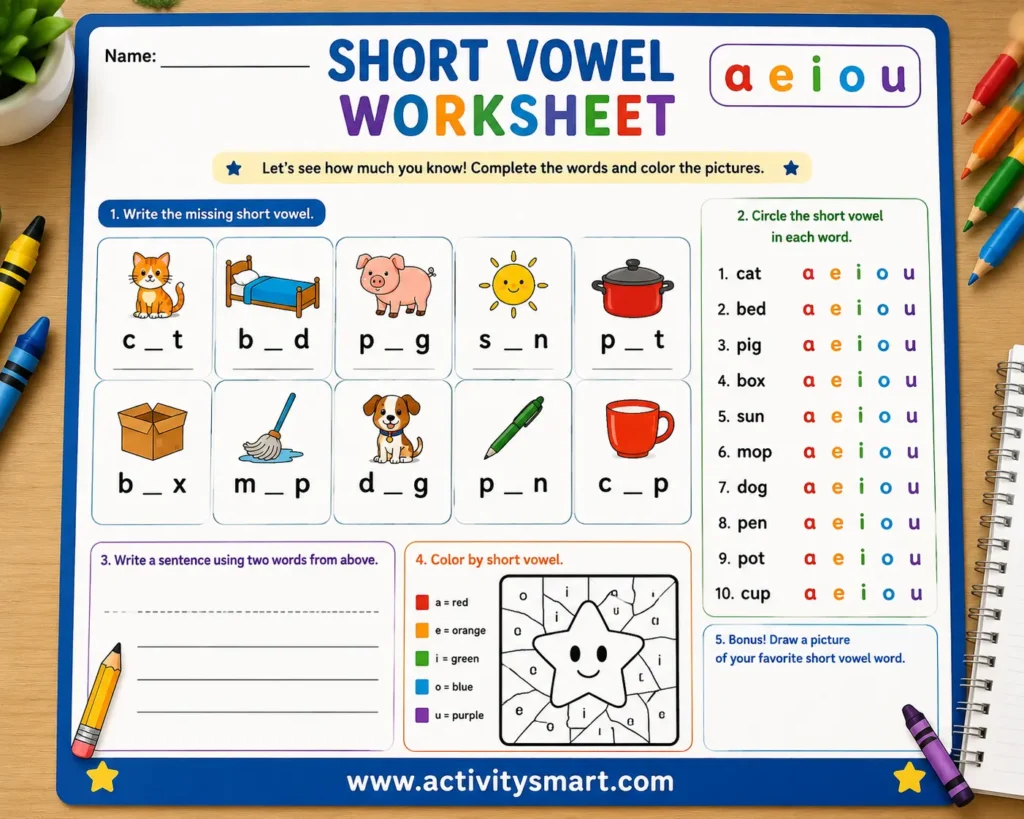
A Four-Week Short Vowel Practice Plan
Week 1: Hear and identify
Choose two vowels and spend the first week on listening. Say short lists, sort picture cards, and ask which word does not belong. Keep written work minimal. The goal is accurate sound identification, because reading practice becomes frustrating when the child cannot yet hear the contrast.
Week 2: Build and blend
Use movable letters to create CVC words. Change only one letter at a time so the child notices how the word changes. Move from map to mat, then mat to sat. Ask the child to point under each letter and blend from left to right without pausing too long between sounds.
Week 3: Read and spell
Mix familiar word families and add short dictation. Read five words, match three words to pictures, and spell two words from sound alone. A small amount of mixed practice reveals whether the child understands the vowel or has memorized one worksheet pattern.
Week 4: Apply in sentences
Use short decodable sentences and simple writing. The child can circle target words, illustrate a sentence, or replace one word to create a new sentence. End the week with a brief mixed-vowel check and reteach only the patterns that remain uncertain.
Adapting Practice for Different Learners
For children learning English
English learners may know the pictured object but use a different word in another language. Name every picture before the task and provide extra mouth modeling. Do not treat an accent difference as a phonics failure. Focus on whether the child can hear and connect the intended classroom sound.
For children with fine-motor difficulty
Reduce copying. Let the child point, stamp, cover, clip, or place a letter card. Oral and reading skills can advance even when handwriting develops more slowly. Large boxes, thick pencils, and fewer items per page also reduce fatigue.
For children who guess
Cover the picture until the word has been attempted, or use nonsense CVC words to remove picture clues. Prompt the child to check the first, middle, and final sounds. Guessing usually decreases when the routine consistently rewards careful decoding.
For children who need more challenge
Add word chains, sentence editing, and vowel substitutions. Ask how changing the middle letter transforms cat into cot or cut. These activities deepen flexible sound knowledge without introducing spelling patterns that are too advanced.
Final Verdict
Short vowel worksheets for kindergarten are most effective when they follow a simple progression: hear the sound, connect it to a letter, build a word, read it, and then write it. Choose uncluttered pages, teach one clear objective at a time, and use errors as clues for the next lesson.
A small set of well-chosen activities can do more than a thick packet. Combine printable pages with oral games, movable letters, and decodable reading, then use our free printable worksheets collection to continue building a balanced kindergarten routine.