Quick Answer
Teaching number sense before written addition means helping children recognize small amounts, count objects accurately, compare groups, and see how quantities combine or separate. Begin with real objects, fingers, dot patterns, and meaningful talk. Introduce equations when children can explain what the numbers represent, not merely recite an answer.
Quick Picks
- Start here: match one spoken number word to each object, then ask how many there are altogether.
- For quick visual recognition: use dice dots or a five-frame with small groups.
- For comparison: align two rows and ask which has more, fewer, or the same amount.
- For early combining: join two collections and describe what changed before writing a sum.
- For mixed readiness: change the quantity and amount of support, not the dignity of the task.
Teaching number sense begins long before a child writes 3 + 2 = 5. A child may sing numbers to twenty yet struggle to give you four blocks, or may recognize three dots immediately without knowing the written numeral. Those are different skills, and both offer useful starting points.
This hands-on guide helps preschool and early elementary teachers, as well as families, choose a next activity based on what a child can actually show. The aim is understanding: quantities remain the same when objects move, neighboring numbers differ by one, and joining groups changes the total. The approach follows the developmental progression described in the What Works Clearinghouse early mathematics guide rather than treating all children of one age as identical.
What Number Sense Means Before Addition
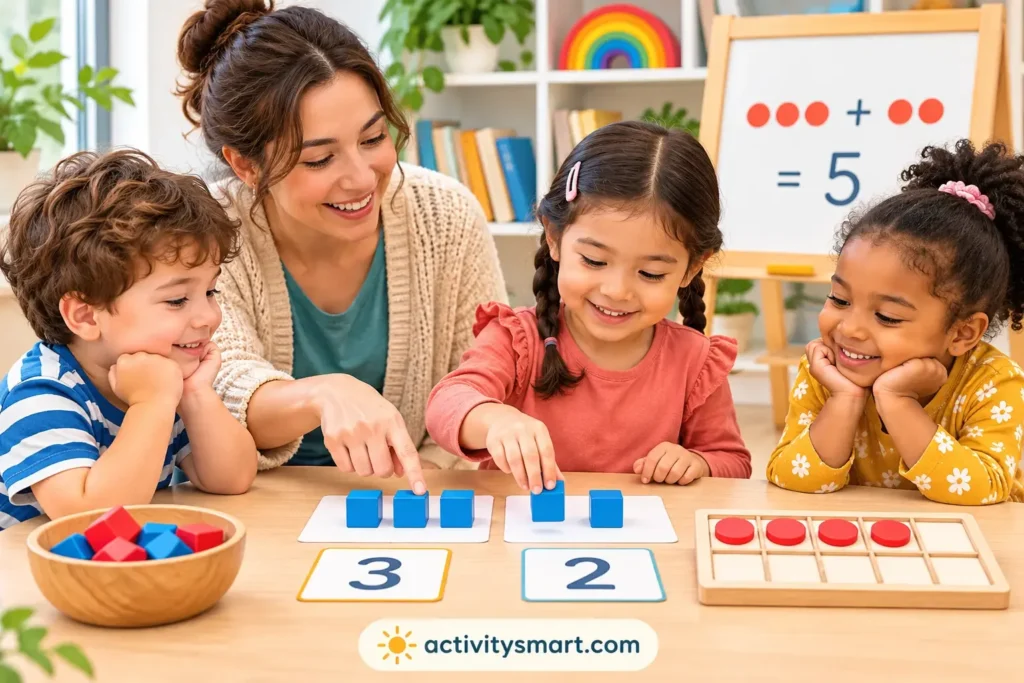
Number sense is a useful umbrella term for understanding quantities, their relationships, and ways to represent them. For beginners, it includes noticing small groups without counting, connecting number words to objects, identifying the last count word as the total, deciding which group is larger, and reasoning about one more or one fewer.
Memorizing a count sequence is a helpful part of this story, but not the entire story. A learner who says “one, two, three, four” while touching only three blocks has not yet coordinated words with objects. A learner who counts four objects correctly but restarts from one when asked “How many?” may still be learning cardinality: that the final count word names the whole collection.
Why understanding comes before symbols
Written equations compress several ideas into a short line. The symbols 3, +, 2, = and 5 require children to connect written marks with amounts, an action of combining, and a relationship between two sides. Using visible collections first reduces the number of new ideas children must juggle simultaneously.
This is not an argument for withholding numerals until an arbitrary birthday. Show a numeral alongside a familiar quantity when it helps make a connection; avoid making copying equations the only evidence of understanding. The {el(1,’IES early mathematics toolkit’)} explicitly sequences subitizing, meaningful counting, comparing magnitudes, and solving basic problems, while allowing teachers to monitor readiness throughout.
What readiness can look like
A practical observation is whether a child can build a set of four, count it once accurately, tell you that four is the total, and notice what happens when one more is added. A different child may already explain several ways to make five. Teach the idea each learner is ready to explore next, then revisit earlier ideas in richer arrangements.
Begin Teaching Number Sense With Meaningful Counting
Make one-to-one counting visible
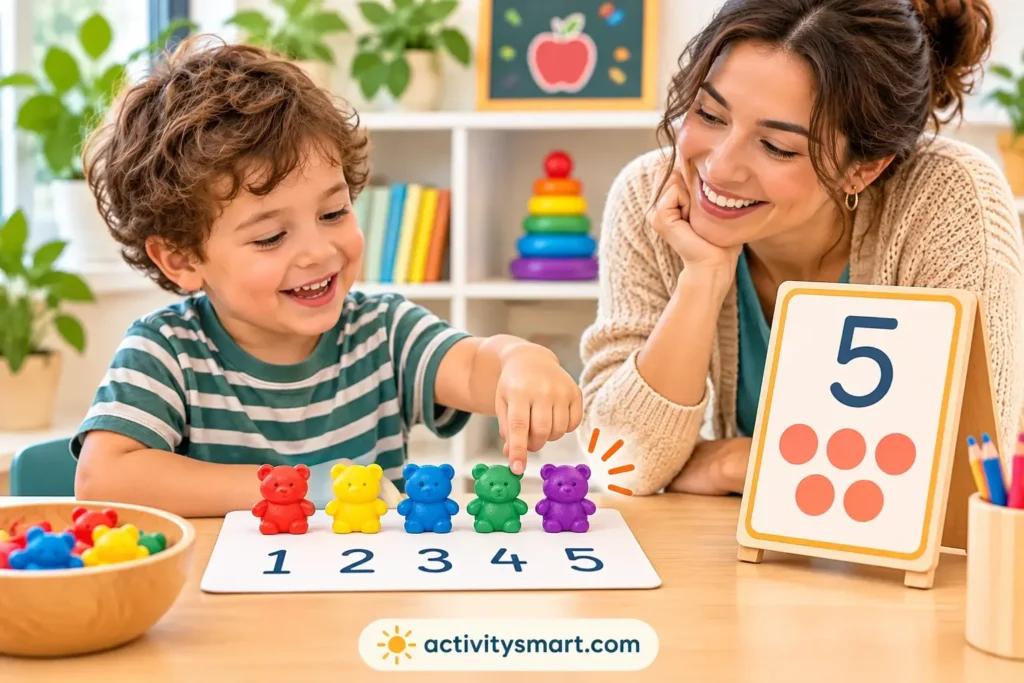
Place three to five large blocks in a loose row. Model touching or moving exactly one block for each spoken number word. Slow your hand so the movement and spoken word happen together. Invite the child to try, and watch for skipped, doubled, or uncounted objects. Moving each object into a bowl is often easier than pointing to a crowded pile.
After counting, ask “How many blocks do we have?” and allow thinking time. If the child starts over, gently model: “We counted one, two, three, four. There are four.” Avoid treating a repeated count as a moral error; it identifies the next idea to teach. For a focused explanation, see ActivitySmart’s {il(0)}.
Change the layout, not the quantity
Count four blocks arranged in a row. Spread the same four blocks into a circle and ask whether there are still four. Let the child verify. Changing spacing does not add or remove objects, even though a spread-out row may look bigger. Ask “What changed?” and “What stayed the same?” instead of requiring an immediate abstract explanation.
Try again with four large paper shapes stuck to a page, then with four taps on a drum. The point is that a collection can contain the same number of objects across different materials and positions. With sound or movement, guide the child to count one event at a time and stop before working with larger groups.
Play a hidden collection game
Show five counters, count them together and cover them with a cloth. Ask “How many are hiding?” The important move is recalling the total rather than seeing or recounting each counter. If the child is unsure, uncover the counters, model the last-number principle, then cover them again. Begin with amounts the learner can count successfully.
The federal early mathematics guide includes a comparable hidden-items example to develop counting and cardinality. Use the idea as a brief check-in, not as a timed test or a competition that singles out hesitant learners.
Notice Small Quantities Without Counting Every Time
Subitizing with dots, fingers and five-frames
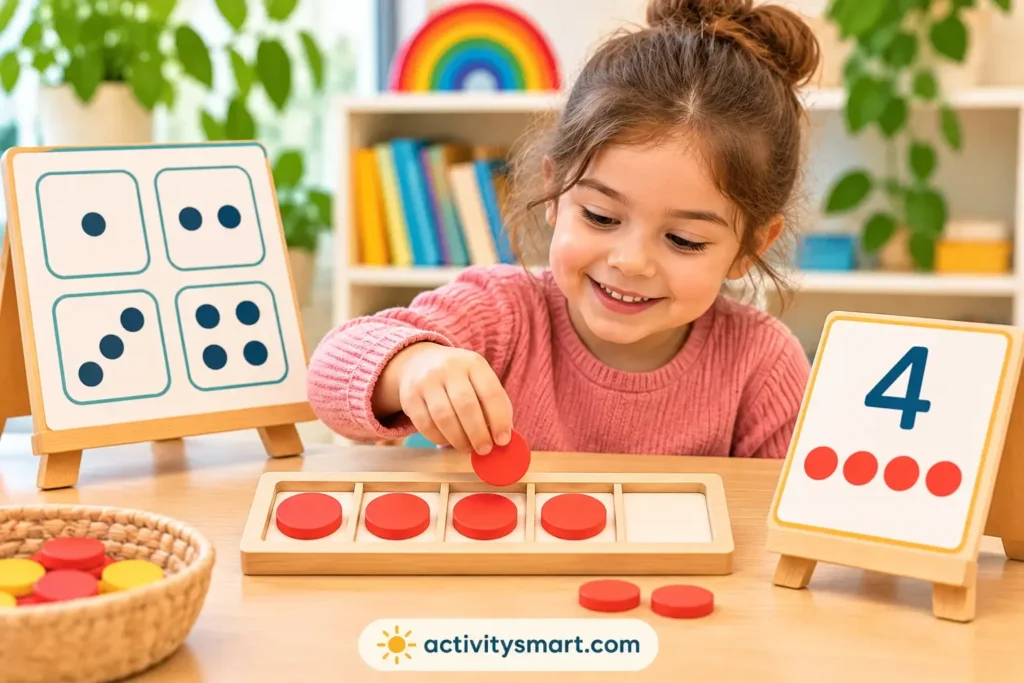
Subitizing means recognizing a small quantity rapidly without counting objects one at a time. Show a card with three well-spaced dots for a moment, hide it and ask “What did you see?” Begin with two or three dots; adjust based on the child’s response. Encourage noticing arrangements, such as “two at the top and one below,” rather than praising only speed.
A five-frame has five boxes in a row. Fill three boxes and ask how many are filled and how many remain empty. Move the three counters to different boxes, if the teaching objective is to recognize the quantity independent of a specific pattern. Later, use a consistent left-filled layout as an anchor for thinking about how many spaces remain to make five.
Show the same amount in different ways
Invite children to make four with fingers, with four blocks, with four claps and with a dot card. Ask how they know each display shows four. If a child must count each example, that is a perfectly reasonable response while recognition develops. If they see “two and two,” name the parts without insisting on a formal addition sentence.
Dot games connect naturally with {il(1,’playful patterns and visual noticing’)}, although detecting an alternating color pattern and recognizing a numerical amount are not identical goals. Use the activity that matches the skill you are currently observing.
Use questions that reveal thinking
“How did you see three?” reveals more than “Was that three?” Another useful prompt is “Can you show it a different way?” A child may make three fingers on one hand and then two plus one across both hands. Such explanations help teachers understand strategies without interpreting speed as intelligence.
Compare Groups: More, Fewer and the Same
Line up sets for a fair comparison
Put four blocks in one row and six in another. Align their starting positions and pair objects one by one. The longer row has two unpaired blocks, making “six is two more than four” visible. Ask which has more, which has fewer, and how the child knows. Reverse the colors or the positions to ensure the answer does not depend on a preferred side.
When a child relies on the physical length of a spread-out group, bring the objects into aligned rows. Ask whether moving the blocks changed how many there are. Encourage the learner to prove an answer by counting or matching. For some children, the visual pairing is more accessible than number words alone.
Make one more and one fewer tangible
Build a tower of five cubes, add one cube and say what happened. Remove one cube and compare again. Ask “What number comes after five?” only after giving the child a chance to notice the added unit. An explanation such as “now there are six because we put one more on” is stronger evidence than reciting six when prompted.
The developmental progression described in the {el(0,’WWC guidance for early number and operations’)} includes comparing sets and understanding how successive numbers increase in magnitude. Not every child follows precisely the same timetable, so return to direct comparisons when number-after questions feel disconnected.
Sort, then count what you sorted
Sort large toy animals into two trays, count each tray and compare totals. This integrates categories with quantities while keeping the mathematics explicit. A child may be excellent at deciding whether something belongs with animals or vehicles yet still need support counting the resulting sets.
For young learners who find handling counters difficult, use larger pieces or attach picture cards to a board. The separate goal of using fingers and tools can be supported through {il(4,’age-appropriate fine motor play’)} without confusing motor speed with mathematical knowledge.
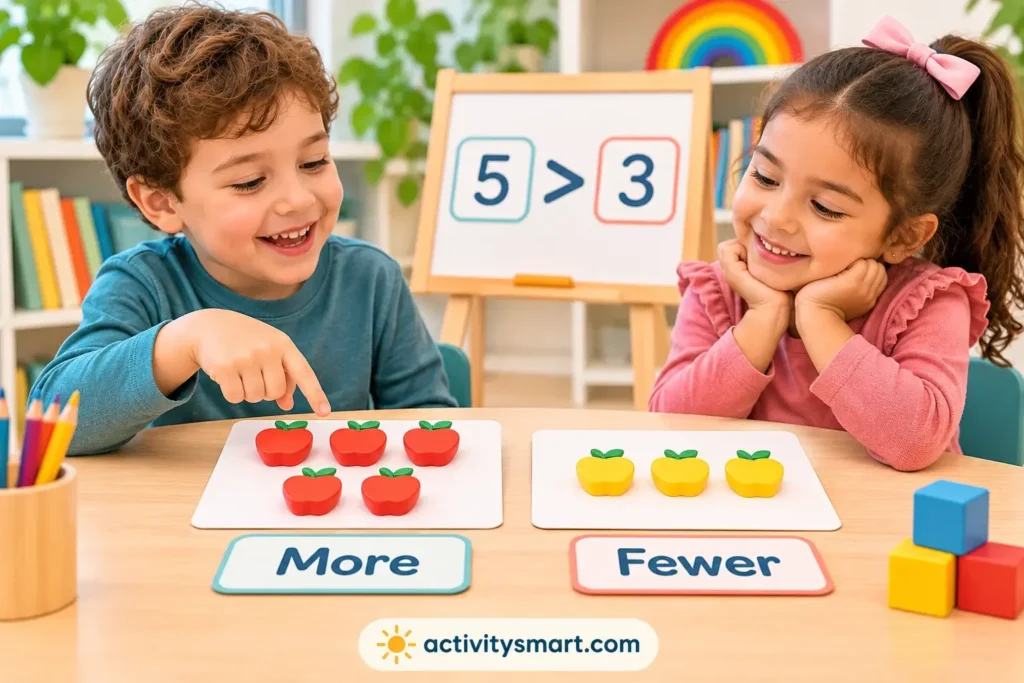
Move From Real Objects to Drawings, Then Symbols
Children benefit from linking representations rather than being pushed abruptly from manipulatives to worksheets. A useful progression is acting out a quantity with objects, making a simple picture of those objects, and discussing an appropriate numeral. This is a teaching sequence, not a requirement that every child master each stage on a fixed schedule.
| Representation | What a child does | What to observe | Helpful next prompt |
|---|---|---|---|
| Real blocks | Moves four blocks, one per count word | Accurate one-to-one tagging and total | “Can you give me four?” |
| Dot card | Recognizes or counts four dots | Recognition across layouts | “How else can you see four?” |
| Drawn circles | Draws four marks for four objects | One mark represents one item | “How do your marks match the blocks?” |
| Numeral card | Pairs 4 with a set of four | Symbol-quantity correspondence | “Which card belongs with this set?” |
| Story and equation | Combines three and one, then explains four | Meaning of joining, not copied symbols | “What does each number stand for?” |
A drawing need not be beautiful to represent a quantity. Four rough circles are useful if the child can explain that each stands for one block. For children who enjoy making marks, {il(7,’early drawing and pre-writing experiences’)} can make the transition inviting, but handwriting quality should not determine whether a math idea is understood.
When should the plus sign appear?
When a learner can join two small groups and describe the total, an adult can say, “We can write what you made as three plus two equals five.” Point to the three-object group, the two-object group, and the combined group as each part of the sentence is spoken. Avoid treating symbol recognition as proof of understanding by itself.
The {el(2,’IES mathematics intervention practice guide’)} recommends carefully chosen concrete and visual representations and clear mathematical language, particularly when learners are struggling. Those recommendations support deliberate connections between actions, pictures and notation; they do not establish that one manipulative or a single lesson works for every learner.
Hands-On Games That Prepare Children to Combine Sets
The snack-shop order
Pretend to run a snack shop using large toy food pieces or picture cards. A customer asks for two pretend apples and one pretend banana. The child makes each group, joins them and explains the total. Change which objects are used while keeping the amount small. If the child finds the combined set confusing, count all the objects together instead of presenting a written sum.
Build two towers and join them
Ask one child to build a tower of three large connecting cubes and another to build a tower of two. Put the cubes together into one tower and count the five cubes. Ask whether the total changes when the tower is laid on its side. A child who answers by counting all may later begin to see the two parts within five.
Make five in different ways
Provide five large two-color counters. Put four red-side-up and one blue-side-up. Turn one red counter to blue and ask what parts the learner sees now. The total is still five, while the parts have changed from four and one to three and two. Build this slowly and use verbal descriptions before introducing equations.
Picture-book quantity detective
Pause at an illustration showing a manageable number of repeated objects. Invite the child to point, count or identify two visible groups. Say “I see two birds on one branch and one on another. How many birds are there altogether?” Choose books with clear, countable pictures rather than guessing from partly hidden characters. Dialogic conversations can pair this with {il(6,’talking about illustrations during shared reading’)}.
Step and stop
Place large floor spots in a line. Take three steps, pause, then take two more and ask how many steps were taken in all. A child may prefer watching an adult or moving a toy along the spots. Keep the route short and clear: each step must correspond to one count. Avoid crowded or slippery spaces and never require a child to jump if that movement is uncomfortable.
Classroom helper collections
Invite children to place one napkin by each seat or one large name card at each place. Count how many are needed and compare with how many are ready. Real tasks offer a reason to count, while the adult still checks the mathematical goal. Short, predictable routines connect well with {il(3,’organized classroom transitions’)}.
These are examples of developmentally responsive activities, not intervention programs with independently tested outcomes. The IES toolkit provides additional modeled routines and progress-monitoring resources that teachers can adapt rather than assuming a game alone will produce mastery.
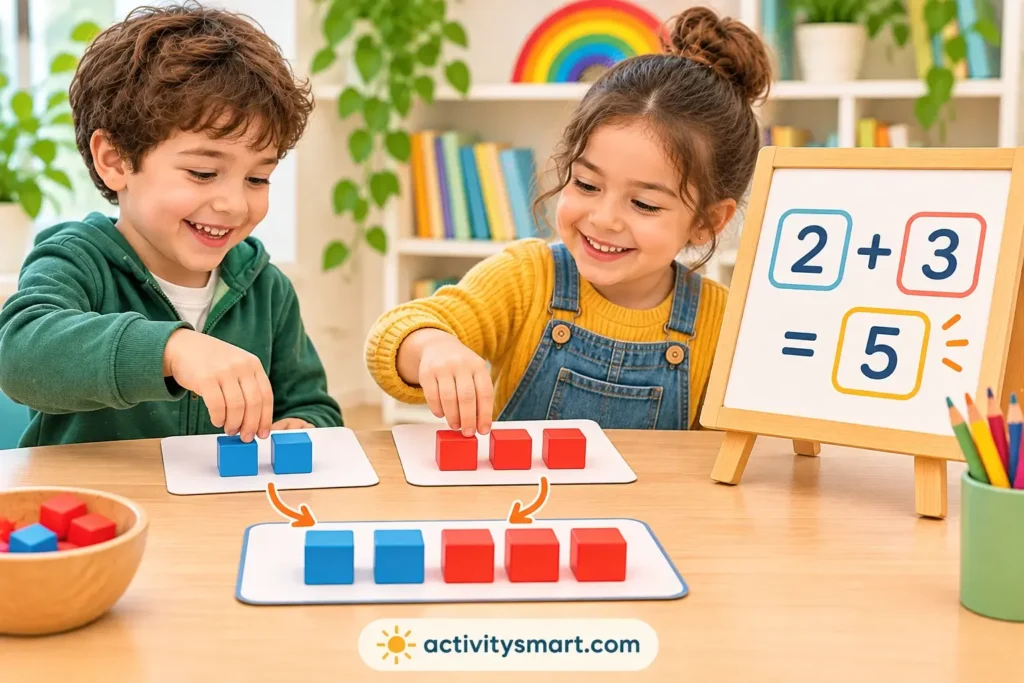
How to Tell Whether a Child Is Ready for Written Addition
Look for several demonstrations across different days and materials, rather than one correct worksheet. Children may show some abilities before others. Keep the numbers manageable and observe whether they understand the situation independently or only after a model.
- Counts a small set accurately: says one number word per item and can name the total.
- Builds a requested quantity: makes a group of four from a larger collection and stops.
- Connects representations: matches a simple dot pattern, set of objects, or numeral.
- Compares meaningfully: explains more, fewer or equal by matching or counting.
- Models joining: combines two small groups and finds how many there are in total.
- Explains an equation in context: points to the objects that each written number represents.
No single checkbox is a formal developmental test. A learner might understand combining objects but still confuse the appearance of numerals, or understand numerals but struggle with oral instructions in the language used at school. Provide alternative ways to show the idea and compare performance over time.
A five-minute observational check
Set out six large counters and a small bowl. Ask the child to give you four. Show three dots briefly and ask what was seen. Make two groups of two and three counters and invite a comparison. Finally, join two and one objects and ask what happened. Record the strategies used, not only whether answers were correct.
For each activity, note whether the child worked independently, used a prompt, or needed a full model. On the next day, change the material but preserve the concept. If understanding transfers, introduce a small new challenge. If not, reteach with clearer objects and fewer competing demands.
Safety, Inclusion and Learner Confidence
For children who still put objects in their mouths, avoid small loose counters, beads, coins, buttons and other choking hazards. Choose large, age-appropriate pieces and supervise handling; follow the product’s age guidance. Count with large blocks, picture cards, fingers or an adult-operated display when loose objects are unsuitable. Keep walking games away from steps and slippery surfaces.
Offer accessible materials for children with visual, motor, sensory or language differences. High-contrast large dots, tactile objects, consistent layouts, spoken descriptions and extra response time can make the underlying math clearer. For a learner who cannot grasp objects comfortably, pointing, eye gaze or directing an adult can still show a mathematical decision.
Use the language a child understands to discuss quantity whenever practical. A hesitant English response is not proof of a mathematical difficulty. Invite caregivers to describe familiar counting routines and adapt classroom vocabulary without replacing precision about “how many,” “more,” “fewer” and “equal.”
If a child has persistent difficulties despite responsive teaching, discuss observations with the school team and family and consider appropriate educational assessment. This article does not diagnose dyscalculia or establish age-specific clinical milestones. For planning more supportive starts to learning, families may also find {il(2,’play-based school readiness guidance’)} useful.
Final Teaching Recommendation
The most useful question is not “Can this child write an addition equation yet?” but “Can this child show what the numbers mean?” Begin with small collections and meaningful counting, make room for quick recognition and comparing sets, and then let a child act out joining two groups. Introduce notation as a concise description of an idea the child has encountered.
Keep materials simple, ask children to explain their strategies, and adjust difficulty based on observed understanding. For educators wanting a fuller research-to-practice pathway, the {el(1,’IES Teaching Math to Young Children Toolkit’)} provides structured modules covering these exact early number concepts. Children should explain a quantity.
Frequently Asked Questions
What is number sense in early childhood?
Number sense is an emerging understanding of quantities, number relationships, and ways to represent them. Early examples include recognizing small groups, meaningful counting, comparing sets and noticing what changes when one item is added.
Should children learn number sense before written addition?
Yes, children should have opportunities to understand and combine small quantities before written addition becomes the main task. Numerals may be introduced alongside objects; the aim is to connect symbols with meaningful actions rather than impose a strict symbol-free period.
What is the difference between counting and cardinality?
Counting is the coordinated process of assigning number words to items, while cardinality is understanding that the final count word names the total. A child may complete a count sequence but still need help answering “How many?” without starting again.
How many objects should beginners count at once?
Beginners should start with a quantity they can manage accurately, often two to five objects, and expand as their counting becomes reliable. There is no single correct range for every child; adjust to their observed strategy rather than age alone.
Is recognizing dice dots without counting useful?
Yes, recognizing small dot arrangements without counting is an example of subitizing, a useful early-number skill. Invite children to explain what they saw and try different layouts so recognition does not depend on memorizing one card.
When should I introduce the plus sign?
Introduce the plus sign when a child can model joining two small groups and discuss the resulting total. Present the symbol as a way to record an action the child understands, while continuing to use objects and pictures.
Are worksheets necessary for building number sense?
No, worksheets are not necessary for beginning number sense because real objects, fingers, movement and pictures can make quantities visible. A simple worksheet may later help connect a familiar action with marks or numerals, but it is not the only evidence of learning.
What if a child keeps counting the same object twice?
If a child counts an object twice, model moving or touching one item for each spoken number word and reduce the set size. Watch the next attempt to see whether tracking objects, recalling number words or coordinating the two is the difficulty.
How can older children practice number sense without babyish games?
Older children can use age-respectful problems involving scores, collections, measuring or game pieces while exploring the same quantity relationships. Choose relevant materials and ask for reasoning; do not assume a child has mastered a concept simply because they are older.
When should I seek additional support for persistent math difficulties?
Seek additional educational support when difficulties continue across settings despite clear instruction and repeated opportunities to practice. Share specific observations with the teacher or school support team; an individual evaluation, when appropriate, is more useful than diagnosing from a checklist online.
Sources and Further Reading
The instructional progression and terminology in this article are informed by the following public education resources. They guide planning but do not guarantee a result for an individual child.
- Teaching Math to Young Children, What Works Clearinghouse — preschool and kindergarten mathematics instruction and developmental progression (2013).
- Teaching Math to Young Children Toolkit, Institute of Education Sciences — teacher activities on subitizing, counting, comparison and solving basic problems.
- Assisting Students Struggling with Mathematics, What Works Clearinghouse — evidence-based guidance on representations, mathematical language and supporting elementary learners (2021).
- Teaching Math to Young Children Toolkit Glossary — clear definitions of counting, cardinality and direct modeling.